Inert Gas Pressure Effects on Powder Size Distribution
Inert gas pressure governs powder size distribution through gas-to-melt kinetic energy transfer, dictating slurry rheology, calender limits, and cell format yield.


Choke
Upstream manifold pressure dictates the kinetic energy transferred from the expanding gas to the liquid metal stream at the nozzle exit. In close-coupled gas atomization systems producing active battery anode materials and specialized alloy powders, delivery pressure typically ranges between 1.8 MPa and 4.5 MPa, with argon suppressing oxidation during flight. When the inert gas expands through convergent-divergent discrete jets or an annular slit, the pressure drop accelerates the gas stream past Mach 2.0.
The momentum flux ratio between the gas and the melt stream governs the initial liquid deformation, drawing the molten alloy into thin sheets and ligaments before droplet detachment occurs.
Elevating manifold pressure increases the gas mass flow rate relative to the melt mass flow rate. The resulting gas-to-melt ratio (GMR) shifts droplet breakup from Rayleigh-type wave disturbance into multimode and catastrophic breakup regimes. At Weber numbers exceeding 350, aerodynamic drag forces rapidly overcome liquid surface tension and internal viscous dissipation.
The melt ligament shears into sub-micrometer filaments within five nozzle diameters of the orifice. Increasing argon pressure from 2.0 MPa to 3.8 MPa typically reduces median particle diameter (D50) by thirty to forty-five percent, shifting the primary peak of the distribution into the target fine-micron window required for fast-charge electrode coatings.
| Gas Species | Manifold Pressure (MPa) | Gas Velocity (m/s) | Gas-to-Melt Ratio | Peak Weber Number | Median D50 (µm) |
|---|---|---|---|---|---|
| Argon | 1.8 | 410 | 1.4 | 180 | 42.5 |
| Argon | 2.8 | 540 | 2.3 | 390 | 24.8 |
| Argon | 4.2 | 680 | 3.6 | 620 | 13.2 |
| Nitrogen | 2.0 | 520 | 1.8 | 260 | 31.4 |
| Nitrogen | 3.5 | 710 | 3.1 | 540 | 16.5 |
Over a four-hour continuous pour, refractory orifice wear expands the melt cross-section by two to five percent, depressing the effective gas-to-melt ratio if gas delivery pressure remains static. Closed-loop mass flow regulators compensate for this drift by escalating gas pressure across the campaign run. The relationship between gas stagnation pressure and resulting powder fineness follows a negative power-law dependency, where the empirical exponent sits between negative 0.6 and negative 0.9 depending on nozzle convergence geometry.
A manifold pressure drop of 0.4 MPa expands the median powder diameter from 18 microns to 26 microns at a constant pour rate of four kilograms per minute.
Beyond a threshold pressure of roughly 4.0 MPa in standard annular configurations, marginal reductions in median diameter encounter diminishing returns. Excessive gas momentum induces shock-wave cell structures downstream of the nozzle exit, where reflected expansion waves and compression shocks dissipate kinetic energy through thermal conversion rather than hydrodynamic work on the liquid metal.


Band
Particle size distribution width determines how densely the metal powders pack within an electrode matrix. Distribution span ~ the difference between the ninetieth percentile diameter (D90) and tenth percentile diameter (D10) divided by the fiftieth percentile diameter (D50) ~ broadens when inert gas pressure climbs above nominal operating windows. High gas velocity sets up severe recirculation zones directly beneath the nozzle core.
These recirculating eddies carry solidified fines back into the hot atomization zone, colliding with partially molten droplets to weld secondary nodules onto particle surfaces.
How Does Gas Delivery Pressure Reshape Particle Geometry?
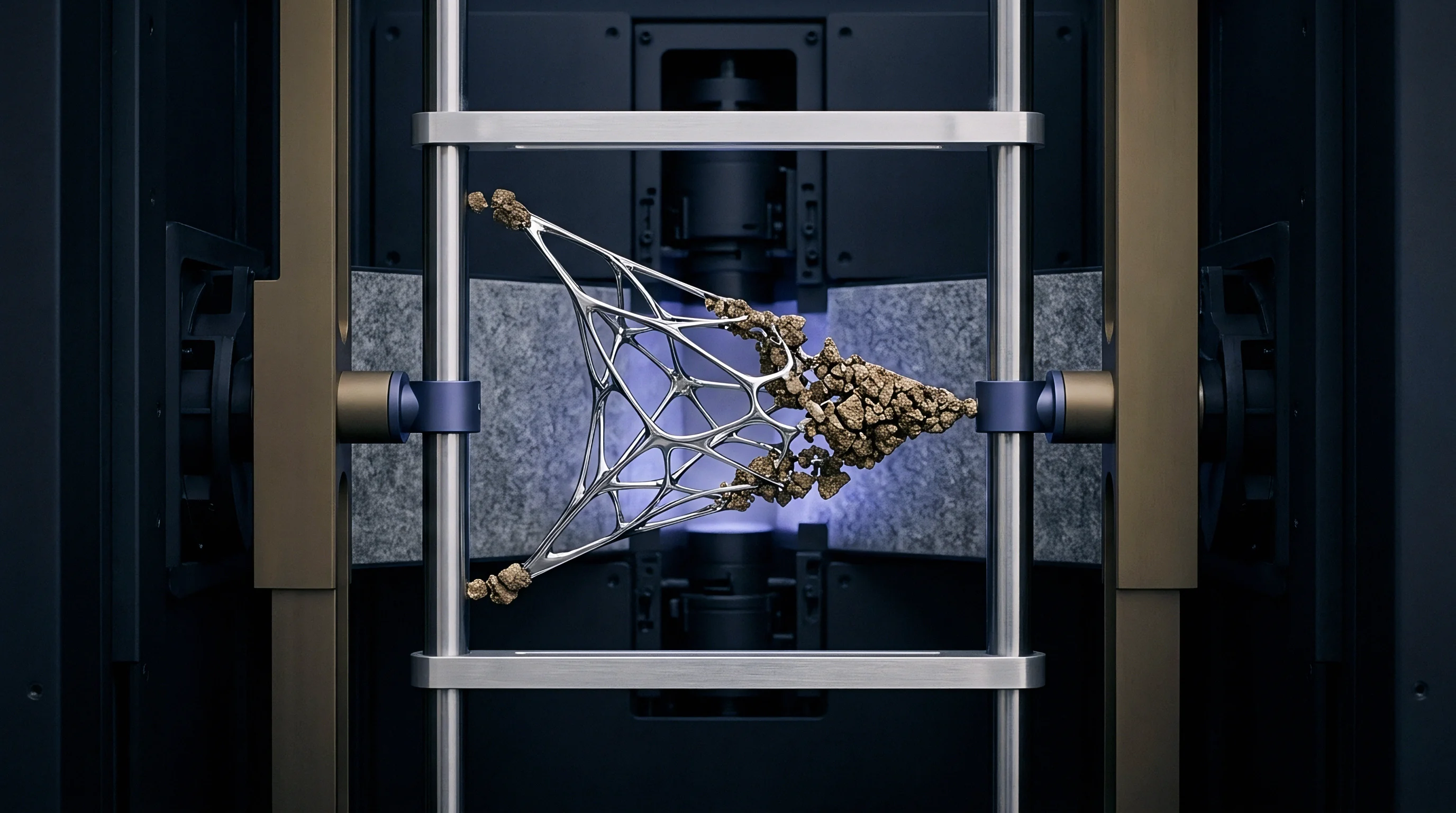
Elevated atomization pressure alters particle morphology directly. Droplets atomized at higher pressures experience cooling rates approaching ten thousand kelvin per second due to the high mass flow of cold gas. The rapid quench prevents surface tension from pulling sheared droplets into spheres before solidification completes, yielding a powder population of elongated tear-drop profiles, irregular flakes, and clusters of sub-five-micron particles welded to larger host spheres.
Recirculation dynamics create specific morphological defects across the atomized batch:
- Welded surface nodules accumulate when sub-micron fines get trapped inside the toroidal recirculation vortex beneath the nozzle tip and fuse to unsolidified droplet surfaces.
- Elongated splat fragments occur when high-velocity gas jets propel semi-solid droplets against the chamber wall before cooling completes.
- Hollow shell inclusions develop when gas expansion pockets enter the liquid ligament during extreme shear-stripping breakup at Mach numbers above 2.2.
- Agglomerated fines clusters form during cyclone separation where static electrostatic charges bind sub-three-micron particles into irregular lumps.
Laser diffraction measurements capture the volume distribution shift as pressure climbs. Below 2.0 MPa, the distribution exhibits a classical log-normal profile with a span below 1.2. As pressure approaches 4.0 MPa, a secondary shoulder emerges in the two-to-six micron band, broadening total span beyond 1.8 and establishing a bi-modal volume profile.
That fine shoulder roughly doubles the Brunauer-Emmett-Teller (BET) surface area measured via nitrogen gas adsorption, often driving it from 0.8 square meters per gram to 1.9 square meters per gram.
Powder lots demonstrating a size distribution span above 1.7 generate erratic binder consumption and localized current density hot-spots in dry electrode calenders.
An uncontrolled increase in gas atomization pressure produces an oversized fraction of sub-five-micron material that consumes liquid binders preferentially during mixing. The resulting electrode slurry suffers from severe phase separation, while dry battery electrode processes develop binder network starvation across coarse particle boundaries, causing coating delamination under standard cyclic pouch cell expansion stresses.

Slurry
Rheological behavior of the electrode paste reflects the particle packing fraction established by the atomization pressure history. When powder arrives with an excessively narrow distribution span, the void volume between particles remains unfilled, lowering the maximum achievable solid loading in the mixing vessel. A tailored distribution span, produced by moderate gas pressure atomization, enables small particles to sit within the interstices of larger particles.
This multimodal packing lowers continuous phase liquid demand, allowing solid content in active anode slurries to rise above fifty-eight weight percent without escalating low-shear viscosity.
Does Elevated Atomization Pressure Compromise Slurry Packing?
Excessive gas pressure shifts the particle distribution toward high specific surface areas, accelerating solvent absorption. In active silicon-graphite slurries utilizing carboxymethyl cellulose (CMC) and styrene-butadiene rubber (SBR), or polyvinylidene fluoride (PVDF) in N-methyl-2-pyrrolidone (NMP), high surface area particles strip free solvent molecules away from the bulk suspension. The loss of free solvent forces polymer binder chains into close contact, initiating premature gelation and elevating paste yield stress.
Slot-die coating heads experience uneven cross-web flow and severe edge-beading when paste yield stress passes twenty pascals.
| Powder Span ((D90-D10)/D50) | BET Area (m²/g) | Solids Loading (wt%) | Yield Stress (Pa) | Viscosity at 100 s⁻¹ (Pa·s) | Coating Streaking Index |
|---|---|---|---|---|---|
| 0.95 | 0.72 | 62.5 | 4.2 | 1.15 | Low |
| 1.35 | 1.08 | 60.0 | 8.6 | 1.42 | Minimal |
| 1.85 | 1.95 | 54.0 | 22.4 | 2.85 | Severe |
| 2.40 | 3.10 | 48.5 | 41.0 | 4.60 | Critical |
Viscosity spikes at high shear rates. During passage through the slot-die lip at shear rates exceeding five thousand reciprocal seconds, suspensions filled with high-pressure atomized powders display shear-thickening dilatancy if the fines fraction exceeds twelve volume percent. Droplets that solidified into non-spherical shapes generate mechanical interlocking under hydrodynamic shear, inducing pressure pulses inside the coating manifold that transfer periodic transverse thickness variations onto the copper current collector foil.
Uniform fluid flow during high-speed slot-die coating requires spherical particle morphology free of welded micro-spheroids.
Surface area scales inversely with diameter. Agglomerations of fine particles resist dispersion under standard planetary mixing protocols. These unseparated clusters create high-resistance nodes across the coated electrode layer, suppressing electron transport into the current collector and lowering rate capability during fast discharge cycles in finished cell architectures.

Calender
Compaction density achieved between hardened steel calender rolls depends directly on the initial particle size distribution created in the atomization chamber. Powders produced under elevated gas pressures display higher yield strength during dry compaction because fine particles possess fewer internal slip dislocations and higher relative density per particle. When passing through a two-roll calender at line speeds between thirty and seventy meters per minute, electrodes containing an excessive fines fraction demand higher linear nip loads to achieve target densities of 1.65 to 1.75 grams per cubic centimeter for silicon-containing anodes.
High calender roll pressures exceed four hundred kilonewtons per meter when overcoming the compaction resistance of ultra-fine powder fractions. This load induces elastic roll bending, leading to uneven electrode density across the web width: the center of the web emerges with lower density than the edges, causing uneven current distribution and accelerated lithium plating along the outer margins during cell charging.
Selection of the cell format imposes strict boundaries on acceptable powder size distribution parameters:
- Pouch cell packaging accommodates slight transverse thickness gradients because flexible aluminum laminate pouches allow uniform stack pressure application via external module compression plates.
- Cylindrical winding processes fail under local density gradients due to tension mismatches that tear the copper foil during automated 4680 or 21700 jellyroll spinning.
- Prismatic hard-case cells require tight volumetric tolerance to ensure the jellyroll or z-fold stack inserts cleanly into the extruded aluminum can without damaging edge insulation.
- Solid-state electrolyte layers demand sub-five-micron particles to minimize interstitial void spaces and avoid high interfacial impedance against the metallic lithium anode.
An engineered blend containing seventy percent coarse atomized powder and thirty percent fine powder fills interstitial voids, increasing the green electrode density prior to calendering. The higher green density reduces the required roll compression ratio from 1.45 down to 1.18, cutting calender roll motor load and eliminating foil wrinkling along the uncoated current collector margins.
Verification of incoming powder compressibility follows an established four-stage shop-floor sequence:
- Dry blend a five-hundred-gram sample of the incoming atomized lot with target polymer binder and conductive carbon additives in an acoustic mixer for three minutes.
- Deposit the dry composite into a precision twenty-millimeter tungsten carbide cylindrical die cavity.
- Apply a progressive compressive axial load from fifty megapascals to four hundred megapascals at a ramp rate of ten megapascals per second using a hydraulic load frame.
- Measure pellet displacement continuously via dual linear variable differential transformers to calculate green density and post-decompression elastic spring-back.
While pouch formats tolerate higher spring-back, cylindrical cell manufacturing suffers catastrophic web-break events if the elastic spring-back of the calendered electrode exceeds six percent. When high atomization pressure generates high surface area powders, the polymer binder undergoes greater strain during compaction. Stored elastic energy in the deformed polymer chains releases upon exiting the roll nip, expanding electrode thickness and inducing longitudinal tension variations.
Winding tension fractures brittle electrode margins. The open question centers on whether inert gas pressure modulation during atomization can be controlled dynamically to trim particle aspect ratios, thereby lowering electrode spring-back without sacrificing the specific surface area needed for rapid lithium-ion exchange.

Warrant
Procurement agreements for battery-grade metal and alloy powders link lot acceptance directly to laser diffraction and gas sorption thresholds. Commercial contracts define particle size limits across D10, D50, and D90 percentiles with explicit tolerances. A standard specification sheet for silicon-alloy powder dictates a D10 above 4.5 microns, a D50 between 12.0 and 15.0 microns, and a D90 below 28.0 microns, coupled with a span strictly under 1.45.
If the atomization plant experiences pressure fluctuations outside of plus or minus 0.05 MPa, the resulting distribution tails violate these boundaries, triggering lot quarantine.
Laser diffraction reports volume distributions directly, while sieve analysis isolates oversize flakes cleanly. Sourcing specifications mandate dual-method verification to prevent fine agglomerates from masking oversize particles in optical analyzers. Standard laser diffraction protocols run under ISO 13320 utilize both wet dispersion and dry venturi feeders to detect shear-sensitive secondary particle clusters.
When gas pressure drifts low, the fraction of particles exceeding forty-five microns escalates, causing immediate rejection during incoming automated screening under ASTM B214 sieve standards.
| Commercial Grade | Manifold Pressure Control (MPa) | Permitted D50 Range (µm) | Maximum Span Limit | Target Format Integration | Scrap Yield Cost Impact ($/kg) |
|---|---|---|---|---|---|
| Grade A Battery Prime | 3.2 ± 0.05 | 12.5 ± 1.0 | 1.30 | 4680 Cylindrical Jellyroll | 4.20 |
| Grade B Cell Standard | 3.0 ± 0.15 | 14.0 ± 2.0 | 1.55 | Prismatic Z-Fold Stacks | 2.10 |
| Grade C Utility Format | 2.5 ± 0.30 | 18.5 ± 3.5 | 1.85 | Stationary Pouch Packs | 0.80 |
| Non-Compliant Off-Spec | Uncontrolled Drift | Outside Window | > 2.00 | Re-melt Secondary Feed | 11.50 |
Argon consumption accounts for thirty to fifty percent of total processing costs per kilogram of finished powder, dominating atomization invoices. Running atomizers at 4.0 MPa instead of 2.2 MPa nearly doubles volumetric gas consumption per ton of throughput. In facilities without closed-loop argon recovery, re-purification, and compression infrastructure, that gas consumption adds between 1.80 and 3.50 dollars per kilogram to the base processing fee.
When tightening gas pressure controls to narrow the distribution span, the usable yield within a twelve-to-twenty-five micron window drops from seventy-five percent to fifty-two percent of total poured melt weight, forcing the powder supplier to amortize the cost of re-melting the scrap fraction across the accepted lots.
Incoming inspection protocols enforce financial penalties when powder morphology drifts from validated baseline lots. Purchase agreements incorporate formal warranty clauses that allocate conversion costs to the material refiner when powder size distributions cause line stoppage at the electrode coater. Under standard warranty terms for battery supply contracts, if a delivered powder lot exhibits a distribution span exceeding 1.60 as measured by ISO 13320 with ultrasonic dispersion, the buyer rejects the shipment at the port of entry, debiting the supplier for all freight handling, return shipping, and the landed duty differential incurred on the imported consignment.