Meaning
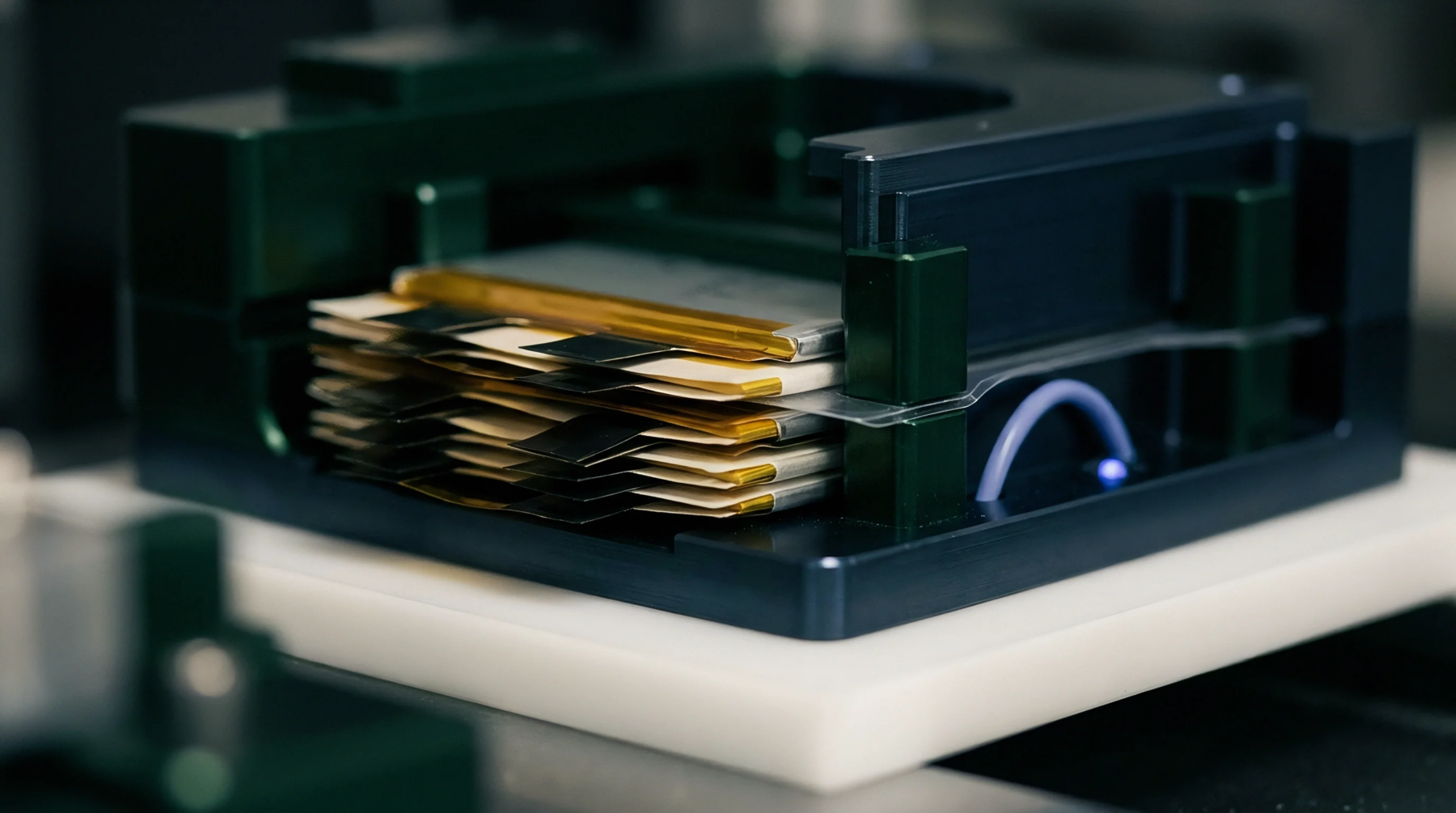
Dynamic redistribution of electrical charge and ionic species between parallel-connected electrode leaves, winding turns, or stacked sheets within a single cell casing balances internal current share. The process of interlayer equalization occurs during rest periods or mild cycling, driven by internal potential differences across individual plate units. It compensates for variations in tab resistance, coating thickness, and thermal gradients across the interior of the jelly roll or pouch stack.
The term stops applying to external module-level balance circuits and addresses solely intrinsic internal physical homogenization.
Current Maldistribution
Internal manufacturing tolerances produce microscopic impedance variations among individual electrode layers inside a cell. During rapid charging pulses, current preferentially enters layers offering the lowest combined ohmic and charge-transfer resistance. The unequal split creates localized states of charge, leaving some leaves saturated while adjacent sheets remain partially loaded.
Interlayer equalization initiates the moment dynamic current stops, initiating internal parallel cross-currents. These micro-currents pass through the common current collector tabs until chemical potentials equalize.
Thermal Influence
Internal temperature gradients inside large-format cells strongly influence the speed of layer balancing. Core layers dissipate heat slower than surface leaves, operating at higher temperatures and consequently lower charge-transfer resistance. As a result, warmer internal layers carry disproportionate current during heavy cycling, widening internal state of charge divergence.
Once the load terminates, internal balancing currents reverse this offset across the stack. Sustained high cross-currents generate parasitic Joule heating within the cell tabs during rest, prolonging internal thermal settling times.
Degradation Consequence
Protracted imbalance between internal layers causes uneven localized degradation across the cell stack. Layers subjected to chronic over-current experience accelerated solid electrolyte interphase growth and risk localized lithium metal deposition. Over hundreds of cycles, non-uniform active material loss reduces net accessible capacity faster than predicted by single-layer modeling.
Monitoring the relaxation behavior of cells during post-charge holding provides indirect evidence of interlayer equalization kinetics. Minimizing this phenomenon requires precision slurry coating, tight tab placement tolerances, and optimized current collector geometry.