Non Destructive Magnetic Coercivity Mapping for Submicron Tungsten Carbide Binder Phase Segregation Limits
Non-destructive magnetic coercivity mapping detects localized cobalt pooling and binder starvation in submicron carbide slitter knives before edge failure.
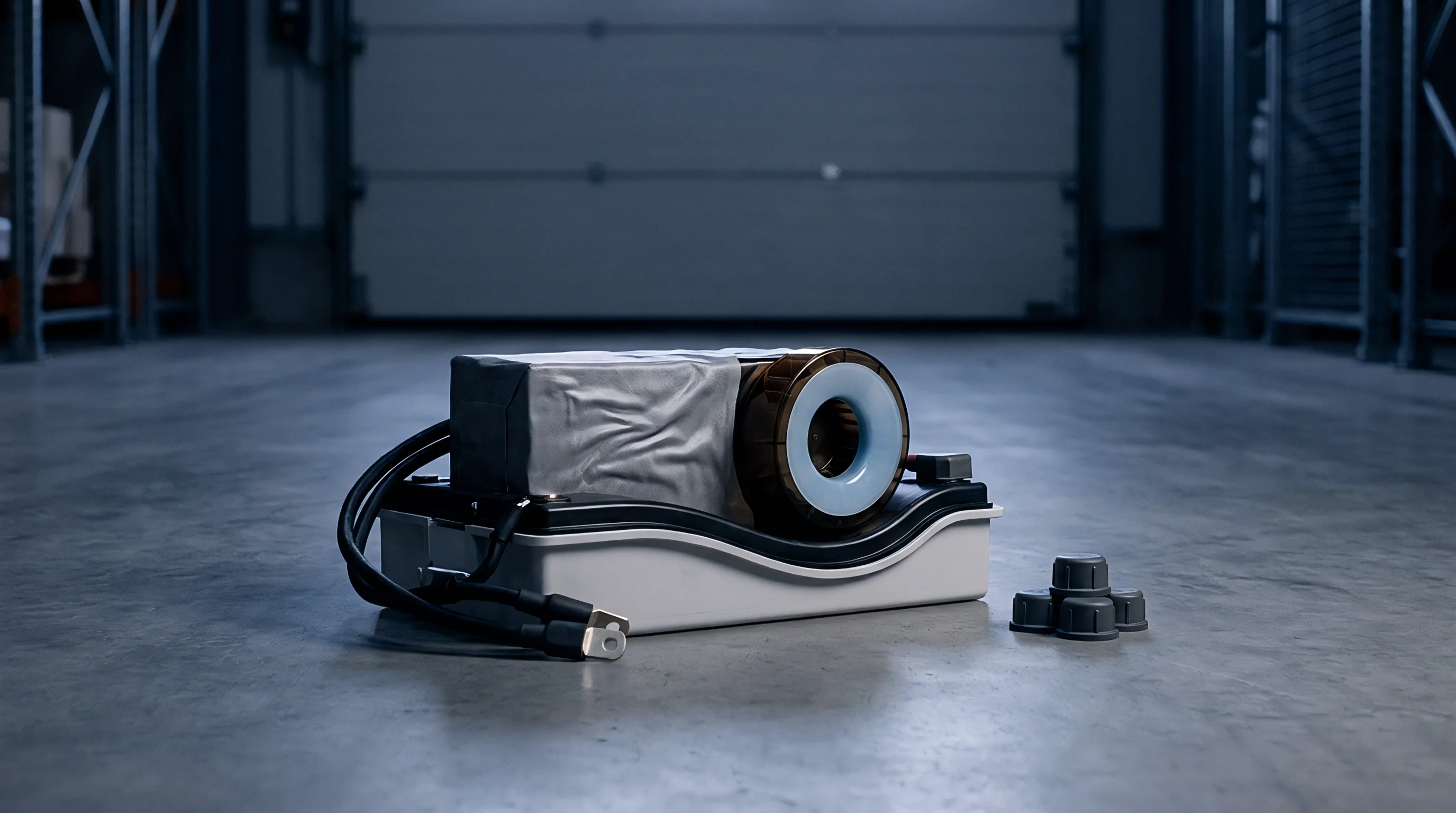

Probe
Point-contact magnetic flux yokes paired with miniature Hall arrays measure localized demagnetizing fields across ground cemented carbide surfaces without inducing mechanical damage. Submicron tungsten carbide grades with six to twelve weight percent cobalt rely on uniform mean free path spacing between carbide grains to maintain edge retention during continuous battery foil slitting. When cobalt segregates into microscopic pools or starves adjacent grain clusters, the local magnetic domain response shifts measurably under an applied excitation field.
The measurement takes five seconds. The sensor head moves linearly across the tool ground flat, recording flux leakage signals that correlate directly to the coercive force of the volume beneath the contact tips.
Excitation coils drive the local workpiece volume into complete magnetic saturation before an opposing sweep field determines the exact point of zero net magnetization. Standard bulk coercimeters quantify the magnetic coercivity of an entire insert inside an encircling solenoid, masking discrete sub-millimeter cobalt lakes within an averaged bulk reading. Localized surface probes bypass this volumetric smoothing by restricting magnetic flux paths to a penetration depth between 0.3 millimeters and 0.8 millimeters.
High field saturation suppresses noise. A sensor tip with twin pole pieces spaced 1.2 millimeters apart concentrates the flux lines within the active cutting perimeter, allowing direct detection of binder anomalies before the tooling engages production foil.
Holding excitation current to 4.2 amperes at 20 degrees Celsius maintains field stability across consecutive test sweeps.
Variations in local cobalt concentration distort the localized coercive field strength because the domain wall mobility inside the ferromagnetic binder depends on the spacing between non-magnetic carbide grains. Pure cobalt binder pools allow rapid domain wall movement under weak reverse fields, driving coercivity downward in localized pockets. Conversely, regions suffering binder depletion exhibit tight tungsten carbide contiguity, forcing domain walls through high energy pin sites and elevating the measured coercive threshold.
Local cobalt pools alter permeability. The resulting magnetic map traces binder distribution gradients across circular slitter knives, tab notching punches, and precision calendering rolls.
- Cobalt pooling occurs when binder migration during liquid phase sintering leaves localized metallic zones exceeding twenty micrometers in diameter, degrading yield strength.
- Carbide skeleton embrittlement develops across cobalt-depleted regions, prompting spontaneous micro-fractures along cutting edges subject to cyclic contact stresses.
- Asymmetric carbon uptake shifts the localized tungsten solubility within the cobalt matrix, precipitating brittle eta phase clusters that distort flux paths.
- Surface grinding damage generates localized residual compressive stress and martensitic transformation in the binder, shifting baseline coercive readings away from bulk sintered values.
Failure to detect binder phase segregation prior to production slitting causes premature edge chipping, burr formation on aluminum and copper current collectors, and subsequent separator penetration inside wound jelly rolls or stacked pouch cells.
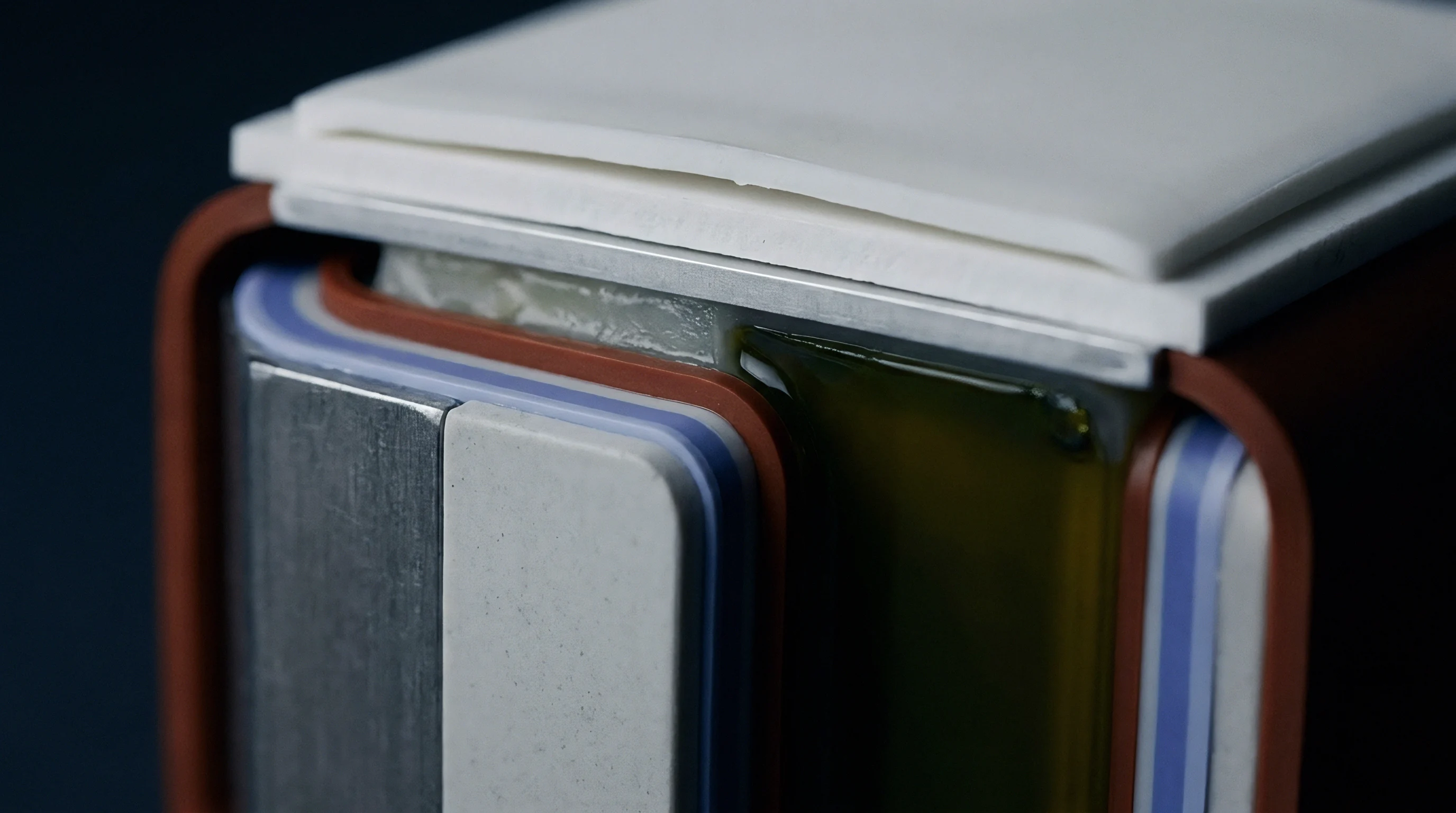
Saturation
Specific magnetic saturation quantifies the dissolved tungsten content inside the cobalt binder phase, establishing whether the sintered carbide sits safely within the two-phase zone. Sintering reactions balance carbon activity to prevent both graphite precipitation at high carbon limits and brittle eta phase formation at low carbon boundaries. A magnetic saturation balance measures total magnetic moment per unit mass under fields exceeding four hundred kiloamperes per meter.
The carrier frequency holds steady. Correlating local magnetic saturation with coercive force maps isolates physical binder migration from chemical composition drift.
| Nominal Cobalt Content (%) | Mean Grain Size (µm) | Coercivity Range (kA/m) | Magnetic Saturation (µT·m³/kg) | Vickers Hardness (HV30) |
|---|---|---|---|---|
| 6.0 | 0.4 | 31.0 to 36.5 | 11.8 to 12.6 | 1950 to 2080 |
| 8.0 | 0.5 | 24.0 to 29.5 | 15.8 to 16.9 | 1720 to 1840 |
| 10.0 | 0.6 | 18.5 to 23.0 | 19.7 to 21.2 | 1540 to 1650 |
| 12.0 | 0.7 | 14.0 to 18.0 | 23.6 to 25.4 | 1380 to 1490 |
Grain boundaries pin magnetic domains. When scanning an eight weight percent cobalt grade, measured coercivity values dropping below 22.0 kiloamperes per meter indicate localized grain enlargement or cobalt clustering. Values exceeding 31.0 kiloamperes per meter signal severe cobalt starvation or grain growth inhibitor precipitation along adjacent carbide boundaries.
Local saturation deviations reveal whether the anomaly stems from poor powder dispersion or furnace atmosphere variations during thermal processing. The signal drops immediately. Precise evaluation separates batch-wide decarburization from localized mechanical segregation induced during pressing operations.
The vendor routinely claims that minor surface coercivity blips reflect standard grinding stresses rather than true metallurgical pooling.

Gradient
Spatial resolution in magnetic mapping defines the minimum detectable defect size across the active cutting periphery. A differential Hall sensor array positioned between soft magnetic flux concentrators resolves coercive force variations across lateral increments of two hundred micrometers. Stepper motor drives advance the workpiece beneath the sensing tip, sampling magnetic responses at uniform coordinate intervals.
Calibration routines demand solid standards. By recording forward and reverse magnetization cycles across each coordinate, the acquisition software constructs a two-dimensional map depicting binder homogeneity.
The factory rejects cutting inserts exhibiting local coercive variations wider than four percent from baseline calibration blocks under ASTM B887 guidelines.
Consider an electrode slitter disc measuring one hundred millimeters in outer diameter and two millimeters in thickness, manufactured from a 9.0 weight percent cobalt submicron carbide. The baseline bulk coercivity measures 22.5 kiloamperes per meter with a uniform saturation level of 17.8 microtesla cubic meters per kilogram. Assume the contact scanning system registers a localized dip down to 17.1 kiloamperes per meter over an arc spanning 1.8 millimeters along the cutting periphery.
This twenty-four percent coercive drop corresponds to an effective localized binder content exceeding 13.5 weight percent. Secondary phases degrade transverse rupture. Under working conditions, this soft pool deforms plastically when slitting cathode foil coated with abrasive lithium nickel manganese cobalt oxide slurry.
| Observed Defect Type | Coercivity Shift (%) | Local Hardness Delta (HV) | Wear Mechanism | Foil Slitting Consequence |
|---|---|---|---|---|
| Macro Cobalt Lake | -20 to -35 | -250 to -400 | Plastic smearing and galling | Heavy burr exceeding 5 µm |
| Micro Binder Cluster | -8 to -15 | -90 to -160 | Adhesive wear and pickup | Slurry flake generation |
| Binder Starvation Zone | +12 to +25 | +110 to +220 | Edge micro-chipping | Collector edge serration |
| Eta Phase Cluster | +25 to +45 | +250 to +380 | Catastrophic edge spall | Web break and short circuits |
Tolerances narrow under thermal load. The physical wear pattern follows the coercive map with high spatial fidelity. Soft cobalt pools attract active material adhesion, accelerating localized friction and heating during high-speed web conversion.
Hard binder-starved regions resist smearing but lack the fracture toughness required to absorb high-frequency vibration during continuous rotary shearing. The edge chips cleanly along the starved perimeter. The line stops completely.
The resulting metallic debris migrates into downstream battery assembly cells, contaminating separators and promoting latent short circuits during subsequent formation cycling.
A tool possessing uniform magnetic properties across its entire periphery delivers predictable mechanical tool life without sudden edge degradation.

Drift
Inspection systems must maintain instrument repeatability over multi-hour production monitoring campaigns. Thermal shifts in the sensor core, coil resistance increases, and surface wear on contact pole pieces introduce systematic drift into magnetic flux mapping records. Mitigating instrument drift involves automated reference recalibration against certified sintered reference blocks after completing a set inspection interval.
The coils detect microstructural shifts. Reference blocks must represent identical carbide grain structures and chemical compositions to maintain consistent Hall voltage transfer functions across all operational channels.
- Mechanical staging secures the slitting disc against a non-magnetic ceramic mandrel, eliminating external ferromagnetic interference from motor frames.
- The sensor head indexes toward the reference baseline ring to verify zero-point drift and demagnetization sensitivity against a certified submicron WC-Co standard.
- Motor stages rotate the component through 360 degrees while the scanning probe maintains constant pneumatic contact pressure of 0.45 bar against the ground face.
- Analog flux signals pass through high-pass filtering networks to eliminate low-frequency machine vibration artifacts before analog-to-digital conversion.
- Software algorithms match angular coordinate timestamps with instantaneous coercive force readings, plotting the full circumferential gradient.
Inspection gates prevent line contamination. Beyond instrument calibration, ambient magnetic interference from nearby electrical equipment alters coercive threshold readings. Shielded test chambers lined with high-permeability alloys isolate the active contact zone from stray alternating-current fields generated by drying ovens and calendering motors.
Without proper magnetic containment, external flux fluctuations introduce phantom segregation patterns into the inspection log, prompting unnecessary rejection of acceptable cutting tools. The buyer cancels the run.
The unresolved engineering dilemma centers on whether localized coercivity mapping can accurately separate the magnetic signature of internal binder segregation from the identical magnetic signature produced by surface-level compressive stress fields introduced during aggressive diamond grinding passes.

Penalty
Purchase specifications for battery tooling components formalize quantitative magnetic thresholds to enforce microstructural consistency across procurement batches. Sourcing contracts that omit explicit non-destructive testing requirements leave tool buyers vulnerable to receiving blended regrind scrap or substandard furnace runs. Establishing rigid acceptance criteria requires defining boundary limits for bulk magnetic coercivity, localized coercivity variance, and minimum specific saturation.
Standard receiving documentation must include verified mapping charts for every cutting edge destined for electrode slitting machines.
Quality agreements must link component acceptance directly to non-destructive magnetic scanning records, establishing financial offsets for production downtime caused by premature tool degradation. When electrode slitting edges degrade ahead of scheduled maintenance intervals, battery assembly lines experience catastrophic foil tearing, burr formation exceeding three micrometers, and expensive cell scrap rates. Documented segregation defects discovered through post-mortem magnetic scanning provide indisputable evidence of metallurgical failure, transferring the cost of production losses and cell quarantine procedures back to the tooling fabricator.
Purchase contracts incorporating Section 8 of ISO 3326 establish clear legal rejection thresholds whenever point-to-point magnetic coercivity deviates by more than five percent across the finished cutting tool profile.