Spatial Point Process Modeling for Microstructural Segregation Analysis in Powder Metallurgy Tool Steels
Spatial point process modeling quantifies microstructural carbide clustering in powder metallurgy tool steels to prevent premature fatigue failure in tooling.


Stock
Rapid solidification during gas atomization curbs macro-segregation in high-alloy powder metallurgy tool steel production. Droplets chill at rates exceeding 10,000 Kelvin per second, locking alloying additions ~ vanadium, tungsten, molybdenum, and chromium ~ into an even initial distribution. Downstream processing, however, introduces spatial variations across the billet cross-section.
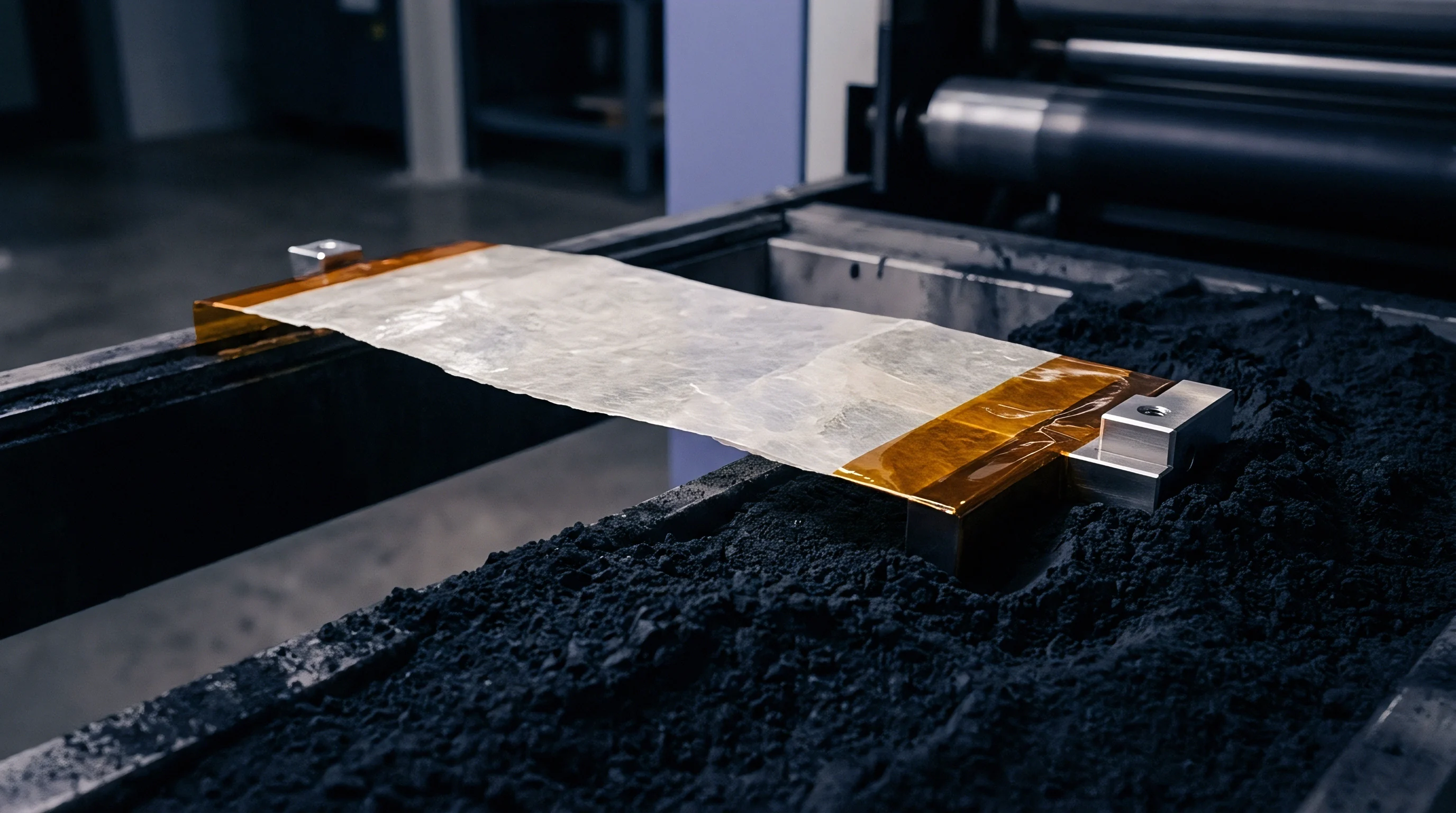
Hot isostatic pressing consolidates the screened powder into dense compacts before heavy forging or rolling reduces them to final bar dimensions. Non-uniform plastic flow and thermal gradients across these reduction schedules drive localized coalescence among primary secondary phases.
Carbide Clustering and Stereological Limitations
Standard metallographic evaluation relies heavily on two-dimensional scalar values. Classical stereology measures phase content via area fraction, mean intercept length, and particle counts per field area, but these bulk metrics miss spatial arrangement entirely. Two microstructures can share identical global volume fractions near twelve percent while exhibiting radically different topologies: one billet maintains homogeneously dispersed vanadium carbides, while another develops stringers and tight cellular networks.
Gas atomized powder yields an average inter-particle spacing of 3.2 micrometers at cooling rates exceeding 10000 Kelvin per second.
Billet centers cool much slower than outer surfaces during large ingot processing or heavy compact consolidation. Micro-segregation during this prolonged heat dissipation sets up local chemistry imbalances, forming coarse primary precipitates that resist dissolution during high-temperature austenitizing. Tooling machined from zones with clustered hard phases concentrates stress under cyclic fatigue, degrading toughness even when the nominal mass fraction matches specification.

Solidification Physics in Rapid Atomization
High-pressure inert gas jets break the molten tool steel stream into micro-droplets during powder synthesis. Nitrogen or argon quenching suppresses long-range solute partitioning, trapping refractory elements inside supersaturated martensitic or austenitic powder particles. Most segregation happens later during thermo-mechanical processing, where thermal exposure during consolidation allows interstitial carbon and heavy carbide-formers to migrate toward prior particle boundaries.
Microstructural anisotropy emerges when plastic deformation draws primary carbide networks out along the main forging axis. Standard scalar parameters under ASTM E1245 miss these alignments because averaging field values washes out sharp local density swings. Spatial point process modeling provides the mathematical framework needed to isolate, measure, and quantify these localized anomalies.
Meeting specification on global volume fraction does not prevent severe localized grouping, which often develops as an unavoidable artifact of large-diameter ingot reduction.


Kernel
Spatial statistical modeling treats individual microstructural features as point patterns across a bounded two-dimensional sampling frame. Centroids of primary carbides extracted from micrographs serve as discrete coordinates in the plane. Complete spatial randomness ~ formulated mathematically as a homogeneous Poisson point process ~ provides the reference baseline.
Departures from this benchmark reveal underlying physical interactions, identifying either attraction or repulsion between neighboring particles.

Mathematical Definition of Point Patterns
A planar point process describes a random distribution of points across an observation window, characterized by an intensity parameter that gives the expected centroid count per unit area. When this intensity stays constant across the entire field, the process is homogeneous. Solidification gradients and directional forging, however, create spatial non-stationarity, requiring inhomogeneous intensity modeling to account for macroscopic segregation trends.
Spatial clustering scales directly with local carbide density while spatial inhibition reflects physical hard-core repulsion between solidifying phases.
Distance-based summary functions evaluate spatial patterns across multiple length scales. Ripley’s K-function measures spatial dependence by calculating the expected number of additional centroids within a radial distance from an arbitrary point. For a pattern with intensity lambda, complete spatial randomness yields a theoretical value of pi multiplied by the square of that radius.
Values above this curve denote clustering, while values below point to spatial dispersion or geometric exclusion.

Besag Transformation and Pair Correlation
Linearization makes cumulative spatial metrics easier to interpret. Besag’s transformation converts Ripley’s K-function into the centered L-function by taking the square root of the K-function divided by pi and subtracting the radial distance, returning zero under complete spatial randomness. Positive peaks pinpoint specific correlation lengths where particle grouping concentrates, whereas negative values reflect physical spacing constraints imposed by particle dimensions.
Derivative functions provide localized spatial resolution. The pair correlation function, taken from the derivative of Ripley’s K-function, tracks the probability density of finding two centroids separated by a given distance relative to a random baseline. At short radii, physical particle size prevents centroids from overlapping, dropping the pair correlation function to zero.
This hard-core radius defines the minimum physical spacing between primary carbides.
Parametric point process models fit these measured coordinates to physical interaction mechanics. Strauss processes apply explicit penalties to neighboring points within a defined interaction radius, while Gibbs point processes incorporate multi-body potential energy terms to model thermodynamic phase repulsion and solute clustering during cooling. Fitting these models produces parameters that track microstructural segregation directly.
| Model Type | Spatial Interaction | Mathematical Parameter | Primary Microstructural Driver |
|---|---|---|---|
| Homogeneous Poisson | Zero interaction (Random) | Constant intensity lambda | Ideal unclustered rapid quenching |
| Strauss Process | Inhibition or attraction | Interaction radius and gamma scale | Hard-core particle exclusion radius |
| Matern Type II | Hard-core inhibition | Distance threshold h | Physical carbide geometry constraints |
| Inhomogeneous Cox | Clustering with spatial gradient | Random intensity function lambda(x) | Thermal gradients during forging |
Consider a 500 micrometer by 500 micrometer metallographic evaluation window containing 1,200 vanadium carbide centroids extracted from a high-speed tool steel billet. Global spatial intensity equals 0.0048 points per square micrometer. Calculating Ripley’s K-function at a radial scale of 15 micrometers yields an unadjusted spatial count density corresponding to an effective value of 850 square micrometers.
Under complete spatial randomness, the expected theoretical value equals 706.8 square micrometers. The resulting Besag L-function value calculates to positive 1.45 micrometers, demonstrating statistically significant spatial clustering at the 15 micrometer length scale.
Whether high-temperature solution annealing can dissolve extreme carbide clusters without causing abnormal matrix grain growth remains an open question across high-alloy tool steel grades.


Optics
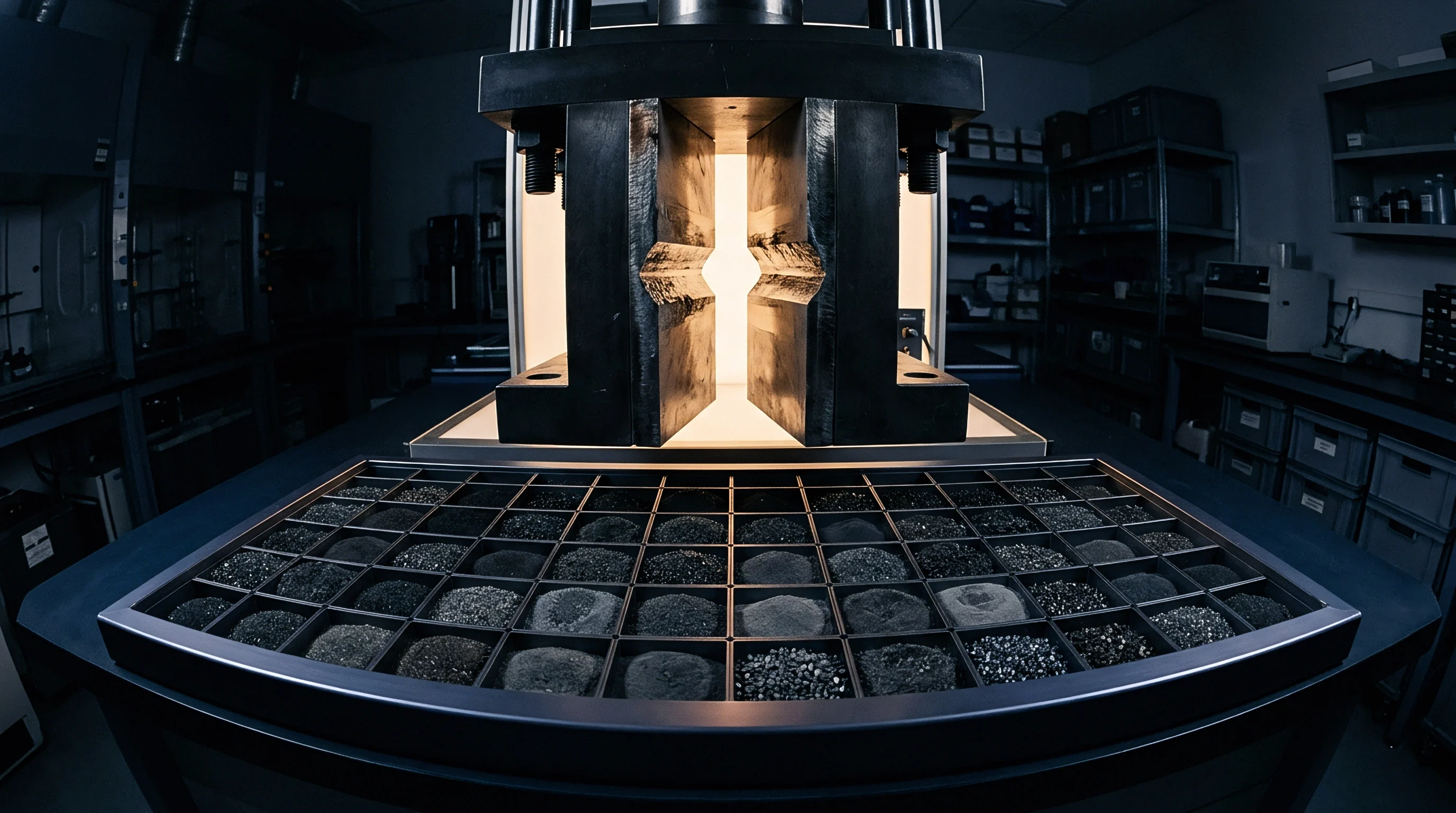
Accurate quantification requires tight image acquisition controls to prevent measurement artifacts. Scanning electron microscopy in backscattered electron mode provides the necessary Z-contrast between the matrix and lighter alloy carbides. This contrast allows automated binarization routines to segment vanadium-rich MC carbides and tungsten-molybdenum-rich M6C carbides from tempered martensite, yielding precise centroid coordinates across thousands of particles per sample.
Why Does Spatial Edge Correction Alter Carbide Clustering Estimates?
Window boundaries truncate neighborhood measurements: particles near the frame perimeter lack full 360-degree observations because adjacent centroids outside the image go unrecorded. Leaving this uncorrected depresses Ripley’s K-function values, producing artificial signs of spatial inhibition near the edges of the field.
Robust analyses apply isotropic weighting factors or translation corrections to account for unobserved areas. Ripley’s isotropic correction calculates the proportion of a search circumference that falls within the observation window, scaling each particle’s weight accordingly. Alternatively, border corrections set an interior evaluation zone and use the outer margin strictly for neighbor counts, keeping edge truncation from biasing segregation metrics.
- Polishing metallographic specimens through one-quarter micrometer diamond suspension to remove surface distortion layer.
- Acquiring backscattered electron micrographs at minimum 2048 by 2048 pixel resolution across twenty non-overlapping fields.
- Applying adaptive local thresholding algorithms to segment distinct carbide stoichiometry groups based on grey-level intensity.
- Extracting spatial coordinate centroids and equivalent spherical diameters for every segmented particle boundary.
- Executing spatial edge-corrected pair correlation calculations to determine inter-particle interaction potentials.
Automated image analysis under ASTM E1245 specifies minimum field sampling counts to prevent bias in secondary phase metrics.
Magnification sets the spatial resolution limits. Low magnification widens the field to capture macro-banding and long stringers, but loses fine secondary carbides; high magnification resolves sub-micrometer precipitates but misses broader clustering patterns. Multi-scale point process modeling bridges this gap by merging datasets across magnification steps, building unified models from 0.5 micrometers up to 2 millimeters.
Inaccurate edge correction underestimates carbide clustering near image boundaries, causing premature qualification of defective steel lots that fail during downstream die stamping operations.


Damage
Mechanical failure in powder metallurgy tool steels usually starts at microstructural defects under cyclic load. Clustered primary carbides act as stress risers because of the elastic modulus mismatch between the ceramic-like particles and the surrounding tempered steel matrix. During cold punching or fine blanking, high local volume fractions inside these clusters magnify local shear stresses, accelerating micro-crack initiation and tool wear.

Micro-Cleavage and Failure Mechanics
Tooling life tracks microstructural homogeneity. When primary carbides cluster tightly, their surrounding stress fields overlap, creating severe hydrostatic tension. Under cyclic loading, closely spaced carbides fracture well below the nominal matrix yield strength; micro-cracks then bridge adjacent particles through the high-density cluster and link into macro-cracks that tear through the matrix.
- Stress Concentration Overlap drives local strain accumulation across dense carbide clusters during high-impact cold working cycles.
- Prior Particle Boundary Networks promote intergranular fracture paths when solute element segregation weakens consolidated powder interfaces.
- Anisotropic Toughness Cleavage accelerates fatigue crack propagation along longitudinal forging directions containing severe linear carbide stringers.
- Matrix Micro-Void Coalescence occurs rapidly within narrow inter-particle channels separating closely spaced primary carbide precipitates.
Spalling on cold-work punch radii correlates closely with high pair correlation peaks at short interaction distances. Steel lots with elevated clustering indices show poor dynamic fracture toughness even when macro-hardness across the heat-treated block measures a uniform Rockwell C value.
| Grade Specification | Dominant Carbide Phase | Peak L(r) Clustering Value | Charpy V-Notch Toughness (J) | Unnotched Bend Strength (MPa) |
|---|---|---|---|---|
| CPM 10V Class 1 | Vanadium Rich MC | 0.42 micrometers | 14.2 | 3850 |
| CPM 10V Segregated | Vanadium Rich MC | 2.18 micrometers | 8.1 | 2920 |
| Vanadis 8 Standard | Vanadium Rich MC | 0.38 micrometers | 16.5 | 4100 |
| ASP 2060 High Alloy | Complex M6C / MC | 1.85 micrometers | 9.4 | 3150 |

Anisotropic Mechanical Degradation
Carbide stringers from heavy reduction impart directional mechanical properties to the finished bar. Transverse impact energy drops sharply when loads run perpendicular to linear carbide clusters. Directionally weighted pair correlation functions along axial, radial, and transverse orientations capture this spatial anisotropy directly.
Quantifying spatial anisotropy with directional point processes enables predictive mechanical modeling. Standard non-destructive tests fail to detect localized carbide banding before tool machining. Evaluating spatial point process parameters from preliminary coupon samples prevents high-value machining of structurally compromised tool steel stock.
Coarse primary carbide clusters dictate the lower bound of fatigue strength regardless of bulk matrix hardness.


Clause
Procurement documents for high-performance tool steel stock require explicit quantitative microstructural metrics to prevent warranty disputes. Chemistry certs, grain size numbers, and macro-etch ratings alone leave tooling manufacturers exposed to wide heat-to-heat variations. Billet procurement sheets increasingly specify spatial point process limits alongside standard hardness and cleanliness ratings.

Quality Dossier and Acceptance Criteria
Receiving inspection frameworks require clear statistical limits for spatial clustering functions, backed by backscattered electron coordinate sets taken from representative coupon cross-sections. Point process metrics give receiving engineers objective criteria for acceptance tied directly to fatigue performance.
Billet acceptance criteria based on spatial point process statistics isolate structural defects that classical area fraction measurements miss entirely.
Procurement specifications define maximum allowable Besag L-function peak values across critical interaction scales. Steel heats exceeding designated spatial clustering limits trigger technical re-inspection or immediate shipment rejection before high-cost tool geometry milling begins.
- Maximum Peak Clustering Threshold sets the upper bound for Besag L-function values across interaction distances from 2 to 20 micrometers.
- Short-Range Hard-Core Radius mandates minimum physical spacing between primary carbide centroids to prevent stress field overlap.
- Anisotropy Ratio Limit establishes maximum permitted variance between longitudinal and transverse pair correlation peak amplitudes.
- Minimum Sampling Field Count dictates required image evaluation area coverage to hold statistical confidence intervals above 95 percent.

Contractual Risk Boundaries
Explicit boundaries protect toolmakers from early failures in production. Heat treatment suppliers regularly face liability claims when quenched and tempered dies crack in early operation, and spatial statistics clarify whether failure stemmed from improper furnace cycles or inherited segregation in the raw stock.
Legal responsibility rests on verifiable baseline material standards documented prior to machining. Incorporating spatial point process parameters into incoming material qualification shifts non-conformance liability back to the steel mill when microstructural clustering exceeds contractually agreed limits.
Material supply agreements specifying a maximum Besag L-function peak value of 0.5 micrometers between 5 and 15 micrometer interaction distances give buyers explicit grounds to reject segregated billet heats before tool conversion.