Microstructural Phase Transformations and Internal Pore Closure Dynamics during Precursor Hydroxide Solid State Lithiation
Solid state lithiation drives dehydroxylation pore formation and subsequent sintering closure, requiring strict thermal and oxygen control to stop microcracks.
Steam
Precursor particles entering a calcination line carry structural water that releases abruptly once the heating bands pass two hundred degrees Celsius. In high-nickel formulations, the co-precipitated transition metal hydroxide ~ typically Ni0.8Mn0.1Co0.1(OH)2 ~ packs into a hexagonal brucite-type lattice under space group P-3m1. As thermal energy breaks the bonds between metal cations and hydroxyl groups, water vapor evacuates the crystal structure at three hundred degrees.
This dehydroxylation converts the parent hydroxide into a transitional rock-salt monoxide phase with space group Fm-3m, collapsing the unit cell dimensions and driving an immediate volumetric shrinkage of nearly twenty-eight percent across individual primary crystallites.
Dehydration across a twelve-micrometer secondary sphere proceeds from the outside in. Surface crystallites hit decomposition thresholds before heat penetrates to the particle core, venting hydroxyl groups and nucleating nanoscale rock-salt domains and basal-plane pores while the center remains unreacted hydroxide. As those surface crystallites shrink against the hydrated core, the resulting tensile stress rips adjacent grain boundaries apart.
These initial tears establish an open pore network that vents residual moisture from the interior. If the ramp rate exceeds five degrees Celsius per minute, internal steam pressures easily outstrip the cohesive strength of the grain boundaries, blowing the secondary spheres into irregular fragments.
Thermogravimetric mass loss reaches twenty-eight percent between two hundred fifty and four hundred fifty degrees Celsius under dry synthetic air.
Pore volume distribution during this thermal window tracks the crystallographic shift from hydroxide to oxide. Mercury intrusion porosimetry shows a clean bimodal profile directly after dehydroxylation: intra-particle mesopores between two and fifteen nanometers sit alongside inter-particle interstitial voids above one micrometer. The nanoscale voids follow the paths vacated by hydroxyl groups along the c-axis of the original brucite lattice, leaving an interconnected channel network ready to draw in molten lithium salts during the next firing stage.
| Stage Temperature Range | Dominant Crystal Structure | Space Group | Theoretical Density Grams per Cubic Centimeter | Specific Surface Area Square Meters per Gram | Cumulative Pore Volume Cubic Centimeters per Gram |
|---|---|---|---|---|---|
| Ambient to 220 C | Transition Metal Hydroxide | P-3m1 | 3.95 to 4.05 | 4.2 to 6.5 | 0.012 to 0.020 |
| 220 C to 380 C | Mixed Hydroxide and Rock-Salt | P-3m1 and Fm-3m | 4.45 to 4.70 | 28.0 to 45.0 | 0.085 to 0.125 |
| 380 C to 500 C | Defect Spinel and Monoxide | Fd-3m and Fm-3m | 4.85 to 5.15 | 12.0 to 22.0 | 0.055 to 0.078 |
| 500 C to 650 C | Lithium-Substituted Rock-Salt | Fm-3m | 4.60 to 4.80 | 4.5 to 8.0 | 0.030 to 0.045 |
The mechanics of dehydroxylation establish primary grain morphology long before lithium enters the host lattice. Transition metal cations rearrange via short-range diffusion over sub-nanometer spans to build dense rock-salt domains, vacating lattice sites that coalesce into intra-granular nanopores. Specific surface area climbs from six square meters per gram in the precursor to over thirty-five square meters per gram once dehydroxylation peaks.
Without sufficient oxygen, cation ordering halts; poor exhaust airflow at this point leaves water vapor trapped in the powder bed, sparking a backward hydrothermal reaction that re-hydrates surface nickel, crusts the particle shells prematurely, and locks corrosive moisture inside the secondary aggregates.
Matrix
Once blended lithium hydroxide monohydrate melts at four hundred sixty-two degrees Celsius, solid-state reaction fronts push inward from the secondary particle surface toward its core. Capillary action draws this liquid salt through the channels opened during dehydroxylation. Lithiation proceeds through sequential topotactic steps: defect rock-salt oxides reorganize into intermediate spinel-like phases before settling into the target layered alpha-NaFeO2 structure under space group R-3m.
For this layered lattice to form, nickel, cobalt, and manganese cations must segregate into distinct octahedral planes separated by sheets of lithium ions.
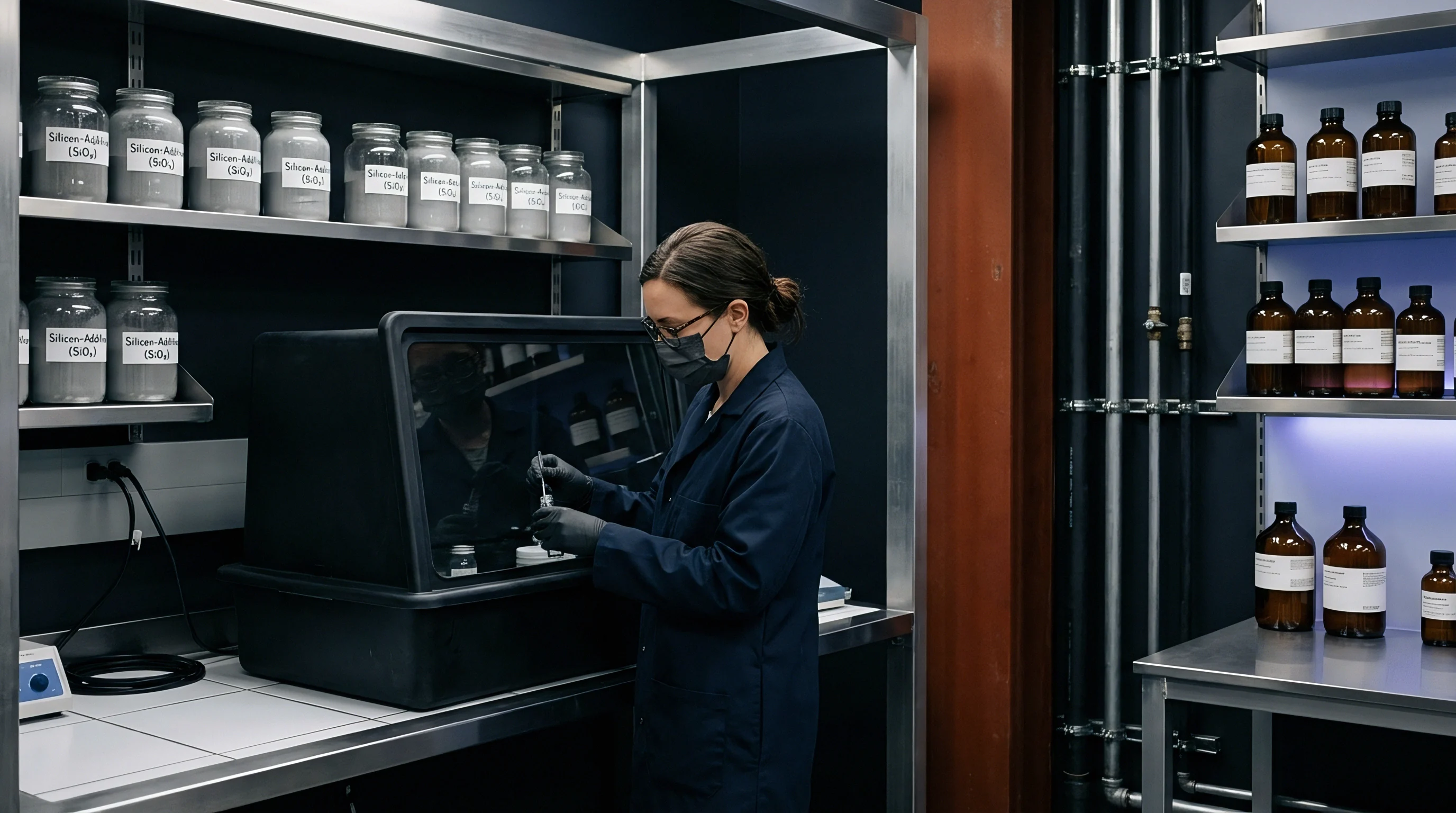
How Does Lithium Infiltration Drive Phase Reorganization?
As molten lithium coats the monoxide lattice, cation exchange begins at the primary crystallite boundaries. Forcing monovalent lithium into divalent rock-salt sites requires nickel to oxidize from Ni2+ to Ni3+ and Ni4+ to preserve charge balance, coupling electron transfer directly to local lattice strain. While the cubic close-packed oxygen framework holds together throughout this transformation, octahedral distortions force transition metal ions out of lithium planes and into neighboring metallic sheets.
Across each secondary agglomerate, phase distribution follows a moving-boundary diffusion profile. Transmission electron microscopy of intermediate dwells captures a layered R-3m shell resting over a transitional defect spinel Fd-3m mantle, with an unreacted Fm-3m rock-salt core at the center. The depth of each concentric band depends on local lithium activity and solid-state diffusion rates.
Below six hundred fifty degrees Celsius, lithium diffusion through the defect rock-salt phase stalls between 10^-12 and 10^-11 square centimeters per second, with spinel intergrowths restricting ion migration and setting up steep compositional gradients.
- Antisite Cation Mixing occurs when divalent nickel ions occupy octahedral 3a lithium sites because their ionic radii match closely at 0.69 and 0.76 angstroms respectively, blocking one-dimensional lithium transport channels.
- Oxygen Vacancy Segregation concentrates uncoordinated anion defects along advancing phase fronts, suppressing local transition metal oxidation and generating localized rock-salt domains.
- Non-Uniform Valence Layering develops across crystallites when exterior nickel atoms oxidize to Ni3+ while interior cations remain locked in Ni2+ valence states, inducing severe lattice parameter divergence.
- Metastable Spinel Pinning locks metal cations into tetrahedral 8a positions under insufficient oxygen flow, raising the activation energy barrier for conversion to the layered R-3m polymorph.
Bulk lattice dimensions shift continuously as the phase matures. The c-axis expands from 14.18 angstroms in early intermediate lithiated phases to roughly 14.45 angstroms in the fully ordered layered phase, while the a-axis contracts from 2.89 angstroms to 2.87 angstroms. This divergence shifts the c/a aspect ratio, providing a direct metric for lithium occupancy and cation ordering.
Ratios above 4.99 confirm complete transition to R-3m symmetry, whereas values under 4.96 point to persistent rock-salt domains and heavy antisite defect concentrations.
X-ray diffraction peak profiles reflect this relief of internal lattice strain as primary crystallites grow and equilibrate. Splitting of the 006/012 and 108/110 doublet peaks marks the departure of cubic rock-salt symmetry in favor of the layered hexagonal lattice; under incomplete lithiation, these pairs blur into broad, asymmetric single reflections. Whether un-lithiated monoxide cores survive the process depends heavily on precursor density and vapor transport within the bed, leaving secondary particle sphericity as a decisive variable in how deep the reaction front actually penetrates.
Flux
Above seven hundred degrees Celsius, sintering kinetics dictate particle densification under driving forces established by chemical potential gradients, capillary pressures, and surface energy reduction. Any remaining lithium flux ~ a eutectic mixture of unreacted lithium hydroxide and lithium carbonate ~ serves as a liquid sintering medium. The liquid wets primary grain boundaries, dissolving angular crystallite edges and feeding transition metal ions toward concave neck regions through Ostwald ripening.
What Controls Pore Spheroidization Rates during Sintering?
Over thermal dwell time, irregular pore channels break up and pull into isolated spheres. Because liquid salts accelerate mass transport, interfacial energy minimization acts quickly across internal surfaces. Differences in chemical potential between curved pore walls and flat grain boundaries drive a steady vacancy flux into surrounding boundary sinks, shrinking the void radius at rates determined by lattice and grain-boundary diffusion.
Pores pinned at three-grain junctions resist thermal closure until adjacent crystallites undergo complete grain boundary migration.
Densification traces three geometric regimes during firing. First, neck formation between adjacent primary grains lowers specific surface area without noticeably shrinking the secondary particle. Next, pore channels pinch off into cylindrical networks along three- and four-grain junctions.
Finally, above seven hundred eighty degrees Celsius in high-nickel cathodes, these cylindrical channels collapse into spherical voids trapped either along moving grain boundaries or inside coarsened grains whose growth penalizes rate performance.
| Calcination Dwell Stage | Temperature Window Celsius | Dominant Mass Transport Mechanism | Primary Grain Diameter Micrometers | Internal Porosity Percent Volume | Specific Surface Area Square Meters per Gram |
|---|---|---|---|---|---|
| Initial Neck Formation | 650 to 720 | Surface and Grain Boundary Diffusion | 0.15 to 0.30 | 22.0 to 32.0 | 2.8 to 4.2 |
| Channel Pinch-Off | 720 to 770 | Liquid-Assisted Boundary Migration | 0.30 to 0.65 | 10.0 to 18.0 | 1.2 to 2.1 |
| Pore Spheroidization | 770 to 820 | Lattice Vacancy and Volume Diffusion | 0.65 to 1.10 | 3.5 to 7.5 | 0.6 to 1.0 |
| Grain Coarsening Over-Sinter | 820 to 900 | Ostwald Ripening and Grain Growth | 1.10 to 2.80 | 1.0 to 3.0 | 0.2 to 0.5 |
Pore elimination hinges on the competition between grain boundary velocity and pore mobility. If the temperature climbs too fast, grain boundaries detach from internal voids and sweep past them, stranding isolated pores deep inside the grains. Without grain boundaries nearby to transport vacancies away, void evacuation stops completely.
Regulated firing schedules keep the boundaries pinned to pores, dragging voids along until they vent out of the particle. Under balanced conditions, crystallites coarsen from three hundred nanometers to roughly one micrometer, bringing internal porosity below five percent.
High-nickel cathodes cannot tolerate the terminal sintering temperatures used for cobalt-rich chemistries without undergoing reduction. Firing an eight-to-one-to-one nickel-manganese-cobalt powder past eight hundred thirty degrees Celsius causes Ni3+ to reduce spontaneously to Ni2+, dumping oxygen gas directly into closed pores. The resulting internal gas pressure counters capillary sintering forces and arrests pore closure permanently.
These gas-filled pockets remain in the secondary particle, lowering tap density and creating mechanical flaws that crack under cycling once boundaries lose contact with the voids.
Stress
Anisotropic lattice shrinkage during cool-down generates substantial internal strain across the aggregate particles. As the synthesized layered crystallites drop from peak firing temperatures to ambient conditions, their hexagonal lattices contract unevenly: thermal expansion along the c-axis is roughly 1.8 x 10^-5 per Kelvin, compared to just 0.5 x 10^-5 per Kelvin along the a-axis. This divergence creates severe shear stresses along randomly oriented grain boundaries.
Crystallites joined with mutually perpendicular c-axes undergo substantial mismatch displacement at their contact planes. Cooling faster than two degrees Celsius per minute raises these local shear stresses past the critical fracture toughness of the material, triggering intergranular microcracks that sever electrical contact between grains. Dense particles devoid of interior voids often display higher crack densities than those retaining a modest fraction of evenly distributed spherical pores, which provide compliance against thermal strain.
Microcracks propagate along internal grain facets where radial lithium concentration gradients generate localized shear stress.
Thermal stresses compound any residual strain left by incomplete lithium diffusion. Agglomerates with compositional differences between surface and core sustain permanent radial stress fields: the outer shell, having reached higher lithium occupancy and fully ordered layering, contracts differently from the lithium-poor center. This leaves the core under radial tension while the outer crust carries tangential compression, an effect aggravated where internal voids trap unreacted oxygen.
These locked-in stresses lower the mechanical load needed to crush secondary particles during electrode calendering.
- Thermal Contraction Divergence occurs during cooling when adjacent primary crystallites shrink unequally along their respective a-axis and c-axis crystallographic directions.
- Boundary Interface Cleavage initiates at high-angle grain boundary nodes where accumulated shear strains surpass the theoretical intergranular fracture energy of the layered oxide.
- Microgap Network Propagation drives radial and tangential microfissures across primary grain facets, opening mechanical pathways from particle cores to exterior surfaces.
- Electrolyte Infiltration and Attack occurs during battery cycling when liquid electrolyte enters opened microfissures, dissolving transition metals and accelerating interfacial impedance growth.
Microstructural design can limit this intergranular stress. Growing hydroxide precursors with radially oriented, rod-like primary grains aligns lattice expansion and contraction along consistent radial axes: c-axis contraction acts circumferentially while a-axis contraction pulls inward, eliminating the destructive cross-boundary shear components.
Kiln
Thermal control in continuous roller hearth kilns determines whether solid-state lithiation yields dense, chemically ordered cathode powders or fractured, under-reacted material. Saggers filled with precursor and lithium salt blends pass through a sequence of zoned temperature stages, where bed depth, sagger pitch, and oxygen flow rates dictate local reaction conditions across the powder volume.
A standard cordierite-mullite sagger measuring 320 by 320 by 80 millimeters carries three to five kilograms of powder. When bed depth exceeds thirty-five millimeters, heat transfer lags produce a forty-degree Celsius thermal spread between the surface and the core during heating ramps. Because dehydroxylation water vapor in the bottom layers cannot clear freely, cathode retention deteriorates; the trapped moisture creates a hydrothermal pocket that delays the Fm-3m to R-3m phase conversion throughout the lower third of the sagger.
| Inspection Parameter | Measurement Standard and Tooling | Target Specification Window | Commercial Lot Reject Threshold | Operational Degradation Mechanism |
|---|---|---|---|---|
| Cation Mixing Ratio Ni on 3a | XRD Rietveld Refinement | 1.2 to 2.2 percent | Greater than 3.0 percent | Sluggish lithium diffusion, severe capacity loss |
| Lattice Ratio c/a | High-Resolution Powder XRD | 4.992 to 5.005 | Less than 4.985 | Incomplete layered phase transformation |
| Internal Particle Porosity | Cross-Section FIB-SEM with Image Analysis | 2.5 to 5.0 percent | Greater than 8.0 percent | Low electrode tap density, premature particle fracture |
| Median Particle Diameter D50 | Laser Diffraction ISO 13320 | 9.5 to 11.5 micrometers | Shift exceeding 1.2 micrometers | Agglomerate fusion or extensive secondary fracturing |
| Specific Surface Area | Multi-Point BET ISO 9277 | 0.65 to 0.95 m2/g | Greater than 1.25 m2/g | Excessive unclosed porosity and surface parasitic reactions |
| Residual Surface Lithium | Potentiometric Titration LiOH and Li2CO3 | Less than 0.85 wt percent combined | Greater than 1.10 wt percent | Severe battery slurry gelling and pack gassing |
Oxygen partial pressure controls the final state of cation ordering. High-nickel cathodes require dry oxygen above ninety-nine percent purity by volume to suppress spontaneous reduction of trivalent nickel during peak calcination dwells. The kiln draft must also purge evaporated moisture and carbon dioxide released from residual lithium carbonate.
In stagnant gas zones, carbon dioxide redeposits onto primary grain surfaces as lithium carbonate while transition metals displace into empty lithium sites, degrading structural order and weakening the particles mechanically.
Incoming material inspections rely on cross-sectional focused ion beam milling paired with scanning electron microscopy to assess internal void closure and crystallite packing. Bulk metrics like tap density and gas pycnometry cannot distinguish external surface roughness from sealed interior cavities. When cross-sections show unclosed macro-cavities wider than five hundred nanometers in particle centers, the buyer enforces quality guarantees.
Material compliance testing under IEC 62660-3 warrants lot rejection if cation mixing exceeds three percent or cross-sectional internal porosity passes eight percent across sampled secondary spheres.