Equilibrium Oxygen Partial Pressure Limits in Fluidized Bed Calcination for Battery Grade Powders
Fluidized bed calcination of battery powders requires oxygen partial pressure above 0.20 bar to suppress cation disorder and phase breakdown.


Bed
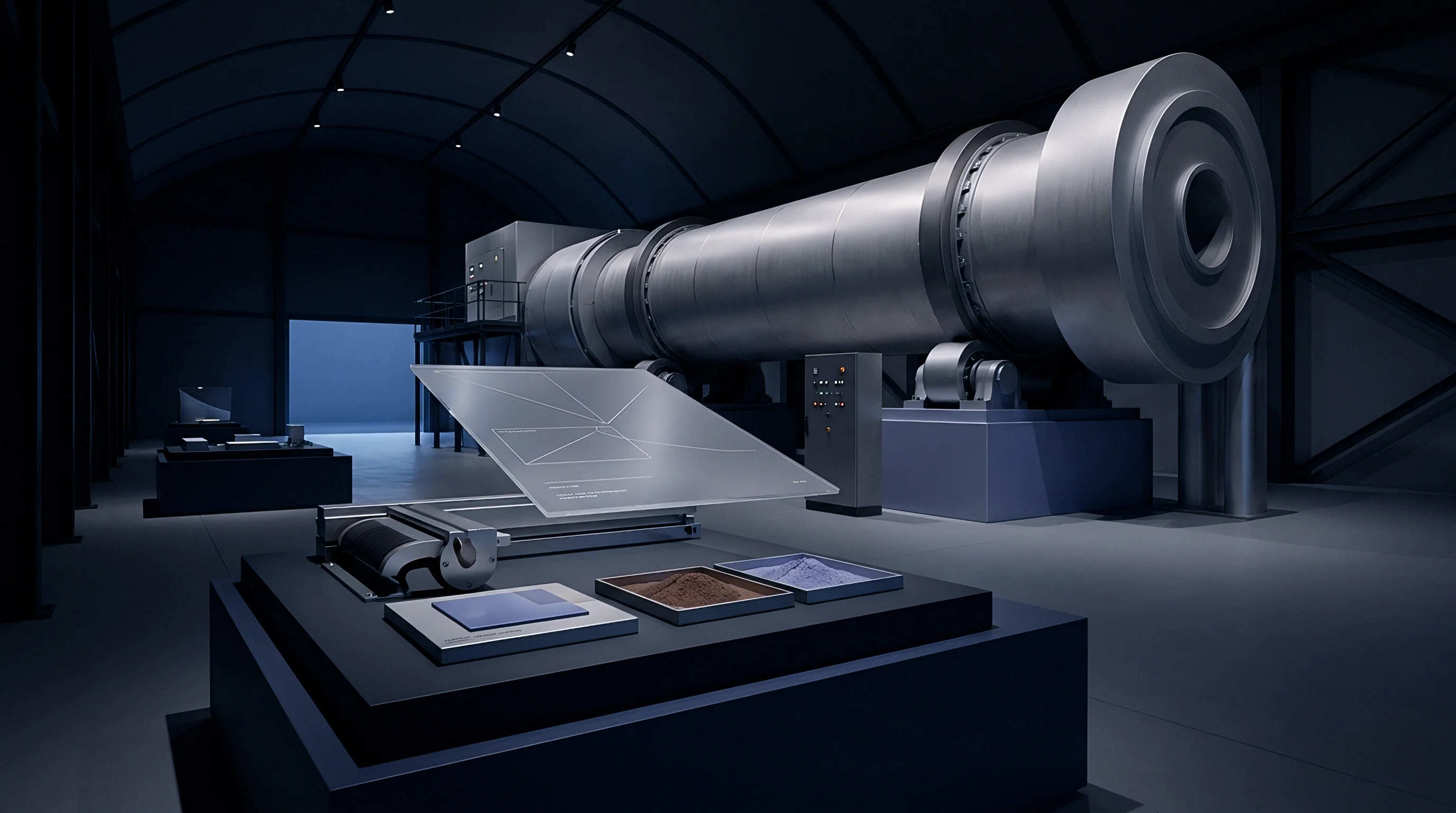
Gas-solid contact dynamics inside fluidization columns set the local thermodynamic environment for active material precursors. The ratio between minimum fluidization velocity and entrainment thresholds determines whether powder particles stay suspended in a homogeneous emulsion or coalesce into fast-rising gas bubbles. These bubbling regimes create spatial variations in reactant concentration, causing oxygen-rich gas to bypass the dense emulsion phase where most powder particles sit.
Keeping the solid phase turning over continuously requires balancing gas velocity against particle diameter and powder density so local stagnant zones do not form.
Fluidization Gas Mechanics and Local Partial Pressure Gradients
Direct gas injection at the distribution plate creates localized shear that breaks precursor agglomerates down into discrete primary crystallites. Within dense fluidization zones, oxygen partial pressure drops rapidly as decomposing hydroxide or carbonate precursors consume free oxygen. Transition metal ions absorb oxygen directly from the surrounding gas stream to oxidize into their target crystal states.
If gas mixing cannot match stoichiometric oxidation kinetics, localized oxygen starvation pockets form around particle clusters.
Oxygen partial pressure gradients along the vertical axis of a fluidized reaction column alter the local chemical potential of the solid phase. Near the bottom gas inlet, oxygen partial pressure stays close to the feed concentration ~ typically maintained between 0.21 bar and 1.00 bar depending on process design. By the time gas travels up through a two-meter powder bed, chemical consumption and dilution from off-gassed water vapor or carbon dioxide reduce the effective oxygen partial pressure below 0.05 bar.
Powder circulating through these depleted zones undergoes surface phase reduction, forming localized rock-salt phases that diminish ultimate discharge capacity.
- Establish continuous fluidization using pure nitrogen purge gas while heating the reactor bed to an initial temperature of 350°C.
- Introduce reactive oxygen gas at a step rate of 5 percent volumetric increments until reaching the target partial pressure ratio of 0.30 bar.
- Increase gas superficial velocity to 1.5 times the minimum fluidization threshold to ensure homogenous bubble distribution across the lower plenum.
- Monitor exhaust gas composition via mass spectrometry to verify that carbon dioxide degassing rates drop below 10 parts per million before raising temperature to final calcination limits.
- Adjust oxygen injection valves dynamically to offset oxygen depletion caused by high-nickel transition metal oxidation during thermal soak cycles.

Bubble Phase Mass Transfer Coefficients across Powder Columns
Mass transfer between the interstitial gas phase and suspended precursor solids limits reaction rates in large-scale columns. Interstitial gas renewal relies on the interchange coefficient between gas bubbles and the surrounding emulsion phase. Keeping bubble diameters below 25 millimeters through acoustic vibration or internal mesh baffles increases the interfacial surface area available for oxygen diffusion into particle pores.
Larger bubbles rise too fast, carrying unreacted oxygen out of the furnace exhaust while leaving dense emulsion zones deficient in oxidizing gas.
At 850°C under fluidized conditions, oxygen partial pressures below 0.15 bar trigger lithium oxide vapor phase loss exceeding 1.8 percent by weight per hour.
Powder circulating through unevenly oxygenated beds exhibits batch-to-batch variations in crystal structure. Internal particle porosity alters internal diffusion pathways, producing steep oxygen concentration gradients inside individual secondary spherical particles ranging from 5 to 15 micrometers in diameter. Core regions of dense precursor spheres experience lower effective oxygen partial pressures than surface layers, leaving unreacted core structures after thermal processing.
Gas flow adjustments must match both particle internal porosity and bed-scale gas mixing rates to maintain uniform oxidation rates across the entire powder charge.
Fluidized reactor designs leave unresolved whether acoustic field assistance can eliminate gas channeling in sub-five-micrometer precursor powders without accelerating vessel wall erosion.
Lattice
Crystallographic stability in high-nickel layered oxide cathodes hinges on maintaining precise oxygen stoichiometry during thermal synthesis. Transition metal layers containing nickel, manganese, and cobalt require high oxygen chemical potential to stabilize nickel in the trivalent state. Lowering the partial pressure of oxygen during high-temperature processing forms oxygen vacancies inside the crystal framework.
Free oxygen vacancies promote transition metal migration, driving structural conversion from the active layered phase to inactive spinel or rock-salt structures.
Equilibrium Phase Boundaries for High Nickel Oxide Powders
Phase stability diagrams for high-nickel compositions show extreme sensitivity to atmospheric oxygen partial pressure above 700°C. For compositions containing 80 percent or greater nickel molar fractions, maintaining the layered alpha-sodium-ferrite structure requires oxygen partial pressures above 0.20 bar at 750°C. Lowering oxygen partial pressure shifts thermodynamic equilibrium toward nickel oxide rock-salt phase formation. This phase transition releases lattice oxygen into the gas phase, permanently reducing the theoretical capacity of the active material.
Higher temperatures accelerate structural phase breakdown unless offset by proportional increases in system oxygen partial pressure. Calcination runs conducted at 850°C under atmospheric air, where oxygen partial pressure equals 0.21 bar, produce measurable nickel disorder in materials containing 90 percent nickel. Operating under pure oxygen atmospheres near 1.00 bar expands the thermal stability window up to 880°C, accelerating crystal growth while suppressing rock-salt phase formation.
Gas pressure control functions as the primary operational variable governing crystal phase purity.
| Cathode Chemistry Class | Target Calcination Temp (°C) | Min Equilibrium pO₂ (bar) | Stable Phase Space | Decomposition Phase at Low pO₂ |
|---|---|---|---|---|
| LiNi0.6Mn0.2Co0.2O2 (NMC622) | 860 to 900 | 0.05 | R-3m Layered Oxide | Fm-3m Rock-salt + Spinel |
| LiNi0.8Mn0.1Co0.1O2 (NMC811) | 760 to 800 | 0.21 | R-3m Layered Oxide | Fm-3m NiO-like Rock-salt |
| LiNi0.90Co0.05Mn0.05O2 (NCM90) | 720 to 750 | 0.60 | R-3m Layered Oxide | Fm-3m NiO-like Rock-salt |
| LiFePO4 (LFP Carbon-coated) | 650 to 720 | 1.0e-12 | Pnma Olivine Structure | Fe2O3 + Li4P2O7 Impurities |
| LiNi0.5Mn1.5O4 (LNMO Spinel) | 850 to 900 | 0.10 | Fd-3m Spinel Structure | Rock-salt + Oxygen Vacancies |

Oxygen Potential Curves for Cation Ordering Transitions
Cation mixing rates correlate directly with local oxygen partial pressure during the final thermal soak phase. Divalent nickel ions, possessing an ionic radius close to lithium ions, tend to occupy lithium sites within the crystal layers whenever oxygen vacancies exist. Oxygen-rich atmospheres maintain nickel ions in the smaller trivalent state, preventing migration into lithium layer positions.
High lithium-site occupancy by nickel ions restricts lithium-ion diffusion pathways, increasing initial cell direct current internal resistance.
- Oxygen Vacancy Aggregation lowers the activation energy required for transition metal migration into alkali layers, destabilizing the crystal lattice.
- Rock Salt Surface Layering forms an electronically insulating barrier on particle surfaces, increasing charge-transfer resistance across the solid-electrolyte interphase.
- Spinel Phase Transformation creates irreversible capacity loss during early cycling by pinning crystallographic planes against reversible lithium insertion.
- Lattice Oxygen Evolution generates micro-cracks along primary grain boundaries during high-temperature processing, accelerating cell capacity fade under fast-charging protocols.
Oxygen potential curves dictate the exact gas composition required at every stage of the heating profile. Early stage processing below 500°C demands moderate oxygen partial pressures to burn off organic binders and residual precursor counter-ions. High-temperature sintering above 700°C demands peak oxygen partial pressures to preserve nickel oxidation states.
Cool-down cycles require sustained high oxygen partial pressure until the powder bed drops below 400°C to prevent surface re-reduction of active crystallites.
Atmospheric control systems maintaining oxygen partial pressures above target thermodynamic limits ensure consistent structural phase purity across high-nickel powder batches.
Control
Monitoring oxygen partial pressure inside continuous fluidized bed reactors requires high-frequency gas sampling systems capable of operating in caustic, high-temperature gas environments. Exhaust streams carry volatile alkali species, fine precursor dust, and corrosive decomposition gases that degrade standard analytical instrumentation. Sample extraction loops must remove particulate matter and condense corrosive vapors without altering the oxygen partial pressure of the sampled gas stream.
Sensor placement within the reactor vessel determines the lag time between atmosphere shifts and control valve responses.
Does High Gas Velocity Shift Oxygen Boundary Layers?
Superficial gas velocity directly impacts boundary layer thickness surrounding individual precursor particles inside the bed. Higher gas velocities compress the stagnant boundary layer, increasing mass transfer coefficients and accelerating oxygen exchange between the bulk gas phase and particle surfaces. Compression of this layer prevents localized oxygen depletion at particle interfaces, maintaining stable oxidation conditions even during rapid exothermic decomposition reactions.
Gas velocity management works alongside partial pressure tuning to optimize surface reaction rates.
| Sensor Technology Type | Response Time (t90) | Operating Temperature Range (°C) | Sensitivity Drift (% per month) | Vapor Poisoning Vulnerability |
|---|---|---|---|---|
| Zirconia Ceramic Cell | Less than 1.5 seconds | 600 to 1000 direct | 0.8 | High to Alkali / Fluorine Vapors |
| Paramagnetic Analyzer | 3.0 to 8.0 seconds | 15 to 50 extractive | 0.2 | Low (requires gas conditioning) |
| Tunable Diode Laser (TDLAS) | Less than 0.5 seconds | 15 to 800 in-situ | 0.05 | Zero (optical non-contact) |
Zirconia Sensor Drift Profiles in Fluorine and Alkali Vapors
Zirconia-based oxygen sensors deployed directly in reaction zones experience signal drift as trace alkali metals deposit on solid electrolyte membranes. Vaporized lithium species react with yttria-stabilized zirconia ceramics at temperatures above 700°C, altering reference electrode potentials and skewing partial pressure readings. Calibration schedules must account for this drift to avoid operating the furnace under unrecognized oxygen-deficient conditions.
Extractive sampling systems with sample gas washing steps provide higher stability at the cost of measurement time lag.
UN 38.3 thermal stability qualification fails when active material exhibits more than two percent structural nickel disorder from oxygen-deficient calcination.
Closed-loop control architectures use differential oxygen feedback to regulate gas mixing stations supplying the fluidization plenum. Mass flow controllers adjust oxygen and inert carrier gas ratios dynamically based on real-time downstream sensor data. Pressure transducers monitor bed differential pressure to detect gas channeling or particle agglomeration events that distort local partial pressure distributions.
Automated safety valves trigger inert gas flushes if oxygen partial pressures exceed safe operational thresholds during volatile off-gassing phases.
Failing to maintain oxygen partial pressure within prescribed process windows yields structural phase degradation, resulting in the rejection of entire powder batches at incoming quality inspection.
Mass
Volatilization of lithium species during fluidized bed calcination alters the stoichiometry of the final active powder. High gas flow rates sweep volatile lithium hydroxide and lithium oxide vapors out of the reactor vessel into gas scrubbers. The rate of alkali vaporization scales with operating temperature, gas superficial velocity, and system oxygen partial pressure.
Suppressing lithium volatilization requires managing gas phase equilibrium reactions while maintaining sufficient oxygen to stabilize transition metal crystal structures.
Alkali Vaporization Rates in Oxygen Enriched Gas Streams
Temperature accelerates lithium vapor pressure exponentially above 750°C. In gas streams containing high water vapor concentrations from precursor decomposition, lithium hydroxide forms the primary volatile gas species. Elevating oxygen partial pressure suppresses the dissociation of solid lithium oxide into volatile metallic lithium species, shifting the vapor-liquid equilibrium toward stable solid phase compounds. Fluidized bed processes must balance gas purge rates to remove water vapor while minimizing the total volume of gas passing through the heated powder bed.
Mass transport calculations establish the operational bounds for fluidization gas velocity and oxygen concentration. Consider a 500-kilogram batch of high-nickel cathode precursor undergoing calcination at 780°C inside a two-meter diameter fluidized bed reactor. Assume a superficial gas velocity of 0.35 meters per second, a total system pressure of 1.05 bar, and an initial gas composition of 80 percent oxygen and 20 percent argon.
Process stoichiometry indicates that converting the hydroxide precursor to layered oxide consumes 18.2 Normal cubic meters of pure oxygen gas per hour.
At an oxygen partial pressure of 0.84 bar, the equilibrium vapor pressure of lithium species equals 1.2e-4 bar. Under these gas flow conditions, the mass transfer rate of lithium out of the solid powder bed reaches 42 grams of lithium metal equivalent per hour. Lowering the oxygen partial pressure to 0.21 bar while keeping total flow velocity constant increases the equilibrium lithium vapor pressure to 4.8e-4 bar, elevating the lithium loss rate to 168 grams per hour.
Over an eight-hour thermal soak period, this partial pressure drop results in a cumulative loss of 1.34 kilograms of lithium, shifting the final lithium-to-transition-metal ratio below specification limits.
- Superficial Velocity Matching balances bed expansion requirements against gas-entrained volatilization mass transfer coefficients.
- Water Vapor Evacuation Rate dictates the minimum purge flow required before raising bed temperatures above the alkali vaporization threshold.
- Oxygen Partial Pressure Floor defines the minimum chemical potential needed to prevent free alkali dissociation in the gas phase.
- Particle Entrainment Limits determine maximum allowable gas velocity to prevent raw precursor losses to downstream cyclone separators.
Mass Balance Equations for Fluidized Powder Calcination
Powder elutriation adds complexity to system mass balance calculations. Fine particles produced by mechanical friction inside the fluidized bed possess higher surface area to mass ratios, accelerating both oxygen uptake and alkali vaporization. Cyclones return elutriated fines to the lower bed zone, but prolonged thermal exposure in high-gas-velocity regions alters their chemical composition relative to bulk powder.
Gas-to-solid mass ratios must be calculated continuously to account for changes in particle size distribution throughout the calcination cycle.
High fluidization velocities lower boundary gas thermal impedance while accelerating volatile alkali escape.
Excess gas velocities are often necessary to prevent bed agglomeration despite the resulting high rates of alkali loss.
Impurities
Sub-optimal oxygen partial pressures during thermal processing generate microscopic defects that undermine long-term electrochemical performance. Cation disorder, where nickel ions occupy lithium crystallographic sites, directly blocks the one-dimensional diffusion channels required for fast lithium insertion and extraction. Non-stoichiometric oxygen conditions also leave unreacted surface bases, primarily lithium carbonate and lithium hydroxide, on finished particle surfaces.
Surface bases react with electrolyte salts during cell operation, generating gas and causing pouch cell swelling.
Anti Site Disorder and Cation Mixing Kinetics
Nickel anti-site defect concentration correlates with the partial pressure of oxygen maintained during sintering. X-ray diffraction analysis demonstrates that decreasing oxygen partial pressure from 0.90 bar to 0.21 bar during NCM90 synthesis increases nickel-lithium anti-site disorder from 1.2 percent to 3.8 percent of total alkali sites. Anti-site nickel ions act as structural pillars that prevent complete lattice contraction during deep discharge, but their presence dramatically lowers lithium-ion diffusion coefficients from 1.0e-10 square centimeters per second down to 2.5e-12 square centimeters per second.
High anti-site disorder manifests electrochemically as large voltage polarization and reduced initial coulombic efficiency. Cells built with high-disorder powders exhibit rapid impedance growth during thermal cycling due to localized crystal lattice breakdown under high operating voltages. Oxygen-rich synthesis environments ensure complete oxidation of divalent nickel to trivalent nickel, suppressing the driving force for anti-site defect formation.
| pO₂ Processing Level (bar) | Ni²⁺/Li⁺ Anti-Site Disorder (%) | Residual Base Li₂CO₃ (wt%) | First Cycle Efficiency (%) | 1000-Cycle Retention (Full Cell) |
|---|---|---|---|---|
| 1.00 (Pure Oxygen) | 0.8 to 1.1 | 0.12 | 89.4 | 86.2% at 1C/1C |
| 0.60 (Enriched Gas) | 1.4 to 1.8 | 0.25 | 88.1 | 82.5% at 1C/1C |
| 0.21 (Atmospheric Air) | 3.5 to 4.2 | 0.58 | 84.2 | 71.0% at 1C/1C |
| 0.05 (Oxygen Deficient) | 6.8 to 8.5 | 1.15 | 76.5 | 48.3% at 1C/1C |
Residual Surface Base Levels in Finished Active Powder
Unreacted lithium compounds on particle surfaces reflect incomplete solid-state reaction kinetics under improper oxygen atmospheres. When oxygen partial pressure drops below equilibrium limits, transition metal oxides fail to integrate available lithium species into the layered lattice, leaving excess lithium on particle exteriors. Surface lithium compounds absorb atmospheric moisture and carbon dioxide during ambient storage, forming thick insulating layers of lithium carbonate.
High surface base content demands intensive water washing post-calcination, which adds manufacturing cost and introduces surface lattice degradation.
- Continuous Atmosphere Log Data documenting localized oxygen partial pressure, bed temperature, and gas superficial velocity at five-minute intervals.
- Rietveld Refinement Certificates verifying nickel-lithium anti-site disorder levels remain below 1.5 percent for high-nickel material lots.
- Residual Base Titration Reports confirming soluble surface lithium carbonate levels do not exceed 0.20 percent by weight.
- Particle Size Distribution Analyses demonstrating zero thermal agglomeration or fines generation resulting from poor fluidization mechanics.
Standard quality specifications mandate that active material supply contracts include explicit limits on surface basicity and structural phase purity verified by high-resolution laboratory diffraction instruments.
Dossier
Establishing commercial specifications for fluidized bed material synthesis requires translating thermodynamic partial pressure boundaries into enforceable technical supply agreements. Material procurement contracts must establish operational parameters for furnace gas delivery systems, including gas purity levels, mass flow control tolerances, and inline analytical verification methods. Cell manufacturers signing multi-year powder off-take agreements attach strict penalty clauses to batch deviations from established thermal and atmospheric process logs.
Specification Boundaries for Atmosphere Control in Supply Contracts
Purchasing agreements define acceptable operational envelopes for oxygen concentration rather than specifying nominal target values alone. A contract line item may mandate maintaining oxygen partial pressure at 0.80 bar with an allowable tolerance of plus or minus 0.02 bar throughout the thermal soak phase. Deviations exceeding three minutes trigger mandatory batch segregation and secondary electrochemical testing at the supplier expense.
Precision atmosphere control requirements shift technical risk from the cell integrator back to the cathode material refiner.
Gas supply infrastructure investments form a substantial component of non-recurring engineering costs in fluidized bed calcination plant construction. High-nickel powder production requires dedicated cryogenic liquid oxygen storage, high-pressure vaporizers, and gas recirculation systems designed to recover unreacted oxygen. Procurement audits evaluate supplier gas infrastructure capacity to verify that backup supply loops can maintain design oxygen partial pressures during main supply system failures.
Sourcing Verification for Fluidized Bed Material Thermal Logs
Material qualification protocols demand complete transparency into historical furnace operational data. Quality assurance teams analyze continuous sensor logs from every calcination run, looking for localized oxygen starvation events caused by fluidization gas supply pressure drops. Automated data auditing algorithms flag suspicious data patterns, such as frozen sensor signals or uncalibrated signal drift, before batches receive final quality release stamps.
Technical dossiers without complete verified atmosphere records are rejected at incoming inspection docks.
Battery cell warranties shift financial liability to material refiners whenever raw cathode powders violate oxygen stoichiometry thresholds.
Verification procedures extend to physical validation of incoming powder shipments via destructive and non-destructive laboratory testing. Cell manufacturers cross-reference supplier-provided batch dossiers against independent measurements of crystal lattice parameters, surface base concentrations, and coin-cell rate capability metrics. Statistical process control charts track lot-to-lot consistency over extended production runs, identifying process drift before material variations degrade full-scale pack assembly yields.
Rigorous analytical verification forms the boundary between theoretical chemical limits and commercial cell manufacturing success.