Argon Entrapment Mitigation in Additive Manufacturing Powders
Argon trapped in atomized powders survives melt-pool consolidation and causes post-HIP thermal pore regrowth unless mitigated by PREP or tight ppm limits.
High-velocity supersonic jets break a molten alloy stream into spherical droplets during inert gas atomization. Beneath the delivery nozzle, melt turbulence generates toroidal circulation eddies that cause local static pressure to drop sharply. Atomizing gas is drawn into the core of the tearing liquid sheets as ligaments pinch and bags shear apart, sealing gas pockets inside the molten droplets before they can spheroidize.
Because droplet surfaces cool at rates exceeding 100,000 Kelvin per second, rapid solidification freezes these packets in place. The resulting thirty to sixty micron particles contain closed internal cavities without surface vents, allowing the hollow spheres to pass directly through mechanical sieves.
Cross-sectional inspection shows that closed cavities distribute unevenly across size cuts. Fractions below twenty microns yield few hollow particles because capillary pressure driven by high surface energy resists internal expansion, while cuts between forty-five and one hundred and six microns trap the highest volume fraction of sealed gas. In-flight collisions in the atomization tower compound the problem by welding satellites onto larger host spheres, trapping annular pockets along fusion boundaries to create subsurface voids that make it through cyclone separation intact.
ASTM F3049 governs feedstock characterization procedures that document internal particle voids across virgin and recycled metal fractions.
Titanium and nickel-base alloys retain entrained argon because of their rapid liquidus-to-solidus transitions. At 1670 degrees Celsius, molten titanium readily absorbs nitrogen and oxygen interstitially, but noble gases exhibit no chemical affinity for transition metals and cannot fit into the crystal lattice. Surface tension contracts the liquid sphere around the pressurized bubble until viscous resistance halts wall thinning, leaving internal gas pressures within solidified powder particles to equilibrate between two and eight atmospheres at room temperature.
Aerodynamic Breakdown in Gas Streams
Disruption of the melt column runs through distinct hydrodynamic regimes dictated by the Weber and Ohnesorge numbers. Discrete convergent-divergent jets discharge gas at Mach 2.2 under delivery pressures of 2.5 to 4.5 megapascals. While melt viscosity resists deformation, interfacial shear draws the stream into thin sheets until dynamic pressure overtakes surface tension, triggering bag breakup.
As these membranes expand downstream into hollow envelopes filled with atomizing gas, Rayleigh-Plateau instabilities pull the bursting fragment edges into rims, sealing pockets of process gas inside the coalescing droplets.
| Breakup Mode | Gas Weber Number Range | Local Droplet Size (µm) | Gas Entrapment Mechanism | Internal Pore Frequency (%) |
|---|---|---|---|---|
| Rayleigh Capillary | We < 12 | 120 to 250 | Primary ligament detachment | 0.08 to 0.20 |
| Bag Breakup | 12 < We < 50 | 45 to 105 | Membrane burst and rim coalescence | 3.80 to 7.20 |
| Multimode Shear | 50 < We < 350 | 20 to 65 | Toroidal vortex suction at melt tip | 1.40 to 3.10 |
| Catastrophic Stripping | We > 350 | 5 to 25 | Shock boundary shear strip | 0.02 to 0.15 |
Atomizers run campaigns with gas-to-metal mass ratios typically between 1.5 and 3.8. Raising this ratio yields finer powder by intensifying kinetic shear across the plume, but it also strengthens the sub-atmospheric recirculation that draws gas back toward the tip of the melt delivery tube. In this stagnation zone, metal vapor condensates mix with entrained argon.
Droplets sweeping through the turbulence sweep up micro-bubbles of argon before ever clearing the spray chamber.

Melt
Laser powder bed fusion applies energy densities between 50 and 120 Joules per cubic millimeter to melt the spread powder bed. When the beam liquefies host particles and their internal voids, Marangoni convection drives fluid velocities across the melt pool at up to four meters per second. Where surface tension falls with temperature, the melt sweeps radially outward along thermal gradients, dragging insoluble argon micro-bubbles into the convective flow.
While buoyancy lifts sub-micron bubbles at only millimeters per second, solidification fronts advance at up to one meter per second, frequently freezing them in place before they reach the surface.
Keyhole-mode welding worsens void formation when peak irradiance vaporizes alloy constituents, driving recoil pressures high enough to punch a deep vapor depression into the pool. Collapse of that cavity traps ambient build-chamber argon alongside whatever gas the powder already held. Operating in conduction mode avoids keyhole collapse, but it leaves feedstock voids untouched; inside the pool, Brownian motion and convective collisions merge smaller bubbles into larger spheres that eventually strike the advancing solid-liquid interface.

Fluid Streamlines inside Track Pools
Thermal gradients dictate the velocity fields within the molten pool. Depending on surface-active elements such as sulfur or oxygen, the temperature coefficient of surface tension drives either inward or outward shear. A positive coefficient turns the flow downward beneath the beam, carrying trapped argon straight toward the root of the weld track, whereas a negative coefficient sweeps fluid toward the edges where freezing walls lock micro-voids into position.
Even though track overlaps remelt sixty percent of adjacent passes, this remelting merely redistributes gas bubbles through the liquid phase rather than venting them to the chamber.
| Bubble Diameter (µm) | Terminal Rise Velocity (mm/s) | Solidification Capture Distance (µm) | Survival Probability in L-PBF |
|---|---|---|---|
| 1.0 | 0.003 | 45 | 0.99 |
| 5.0 | 0.076 | 45 | 0.94 |
| 15.0 | 0.685 | 45 | 0.72 |
| 35.0 | 3.720 | 45 | 0.38 |
| 60.0 | 10.950 | 45 | 0.12 |
Once frozen into the track, trapped argon pockets remain distinctly spherical, with smooth interior surfaces and sphericity coefficients above 0.88 that distinguish them from irregular lack-of-fusion defects packed with unmolten powder. Rapid solidification curtails Ostwald ripening while the track forms, leaving fine micropores scattered through grain interiors and along dendrite arms where bulk gas analysis can track differences from one powder lot to another.
Do Hatch Spacing Variations Release Trapped Inclusions?
Adjusting hatch spacing alters both track overlap and thermal accumulation. Tighter spacing widens the remelt zone and subjects earlier passes to repeated heat cycles, lowering local melt viscosity and extending liquid lifetimes by several hundred microseconds. Even so, the laser passes before bubbles can rise through the melt depth.
Closer tracks also raise cumulative heat input, increasing the risk of keyhole instability that pulls fresh chamber gas into the melt. Conversely, high scan speeds elongate the pool tail and trap rising bubbles against steep solidification angles, so hasty parameter changes often multiply porosity across the component rather than clearing it.
Powder lots carrying high volumes of entrapped gas directly degrade high-cycle fatigue life in finished components, acting as initiation sites for premature subsurface cracking under cyclic tensile loads.

Regrowth
Hot isostatic pressing closes internal porosity through creep deformation and solid-state diffusion, applying pressures between 100 and 150 megapascals at 900 to 1180 degrees Celsius. Once compressive stresses exceed the yield point of the alloy at temperature, plastic flow collapses empty voids and brings opposing surfaces into atomic contact, sintering vacuum pores shut. Argon-filled pores respond differently.
Because the inert gas cannot dissolve into the metal lattice, it simply compresses elastically as the void shrinks around it.
Internal pressure rises to equilibrate with the autoclave at temperature. Compressing a pore from thirty microns to three increases its internal gas density a thousandfold, leaving the gas sealed in a microscopic cavity under gigapascal stresses once cooled to room temperature. As-hipped parts routinely exceed 99.9 percent density in mechanical tests, and standard Archimedes immersion measurements will indicate near-theoretical density across test specimens.
A component exposed to 1050 degrees Celsius for four hours following hot isostatic pressing demonstrates pore area fraction increases from 0.02 percent to 0.45 percent.
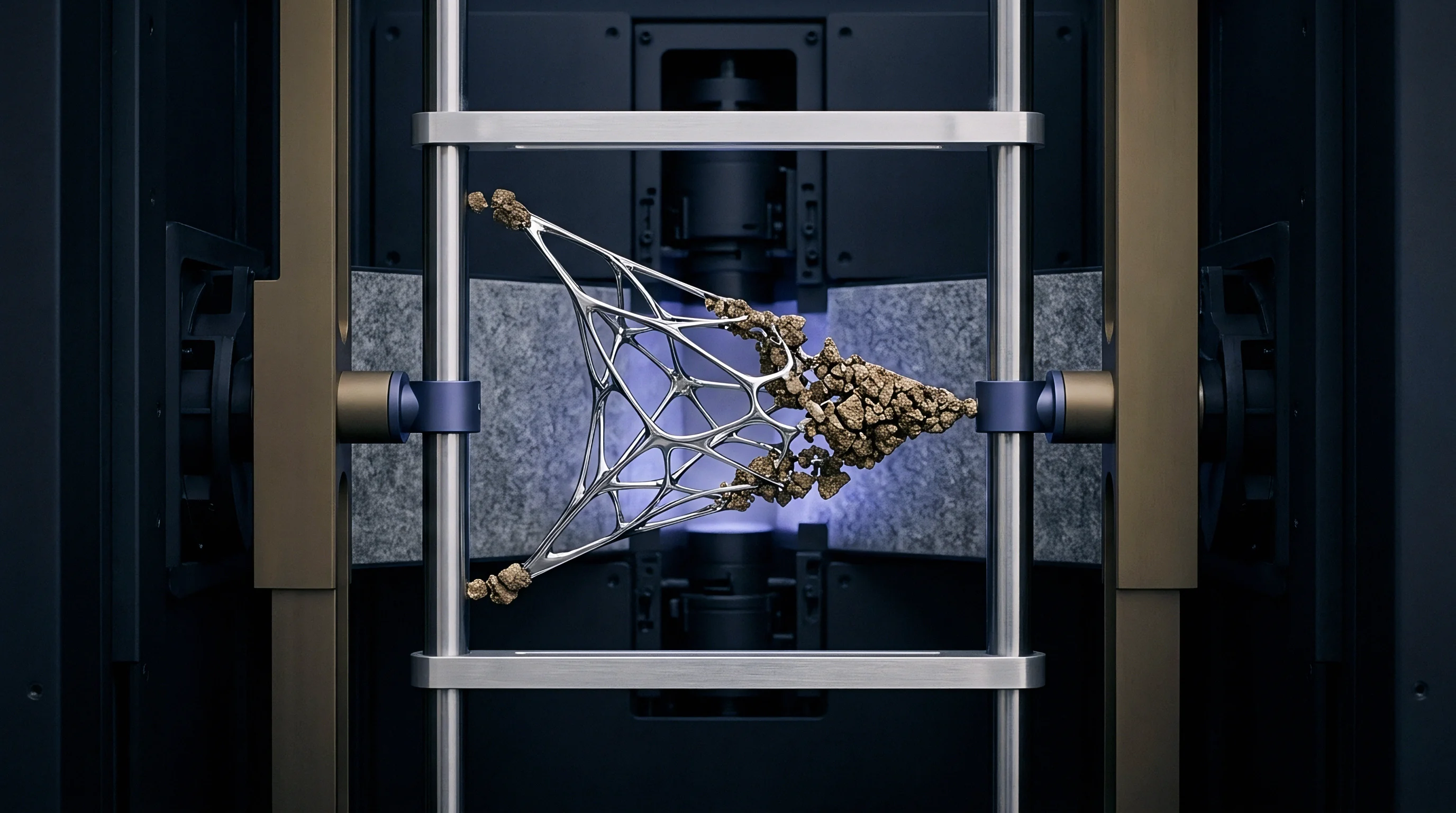
Subsequent thermal cycles release the strain energy stored within these compressed cavities. During solution annealing, homogenization, or stress relief, parts encounter high temperatures without external containment pressure. As lattice mobility rises and matrix yield strength drops, the pressurized argon drives vacancy diffusion from nearby grain boundaries toward the cavity walls, swelling void volume until internal gas pressure drops back into balance with the creep strength of the alloy.
This thermally induced porosity often emerges only after finish machining.

Does Hot Isostatic Pressing Eliminate Entrapped Argon?
Autoclaving shrinks void dimensions without altering the mass of inert gas trapped inside the part. Because that gas inventory remains constant across compaction cycles, reducing void volume simply packs atoms into tighter spaces, leaving them primed to drive creep cavitation along grain boundaries during subsequent heating:
- Mechanical Equilibrium Dissolution occurs when chamber pressure vents to atmosphere while the metal cools, freezing severe internal pressures inside the shrunken cavities.
- Thermal Yield Reduction softens the surrounding matrix as temperatures surpass 0.6 of the homologous melting point during subsequent heat treatments.
- Vacancy Flux Migration channels vacancies from grain boundaries toward high-energy cavity surfaces, driven by internal gas pressure gradients.
- Cavity Boundary Swelling dilates the void boundary past its pre-compaction dimensions, leaving rounded microscopic pores visible on polished cross-sections.
- Microstructural Rupture Interconnection bridges neighboring grain-boundary bubbles under sustained service loads, opening macroscopic creep fissures.
Brittle fractures follow these pathways, with thermally induced voids concentrating along high-angle grain boundaries in nickel-base alloys. In specimens subject to pore regrowth, creep-rupture life at 650 degrees Celsius falls by seventy percent compared to material made from gas-free powder, as plastic strain localizes along ligaments between voids that standard density checks overlook. It remains an open micromechanical question what critical vacancy threshold triggers spontaneous cavity growth at operating temperatures below standard solution treatment levels.
Process
Alternative atomization routes avoid inert gas encapsulation during breakup altogether. Vacuum induction melting with inert gas atomization remains widespread, but processes that replace argon with soluble gases or eliminate fluid impingement keep feedstocks free of bubble pickup. In rotating electrode systems, bar stock is melted with electric arcs or plasma torches without pneumatic gas jets; centrifugal force hurls the molten film outward across the perimeter of the spinning bar, thinning the sheet until it breaks cleanly into droplets within a vacuum or low-pressure helium chamber.
Powders produced by plasma rotating electrode systems contain no internal gas pockets. Droplets spheroidize and solidify in flight without passing through turbulent recirculation eddies, yielding cross-sections entirely free of internal hollows under optical microscopy. Size distributions lean coarser than those from gas atomization, typically between forty-five and one hundred and fifty microns, and shifting that yield finer for laser powder bed fusion requires rotational speeds above twenty thousand revolutions per minute.
The ceramic-free melting arrangement also protects chemical purity while avoiding argon porosity entirely.
Alternative Melting Configurations
Electrode induction-melting gas atomization melts slowly rotating alloy rods in an induction coil without crucible contact, feeding the liquid stream straight into a high-pressure nozzle. Changing the gas species changes the physics of entrapment. Running atomizers on pure helium alters breakup dynamics because of helium’s lower density, higher sound velocity, and superior thermal conductivity.
With a sonic velocity nearly three times that of argon, helium delivers equivalent kinetic breakup energy at lower mass flow rates, while its sixty-fold higher thermal conductivity cools droplets before recirculation can swallow gas pockets.
| Atomization Technology | Process Gas Medium | Mean Particle Sphericity | Internal Porosity Volume (%) | Bulk Argon Content (ppm by weight) |
|---|---|---|---|---|
| VIGA (Standard) | Argon | 0.91 | 0.40 to 1.20 | 0.8 to 2.5 |
| EIGA (Optimized Nozzle) | Argon | 0.93 | 0.15 to 0.45 | 0.3 to 0.9 |
| EIGA (High Velocity) | Helium | 0.89 | 0.01 to 0.05 | < 0.05 |
| Plasma Atomization (PA) | Argon | 0.96 | 0.08 to 0.25 | 0.2 to 0.6 |
| PREP (Centrifugal) | Helium / Partial Vacuum | 0.98 | < 0.005 | < 0.01 |
Helium also diffuses through titanium alloys. Thanks to their small atomic radius, helium atoms migrate through interstitial lattice defects during prolonged heating, diffusing out through the surface of consolidated parts during annealing rather than driving pore inflation. The higher price of helium balances against scrap reductions on fracture-critical parts.
By contrast, post-atomization fluidized bed vacuum degassing can heat conventional powders below their sintering threshold to remove adsorbed moisture, but it leaves sealed internal cavities completely untouched.

Will Rotating Electrode Feedstocks Justify Their Premium?
Rotating electrode powders sell at three to five times the price of conventional gas-atomized lots, partly because yields under forty-five microns hover around twenty-five percent compared to roughly sixty percent for free-fall atomization. In aerospace and medical procurement, however, that initial premium balances against rejection rates on rotating turbine discs and structural airframe components where internal gas porosity cannot be tolerated. Downstream expenses for weld rework, post-HIP bubble swelling audits, and scrapped parts quickly erase the upfront savings of cheaper powder.
Mechanical grading routines remove irregular fines through air classification without affecting sealed hollows:
- Draw representative samples from three extraction depths inside sealed transfer drums using stainless-steel thief samplers.
- Dry powder fractions under a fifty millibar vacuum at eighty degrees Celsius to remove ambient surface moisture.
- Feed dried powder through an acoustic air-jet sieve stack to isolate fractions between fifteen and fifty-three microns.
- Run classified material through a counter-flow vertical elutriator, allowing lower-density hollow particles to float upward for separation.
- Pack dense fractions under high-purity argon containing less than five parts per million moisture and oxygen.
Separation efficiency in these systems depends directly on the density contrast between solid metal spheres and hollow particles.
Invoice
Feedstock purchase orders carry direct commercial liabilities tied to trace gas content, since inert gas levels in virgin powder drums correlate with void counts in finished builds. Conventional procurement specifications set strict thresholds for oxygen, nitrogen, hydrogen, and carbon while ignoring noble gases entirely. Chemical certificates routinely guarantee metallic purity above 99.5 percent without accounting for parts per million of entrapped argon, leaving buyers paying eighty dollars per kilogram for aerospace-grade Ti-6Al-4V holding unmeasured insoluble gas.
Procurement contracts establish boundary conditions for chemical acceptance.
Inert gas fusion paired with thermal desorption mass spectrometry measures total argon in bulk powder lots by melting samples inside graphite crucibles under ultra-pure carrier gas. Mass spectrometers calibrated against known argon leak standards detect residual levels down to 0.01 parts per million by weight. Where uncontaminated plasma rotating electrode powders register below 0.01 parts per million, standard gas-atomized lots typically run between 0.5 and 3.0 parts per million argon ~ an amount that introduces millions of micro-voids per kilogram of melted feedstock.
A lot containing more than 0.20 parts per million argon by weight generates rejectable fatigue scatter in rotating hardware.
Receiving inspections pair cross-sectional metallography with automated image analysis. Technicians mount, polish, and examine five thousand powder particles across multiple fields of view, using image analysis to calculate porosity percentages and flag spherical voids. In parallel, helium pycnometry benchmarks skeletal density against theoretical alloy values, exposing closed internal pores whenever skeletal readings fall short.
Lots exceeding allowable void limits trigger formal return authorizations and warranty claims against the atomizer.
Purchase Order Specifications
Procurement agreements set explicit limit metrics for noble gas content across metal additive manufacturing feedstocks:
- Noble Gas Quantification Thresholds cap argon content at 0.15 parts per million as measured by thermal desorption mass spectrometry on composite drum samples.
- Cross Section Void Fractions limit hollow particles to less than 0.3 percent across two thousand evaluated spheres between twenty and sixty-three microns.
- Thermally Induced Porosity Qualification requires witness coupons consolidated from candidate powder lots to undergo standard hot isostatic pressing followed by vacuum heating at 1050 degrees Celsius for four hours without exhibiting pore area increases greater than 0.05 percent.
- Lot Rejection Recourse Terms assign freight charges, testing laboratory fees, and full powder replacement liabilities to the atomizer whenever delivered material breaches specification.
Under Section 8.4 of AMS7015, feedstock suppliers must disclose the atomizing gas species and furnish thermal desorption gas test data upon request, placing financial responsibility for downstream porosity defects directly on the powder producer.