Nonlinear Creep Damage Parameter Extraction for AA3003 Coolant Plate Joints
Extracting AA3003 braze joint creep damage parameters requires DIC strain mapping under multiaxial stress to prevent premature cold plate fluid leakage.
Microstructure
Aluminum-manganese core sheet AA3003 relies on fine manganese aluminide dispersoids to suppress grain growth during high-temperature fluxless or controlled atmosphere brazing. Cooling plates in modern electric vehicle battery packs utilize clad sheet combinations, typically AA3003 paired with AA4045 or AA4343 silicon-rich cladding alloys. During thermal processing at temperatures between 590 °C and 610 °C, the cladding melts, flowing by capillary action into seam joints and channel fillets.
This process exposes the core material to elevated temperatures that alter its underlying crystal lattice, forming distinct grain topologies across the joint boundary.
Mechanical performance under long-term thermal dwell depends on the local distribution of intermetallic phases. Cold plate joints experience combined mechanical clamping forces, internal hydraulic pressure up to 0.4 MPa during peak coolant flow, and thermal cycling from -40 °C to +85 °C. Dispersoid-free zones form adjacent to the braze interface, creating local yield strength differentials. Strain accumulates preferentially within these softened zones under sustained mechanical load.
Brazing Metallurgy and Interphase Diffusion
Process temperatures exceeding 590 °C melt silicon-rich cladding while driving elemental exchange into the core metal. Silicon diffuses rapidly from the molten pool into the solid AA3003 matrix, interacting with iron and manganese to precipitate coarse alpha-phase intermetallics. These dense phase fields disrupt the uniform dispersion of sub-micron particles.
Recrystallization during the thermal braze cycle transforms the rolled strain-hardened grain structure of AA3003-H14 into an annealed, coarse equi-axed state. The average grain size increases from 15 micrometers to over 120 micrometers in the heat-affected zone. Coarse grains exhibit fewer grain boundary intersections per unit volume, increasing the effective stress borne by individual boundaries.
Grain boundary sliding accelerates at elevated temperatures, concentrating micro-strain at fillet radii.

Void Nucleation Mechanisms in Braze Fillets
Internal hydraulic pulses combined with thermal expansion mismatch induce localized shear strain along grain boundaries. Vacancy migration accelerates toward high-stress regions under isothermal dwell. Micro-voids nucleate at coarse iron-manganese-silicide intermetallic particles due to the stiffness mismatch between the rigid intermetallic phase and the ductile aluminum matrix.
Continued stress exposure causes these micro-voids to grow along grain boundaries oriented perpendicular to the maximum principal tensile stress. Void growth rates depend on local stress triaxiality and vacancy diffusion rates. In braze fillet geometries, geometric discontinuities create localized multiaxial stress fields, multiplying the effective strain rate compared to uniaxial laboratory coupon specimens.
- Silicon-depleted matrix softening occurs when silicon diffuses inward from the clad alloy, forming coarse intermetallic particles that strip solid-solution strength from adjacent aluminum grains.
- Grain boundary cavity coalescence develops along triple points under sustained internal hydraulic pressure at peak cooling temperatures.
- Heat-affected zone coarsening reduces local yield strength within three hundred micrometers of the fillet root.
- Interphase micro-cracking initiates along rigid iron-manganese-silicide plates when cyclic thermal stresses override local ductility limits.
Transient furnace temperature spikes fall within normal process windows and cannot account for accelerated joint deformation under static pressure testing.
Creep
Time-dependent plastic strain accumulation in AA3003 cold plates limits mechanical joint integrity during extended high-temperature coolant loops. At operating temperatures above 0.4 times the absolute melting point of aluminum (approximately 930 Kelvin), AA3003 exhibits measurable viscoplastic deformation even under stresses below its macroscopic yield strength. Pack thermal management designs must account for this continuous deformation to prevent structural degradation over a fifteen-year service life.
Constitutive Formulations for Secondary and Tertiary Dwell
Standard power-law equations model steady-state deformation rates accurately but fail to capture accelerating strain immediately preceding structural rupture. Phenomenological continuum damage mechanics incorporates a scalar damage variable, omega, which ranges from zero in the undamaged state to unity at complete structural separation. The Norton-Bailey power law models secondary creep strain rate as a function of effective stress, temperature, and material constants.
Kachanov-Rabotnov formulations modify the effective stress tensor by dividing by the factor one minus omega, representing the reduction in load-bearing cross-sectional area caused by internal micro-voids. The kinetic law of damage evolution couples damage accumulation rate directly to stress and current damage level. Extracting these non-linear parameters requires curve-fitting experimental strain-time histories recorded across multiple stress levels and thermal conditions.
AA3003 braze fillets tested under 25 MPa sustained shear stress at 95 °C reach tertiary strain acceleration within 420 thermal hours.

Arrhenius Thermal Scaling across Operating Windows
Activation energies governing dislocation climb in aluminum alloys range between 120 and 142 kilojoules per mole. Thermal scaling functions utilize an Arrhenius term to shift strain rate curves across different temperature regimes. Laboratory testing conducted at 120 °C accelerates strain accumulation, allowing engineers to extrapolate baseline damage parameters down to normal coolant operating temperatures of 65 °C.
| Temperature (°C) | Specimen Region | Stress Coefficient A (MPa^-n h^-1) | Stress Exponent n | Damage Exponent r | Activation Energy Q (kJ/mol) |
|---|---|---|---|---|---|
| 70 | Parent AA3003-H14 | 1.12e-14 | 4.2 | 3.8 | 131.5 |
| 70 | CAB Braze Fillet Zone | 4.85e-13 | 4.8 | 4.5 | 126.0 |
| 95 | Parent AA3003-H14 | 3.45e-12 | 4.3 | 3.9 | 131.5 |
| 95 | CAB Braze Fillet Zone | 1.92e-10 | 4.9 | 4.7 | 126.0 |
| 120 | Parent AA3003-H14 | 5.80e-10 | 4.5 | 4.0 | 131.5 |
| 120 | CAB Braze Fillet Zone | 2.41e-08 | 5.2 | 4.9 | 126.0 |
Extracted parameters demonstrate that the braze fillet zone exhibits an elevated stress exponent compared to the parent sheet material. This increase stems from localized microstructural inhomogeneities and silicon enrichment along the joint boundary. Consequently, strain accumulation accelerates rapidly within the joint fillet under high internal pressure loads.
Higher silicon content in the braze pool consistently reduces time to tertiary strain onset under elevated operating temperatures.
Solver
Finite element subroutines integrate coupled differential equations to map damage evolution across complex three-dimensional cold plate geometries. Commercial implicit solvers like Abaqus and ANSYS execute user-defined material subroutines, such as CREEP or UMAT, at every integration point within the mesh. Stable time incrementation algorithms balance computational efficiency against numerical convergence limits, especially when stiffness degradation rates increase near failure.
How Does Stress Multiaxiality Shift Triaxial Creep Exponents?
Hydrostatic tension within confined coolant channels accelerates void growth compared to uniaxial tension laboratory coupon data. Multiaxial stress states modify the equivalent creep damage potential through stress triaxiality ratios, defined as hydrostatic stress divided by von Mises equivalent stress. In stamped cooling channel joints, braze fillet roots experience stress triaxiality ratios exceeding 1.5, altering the localized void growth rate.
To capture these geometry-dependent effects, the damage evolution law incorporates Hayhurst multiaxial stress parameters. This extension weights the relative contributions of maximum principal stress, hydrostatic stress, and von Mises equivalent stress. Calibrating these weighting factors requires comparative testing between flat tensile coupons, notched bar specimens, and pressurized tube assemblies.

Parameter Identification through Non-Linear Least Squares Calibration
Optimization algorithms minimize the residual scalar distance between measured digital image correlation strain curves and finite element numerical outputs. The extraction process uses Levenberg-Marquardt or genetic optimization routines to solve for the material parameter vector containing the stress coefficient, stress exponent, damage coefficient, and damage exponent. Uniqueness of the extracted parameter set relies on evaluating data across multiple stress ratios simultaneously.
Finite element meshes around internal braze fillets require fine boundary layer density to prevent artificial strain localization during implicit time integration.
Parameter extraction follows a structured mathematical calibration sequence to ensure numerical stability and physical validity during long-term pack simulation runs.
- Execute primary tensile creep rupture tests on notched and unnotched joint specimens across three stress levels at peak coolant temperature.
- Process digital image correlation full-field strain fields to decouple primary strain hardening from secondary steady strain rates.
- Solve objective penalty functions via non-linear optimization algorithms to isolate stress sensitivity exponent n alongside damage exponent r.
- Import the extracted material parameter vector into implicit solver subroutines to verify mesh convergence against experimental burst tests.
Consider a calibration scenario for an AA3003 braze joint operating at 95 °C under a sustained local shear stress of 30 MPa. The experimental target yields an initial secondary strain rate of 1.25e-5 per hour and a time-to-rupture of 850 hours. The numerical objective minimizes the normalized error sum between predicted strain curves and optical strain measurements across five discrete time intervals.
Setting the stress exponent n to 4.9 forces the optimization solver to converge on a damage coefficient B of 2.15e-11 MPa^-k h^-1 and a damage exponent r of 4.7.
If the damage exponent r is underestimated by 15 percent, the implicit solver overpredicts joint lifetime by more than 350 thermal hours, leading to premature field failures.
Clause 6.4 of ISO 12100 mandates finite element stress validation under peak hydraulic shock loading, shifting certification liability to the pack enclosure engineering practice.
Bench
Experimental test rigs isolate mechanical pressure loads from ambient thermal fluctuations to collect high-fidelity deformation data. Testing AA3003 coolant plate joints requires custom environmental chambers integrated with optical access ports for non-contact strain measurement. Precise control of fluid pressure, ambient temperature, and mechanical boundary conditions prevents parasitic thermal expansion errors from corrupting the raw creep displacement signal.
Digital Image Correlation at Elevated Thermal Dwells
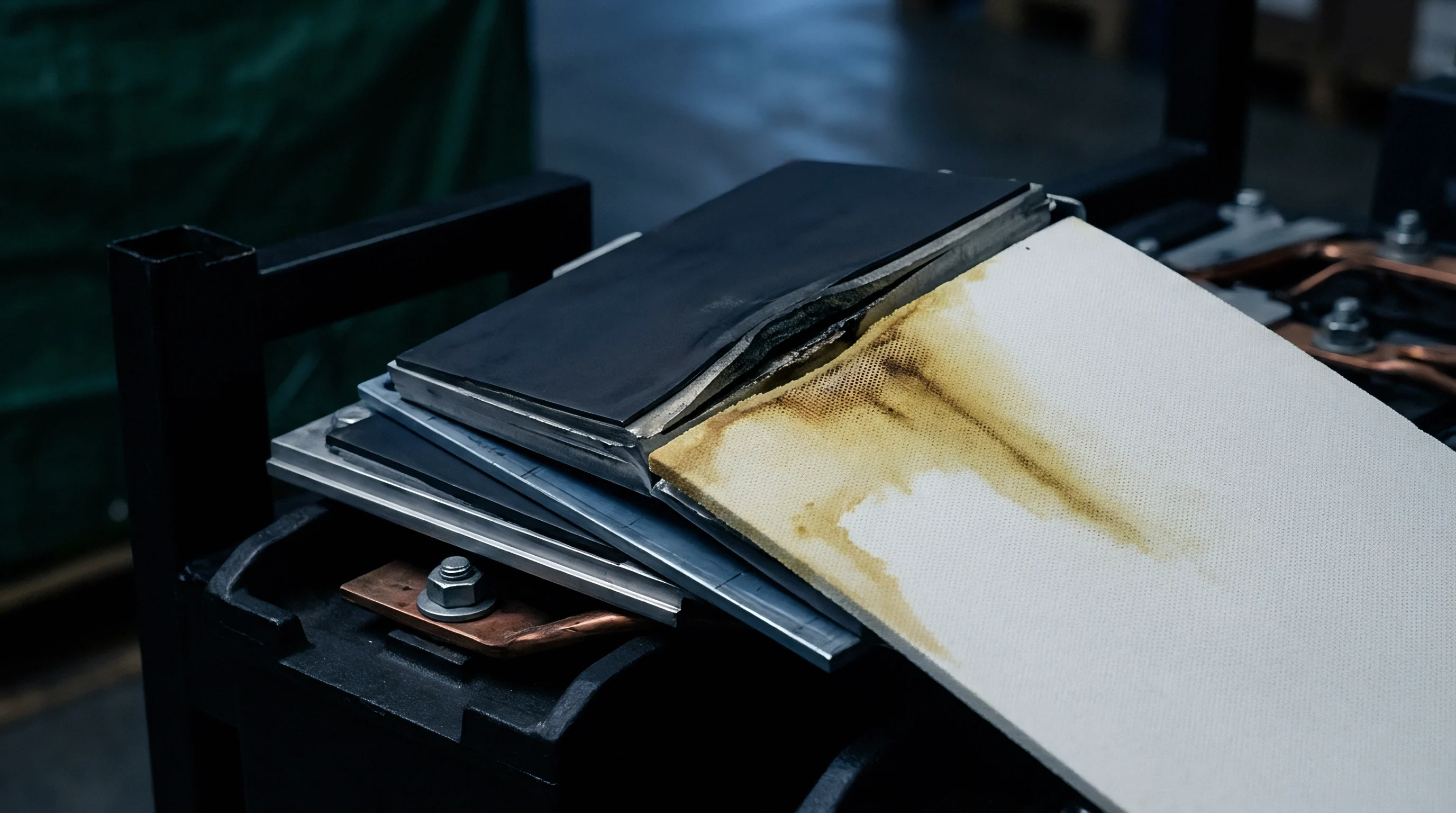
Optical cameras tracking high-contrast speckle patterns quantify localized strain gradients across three-millimeter braze overlap zones. High-temperature matte black speckle paint must withstand hundreds of thermal hours without flaking, blistering, or experiencing color degradation. Dual-camera three-dimensional optical systems compensate for out-of-plane thermal expansion movements of the cooling plate assembly during heating cycles.
Thermal optical turbulence inside environmental chambers distorts light pathways, introducing artificial noise into strain calculations. Environmental controls utilize active air-baffling systems and optical grade quartz glass windows to stabilize index-of-refraction variations across the field of view. Sub-pixel interpolation algorithms track speckle movement to achieve strain resolution down to fifty micro-strain.
Stress Relaxation and Stepped Dwell Test Schedules
Fixed-displacement loading frames measure load decay over time to decouple instantaneous plastic flow from time-dependent viscous deformation. Stepped load dwell schedules apply incremental stress steps to a single specimen, reducing total test matrix duration while gathering strain rate data across multiple stress states. Data processing routines convert stress relaxation decay rates directly into equivalent secondary strain rate curves.
| Formulation Model | Strain Components Captured | Parameter Count | Calibration Complexity | Computational Overhead |
|---|---|---|---|---|
| Norton-Bailey Power Law | Secondary creep strain rate | 3 | Low | Minimal |
| Kachanov-Rabotnov Damage Model | Secondary and tertiary strain acceleration | 5 | Moderate | Low to Moderate |
| Anand Viscoplastic Model | Strain hardening, rate dependency, dynamic recovery | 9 | High | Moderate |
| Chaboche Viscoplasticity with Damage | Kinematic hardening, cyclic creep, tertiary rupture | 12 | Very High | High |
GMW14337 coolant plate durability testing demands three thousand hours of pressure thermal cycling without measurable fluid micro-leakage.
High-precision optical benchmarking demands strict elimination of test setup artifacts that corrupt material parameter extraction routines.
- Heat haze refraction gradient alters optical path density when natural convection currents rise off heated cold plate surfaces.
- Speckle pattern degradation occurs as surface oxidation changes black paint emissivity during hundred-hour thermal exposure windows.
- Out-of-plane thermal expansion displacement introduces false axial strain values in single-camera two-dimensional digital image systems.
- Load cell thermal drift corrupts force transducers situated within environmental chambers lacking active water cooling.
Incorrect damage exponent extraction leads to unpredicted micro-channel braze separation, flooding battery module enclosures with glycol-water fluid and causing catastrophic electrical shorting across high-voltage busbars.
Warranty
Long-term liability agreements between pack integrators and cooling plate stampers rest on verified mechanical end-of-life predictions. When a cold plate braze joint separates in field service, fluid leakage compromises battery module electrical isolation, triggering module-level or pack-level replacement events.
Tooling Amortization and Joint Reliability Limits
Stamping die wear alters internal ridge geometry, shifting fillet radius dimensions by fifty micrometers over a fifty-thousand-unit production run. Variations in fillet radius directly change local stress concentration factors, multiplying strain accumulation rates in late-stage production parts. Quality agreements must bind joint durability predictions to upper and lower tolerance limits of the stamping die drawing.
Furnace braze quality varies across multi-zone belt furnaces due to local temperature gradients and flux density drift. First-article inspections confirm structural integrity on day one, but long-term creep damage parameters change if braze fillet cross-sectional areas shrink due to clad erosion.

Supplier Quality Verification Sign-Off Procedures
First-article inspections demand destructive shear testing paired with metallographic grain sizing across five furnace zones. Thermal pack buyers mandate that suppliers submit fully calibrated material subroutine input files alongside raw test data. Independent laboratory verification ensures that extracted parameters match production lot statistics before tooling amortization costs are cleared for high-volume manufacturing release.
Cooling plate joint fatigue failures during field operation trigger full module recall liability under automotive tier-one supply agreements.
Whether accelerated coupon-level creep parameter extraction reliably predicts ten-year structural durability under random vibration coupled with thermal coolant pressure pulses remains an open empirical question across the automotive pack integration industry.