Transverse Dynamic Shock Response in Powder Metallurgical Enclosures
Transverse shock in powder metallurgical battery enclosures drives brittle shear failure along low-density pore boundaries unless sintered density exceeds 7.3 g/cm³.
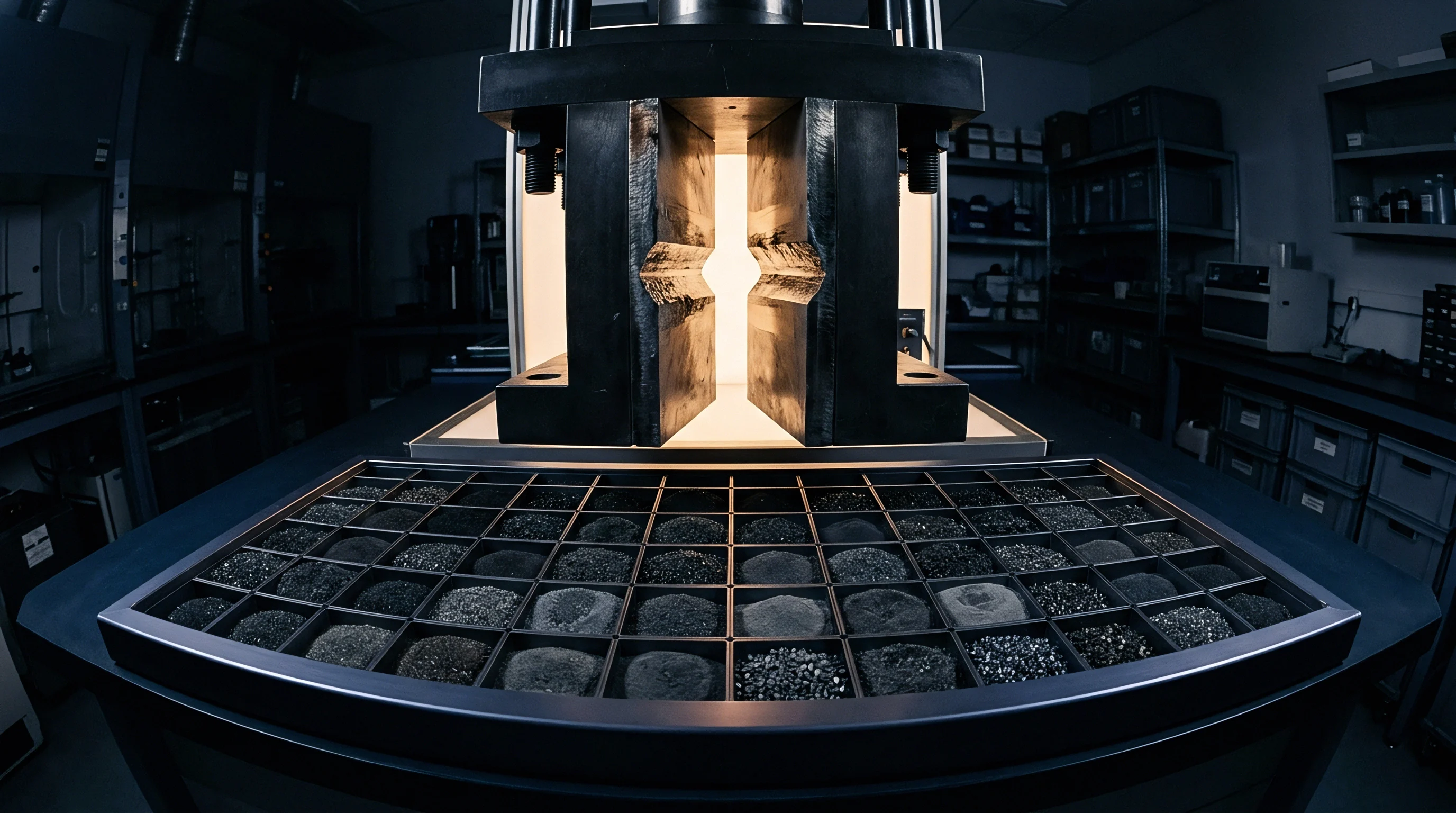

Pore
Press-and-sinter metal casings leave the line with an inherent void volume between 8% and 18% when processed from standard iron-copper or austenitic stainless steel powders without secondary infiltration. Under transverse mechanical shock, these microscopic voids concentrate stress and govern crack initiation inside a battery pack enclosure. Transverse loads throw internal cells against the housing perimeter, driving high peak forces directly into unsintered or partially sintered powder boundaries.
Designers choosing powder metallurgical enclosures for weight reduction or net-shape economics often look only at static tensile figures. But static yield figures misrepresent how a material behaves during millisecond impact events. A component with 450 MPa static yield strength can shatter in a brittle fashion at just 120 MPa when hit by a sudden transverse acceleration impulse.
Interparticle neck boundaries determine whether an enclosure flexes elastically or shatters when internal battery cells shift laterally. Standard mechanical datasheets report bulk density in grams per cubic centimeter, but bulk density hides the local density gradients that form during uniaxial pressing. Deep wall cavities can develop density variations up to 0.4 g/cm³ between the punch face and the neutral pressing zone.
These low-density pockets sit right at structural transitions where sidewalls meet mounting flanges. Under transverse shock, impact energy focuses along these porous seams, starting microvoid coalescence long before the main enclosure wall reaches its calculated yield threshold.
A bulk density rating of 7.15 g/cm³ drops to 6.72 g/cm³ across deep enclosure corners pressed without multi-action tooling.
Powder morphology dictates particle packing efficiency, green compact density, and the shape of residual voids. Gas-atomized spherical powders pack evenly, while water-atomized irregular powders form interlocking geometries that create sharp internal notch tips under impact. Managing transverse shock response comes down to controlling the compaction variables that drive particle neck growth during thermal bonding:
- Apparent powder density fixes the stroke compression ratio inside the die tooling, setting the minimum compaction tonnage needed to eliminate gross voids along outer enclosure ribs.
- Green compact density sets the spacing between metal granules before entering the sintering furnace, where poor particle contact prevents thermal neck growth along lateral load paths.
- Sintering furnace atmosphere strips surface oxides from alloy particles through hydrogen reduction, producing true metallic diffusion bonds across interparticle boundaries rather than brittle oxide interfaces.
- Secondary sizing pressure collapses surface porosity down to 0.8 mm via cold repressing, raising localized fatigue thresholds along outer enclosure skins exposed to flexural tension.
Ignoring local void fractions during structural calculations leads to cracked perimeter walls, broken retention ears, and uncontained cell groups during a vehicle crash.
Impulse
Kinetic energy transfer during transverse impact follows stress wave paths running perpendicular to internal cell planes. When a test sled arrests or a battery pack suffers a lateral drop, the internal cell array drives outward like a solid punch against the interior casing wall. Cylindrical cells in polymer cradles concentrate line forces into PM casing ribs, whereas prismatic cells exert distributed planar pressure that creates severe bending moments across unsupported PM spans.
Transverse shock pulses typically deliver acceleration amplitudes between 50g and 500g over 3 ms to 11 ms, matching qualification standards such as UN 38.3 Test 4 and MIL-STD-810H Method 516.8.
Powder metallurgy parts handle strain rates very differently than wrought sheet metal housings. Sintered iron, nickel steels, and sintered aluminum alloys show a sharp jump in yield strength paired with a drastic loss of ductility when strain rates rise from quasi-static levels of 0.001 s⁻¹ to shock levels above 100 s⁻¹. At shock rates, dislocation motion stalls at pore boundaries.
Instead of plastic deformation blunting crack tips, the high-rate stress wave forces microcracks to leap directly between adjacent voids. As a result, the energy absorption capacity of a porous enclosure drops by up to 60% under transverse shock compared to static bend tests.
A five-millisecond transverse acceleration pulse at 150g reduces total fracture elongation in sintered 316L stainless steel from 12% to under 3%.
Finite element models built on standard tabular plastic strain properties miss this rate-dependent embrittlement entirely. Getting accurate structural predictions requires Johnson-Cook constitutive parameters calibrated through split-Hopkinson pressure bar testing across the actual density spectrum produced by the furnace. Porous metal also alters wave transmission through its lower acoustic impedance.
Reflected tensile waves bouncing off outer boundaries meet incoming compressive waves, tearing internal spall planes through the wall thickness.
| Material Grade | Processing Method | Bulk Density (g/cm³) | Quasi-Static Elongation (%) | Dynamic Fracture Toughness (MPa·m¹/²) | Transverse 100g Shock Outcome |
|---|---|---|---|---|---|
| Fe-Cu-C (FC-0208) | Single press and sinter | 6.85 | 1.8 | 14.2 | Catastrophic wall cracking |
| Fe-Cu-C (FC-0208) | Double press and sinter | 7.35 | 3.5 | 22.6 | Microcracking at bolt bosses |
| Fe-Ni-Mo (FL-4405) | Sinter-hardened and tempered | 7.20 | 2.1 | 19.8 | Brittle corner shear failure |
| 316L Stainless Steel | Metal injection molding | 7.65 | 38.0 | 68.5 | Plastic deformation without rupture |
| 6061-T6 Aluminum | Wrought extrusion reference | 2.70 | 12.0 | 29.0 | Elastic flexure and rebound |
The core design trade-off is how much secondary copper infiltration or hot isostatic pressing an integrator can afford before the cost advantages of powder metallurgy vanish.

Wall
Designing sintered enclosures means accounting for tool extraction kinematics, punch movements, and neutral axis placement from the start. Powder compaction requires vertical die extraction with no lateral undercuts, which forces internal support ribs to run parallel to the pressing stroke. When transverse shock loads act perpendicular to these ribs, the enclosure is subjected to severe unreinforced bending moments.
Sintered components also lack continuous grain flow. Extrusions align grain structure along the perimeter, whereas powder metallurgy creates an isotropic but porous grain network with lower transverse shear resistance at wall intersections.
Draft angles and corner radii dictate stress concentrations under transverse impact. A sharp internal radius of 0.5 mm creates a stress concentration factor over 3.2 in a sintered steel casing under lateral flexure. Increasing that radius to 2.5 mm drops the factor to 1.4, keeping peak stress below the failure threshold.
Wall thickness transitions also need to be gradual. Stepping abruptly from a 4.0 mm mounting rail down to a 1.8 mm sidewall causes uneven cooling in the sintering furnace and inconsistent powder compaction across the part.
- Tooling layout verification verifies uniform punch fill ratios across deep ribs and flat covers before machining hardened tool steel cavities.
- Corner fillet modification replaces sharp ninety-degree corners with multi-radius transitions to spread transverse bending loads across wider cross-sections.
- Secondary machining operations remove surface witness lines and punch burrs that would otherwise trigger cracking under lateral impact.
- Interlocking casing joints transfer transverse shear forces through mechanical tongue-and-groove features instead of relying solely on perimeter bolts.
Gasket seating channels present another point of failure. Enclosures rated for IP67 or IP69K protection rely on narrow perimeter grooves to compress elastomeric seals. In powder metallurgy housings, pressing or machining a groove into a 3.0 mm wall leaves a floor thickness of just 1.2 mm.
Transverse impact slams the cell mass sideways against this thinned lip, shearing the gasket track and compromising environmental sealing.
Part drawings lacking explicit corner radius tolerances permit toolmakers to leave sharp punch edges that halve casing impact resistance.
Passing laboratory drop tests on flat concrete using sample plaques does not guarantee that finished sintered casings will withstand real structural shock loads.

Shear
Microscopic analysis of fractured powder metallurgy enclosures shows clear shifts in failure modes depending on loading velocity and void structure. Under low-speed lateral loading, failure occurs through ductile dimple rupture across sintered necks with minor void distortion. Under transverse shock, propagation shifts to transgranular cleavage and interparticle separation.
Cracks bypass particle cores altogether, tearing quickly through the narrowest necks where local shear stresses exceed material strength.
Notch sensitivity in powder metallurgy parts jumps sharply if surface oxidation or decarburization occurs. Poor atmosphere control in the sintering furnace can deplete carbon from the surface layer of an iron-carbon enclosure down to 0.3 mm. This soft skin lowers fatigue strength, whereas over-carburization creates a brittle shell prone to microcracking during slight flexure.
Once a microcrack starts at the surface, stress intensity at the tip quickly exceeds the dynamic fracture toughness of the porous substrate, driving the crack through the entire wall within microseconds.
UN 38.3 Test 4 mandates eighteen separate shock pulses without casing breach or mass loss to secure commercial transport certification.
Validating transverse shock resistance requires instrumentation that can capture high-frequency stress waves. Piezoelectric accelerometers mounted straight to the enclosure frame pick up high-g ring-down spikes that standard piezoresistive sensors filter out. Laser Doppler vibrometry tracks real-time wall deflection, pinpointing whether structural cracking starts at fastener bosses, rib roots, or central wall spans.
| Observed Failure Mode | Root Metallurgical Cause | Stress Concentration Mechanism | Detection Protocol | Process Remediation Pathway |
|---|---|---|---|---|
| Gasket flange shearing | Inadequate sintered neck area | Lateral punch force from cell mass | High-speed optical crack tracking | Increase sintering temperature to 1250°C |
| Corner web cleavage | Density drop in deep die cavities | Transverse flexural bending moment | Resonant acoustic inspection | Incorporate multi-plate upper punch tooling |
| Fastener boss pullout | Intergranular oxide inclusions | Thread shear and tensile shock wave | Torque-to-failure batch sampling | Switch to vacuum sintering with hydrogen purge |
| Mid-wall spall fracture | Reflected shock wave tension | Internal pore acoustic mismatch | Scanning acoustic microscopy | Liquid phase copper infiltration of pores |
Under Section 6.2 of the international transport testing manual, any through-crack allowing electrolyte leakage or visible cell displacement causes an immediate qualification failure and invalidates the UN transport dossier.
Seam
Commercial disputes over battery housings often occur right at the seam between the powder metallurgy fabricator and the pack integrator. The fabricator quotes parts based on 2D drawings, guaranteeing chemistry, bulk density, and ISO 2768 tolerances. The integrator, meanwhile, must guarantee full assembly survival under automotive or industrial drop tests.
When an enclosure fails during testing, the sintering house points to compliant material test coupons, leaving the integrator to absorb redesign costs and schedule delays.
Tooling costs for powder metallurgy compaction range from twenty thousand to eighty thousand dollars per die set. Modifying finished tooling to add wall thickness or enlarge internal fillets requires wire EDM or scrapping punches altogether. If the original purchase order leaves out dynamic impact requirements, the buyer absorbs those modification costs.
Integrators can protect themselves by specifying dynamic fracture toughness minimums in the master component spec, anchoring acceptance criteria to high strain rates instead of standard tensile bar data.
Sourcing teams need to look at total landed cost when weighing press-and-sinter components against die-cast aluminum or stamped steel. Powder metallurgy delivers high material yield and cuts out secondary milling, but quality control requires non-destructive testing infrastructure. Resonant acoustic testing and CT scanning add recurring per-part costs.
High production runs easily absorb this inspection overhead, but low-volume specialty packs can become cost-prohibitive.
Combining high sintered density with generous corner radii protects casing boundaries far better than simply thickening a brittle, low-density wall.