Integrating UN 38.3.5 Test Summary Documents into Dangerous Goods Declarations
Integrating UN 38.3.5 test summaries into dangerous goods declarations requires exact data alignment, digital URL linkage, and verified lab accreditation.


Origin
Section 38.3.5 of the United Nations Manual of Tests and Criteria imposes a strict documentary chain for lithium cells and batteries manufactured after January 1, 2020. Transport regulations across all modes ~ including the International Air Transport Association Dangerous Goods Regulations, the International Maritime Dangerous Goods Code, and the Agreement Concerning the International Carriage of Dangerous Goods by Road ~ incorporate this mandate directly into cargo acceptance rules. Shippers face immediate cargo turnarounds when offering lithium battery consignments without an accompanying or traceable test summary document.
The document provides verified evidence that a specific cell or battery design passed the mandatory safety tests of UN 38.3, spanning altitude simulation, thermal testing, vibration, shock, external short circuit, impact or crush, overcharge, and forced discharge.
Transport declarations require a direct reference to this verified test record to prove the cargo matches the tested prototype design. Prior to the adoption of paragraph 38.3.5, logistics operators relied on full, highly technical lab reports that contained proprietary cell internal construction data or minimal certificates of conformity that lacked standardized safety data points. The UN 38.3.5 Test Summary standardizes ten mandatory data points into a concise public document that downstream handlers, forwarders, and enforcement authorities verify without exposing trade secrets.
The UN 38.3.5 Test Summary converts technical test reports into ten standardized, publicly verifiable data points required for regulatory transport declarations.
Integrating this test summary into dangerous goods transport documents creates an unbroken audit trail from the cell manufacturing facility to the ultimate destination. Freight forwarders check the document at cargo tender to confirm that the physical cell numbers, battery weights, and energy ratings listed on the Shipper’s Declaration for Dangerous Goods correspond exactly to the tested specimen. Omission creates immediate liability.
| UN 38.3.5 Required Element | Specific Technical Content | Dangerous Goods Declaration Mapping |
|---|---|---|
| Cell or Battery Manufacturer Details | Name, address, phone number, email, and website of cell manufacturer | Shipper or Manufacturer validation fields on transport documentation |
| Testing Laboratory Information | Name, address, phone, email, website, and ISO/IEC 17025 accreditation | Audit verification cross-reference for carrier dangerous goods desks |
| Unique Test Report Identifier | Lab report tracking number and exact date of test completion | Additional Handling Information field on air waybills and ocean bills |
| Detailed Product Description | Cell or battery type, mass, Watt-hour rating or Lithium content, casing style | Proper Shipping Name, UN Number, and net quantity declarations |
| List of Completed Tests | Confirmation of T.1 through T.8 test completion and Pass result | Compliance confirmation for Packing Instructions 965-970, ADR SP 188/230 |
Discrepancies between physical battery specs and test summary data render the transport declaration invalid. The absence of a valid UN 38.3.5 document invalidates cargo insurance coverage during international transit.

Paperwork
Cross-referencing test documentation on transport filings transforms a standalone lab certificate into an enforceable compliance record. The Shipper’s Declaration for Dangerous Goods serves as the legally binding commitment that cargo meets all dangerous goods regulations. When preparing air shipments under IATA Packing Instruction 965 or 967, or ocean shipments under IMDG Code Special Provision 230, the declarant enters the UN 38.3.5 document tracking reference directly into the dedicated document management system or transport paperwork.
Digital document integration relies on persistent Uniform Resource Locators or quick-response codes embedded within the dangerous goods transport document. Inserting a direct link into the Additional Handling Information block of the Shipper’s Declaration enables acceptance clerks to pull the original test summary PDF within seconds during ground checks. The document reference must point to a file that contains all ten mandatory elements specified in UN Manual of Tests and Criteria, Revision 7, Section 38.3.5.
The structural link between the test summary and the transport declaration follows a precise sequence across transport documentation formats:
- Document Reference Insertion links the unique UN 38.3.5 test summary serial number directly into the Additional Handling Information section of the dangerous goods declaration.
- Exact Mass Verification matches the net lithium cell or battery weight reported on the transport declaration against the maximum tested mass listed on the test summary.
- Watt-Hour Alignment verifies that the cell or battery energy capacity entered on the declaration does not exceed the tested upper threshold documented by the testing laboratory.
- Physical Product Nomenclature reproduces the exact model number, brand name, and physical casing designation on the declaration as specified on the lab summary sheet.
Freight forwarders and air carriers enforce strict document verification protocols at cargo acceptance desks worldwide. Transport documentation lacking exact model matching faces mandatory detention at transit hubs.
Failure to align model designations between cargo labels and test summary files triggers immediate carrier rejection under IATA Dangerous Goods Regulations.
Contractual terms between cell buyers and logistics providers frequently define document liability rules for transport delays. Under standard shipping contracts, the shipper warrants that all UN 38.3.5 test summaries linked to the dangerous goods declaration reflect valid, unexpired lab results performed by an accredited laboratory under ISO/IEC 17025 oversight.


Mismatch
Inconsistencies between physical cargo markings and declared shipping certificates account for the majority of air cargo hold decisions. Acceptance inspectors compare the physical cell model printed on the outer casing or battery management system enclosure against the model identifier stated on the UN 38.3.5 summary sheet. When a supplier updates internal cell chemistry, modifies separator thickness, or alters anode active material density without updating the test summary document, the document linkage breaks.
The table below outlines key points where data inconsistencies destroy document validity during carrier inspections.
| Discrepancy Category | Observed Variance Condition | Carrier Action and Transport Consequence |
|---|---|---|
| Model Identifier Mismatch | Cell carries internal factory code; declaration lists commercial pack part number | Immediate cargo refusal at carrier tender; line-item re-declaration required |
| Watt-Hour Threshold Variance | Label lists 105 Wh; UN 38.3.5 document specifies T.1-T.8 test at 98 Wh maximum | Consignment reclassified as fully regulated Class 9 cargo; air transport rejected |
| Mass Deviation | Shipped pack mass exceeds test summary recorded mass by more than 2 percent | Invalidation of UN 38.3 test validity; complete re-testing required |
| Missing Lab Accreditation | Test summary signed by non-accredited internal facility without ISO/IEC 17025 proof | Maritime port authority detention; customs safety file clearance denied |
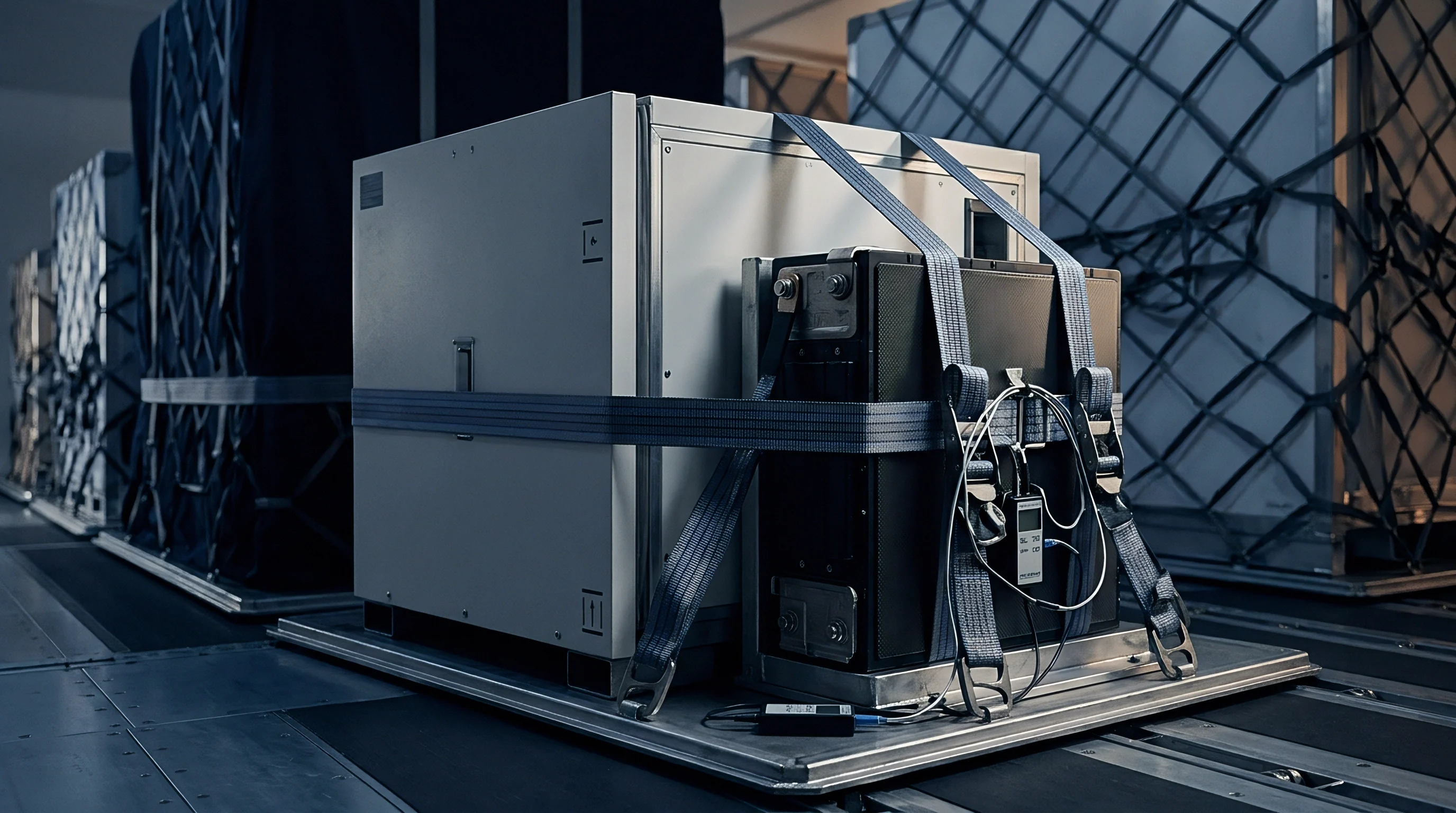
Does Every Cell Revision Demand a New Test Summary?
Modification of an existing cell design introduces significant legal ambiguity into dangerous goods transport declarations. Paragraph 38.3.2.2 of the UN Manual of Tests and Criteria defines changes that necessitate full re-testing of a lithium cell or battery design. A change in cathode formulation, active material mass loading by more than 20 percent, or cell casing dimension triggers mandatory T.1 through T.8 re-testing.
Offering cells under an old test summary after incorporating structural changes constitutes filing a false dangerous goods declaration.
Arguments regarding design continuity often collapse during deep customs audits.
Arithmetic
Mathematical alignment between single-cell test data and multi-cell pack configurations determines whether a transport declaration holds under scrutiny. When a pack manufacturer assembles single lithium-ion cells into a multi-cell battery, transport rules decide whether the single-cell UN 38.3.5 test summary suffices or if the assembled pack demands its own dedicated T.1 through T.8 test file. A multi-cell battery containing aggregated energy exceeding 20 Wh for cells or 100 Wh for batteries demands a dedicated pack-level UN 38.3.5 test summary.
Calculating state of charge limits for air transport under IATA PI 965 Section IA and IB demands precise operational controls. Cells shipped as cargo must not exceed 30 percent state of charge at the time of air tender. The dangerous goods declaration carries a mandatory confirmation of this state of charge ceiling.
| Regulatory Parameter | Single-Cell Limit | Multi-Cell Battery Limit | Transport Document Designation |
|---|---|---|---|
| Excepted Wh Limit (ADR SP 188 / IMDG SP 188) | Equal to or less than 20 Wh | Equal to or less than 100 Wh | UN 3480 / UN 3090 Excepted Dangerous Goods |
| Fully Regulated Class 9 Threshold | Greater than 20 Wh | Greater than 100 Wh | UN 3480 / UN 3090 Class 9 Dangerous Goods Document |
| Maximum Package Net Weight Section IB | 10 kg net battery mass | 10 kg net battery mass | IATA Shipper’s Declaration PI 965 IB |
| Maximum Package Net Weight Section IA | 35 kg net battery mass | 35 kg net battery mass | IATA Shipper’s Declaration PI 965 IA cargo aircraft only |
Audit procedures for verifying test summary integrity prior to executing transport declarations follow a defined sequence:
- Verify that the UN 38.3.5 document originates from an ISO/IEC 17025 accredited laboratory by checking the accreditation body symbol and registration number.
- Compare the physical cell model identifier printed on the cell wrapper against the exact string listed under the Product Description section of the summary.
- Recalculate the Watt-hour rating using nominal voltage multiplied by rated Ampere-hour capacity to ensure mathematical consistency with declared values.
- Confirm that all eight UN 38.3 tests (T.1 through T.8) show explicit Pass results, with T.7 overcharge testing verified for rechargeable systems.
- Confirm that the test summary carries the typed signature, full printed name, and corporate title of the authorized laboratory representative.
Consider a sourcing scenario involving a 48V, 20Ah lithium iron phosphate (LiFePO4) battery pack designed for industrial motive applications. The individual cells inside the pack carry a 3.2V, 5Ah rating (16 Wh per cell). Sixteen cells connected in series yield a total pack nominal voltage of 51.2V and a total energy capacity of 1,024 Wh. Because 1,024 Wh vastly exceeds the 100 Wh threshold established by Section 38.3 of the UN Manual, the shipper cannot rely on the 16 Wh single-cell test summary alone on the dangerous goods declaration.
The assembled pack requires a distinct, pack-level UN 38.3.5 test summary confirming success across tests T.1 through T.8. If the pack includes integrated overcharge protection circuitry, test T.7 must be explicitly listed as Passed on the final transport summary file.

Transit
Port authorities and airline acceptance clerks inspect dangerous goods filings as the primary line of defense against undeclared hazardous cargo. When a container ship enters port or an air freighter prepares for loading, cargo safety inspectors perform randomized cross-checks between transport declarations and online UN 38.3.5 test summary databases. Discrepancies trigger full freight rejections.
Customs holds cargo indefinitely when documentation linkages fail verification checks.
The legal importer of record assumes absolute financial responsibility for regulatory non-compliance when importing lithium batteries across international boundaries. Under the EU Battery Regulation, market surveillance authorities possess statutory power to seize non-compliant inventory, order commercial recalls, and impose administrative fines when UN 38.3.5 documentation cannot be produced immediately upon demand.
Insurers deny unverified fire claims when shippers fail to produce matching UN 38.3.5 test summaries for damaged lithium cargo.
Insurance contracts covering air and maritime freight explicitly exclude losses resulting from improper dangerous goods declarations or missing mandatory safety testing documentation. When a thermal event occurs during ocean transit, marine underwriters demand the immediate production of the dangerous goods file, including the verified UN 38.3.5 test summary. Inability to produce a valid, matching test summary executed prior to the shipment date provides grounds for insurance claim denial.
Cargo tendered with fully verified digital links between the Shipper’s Declaration and the UN 38.3.5 test summary clears port acceptance desks without manual holding intervention.