Mass Spectrometry Diagnostics for Knudsen Leak Differentiation in Solid Electrolytes
Mass spectrometry differentiates Knudsen from viscous leaks in solid electrolytes by measuring tracer gas effusion ratios to isolate nano-cracks from bulk defects.

Vacuum
Incoming inspection of sulfide and oxide solid-state separators runs into an immediate vacuum signature problem. Micro-cracks, pinholes, and uneven ceramic-to-polymer perimeter seals all leak gas in ways that standard gross-leak sniffers misread. Sorting real failures from background drift requires quantitative residual gas analysis under high vacuum.
Across a differential pressure boundary, gas transport follows the Knudsen number ~ the ratio of molecular mean free path to defect pore diameter. Once this ratio clears 10, molecule-wall collisions take over from intermolecular collisions, shifting flow into pure molecular effusion.
Under Knudsen conditions, individual gas species move across a defect independently of total upstream pressure, effusing at rates inversely proportional to the square root of their molecular weights. Viscous laminar flow behaves entirely differently: it scales with the square of the pore diameter and tracks gas viscosity directly. When test conditions mix these regimes, uncorrected leak rates obscure what is physically happening in the cell.
Treating a sudden rise in helium background as bulk delamination can easily scrap a separator whose only issue is benign, sub-micron grain-boundary porosity.
Standard helium leak ratings assume viscous Poiseuille flow, expressing leakage as equivalent air flow at atmospheric pressure. That assumption breaks down on a 30-nanometer intergranular fissure in a sintered lithium lanthanum zirconium oxide separator, where Poiseuille calculations underestimate actual atmospheric ingress. Helium diffuses via Knudsen transport while ambient nitrogen and oxygen push through under a transition regime.
A supply contract that specifies a gross leak rate without naming the tracer gas, chamber base pressure, and molecular mass correction factors leaves warranties effectively unhedged.
Viscous laminar flow models underestimate air ingress across nanometer-scale electrolyte defects whenever molecular mean free path exceeds pore diameter.
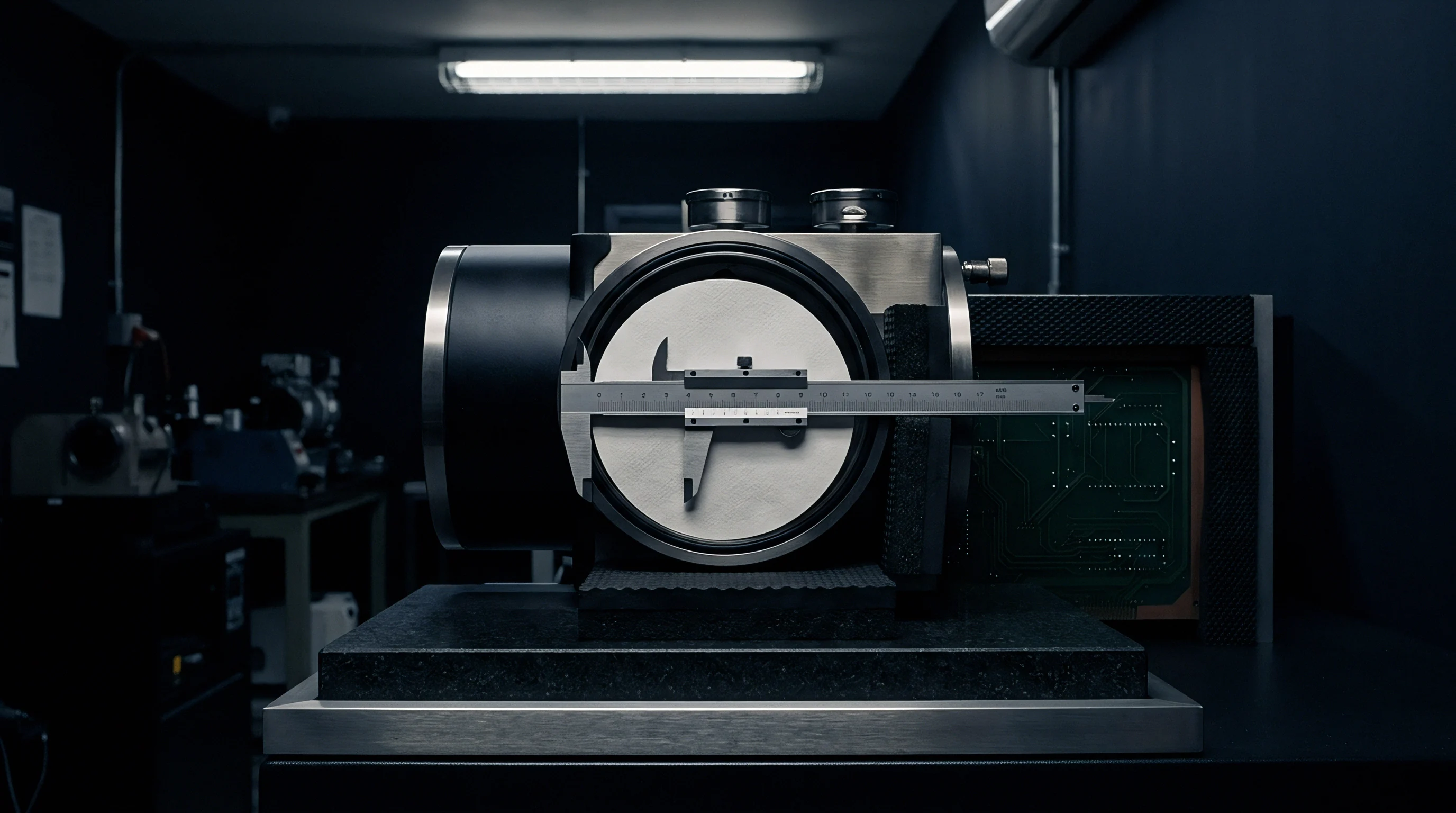
Distinguishing these regimes requires a vacuum bench that holds below 10-5 millibar during continuous quadrupole mass filter sweeps. The sample fixture clamps the flat electrolyte pellet or laminated pouch cell directly over an ultra-high vacuum flange using perfluoroelastomer or indium wire seals. Clamping torque must be dialed in carefully.
Over-tightening creates radial shear stresses that crack brittle ceramics under vacuum, creating false leaks. Under-tightening allows gas to slip past the elastomer perimeter, swamping the detector baseline.
Testing begins with an extended baseline survey before introducing tracer gas. Inside the quadrupole ionizer, incoming molecules fragment along predictable charge pathways. Routine monitoring tracks hydrogen at mass-to-charge ratio 2, helium at ratio 4, methane at ratio 16, water vapor at ratio 18, nitrogen and carbon monoxide at ratio 28, oxygen at ratio 32, and argon at ratio 40.
Water desorption dominates clean baselines, tailing off slowly over several hours. Genuine fissures, by contrast, show up as sharp, square-wave signal steps the moment tracer gas contacts the atmospheric side.
Elevated mass-4 signals observed during factory audits frequently reflect surface desorption of residual helium absorbed during pouch degassing rather than physical through-leaks.

Kinetics
Differentiating transport mechanisms relies on Graham’s law of effusion and standard kinetic theory. A gas molecule’s mean free path is set by its temperature, absolute pressure, and hard-sphere collision diameter. At room temperature and 10-4 millibar, helium has a mean free path near 1.7 meters.
Confined within a 50 nanometers electrolyte defect, its Knudsen number reaches roughly 34,000, meaning gas molecules traverse the channel without colliding with one another.
Transmission probability through a real crack depends heavily on channel length and cross-sectional geometry. Clausing factors adjust ideal thin-orifice conductances to account for resistance through long, tortuous grain boundaries. In sintered garnet ceramics like doped LLZO, intergranular crack paths are highly convoluted, with channel length often exceeding hydraulic diameter by a factor of 100 or more.
Sulfide glasses such as lithium phosphorus sulfur chloride offer straighter paths after cold isostatic pressing, though mechanical stack pressure tends to open intergranular fissures over time.

Knudsen Number Boundaries in Separator Voids
Characterizing separator voids requires firm boundaries between Knudsen transport, transition flow, and viscous Poiseuille movement. Each mode reveals itself through a characteristic relationship between molar flow, upstream pressure, and gas molecular properties. In the transition zone, where the Knudsen number falls between 0.1 and 10, both wall collisions and intermolecular friction shape the throughput.
Resolving data across this intermediate region requires non-linear regression on the mass spectrometer output.
| Knudsen Number | Dominant Regime | Pressure Dependence | Viscosity Dependence | Mass Dependence |
|---|---|---|---|---|
| Kn > 10 | Pure Knudsen Diffusion | Linear with differential pressure | Zero dependence | Inverse square root of molecular mass |
| 0.1 ≤ Kn ≤ 10 | Transition Flow | Non-linear mixed polynomial | Partial inverse dependence | Mixed mass and collision diameter |
| Kn < 0.1 | Viscous Poiseuille Flow | Quadratic with absolute pressure | Inversely proportional to viscosity | Zero direct mass dependence |
Because volumetric throughput in viscous flow depends on mean absolute pressure across the membrane, its molar rate scales quadratically with pressure. Pure Knudsen effusion scales in a direct, linear relationship with the partial pressure drop. Stepping upstream feed pressure from 200 millibar to 1,200 millibar absolute separates the two: plotting molar flux divided by differential pressure against mean pressure produces a flat line for Knudsen effusion, whereas an upward slope flags viscous laminar flow through open pinholes.

Multi-Gas Effusion Ratios
Confirming Knudsen effusion calls for multi-gas dosing. An equimolar binary mix of 50 percent helium and 50 percent argon provides clean separation. In viscous laminar flow, both gases move together at a shared velocity dictated by the bulk mixture’s viscosity; the ratio of helium to argon ions at the electron multiplier matches their upstream partial pressure ratio, skewed only by ionization cross-sections.
Under pure molecular flow, each gas travels at its own pace. The theoretical flux ratio of helium to argon equals the square root of argon’s atomic weight (39.948 unified atomic mass units) divided by the square root of helium’s (4.0026 unified atomic mass units), giving an ideal ratio of 3.159. Once detector signals match this 3.159 baseline after standard ionization and transmission corrections, the leak path is confirmed to be molecular.
A helium-to-argon effusion flux ratio approaching 3.16 establishes molecular wall transport rather than open viscous channel flow.
Distinguishing binary gas behavior keeps pack assemblers from misclassifying leak severity. An electrolyte with pure Knudsen leakage transfers absolute mass very slowly: moisture ingress through nanometer-scale pores takes months or years to reach the lithium metal anode. An open viscous crack with an identical initial helium rating admits ambient water vapor orders of magnitude faster when barometric pressure swings during ocean shipping, degrading cells almost immediately.
Adsorption of polar species onto sulfide electrolyte surfaces can distort empirical effusion ratios.
Moisture, carbon dioxide, and solvent residues bond chemically to alkaline lithium sulfide interfaces, producing surface-hopping diffusion that runs in parallel with gas-phase Knudsen transport. Running diagnostics with noble gas mixtures eliminates this chemical binding, ensuring the measured transmission reflects only the physical geometry of the ceramic void network.
If mass spectrometer ratios wander from the theoretical inverse-square-root value without responding to pressure adjustments, the leak channel involves combined gas-phase effusion and surface hopping along grain boundaries.
Bench
Running these diagnostics in practice requires a vacuum test bench that holds delicate solid electrolytes firmly without introducing artificial leak paths. The vacuum circuit pairs a dry scroll backing pump with a wide-range turbomolecular pump running at 1,500 hertz and an open-ion-source quadrupole mass spectrometer. Test chambers are machined from electropolished 316L stainless steel to suppress internal moisture and hydrogen outgassing, with heating jackets baking the walls at 150 degrees Celsius between test runs.
Separator geometries vary considerably across cell chemistries. Thin ceramic membranes between 20 and 50 micrometers thick shatter under raw knife-edge mounts. Tooling instead relies on fluorosilicone O-rings recessed into polished aluminum guard rings that stop compression at 15 percent of nominal ring cord thickness.
When evaluating laminated pouch cells, the entire unit goes into the vacuum chamber while the tracer line feeds directly into an engineered fill port or an external dosing cup.
The dosing shroud maintains a controlled gas atmosphere across the outer separator surface. An automated manifold blends calibrated streams of helium, neon, argon, and krypton under continuous barometric logging. Differential pressure across the ceramic is tracked to 0.05 millibar.
Capacitance manometers are preferred here; thermal Pirani or Penning gauges introduce drift during gas composition shifts.
Quadrupole instruments require routine calibration against known standards. A calibrated quartz capillary leak yielding between 10-8 and 10-9 millibar liters per second of helium is plumbed into the manifold to convert raw ion current in picoamperes into molar leak rates. Multiplier voltages are tuned regularly to prevent gain saturation during large tracer spikes.
Test execution follows an established sequence:
- Chamber Baseline Pumpdown brings the empty test volume below 5 × 10⁻⁷ millibar, establishing background ion currents for mass channels 2, 4, 18, 28, 32, and 40.
- Permeation Blank Verification confirms the seal tooling with a solid copper blank pellet, holding helium exposure for two hours to establish the baseline perimeter elastomer leakage rate.
- Specimen Mounting positions the solid electrolyte membrane between precision elastomeric seals, torquing mounting fasteners to 1.2 Newton-meters using a cross-pattern sequence.
- Atmospheric Evacuation draws vacuum on the downstream chamber side while maintaining upstream pressure at barometric equilibrium using pure dry nitrogen.
- Multi-Gas Tracer Exposure introduces an equimolar gas blend at regulated differential pressure steps, logging mass spectra at 100-millisecond intervals across the scan range.
- Conductance Decay Measurement isolates upstream gas supplies, tracking channel clearance rates to separate surface outgassing kinetics from continuous geometric effusion.
Skipping blank runs or overlooking baseline drift ruins the diagnostic. If elastomer seals absorb helium during a prior high-flux run, gradual outgassing skews subsequent channel readings. Standard nitriles and neoprenes dissolve significant volumes of light noble gases and outgas slowly.
Perfluoroelastomers avoid this issue, maintaining low gas solubility and thermal stability through 150-degree bake-out cycles.
Without continuous permeation checks on the fixture tooling, rising background signals can easily hide the initial onset of separator micro-cracking.


Differentiation
Separating transport modes mathematically requires multivariable regression across the raw mass spectrometer data. The analysis isolates three distinct paths: Knudsen effusion, viscous Hagen-Poiseuille flow, and true solid-state matrix permeation through binder polymers or composite films. Each mechanism produces a unique functional response to changes in gas molecular weight, pressure gradient, and system temperature.
Matrix permeation involves gas dissolution into the polymer followed by concentration-driven diffusion. In composite separators where ceramic garnet particles sit inside poly(ethylene oxide) or poly(vinylidene fluoride) binders, dissolution occurs alongside Knudsen effusion through imperfect particle boundaries. Permeation follows an Arrhenius relationship, accelerating exponentially with temperature.
Pure geometric Knudsen effusion does the opposite, showing an inverse square root temperature dependence: as thermal velocity climbs, gas density drops, slightly reducing molar throughput.

Worked Arithmetic for Channel Geometry Resolution
The physical geometry of a leak path can be backed out directly from steady-state flow data. Consider a doped sulfide separator membrane with a thickness of 30 micrometers (3.0 × 10⁻⁵ meters) and an active area of 10 square centimeters tested at 298 Kelvin. Downstream vacuum sits at 1.0 × 10⁻⁵ millibar, with the upstream face held at 1,000 millibar (1.0 × 10⁵ Pascals) under a 50/50 molar helium/argon blend.
After stabilization, the mass spectrometer logs the following steady-state molar rates:
- Measured Helium Molar Rate settles at 4.20 × 10⁻⁹ moles per second across the exposed separator boundary.
- Measured Argon Molar Rate settles at 1.34 × 10⁻⁹ moles per second under identical steady-state conditions.
- Observed Effusion Ratio calculates to 4.20 divided by 1.34, yielding a numerical ratio of 3.134.
The measured ratio of 3.134 matches the theoretical Knudsen limit of 3.159 within 0.8 percent, confirming molecular flow with zero viscous bypass. Working back to channel diameter and pore density uses the Knudsen conductance formula for circular capillaries, corrected for tortuosity. For a channel of radius r and length L, conductance CK is:
CK = (4/3) × (2 × π × R × T / M)0.5 × (r3 / L)
Here R is the gas constant (8.314 Joules per mole-Kelvin), T is 298 K, M is molar mass (0.004003 kg/mol for helium), and L is membrane thickness scaled by path tortuosity. Using an intergranular tortuosity factor of 1.8 from scanning electron cross-sections, path length L comes to 5.4 × 10⁻⁵ meters. Molar throughput Q equals CK multiplied by pressure differential divided by (R × T).
A single cylindrical pore carrying this total flow would have an unphysically large radius that violates the Knudsen criterion. The leakage instead moves through a parallel array of sub-micron channels. Capping channel radius r at 25 nanometers (2.5 × 10⁻⁸ meters) to maintain molecular flow at 1,000 millibar (where helium mean free path is approximately 170 nanometers), single-pore conductance calculates as:
Csingle = (4/3) × (2 × π × 8.314 × 298 / 0.004003)0.5 × ((2.5 × 10⁻⁸)3 / (5.4 × 10⁻⁵))
Single-channel helium conductance evaluates to 6.88 × 10⁻¹⁶ cubic meters per second. At 50,000 Pascals helium partial pressure, that yields 1.39 × 10⁻¹⁷ moles per second per channel. Dividing the total measured helium rate of 4.20 × 10⁻⁹ moles per second by this single-channel throughput indicates roughly 3.02 × 10⁸ open nanometer-scale channels across the 10 square centimeter sample area.
| Transport Pathway | Pressure Response | Temperature Response | He / Ar Molar Ratio | Root Failure Cause |
|---|---|---|---|---|
| Viscous Micro-Pinhole | Flux ∝ (Pup2 – Pdown2) | Flux decreases with T (viscosity rise) | Tracks bulk ratio (~1.00) | Brittle through-thickness cracking |
| Knudsen Grain Defect | Flux ∝ (Pup – Pdown) | Flux ∝ T-0.5 | Effusion ratio (~3.16) | Incomplete necking or intergranular voiding |
| Polymer Matrix Permeation | Flux ∝ (Pup – Pdown) | Flux ∝ exp(-Ea / RT) | Diffusivity-solubility product dependent | Binder saturation or composite phase boundary |
| Virtual Seal Desorption | Flux independent of upstream P | Flux accelerates rapidly with T | Outgassing composition dominated by H2O | Inadequate cell bake-out or pouch entrapment |
High gas throughputs present known detection pitfalls on electron multipliers during ratio quantification.
At high helium pressures, secondary electron multiplier saturation depresses adjacent channel readings. Rapid switching between mass 4 and mass 40 also causes settling errors along the dynode resistor chain. Above 10-6 millibar liters per second, switching to a Faraday cup avoids multiplier gain fatigue entirely, providing linear current tracking at the expense of baseline picoampere sensitivity.
Treating molecular effusion through intergranular voids as viscous Poiseuille flow overstates physical pore diameters by an order of magnitude, producing badly flawed estimates of moisture ingress during long-term storage.
Integrity
Solid separators face severe localized mechanical strain during cycling. Lithium dendrites wedging into grain boundaries can generate local stresses in the hundreds of megapascals. Real-time mass spectrometry captures these micro-cracks long before an electrical short registers as a voltage drop or thermal runaway.
Monitoring gas transport across a working cell provides an early warning of separator breakdown.
During early plating, current crowding at ceramic surface defects pushes lithium metal into intergranular voids, splitting grain boundaries as it grows. These micro-cracks link up previously isolated voids to form continuous Knudsen pathways across the separator. A vacuum fixture monitoring the counter-electrode chamber catches tracer gas transmission immediately, detecting structural failure 10 to 50 operating cycles ahead of terminal voltage collapse.
Separator micro-cracking generates measurable Knudsen transmission spikes dozen of cycles before electronic short circuits register on battery cycler channels.
Hermetic cell packaging exists primarily to exclude atmospheric moisture. In sulfide systems, incoming water vapor reacts exothermically with Li3PS4 or Li6PS5Cl phases to generate toxic hydrogen sulfide gas. This reaction consumes lithium from the solid electrolyte, degrades ionic conductivity, and builds internal pressure inside the cell pouch.
Knudsen leak paths through perimeter seals or cracked ceramic ribbons drive this breakdown long before packs are assembled.
Standard packaging evaluations, such as the UN 38.3 suite for lithium cells, focus on extreme mechanical stress rather than fine hermeticity. Cells readily pass UN 38.3 altitude, thermal shock, and vibration testing without showing electrical defects, despite suffering internal micro-cracks across the ceramic separator. Once moved into humid warehouse storage, atmospheric moisture works through these nanometer-scale channels and starts degrading the cell from the inside out.
Receiving quality plans prevent these field failures by establishing residual gas acceptance gates:
- Hermeticity Baseline Certification requires production cells to demonstrate total molecular leakage below 1.0 × 10⁻⁸ millibar liters per second equivalent air flow prior to pack integration.
- Tracer Ratio Verification demands multi-gas exposure testing on destructively sampled separator lots, rejecting batches that demonstrate viscous flow regimes indicative of through-thickness micro-cracks.
- Post-Stress Leak Scanning evaluates separator samples extracted from cells subjected to UN 38.3 thermal cycling between minus 40 degrees Celsius and 75 degrees Celsius, flagging structural delamination at ceramic-polymer interfaces.
- Effluent Gas Chromatography Tracking monitors test chamber exhaust for secondary reaction products, specifically hydrogen sulfide or hydrogen chloride, indicating active chemical degradation induced by carrier gas trace moisture.
Relying on generic certificates of conformance without requiring baseline residual gas data shifts all liability for moisture damage onto the pack builder. Ocean freight routinely exposes shipping containers to relative humidity above 90 percent and diurnal temperature cycling that drives barometric pumping. Defect paths that appear negligible under dry bench tests take in damaging amounts of moisture under maritime transit conditions.
International dangerous goods regulations place strict legal responsibility on the shipper of record to ensure packaging maintains integrity during transit without emitting toxic breakdown gases like hydrogen sulfide.

Recourse
Commercial procurement of solid-state cells requires explicit allocation of liability for sub-micron separator defects. Standard supply contracts rely on basic capacity retention or open-circuit voltage stability at factory handover. Those thresholds fail to identify Knudsen-scale micro-fissures.
Latent grain-boundary cracks easily pass final electrical check-out, only to propagate in the field and trigger capacity fade, high self-discharge, or internal shorts.
Purchase specifications need clear technical exhibits detailing leak test methods, acceptance limits, and dispute arbitration terms. Embedding quantitative residual gas standards into the master supply agreement establishes unambiguous rejection criteria. When incoming lots fail mass spectrometry screening, the contract should specify immediate quarantine rights, audit escalation triggers, or supply suspension without extended cure periods.
Technical quality schedules translate these requirements directly into contract text:
Seller warrants that all delivered solid electrolyte separator components and hermetically sealed solid-state cells exhibit a maximum helium effusion rate not exceeding 5.0 × 10⁻⁹ millibar liters per second under high-vacuum differential testing, with an equimolar helium-argon effusion ratio conforming to pure molecular flow limits within a fifteen percent tolerance band. Any delivered lot demonstrating viscous transport regimes Kn < 0.1 or chemical decomposition gas signatures upon incoming destructive mass spectrometry screening shall be deemed non-conforming, entitling buyer to immediate lot rejection, customs duty refund allocation, and full replacement at seller expense.
Disputes over degraded cells typically balance claims of improper customer handling against evidence of manufacturing flaws. Clear mass spectrometry data resolves the issue: demonstrating that defect channels follow Knudsen effusion characteristics tied to sintering anomalies rather than impact-induced fractures proves the problem originated in the fabrication cleanroom.
Financial exposure mounts quickly once cracked cells pass incoming inspection. An automotive module using 10,000 solid-state pouch cells at 85 dollars per unit represents 850,000 dollars in bare cell value alone. Pack integration adds roughly 400,000 dollars in cooling hardware, structural busbars, and labor.
If two percent of cells harbor latent viscous micro-cracks that open during pack assembly, the entire 1.25-million-dollar production run requires quarantine and teardown.
Tariffs and reverse logistics compound the loss. Solid-state cell imports incur duties between 2.7 and 3.4 percent depending on tariff classification, alongside unrecoverable hazardous shipping surcharges. Re-exporting defective lithium battery lots demands certified Class 9 hazardous packaging, safety documentation, and carrier approvals.
If the supplier refuses return logistics responsibility, disposal costs under local hazardous waste rules fall entirely on the importer of record.
The boundary between a minor grain-boundary void and an active dendrite propagation pathway remains unresolved in international standards organizations, leaving the legal definition of an acceptable solid electrolyte leak rate subject to ongoing technical dispute.