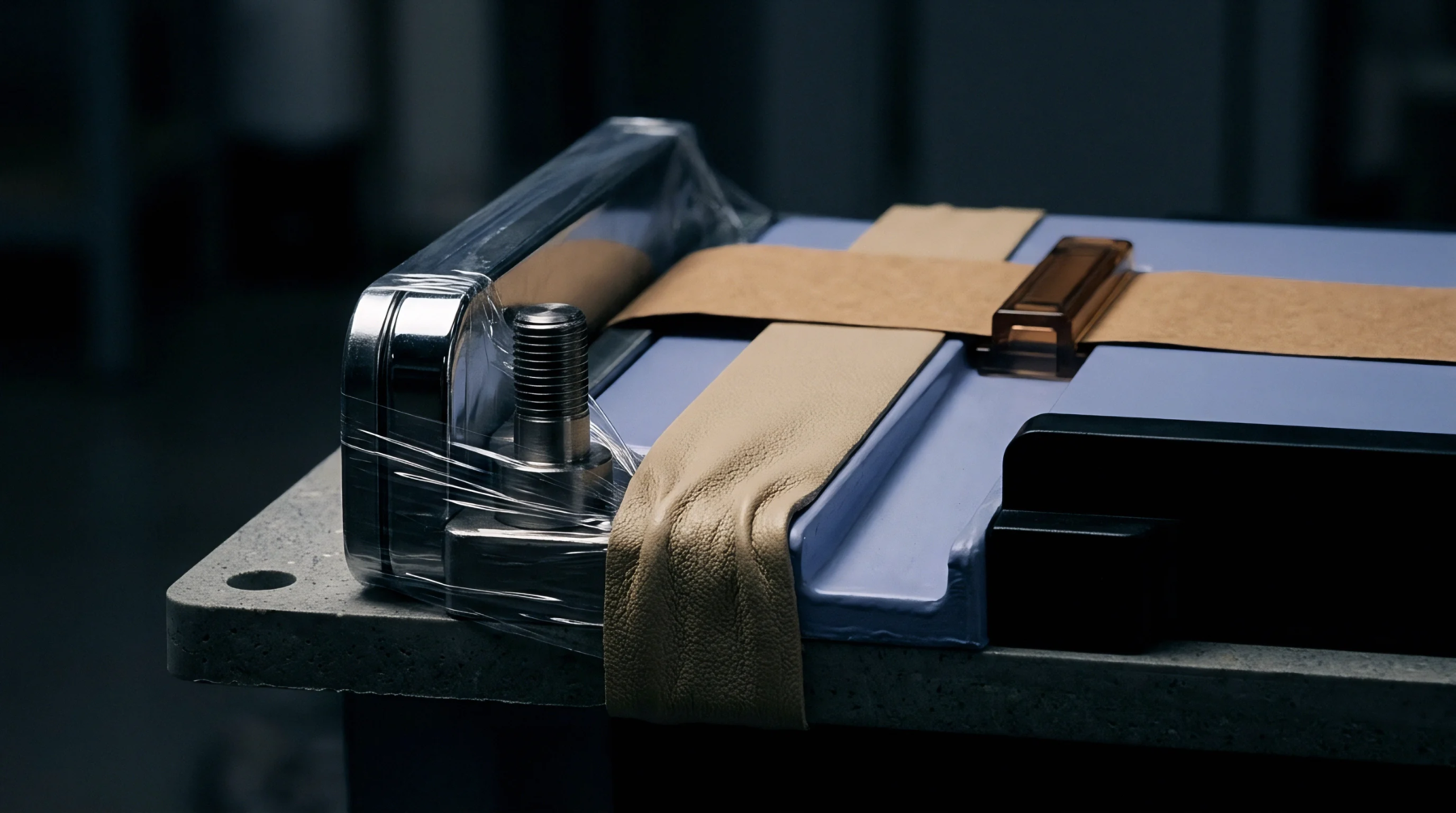
In Situ Strain Measurement Prismatic Compression Testing Fixtures
In situ prismatic cell strain testing requires rigid frame compliance calibration and active thermal decoupling to isolate electrochemical stack breathing.
Lattice parameter changes and macroscopic dimensional shifts recorded directly inside electrochemical cells while current passes reveal dynamic stress states generated during insertion, extraction, or phase transformation processes. Tracking in situ strain provides real-time quantitative monitoring of mechanical distortion without relaxing the sample or removing it from its active environment. Measurements correlate applied current density and state of charge directly with unit cell expansion, contraction, or mechanical load accumulation.
The validity of these strain values ends if internal contact loss or severe electrolyte depletion changes the underlying electrochemistry, creating heterogeneous current paths that misrepresent the nominal bulk behavior.
Mechanical distortion manifests across microscopic crystallographic scales and macroscopic cell dimensions simultaneously. Synchrotron X-ray diffraction measures in situ strain within crystal lattices by recording changes in Bragg diffraction peak positions as lithium moves into or out of the host framework. Shifted diffraction angles correspond to modifications in interplanar d-spacing via Bragg law calculations.
On the macroscopic pack level, fiber Bragg grating sensors, linear variable differential transformers, and precision load cells monitor real-time mechanical expansion during cycling. Pouch and prismatic cells constrained inside fixed test fixtures generate fluctuating compressive loads that correspond to phase transitions within active graphite, silicon, or nickel-rich oxide compounds.
Insertion reactions force host crystal lattices to expand or contract according to their electronic and chemical configurations. Silicon anodes demonstrate severe in situ strain, where full lithiation expands the unit volume by nearly three hundred percent, creating compressive stress fields that deform surrounding separator membranes and module housings. Intercalation of lithium into graphite proceeds through distinct staging transitions, producing stepped strain profiles that match stage-two and stage-one ordering plateaus.
High-nickel layered cathode materials present complex strain profiles characterized by initial volumetric expansion at moderate states of charge, followed by rapid lattice collapse along the c-axis above 4.1 volts. Mismatches between expanding and contracting crystalline domains create intergranular shear stresses that drive particle degradation.
Module architects and battery enclosure designers use in situ strain profiles to calculate the mechanical tolerances of structural pack assemblies. Uncontrolled volumetric swelling damages structural adhesive bonds, deforms thermal management plates, and crushes separator pores, which inhibits electrolyte diffusion and initiates localized plating. Engineers utilize dynamic strain curves to size spring-loaded module compression systems, ensuring that cells retain sufficient mechanical pressure to avoid contact loss without exerting destructive crushing forces during complete charge.
Active material buyers specify dopants, such as aluminum, magnesium, or tungsten, specifically to smooth steep lattice strain spikes that occur near end-of-charge cutoffs. Sourcing agreements reject active material lots whose crystallographic strain responses diverge from qualified reference footprints.
In situ prismatic cell strain testing requires rigid frame compliance calibration and active thermal decoupling to isolate electrochemical stack breathing.
Expertise is a utility, not a secret. sentiention™ publishes its working knowledge as open reference: intelligence layer covering the materials it sources, the markets it enters, and the reference that serves both.