Quantifying Creep Relaxation and Laser Weld Fatigue in Pack Busbars
Quantifying busbar life requires matching flexure spring rates to cell swelling and capping thermal creep relaxation to preserve laser weld fatigue limits.
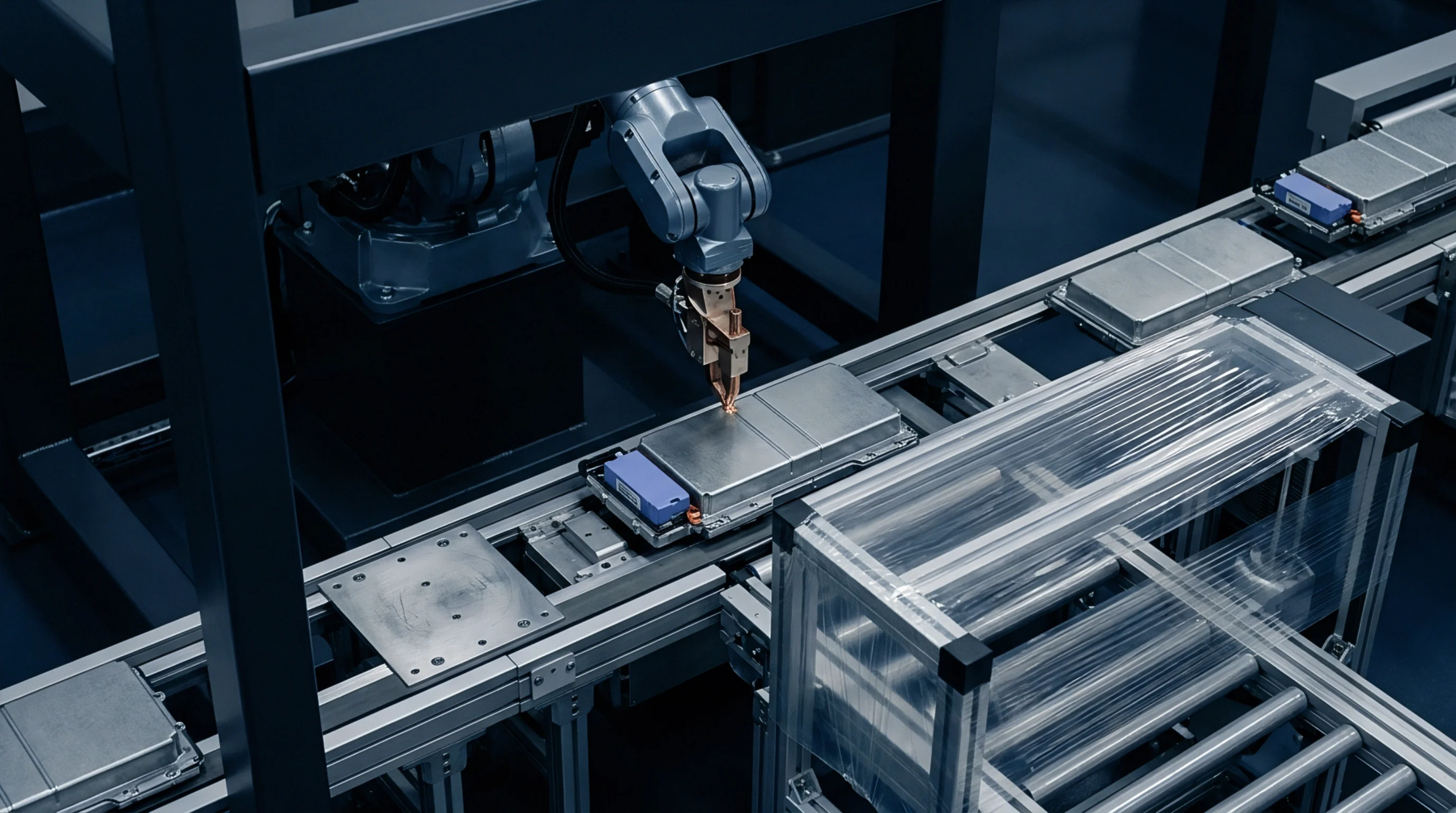
Volumetric cavity creation occurring within solidifying metallic weld pools due to gas entrapped in the melt or keyhole collapse during high-energy joining operations represents a critical defect mechanism across cell interconnect manufacturing. Quality control frameworks assess pore formation because internal voids diminish effective cross-sectional conduction area, concentrate localized mechanical stresses, and weaken structural peel strength across critical joints. The phenomenon governs weld pass-fail criteria on automated cell tab joining lines, defining the operational parameter window for laser, ultrasonic, and resistance spot welding systems.
Its boundary stops at macro-cracking phenomena, separating isolated spherical or irregular internal gas voids from structural cleavage or fatigue-driven metallic separations.
Laser welding of battery conductors operates in deep-penetration keyhole modes where intense vaporization pressure forms an open vapor depression in the liquid metal. Instabilities in the keyhole wall trigger periodic collapse of the cavity, trapping vaporized metallic elements like zinc or magnesium alongside shielding gases inside the rapidly freezing melt pool. Atmospheric contaminants, surface organic residues, rolling lubricants, and heavy surface oxides break down under high beam energies, liberating volatile gases that drive aggressive pore formation throughout the fusion zone.
When joining dissimilar metals, such as copper tabs to aluminum cell terminals, wide gaps in melting points and thermal conductivity disrupt uniform fluid flow, intensifying chaotic liquid circulation that freezes bubbles in place before they can rise to the molten surface.
Uncontrolled porosity distributions degrade electrical performance and mechanical integrity simultaneously. Internal voids reduce the effective conductive metallic cross section, which inflates joint electrical resistance and triggers localized resistive Joule heating under high charge and discharge currents. In severe cases, clustered micro-voids coalesce into continuous sub-surface channels that compromise hermeticity, allowing moisture to reach active materials or facilitating internal electrolyte leakage.
Mechanically, pores act as sharp internal stress concentrators, degrading joint shear and tensile peel strength. Under continuous vibrational fatigue during vehicle operation, micro-cracks originate directly from sharp pore edges, propagating outward through the fusion zone until the electrical interconnect shears completely from the terminal.
Eliminating internal porosity requires precise control of energy delivery, surface cleanliness, and beam optics. Automated production lines deploy wobbling laser scan optics that oscillate the laser beam in circular or elliptical patterns to widen the molten pool, keeping the melt fluid longer to allow entrapped gases to escape. Surface preparation protocols employ automated plasma cleaning, laser ablation, or chemical degreasing to remove hydrocarbon films and oxides prior to joining, eliminating volatile precursors to pore formation.
In-line acoustic monitoring, photodiode optical emissions tracking, and post-weld inline X-ray inspection systems identify internal voids immediately after joining. Production quality agreements set strict limits on maximum allowable pore size, void area percentages, and pore proximity to joint boundaries, immediately flagging weld equipment that drifts out of calibrated process envelopes.
Quantifying busbar life requires matching flexure spring rates to cell swelling and capping thermal creep relaxation to preserve laser weld fatigue limits.
Expertise is a utility, not a secret. sentiention™ publishes its working knowledge as open reference: intelligence layer covering the materials it sources, the markets it enters, and the reference that serves both.