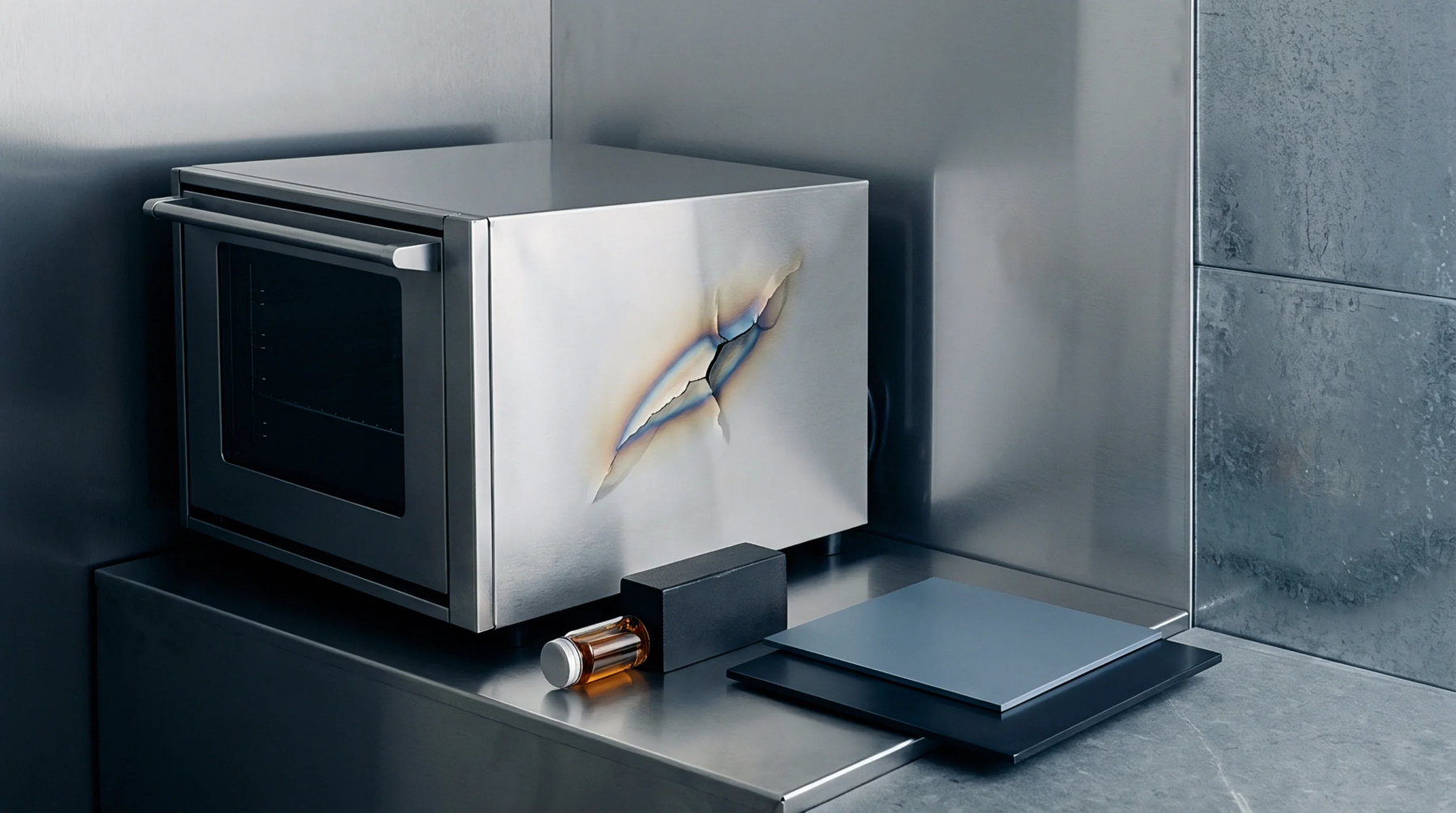
Quantifying Creep Relaxation and Laser Weld Fatigue in Pack Busbars
Quantifying busbar life requires matching flexure spring rates to cell swelling and capping thermal creep relaxation to preserve laser weld fatigue limits.
Progressive increases in contact resistance occurring across metallic terminal joints, bolted busbars, and welded battery connections characterize aging phenomena within electrical energy paths over prolonged service lifetimes. The metric evaluates the loss of conductive efficiency across mating surfaces as a function of thermal cycling, micro-motion fretting, and environmental chemical corrosion. It governs pack thermal efficiency calculations and voltage loss limits, establishing the operational timeline within which an interconnected battery system meets internal impedance specifications.
The scope stops at bulk material degradation, separating interfacial contact phenomena from internal electrochemical impedance changes inside the cell core.
Multi-material contacts undergo physical and chemical transformations when exposed to cyclic operational environments. Prolonged thermal expansion differentials cause minute relative motions across bolted or clamped joints, a mechanism known as fretting wear that grinds away protective plating and generates non-conductive metallic debris. Atmospheric moisture and aggressive chemical agents penetrate micro-voids across the joint perimeter, generating passive oxide films that choke current pathways.
In welded configurations, interface resistance drift stems from micro-crack propagation driven by vibrational fatigue, galvanic corrosion between dissimilar metals, or the growth of brittle intermetallic layers at aluminum-copper fusion zones. Because current concentrates through microscopic contact asperities, any constriction of true metallic contact area sharply elevates localized ohmic losses. Local hot spots form across remaining contact points, driving further oxidation in an accelerating thermal-electrical degradation loop.
Rising contact resistance across high-current electrical nodes distorts thermal control inside battery modules. Unchecked interface resistance drift elevates localized Joule heating by the square of the operating current, converting a nominal joint into a secondary heat source during high-rate charging or discharging. Thermal sensors placed across the module often misinterpret these localized connection spikes as cell thermal runaway events, triggering premature power derating or spurious fault warnings.
In severe cases, extreme temperature elevations melt nearby electrical insulation, degrade adjacent cell seals, or initiate thermal runaway within neighboring cells. Balancing circuits face skewed voltage readings due to extraneous resistive voltage drops across interconnect joints, compromising pack state-of-charge tracking precision and operational reliability over multi-year deployments.
Monitoring joint longevity mandates accelerated stress exposure combined with high-precision four-wire micro-ohm measurement cycles. Validation programs subject complete interconnect assemblies to combined temperature and humidity environmental testing, logging interface resistance drift over thousands of hours of exposure. Joints undergo powered thermal shock sequences, where high-rate current pulses alternate with rapid temperature swings to recreate real-world vehicle duty profiles.
Surface analytical tools such as scanning electron microscopy and energy-dispersive X-ray spectroscopy map oxide formation, intermetallic growth, and fretting debris across disassembled interfaces. Sourcing specifications mandate that resistance shifts cannot exceed a strict percentage threshold, often capping allowable growth at ten to twenty percent above initial baseline values across standard automotive design lifetimes. Connection systems that exceed these thresholds require redesign through revised contact geometries, surface plating revisions, or higher-integrity joining methods.
Quantifying busbar life requires matching flexure spring rates to cell swelling and capping thermal creep relaxation to preserve laser weld fatigue limits.
Expertise is a utility, not a secret. sentiention™ publishes its working knowledge as open reference: intelligence layer covering the materials it sources, the markets it enters, and the reference that serves both.