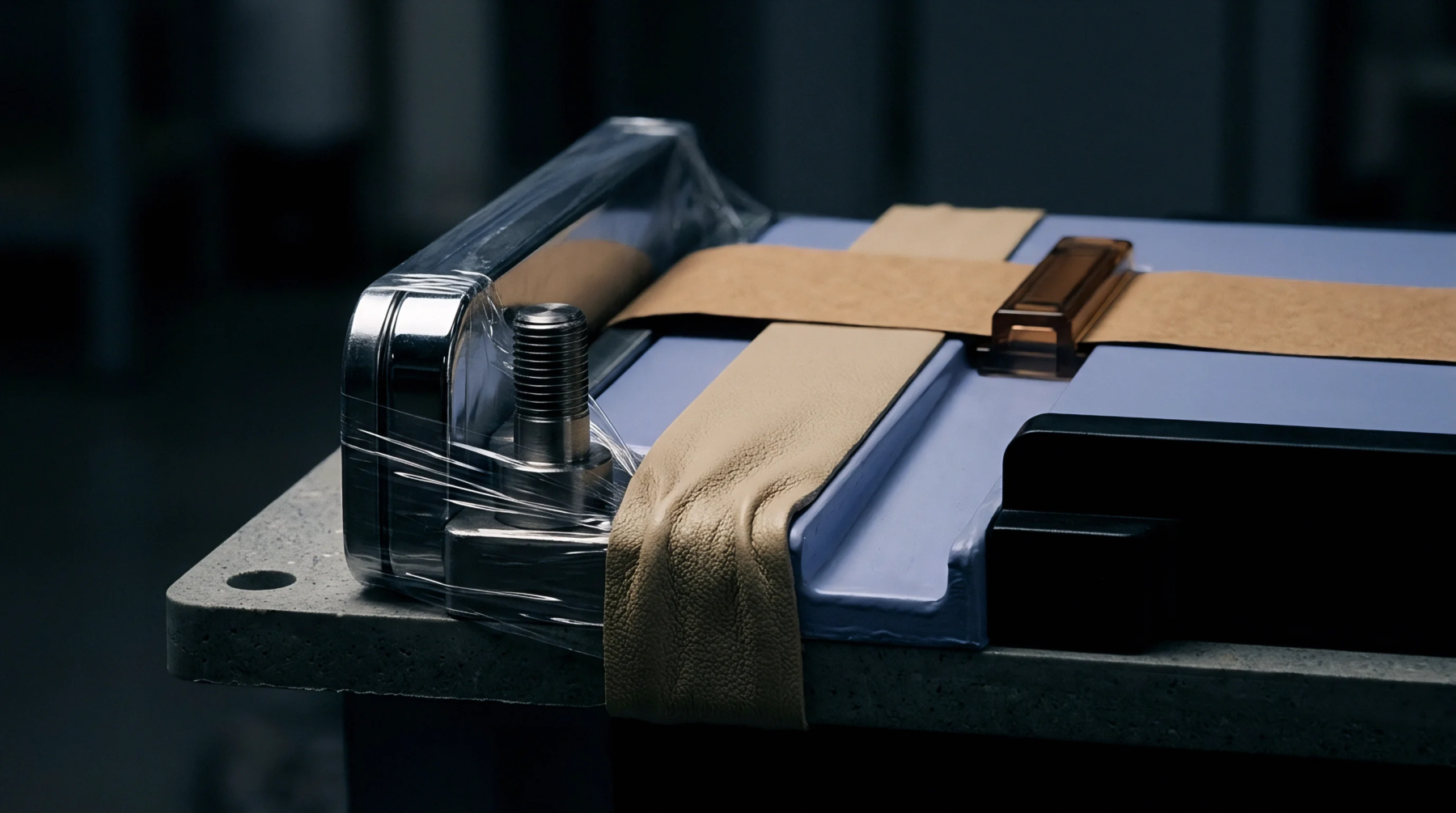
Mechanical Clamping Compression Mechanics under Cyclic Lithium Cell Swelling
Controlled mechanical clamping combines rigid platen bracing with elastomeric cushions to constrain cyclic lithium cell swelling stress between 0.2 and 0.5 MPa.
Resilient microcellular elastomeric pads positioned between individual cells inside battery modules to absorb cyclic volumetric expansion and sustain uniform contact stress define an essential compliance component in modular pack architecture. The silicone foam cushion acts as a mechanical spring, compressing during cell charging expansion and expanding back during discharge to maintain baseline interface pressure over thousands of cycles. Boundaries of the component include the cut sheet pad, optional pressure sensitive adhesive backings, and integrated dielectric film layers, terminating at adjacent cell casing faces and module structural end frames.
The material excludes exterior pack thermal insulation wraps, rigid plastic separator spacers, and liquid gap filling adhesives. Sourcing engineers evaluate these pads based on compression force deflection curves, flammability ratings, and long term compression set resistance under operating temperature extremes.
Open and closed cell microcellular structures formulated from crosslinked polysiloxanes exhibit a characteristic nonlinear compressive stress-strain profile. Initial deformation requires low stress as cell walls flex, followed by an extended plateau region where the silicone foam cushion absorbs cell thickness increases while generating minimal force rise. Approaching high compression levels initiates cellular densification, causing compressive stiffness to rise sharply to prevent destructive cell expansion.
Compressive performance remains stable across an operating temperature window from minus fifty to over two hundred degrees Celsius, far exceeding the functional range of conventional polyurethane foams. Low compression set characteristics allow the material to recover original dimensions repeatedly when cells contract during deep discharge periods.
Inserting compliant silicone pads between rigid or semi-rigid cells decouples individual expansion behaviors and stops tolerance stackup from breaking module end plates. The foam acts as a thermal barrier, slowing heat transfer from a failing cell to its neighbors during localized thermal runaways. High dielectric strength inherent to polysiloxane polymers prevents electrical arc tracking between adjacent metal prismatic casings or aluminum laminated pouches.
Flame retardant additives enable compliance with UL 94 V-0 safety benchmarks, preventing the cushion from propagating open flames during internal cell venting events. Suppressing vibrational resonance and cushioning against road shocks reduces mechanical stress transmitted into fragile busbar weld joints.
Technical procurement tenders specify cushion materials through precise compression force deflection targets, typically measured at twenty-five percent compression per ASTM D1056. Supply agreements define allowable thickness tolerances down to tenths of a millimeter, because variations across multi-cell stacks directly distort final module dimensions. Outgassing specifications, including total volatile condensable material thresholds under ASTM E595, ensure that silicone volatiles will not vaporize and contaminate sensitive high voltage relay contacts.
Sourcing teams compare compression set percentages after sustained heat aging to verify that clamping pressure will not decay prematurely. Silicone foam cushion integration dictates the mechanical stability and cyclic endurance of constrained pouch and prismatic battery assemblies.
Controlled mechanical clamping combines rigid platen bracing with elastomeric cushions to constrain cyclic lithium cell swelling stress between 0.2 and 0.5 MPa.
Expertise is a utility, not a secret. sentiention™ publishes its working knowledge as open reference: intelligence layer covering the materials it sources, the markets it enters, and the reference that serves both.