Carbide Dispersion Analysis in Powder Metallurgy Tool Steels
Automated SEM stereology verifies sub-two-micrometer carbide dispersion in PM tool steels, preventing edge chipping and premature fatigue failure in tooling dies.


Partition
Inert gas atomization uses rapid solidification to suppress macrosegregation, freezing solute elements within liquid droplets before liquidus partition coefficients can form coarse eutectic precipitates. By contrast, conventional ingot casting produces marked solidification banding, leaving primary eutectic carbide networks over 30 micrometers wide along the rolling direction. Atomizing high-alloy tool steel yields spherical powder particles cooled at rates between 100 and 10,000 kelvin per second.
As these droplets solidify, their dendritic arm spacing refines, confining solute enrichment to interdendritic gaps under 2 micrometers.
The phase identity and precipitation sequence of primary carbides depend on the thermodynamic equilibrium of vanadium, tungsten, molybdenum, and chromium. Vanadium-rich MC carbides are thermally stable enough to nucleate straight from the melt above 1250 degrees Celsius. Tungsten and molybdenum partition mainly into M6C carbides at lower liquidus temperatures, while chromium precipitates as M7C3 or M23C6 during secondary solidification or later solid-state cooling.
Solidification rates exceeding 1000 kelvin per second confine vanadium partition to droplet interdendritic spacings below two micrometers.
Alloy chemistry controls the carbide balance and the morphology of secondary hard phases throughout the matrix:
- Vanadium monocarbide phases form equiaxed cubic particles that resist Ostwald ripening during hot isostatic consolidation.
- Complex molybdenum-tungsten carbides form elongated, irregular structures along grain boundaries when sintering dwells exceed standard limits, reaching hardness values of 1500 HV.
- Chromium-bearing carbides dissolve during austenitization above 1050 degrees Celsius, supplying the martensitic matrix with enough carbon and chromium for a full secondary hardening response.
- Carbon-nitrogen stoichiometry shifts MC precipitation from skeletal dendrites to faceted polyhedral crystals.
The distribution of droplet sizes sets the scale of refinement in the consolidated billet. Powder fractions under 45 micrometers cool significantly faster than coarser particles between 106 and 150 micrometers, which retain internal dendritic networks and visible eutectic colonies. Hot isostatic pressing consolidates both into fully dense material, but the larger droplets carry their localized carbide clusters into the final microstructure.
Subsequent hot working breaks down former particle boundaries without changing the carbide size distribution fixed during droplet freezing. As a result, powder metallurgy keeps primary MC carbides between 0.5 and 3.0 micrometers, whereas ingot-cast steels of similar composition contain primary carbide clusters spanning 20 to 50 micrometers. Microstructural uniformity begins right at the atomization nozzle.


Stereology
Quantitative metallography relies on statistical models to extrapolate three-dimensional particle distributions from two-dimensional polished cross-sections. Manual rating charts such as ASTM E45 or SEP 1572 fall short for powder metallurgy grades because their standard templates expect large, elongated stringers. Instead, modern quality control uses automated image acquisition and backscattered electron imaging on a field emission scanning electron microscope.
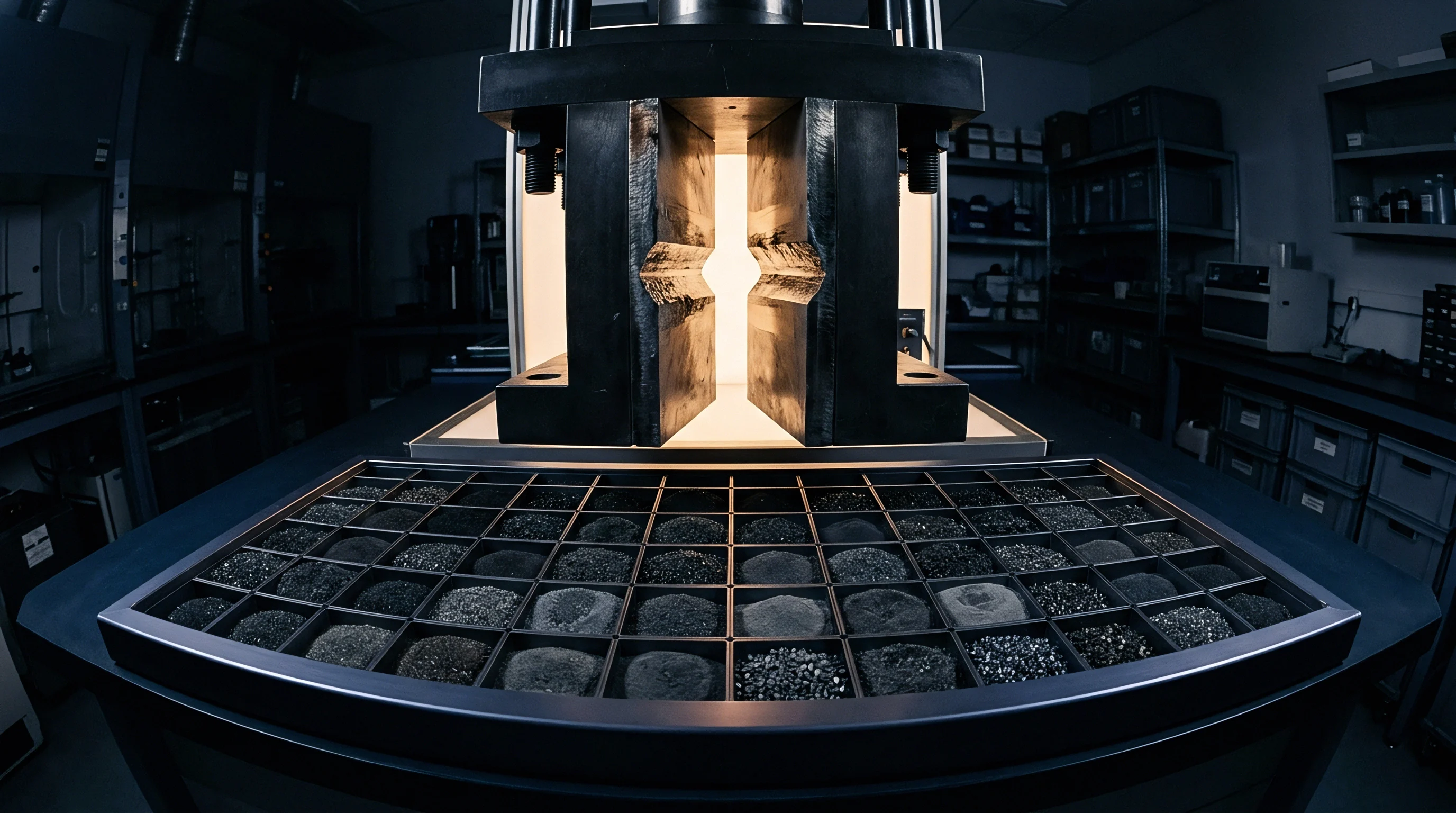
Image Segmentation Protocols
Setting the proper threshold dictates whether fine secondary carbides get counted or disappear into matrix noise. Elements with high atomic numbers, like tungsten and molybdenum, produce strong backscattered electron yields and show up bright in BSE images. Vanadium carbides have a lower mean atomic number than the iron matrix, so they appear darker than the surrounding martensite.
Dual-threshold digital segmentation isolates both phase groups into separate grey-level channels.
| Parameter | Mathematical Definition | Physical Significance | Target Range | Uncertainty |
|---|---|---|---|---|
| Area Fraction | Total carbide area divided by total field area | Total hard phase volume available for abrasive wear resistance | 0.12 to 0.28 | +/- 0.015 |
| Mean Equivalent Diameter | Diameter of circle with equal projected area | Resistance to brittle microcracking under cyclic contact stress | 0.8 to 1.8 micrometers | +/- 0.12 micrometers |
| Maximum Carbide Size | Feret diameter of the largest observed particle | Primary fatigue initiation flaw size within active tooling surfaces | less than 4.5 micrometers | +/- 0.4 micrometers |
| Mean Free Path | Average edge-to-edge matrix spacing between particles | Matrix mean unpinned dislocation slip length determining toughness | 2.1 to 4.8 micrometers | +/- 0.25 micrometers |
| Nearest Neighbor Distance | Centroid-to-centroid distance to closest neighboring particle | Metric of spatial randomness versus localized micro-clustering | 1.2 to 2.6 micrometers | +/- 0.18 micrometers |
Contrast drift during automated scanning can distort equivalent circle diameter calculations over long runs. To prevent this, Faraday cup calibration locks the beam current at 10 nanoamperes before serial tiles are collected. Each field covers 50 by 50 micrometers at 5000 times magnification, yielding a pixel resolution of 20 nanometers per pixel.
Analysis software then measures every feature above a 0.2-micrometer threshold, filtering out relief artifacts from polishing.
A thirty-field backscattered electron montage at 5000 times magnification captures over 15,000 discrete carbide particles with an area fraction uncertainty of 0.015.
Spatial Distribution and Nearest Neighbor Analysis
Random spatial arrangements follow Poisson point process models, where nearest-neighbor spacings fit a standard Gaussian curve. Carbide clustering skews this distribution toward smaller values, forming dense particle groups separated by wide gaps of unpinned matrix. The clustering index compares the observed mean nearest-neighbor distance against the theoretical distance for a purely random layout; values below 0.85 signal severe particle aggregation.
- Specimen cross-sectioning cuts samples along both transverse and longitudinal axes using low-speed diamond saws under continuous coolant flow.
- Mechanical grinding steps through 240, 400, 800, and 1200 grit silicon carbide papers, rotating the specimen for thirty seconds at each stage.
- Diamond polishing applies 3-micrometer and then 1-micrometer polycrystalline diamond suspensions on woven synthetic cloths, maintaining the surface planarity needed for stable focus depth.
- Vibratory finishing removes residual surface damage with a 0.05-micrometer colloidal silica suspension for sixty minutes, leaving samples unetched for backscattered electron imaging.
- Automated montage acquisition records sixty contiguous, non-overlapping fields across the core of the polished specimen.
Flawed stereological calibration can allow defective tool batches into production, where premature spalling breaks punch edges.

Banding
Hot isostatic pressing consolidates loose spherical powder into fully dense billets without mechanical working. Sealed steel cans filled with degassed powder are processed between 1100 and 1180 degrees Celsius under 100 to 140 megapascals of hydrostatic argon pressure, held for four hours. This uniform stress field eliminates internal porosity without causing directional material flow.
Subsequent forging and hot rolling introduce severe linear strain, aligning dispersed carbides into directional lanes. Heavy bar reduction elongates the structure, pulling neighboring particles into longitudinal strings along the main flow axis. Where ingot-cast tool steels develop continuous eutectic carbide bands extending over millimeters, powder metallurgy grades limit banding to minor fluctuations in local volume fraction.
Deformation reduction ratios govern whether subtle microstructural banding resolves into benign flow lanes or continuous fatigue pathways.
Minor directional carbide alignment is often regarded as having negligible impact on transverse rupture strength in finished tooling components.

Notch
Stress concentration near secondary hard phases sets the threshold for microcrack nucleation under cyclic loading. Because hard carbides have elastic moduli between 350 and 450 gigapascals while the tempered martensitic matrix sits around 210 gigapascals, this stiffness mismatch creates localized shear stress peaks at the particle-matrix interface. Under load, dislocation pileups generate tensile stresses high enough to exceed interfacial bond strength.
Fracture mechanics dictates that critical stress intensity factors control how cracks propagate from internal defects. A carbide particle functions as a microscopic Griffith notch, and the flaw size needed to trigger catastrophic brittle failure drops as matrix hardness rises above 60 HRC. For instance, a 5-micrometer carbide cluster in a 64 HRC matrix can drive fracture toughness below 12 megapascal root meters, initiating microcracks at stress levels far below nominal yield strength.
| Grade Family | Carbide Volume Fraction | Dominant Carbide Type | Mean Diameter (micrometers) | Transverse Rupture Strength (MPa) | Impact Energy Unnotched (J) |
|---|---|---|---|---|---|
| AISI M4 PM | 0.14 | MC and M6C | 1.1 +/- 0.2 | 4100 +/- 250 | 38 +/- 4 |
| AISI T15 PM | 0.21 | MC and M6C | 1.4 +/- 0.3 | 3700 +/- 220 | 28 +/- 3 |
| AISI A11 PM | 0.18 | MC | 1.6 +/- 0.3 | 3900 +/- 280 | 32 +/- 4 |
| High V-Co PM | 0.26 | MC and M6C | 1.8 +/- 0.4 | 3400 +/- 310 | 22 +/- 3 |
Higher carbide volume fractions improve abrasive wear resistance, but impact toughness drops as particle size and clustering increase. For precision stamping and rotary slitting dies, edge retention depends on avoiding micro-chipping. When shearing thin foil for lithium-ion battery electrodes, slitter edges face localized contact stresses over 3000 megapascals.
Oversized carbides fracture under this cyclic loading, tearing away from the matrix and leaving open edge voids that create burrs on the trimmed foil.
- Interfacial void formation begins at the tensile poles of equiaxed vanadium monocarbide particles under cyclic shear strain.
- Particle cleavage cracking dominates in angular M6C carbides exceeding 3 micrometers in equivalent circular diameter, reducing toughness.
- Matrix fatigue progression connects microcracks across adjacent carbide bands, accelerating macro-chipping along cutting edges.
A fine dispersion preserves edge sharpness because small hard particles wear flush with the matrix rather than plucking out during abrasive contact.

Yield
Procurement specifications for powder metallurgy tool steels need clear microstructural thresholds backed by quantitative stereological data. Mill certificates showing only bulk chemical analysis and macro-hardness leave buyers vulnerable to inconsistent powder batches or defective consolidation. Proper incoming verification requires quantitative metallographic analysis of sample slices taken from both ends of the billet.
Purchasing agreements should define explicit limits for maximum carbide diameter, mean free path, and spatial clustering. Standard purchase orders that rely on generic grade designations do not enforce tight microstructural control. Orders ought to mandate non-destructive testing requirements, metallographic preparation methods, and automated SEM inspection protocols before final payment approval.
ASTM E1245 specifies the mandatory statistical field sample count for automated inclusion and secondary phase rating in high-performance tool steels.
A purchase clause setting rejection thresholds for continuous carbide clusters over four micrometers in diameter places financial liability for premature tool failure squarely on the supplier.