Predictive Coupled Hydrodynamic Electrochemical Modeling of Localized Intermetallic Phase Dissolution inside Hermetic Pack Enclosures
Coupled hydrodynamic-electrochemical modeling predicts intermetallic dissolution in sealed packs by linking thin-film condensation to micro-galvanic corrosion kinetics.

Film
Boundary Layer Liquid Accumulation
Inside hermetically sealed battery enclosures, condensed liquid layers migrate over structural aluminum surfaces under gravity and local thermal gradients in the gas phase. Temperature drops across the pack walls produce micro-scale variations in surface tension that drive thermocapillary flow across internal busbars and structural tray cast walls. Depending on local relative humidity and temperature transients, liquid film thickness on vertical and inclined enclosure faces varies between 5 micrometers and 120 micrometers.
Condensing water vapor first forms discrete droplets on the metal, which then coalesce into continuous films bridging electrical contacts and structural components.
- Vapor molecules migrate toward internal structural surfaces that drop below the local dew point temperature during rapid pack cooling cycles.
- Initial nucleation forms microscopic droplets on intermetallic surface features where local surface energy variations promote wetting.
- Direct vapor absorption grows these droplets until neighboring ones touch and merge into irregular liquid patches across the metal substrate.
- Gravity and internal air flow then drag the accumulated fluid layer down into structural seams, busbar joints, and cell pouch tabs.
Surface tension gradients drive film movement at velocities up to 0.45 millimeters per second when internal pack temperature differentials exceed 3.2 degrees Celsius per centimeter.
Fluid pooling in low-clearance crevices accelerates local chemical reactions. Surface roughness dictates how much liquid a surface holds: raw die-cast aluminum trays retain nearly triple the fluid volume per unit area of post-machined mounting surfaces. Flow velocities within the liquid boundary layer remain in the creeping flow regime, where viscous drag dominates inertial forces.
Oxygen transport through these thin liquid films dictates the reduction kinetics that keep anodic reactions going on embedded intermetallic particles.

Capillary Drag and Transport Mechanics
Capillary forces draw liquid into narrow gaps between cell housings and structural enclosure parts. Clearances under 0.8 millimeters set up strong capillary pressure gradients that pull thin electrolyte layers deep into mechanical joints. Within these tight spaces, mass transfer relies mostly on molecular diffusion because bulk fluid movement drops off sharply.
Accumulated fluid profiles stay stable until vibration or thermal expansion shifts the channel geometry. If local evaporation temporarily outpaces incoming condensation, the liquid film breaks up, leaving micro-droplets trapped around intermetallic precipitates. Fluid drainage down vertical structural walls follows standard film dynamics, where viscosity and wall drag set the drainage time constants.
Film movement stops once internal relative humidity drops below saturation. Under dry pack conditions, internal surfaces maintain high electrical isolation.
Pit
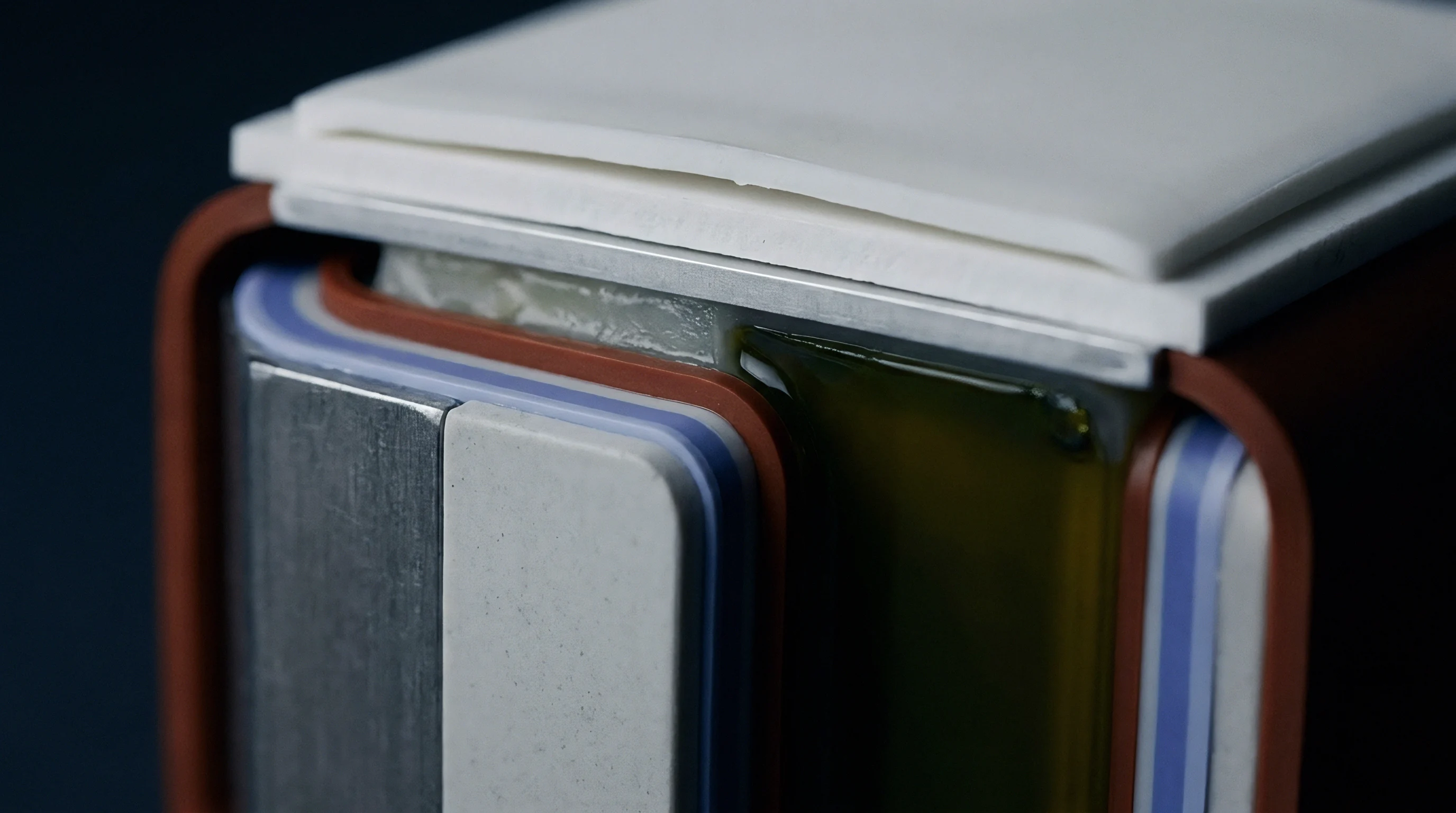
Galvanic Phase Dissolution Kinetics
Structural aluminum alloys and busbar materials contain intermetallic phases that form local galvanic couples when covered by thin liquid films. Alloy 6061-T6, for instance, contains magnesium-silicide precipitates along with copper- and iron-bearing intermetallics like Al3Fe and Al12Fe3Si. In dilute chloride condensates, iron-rich phases show open-circuit potentials up to 350 millivolts noble relative to the surrounding aluminum matrix.
Magnesium-silicide phases act anodically, dissolving preferentially to leave porous micro-cavities that concentrate local stress.
| Phase Composition | Open Circuit Potential versus SCE (mV) | Galvanic Current Density (μA/cm²) | Dominant Reaction Mode |
|---|---|---|---|
| Al3Fe Precipitate | -540 | 42.5 | Cathodic matrix dissolution around particle |
| Mg2Si Particle | -1180 | 88.2 | Preferential anodic particle dealloying |
| Al2Cu (Theta Phase) | -660 | 31.0 | Cathodic driving of adjacent matrix attack |
| Al12Fe3Si Constituent | -590 | 18.4 | Oxygen reduction site with matrix pitting |
Electrochemical dissolution of intermetallic phases initiates localized attack through structural walls and sealing faces. Current density distribution around an isolated particle depends heavily on film conductivity. Dilute condensates present high ionic resistance, confining galvanic action to within 50 micrometers of the particle perimeter.
As dissolution continues, hydrolysis inside the active cavity acidifies the solution, driving local pH down between 3.1 and 3.8.
Liquid layer conductivity below 15 microsiemens per centimeter confines galvanic corrosion currents to the immediate boundary of the intermetallic particle.
Pitting propagation depends on a steady supply of cathodic reactant to adjacent metal surfaces. Oxygen diffusion through thin fluid films provides the flux needed for cathodic reduction at noble intermetallic sites. Once condensation layers thicken beyond 200 micrometers, oxygen diffusion resistance rises, slowing penetration rates even though bulk fluid volume is higher.
Microstructural Phase Qualification
Preventing localized intermetallic dissolution requires tight control over alloy composition and thermal history. Metallurgical inspection routines verify phase distribution across critical sealing surfaces before components head to assembly lines.
- Intermetallic particle size limits maximum particle diameter to 5 micrometers across all structural sealing surfaces to minimize local galvanic potential gradients.
- Constituent area fraction restricts total noble intermetallic phase coverage to under 1.2 percent in structural aluminum extrusions.
- Homogenization heat treatment eliminates solute segregation spikes that drive micro-galvanic potential offsets across grain boundaries.
- Surface passivation quality confirms that chromium-free conversion coatings deliver a breakdown potential at least 400 millivolts above open circuit potential.
Structural die-cast housing alloys frequently pass standard salt spray exposure without showing structural degradation. However, that test environment applies continuous salt fog at elevated temperatures, which bears little relationship to the intermittent, low-conductivity condensation cycles experienced inside hermetically sealed battery enclosures under real thermal swings.
Microclimate
Why Standard Condensation Models Miss Intermetallic Attack?
Moisture ingress past enclosure seals, combined with traces of cell outgassing, creates a distinct internal chemical environment. Hermetic seals allow slow water vapor transport driven by ambient humidity changes and internal pressure swings. Over time, vapor accumulates in the pack cavity and reaches the dew point whenever cooling drops wall temperatures below internal saturation thresholds.
Trace organic carbonates or fluorine-bearing gases from cell vents then alter both the surface tension and chemical aggressiveness of the condensed film.
| Environmental Parameter | Nominal Sealed Value | Severe Duty Transient Value | Impact on Dissolution Kinetics |
|---|---|---|---|
| Internal Dew Point (°C) | 12.5 | 38.2 | Controls fluid condensation onset temperature |
| Condensate pH | 6.8 | 3.4 | Accelerates aluminum oxide film breakdown |
| Chloride Concentration (ppm) | 0.5 | 14.0 | Initiates pit nucleation on intermetallic sites |
| Carbonate Trace Level (ppm) | 0.0 | 125.0 | Reduces fluid surface tension and enhances wetting |
Trace species in the sealed atmosphere dissolve into condensed films, raising ionic conductivity. Hydrofluoric acid formed when electrolyte solvent residues react with ingressed moisture lowers the liquid’s pH. This acidic environment dissolves the protective aluminum oxide film, exposing intermetallic phases to direct electrochemical attack.
Inclusion of 5 ppm hydrofluoric acid in internal condensate increases intermetallic dissolution current density by a factor of four.
Internal pressure changes cycle ambient air through gasket micro-leaks. Pressure compensation valves with hydrophobic breather membranes stop bulk liquid ingress while allowing vapor transport. Membrane pore size distribution then determines how fast water vapor diffuses into the cavity during extended storage in humid climates.

Atmospheric Failure Degradation Pathways
Corrosion inside sealed battery packs advances through distinct mechanical and chemical steps. Identifying these pathways guides material selection and seal design.
- Seal permeability degradation allows continuous moisture accumulation that raises baseline internal humidity above 85 percent.
- Acidic condensate accumulation lowers fluid pH near structural joints, triggering rapid breakdown of protective surface oxides.
- Intergranular dissolution propagation extends micro-cracks along grain boundaries subjected to sustained stress and local galvanic currents.
- Insulation resistance decay occurs as conductive corrosion slurry spreads across high-voltage busbar supports.
Ignoring atmospheric changes inside the enclosure leads to premature isolation faults and loss of structural integrity. Standard IEC 60068-2-30 qualification testing uses thermal cycling under high humidity to expose these condensation pathways before tooling designs freeze.
Grid
Multiphysics Discretization and Transport Coupling
Coupled predictive modeling of localized intermetallic dissolution requires solving thin-film hydrodynamics, Nernst-Planck species transport, and potential fields simultaneously over moving mesh geometries. Fluid flow in the condensed film follows a shallow-water Navier-Stokes formulation, with zero-slip conditions at the solid interface and temperature-dependent surface tension forces at the liquid-gas boundary. An arbitrary Lagrangian-Eulerian spatial discretization scheme tracks metal surface recession as intermetallic phases dissolve.
Species transport equations account for diffusion, electromigration, and advection within the film. Mesh elements inside the liquid domain require adaptive refinement down to sub-micrometer scales within the electrochemical boundary layer surrounding active particles. Near dissolving surfaces, element aspect ratios must stay below 3.0 to prevent numerical diffusion artifacts from skewing local concentration gradients.
Consider a representative calculation with an isolated cylindrical Al3Fe particle (radius 5 micrometers) embedded in a 6061 aluminum matrix and covered by a 50-micrometer static condensate film with 5 ppm chloride ions. The model discretizes the liquid domain into a 2D axisymmetric mesh of 24,000 triangular elements. Cathodic oxygen reduction on the Al3Fe surface uses Tafel kinetics with an exchange current density of 1.2 x 10^-3 A/m² and a transfer coefficient of 0.5.
The adjacent aluminum matrix dissolves anodically with an exchange current density of 4.5 x 10^-4 A/m² and a transfer coefficient of 1.5, relative to a breakdown potential offset of -0.72 V versus standard hydrogen electrode.
Calculations show that within the first 3,600 seconds of continuous condensation, local current density at the particle boundary peaks at 64 μA/cm². Oxygen directly above the particle center depletes within 420 seconds, pushing the primary cathodic reaction zone outward toward the edge of the liquid film where atmospheric oxygen replenishment is unhindered. Under steady thermal conditions over 100 hours of exposure, this localized dissolution yields a pit depth of 1.8 micrometers around the particle perimeter.
Iterative convergence requires absolute residuals for potential fields and species concentrations to drop below 10^-6 per step. Implicit backward-differentiation formulas with dynamic step-size control handle the time-stepping, capturing fast initial kinetic transients alongside slow, long-term surface recession.
Simulation Framework Requirements
Deploying these coupled hydrodynamic-electrochemical models requires structured documentation to validate simulation outputs against physical corrosion measurements.
- Thermodynamic database inputs provide temperature-dependent solubility limits, species diffusivities, and mineral precipitation constants.
- Kinetic polarization curves supply measured anodic and cathodic Tafel slopes for specific intermetallic phases in low-conductivity electrolyte solutions.
- Hydrodynamic boundary parameters define temperature-dependent contact angles, surface roughness drag coefficients, and gas phase shear stresses.
- Mesh convergence studies confirm that calculated local corrosion current densities are independent of spatial grid resolution across refinement scales.
Whether numerical models accurately capture dissolution rates under fluctuating temperature and pressure profiles remains an open question that demands further physical validation.
Margin

Tooling Capital and Qualification Costs
Capital investments in pack tooling and enclosure manufacturing require balancing simulation costs against physical qualification testing and warranty risk. Tooling for die-cast aluminum pack housings involves non-recurring engineering costs between $250,000 and $850,000 per set, depending on size and core complexity. Altering structural housing geometry after steel has been cut incurs heavy mold modification charges and delays product launches by months.
| Validation Methodology | Direct Capital Commitment ($) | Execution Lead Time (Weeks) | Risk Identification Capability |
|---|---|---|---|
| Empirical Chamber Testing Only | 120,000 | 24 | Detects late-stage physical failure modes |
| Coupled Multiphysics Modeling | 45,000 | 6 | Identifies microclimatic pit nucleation zones early |
| Combined Modeling and Physical Testing | 150,000 | 28 | Provides verified design margin and risk mitigation |
Predictive modeling lowers capital risk by highlighting condensation zones before steel is cut. Simulating microclimate evolution and intermetallic dissolution costs a fraction of physical testing while allowing engineers to evaluate housing geometries, internal baffles, and breather placement in software. Front-loading this analysis preserves capital for cell procurement and battery management optimization.
Multiphysics modeling identifies localized corrosion risks weeks before physical prototypes enter environmental testing chambers.
Unplanned warranty expenses from internal corrosion leaks quickly outstrip development budgets. Field failures where intermetallic dissolution penetrates cooling plates or outer walls trigger costly recalls and regulatory reviews. Allocating budget for simulation early in design protects long-term project margins.

Commercial Risk Seams
A clear division of technical and compliance responsibilities prevents disputes between cell manufacturers, foundries, and pack integrators. Contracts must set explicit boundaries for environmental performance and microclimate management.
Standard quality agreements specify that enclosure suppliers deliver structural castings meeting strict intermetallic distribution standards, while pack integration engineers retain responsibility for internal climate controls and breather sizing under UN 38.3 structural integrity guidelines.