Packing Instruction 965 Baseline Compliance Verification Requirements
Air shipment under Packing Instruction 965 demands verified sub-30% charge, UN 38.3 test summaries, and certified packaging strictly for cargo aircraft.

Threshold
Standalone lithium ion cell air transport is classified under United Nations number UN 3480, governed globally by the International Civil Aviation Organization Technical Instructions and executed commercially under the International Air Transport Association Dangerous Goods Regulations. Packing Instruction 965 applies strictly to lithium ion cells and batteries offered for carriage without accompanying equipment. Every consignment under this instruction travels exclusively aboard dedicated cargo aircraft; passenger airframes remain closed to standalone lithium ion energy storage across every global routing.
Regulatory classification divides Packing Instruction 965 into two operational paths following the removal of Section II standalone provisions: Section IA and Section IB. This division governs packaging construction standards, gross mass limits, documentation formality, and inspection rigor at carrier acceptance desks.
Cell capacity and total package weight dictate the regulatory baseline. Section IA covers cells exceeding 20 Watt-hours and batteries exceeding 100 Watt-hours, alongside smaller units packed in quantities surpassing Section IB net weight allowances. Section IB accommodates cells up to 20 Watt-hours and battery packs up to 100 Watt-hours where package quantities remain at or below 10 kilograms net mass.
Exceeding those electrical ratings routes the consignment immediately into full Class 9 specification protocol.
Section IA air cargo movements cap package net mass at thirty-five kilograms aboard freighter aircraft.
Cargo handlers verify the Watt-hour ratings declared on outer cases against strict limits. Cells carry no legal tolerance on the 20 Watt-hour boundary. A cell rated at 20.2 Watt-hours falls into Section IA, requiring UN-certified packaging, formal dangerous goods declarations, and full dangerous goods tariff billing.
| Parameter | Section IA | Section IB |
|---|---|---|
| Cell Watt-Hour Ceiling | Exceeding 20 Wh | 20 Wh or Less |
| Battery Watt-Hour Ceiling | Exceeding 100 Wh | 100 Wh or Less |
| Packaging Performance | UN Certified Packaging Group II | Rigid Outer Strong Packaging |
| Maximum Net Mass Per Package | 35 kg Cargo Aircraft Only | 10 kg Cargo Aircraft Only |
| Shipper Declaration Paperwork | Full Dangerous Goods Declaration | Air Waybill with Nature and Quantity |
| Hazard Labeling Format | Class 9 Hazard and Cargo Aircraft Only | Class 9A Lithium and Cargo Aircraft Only |
Tendering an erroneously classified Section IB carton brings immediate carrier rejection, cargo impoundment, carrier blacklisting, and civil enforcement penalties exceeding thirty-five thousand dollars per violation from civil aviation safety regulators.

Charge
Air transport authorities enforce a strict limit on chemical energy storage inside standalone cells before acceptance onto an airframe. The mandate restricts cell state of charge to a maximum of thirty percent of rated design capacity during transit, reducing thermal runaway risk, propagation speed, and toxic gas discharge volume during unexpected depressurization or physical shock.

Does Internal Impedance Distort Gauge Measurements?
Measuring the baseline state of charge across high-volume production runs presents physical measurement challenges. Factory test channels rely heavily on terminal voltage to infer battery reserve, yet voltage curves for lithium iron phosphate cells stay exceptionally flat between twenty percent and seventy percent state of charge. A five-millivolt reading shift at room temperature spans a fifteen percent difference in actual electrochemical charge.
Equilibration periods alter measured terminal potentials. Cells fresh from factory formation lines carry elevated polarization voltages that degrade over forty-eight hours of rest. Inspectors verify that factory resting periods exceed forty-eight hours before final open-circuit voltage screening occurs; skipping this dwell produces shipments that pass internal gates yet test out of compliance at freight collection hubs.
Open-circuit voltage verification on iron phosphate cells demands four hours minimum resting stabilization.
Coupling ampere-hour integration with precise open-circuit voltage resting tables addresses the flat-curve verification challenge. Quality auditors require factory test channels to execute a controlled discharge cycle to zero percent reference state, followed by an exact ampere-hour metered top-up to twenty-seven percent. This target provides a three percent buffer against thermal drift and channel calibration variance.
- Depletion Cycle brings the cell down to discharge cut-off voltage under a controlled half-C discharge rate inside ambient test chambers held at twenty-five degrees Celsius.
- Rest Interval allows cell internal chemistry and thermal gradients to stabilize for thirty minutes while measurement circuits log zero current flow.
- Controlled Top-Up delivers twenty-seven percent of nameplate capacity through precision coulometric counting calibrated against national laboratory references.
- Open-Circuit Check records the settled cell voltage across gold-plated four-wire kelvin clips to confirm alignment with validated chemistry lookup charts.
When open-circuit voltage is measured on fully relaxed chemistry, cell state remains safely above transport stability floors without rising into propagation ranges.


Carton
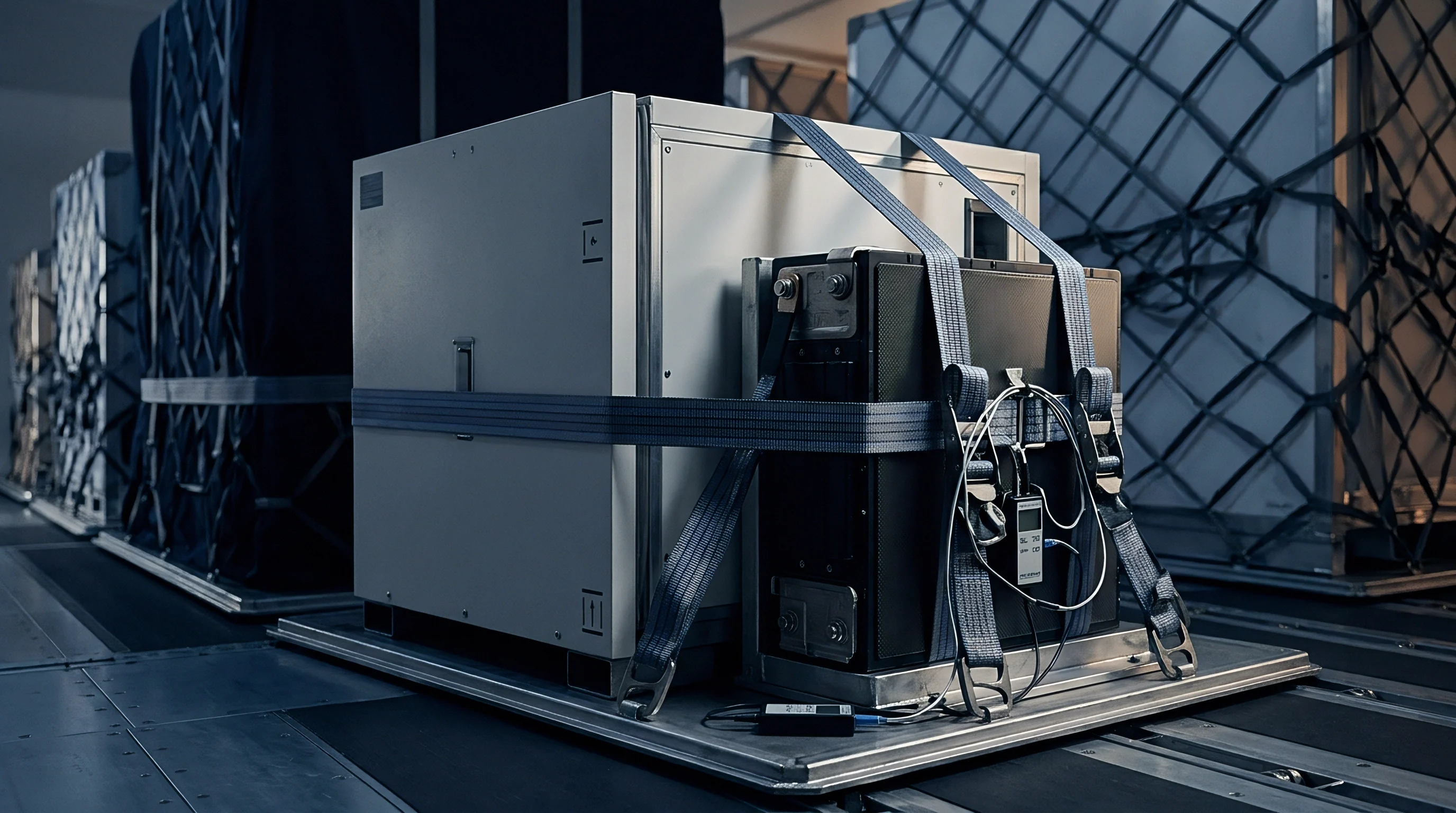
Outer packaging shields secondary cells against mechanical deformation, vibration harmonics, and unexpected external impact during transit. Section IA consignments demand UN-rated packaging meeting Packing Group II performance standards, verified through independent drop, stack, and puncture certification runs. Section IB packages undergo a one-point-two-meter drop sequence onto concrete without structural rupture or cell displacement.
Packaging Structural Protection Criteria
Corrugated cardboard containers deform under sustained relative humidity inside airport transfer zones, losing up to forty percent of their box compression strength when warehouse relative humidity passes eighty percent. Packaging engineers specify double-wall or triple-wall fiberboard with high wet-strength additives to maintain structural integrity across ocean-adjacent air transit hubs.
Inner packaging isolates individual cells to prevent external short circuits. Separators, thermoformed trays, and individual plastic sleeves must retain position when cartons tip during sorting. Direct terminal-to-terminal contact establishes short circuits, generating local resistive heat capable of igniting carton dividers.
- Terminal Insulation Caps cover positive and negative posts using non-conductive vinyl or polyester barriers that stay affixed under three kilograms of pull force.
- Die-Cut Trays seat individual cells inside thermoformed wells that maintain five millimeters clearance between adjacent metallic cell walls under transit vibration.
- Cushioning Fillers compress under shock absorption without releasing fine particulate matter or shredding during standard airport conveyer transfers.
- Moisture Barriers seal boxed assemblies inside heat-sealed foil bags containing desiccant packs when tropical transit routings risk internal condensation.
Packaging design integrity ensures cells arrive intact, with drop testing validating durability across six distinct impact vectors.
| Drop Sequence Orientation | Drop Height | Impact Surface | Pass Verification Standard |
|---|---|---|---|
| Flat on Bottom Face | 1.2 Meters | Solid Concrete Plate | Zero Cell Damage or Shifting |
| Flat on Top Face | 1.2 Meters | Solid Concrete Plate | Zero Outer Rupture |
| Flat on Long Side | 1.2 Meters | Solid Concrete Plate | Zero Liner Tearing |
| Flat on Short Side | 1.2 Meters | Solid Concrete Plate | Zero Internal Movement |
| Impact on Bottom Corner | 1.2 Meters | Solid Concrete Plate | Carton Retains Containment |
| Impact on Long Edge | 1.2 Meters | Solid Concrete Plate | No Short Circuits Induced |
Minor cosmetic cardboard crushing during drop trials satisfies safety requirements only if internal cells remain secure and undamaged inside the outer packaging.


Dossier
Paper records substantiate technical compliance before aircraft ramp workers touch any cargo pallet. Dangerous goods specialists at airlines review paperwork with zero tolerance for clerical discrepancies. The primary technical foundation remains the United Nations 38.3 Test Summary document, structured according to paragraph 38.3.5 of the UN Manual of Tests and Criteria.
Is Third-Party Laboratory Accreditation Compulsory?
Airlines systematically inspect test summaries for specific technical entries, including cell manufacturer, laboratory accreditation credentials, test report reference serials, cell chemistry, physical dimensions, and exact gram weights. A missing signatory title or absent laboratory ISO 17025 accreditation stamp grounds the freight on cargo terminal floors.
UN 38.3 test summaries lack validity without explicit documentation of the eight sequential physical tests.
Shippers reconcile laboratory test descriptions against physical factory labels. Discrepancies between the cell part number etched onto the casing and the model designation listed in the UN 38.3 summary trigger instant documentation rejection. Shipping newly revised cell revisions under legacy base-model test reports risks cargo seizure.
- Altitude Simulation tests low pressure conditions at 11.6 kilopascals for six hours to verify seal resilience and prevent electrolyte leakage.
- Thermal Profile cycles cells between negative forty degrees and positive seventy-two degrees Celsius to expose expansion fractures and thermal mismatch.
- Vibration Cycle subjects units to logarithmic frequency sweeps from seven to two hundred Hertz across three mutually perpendicular axes.
- Shock Impact delivers half-sine acceleration pulses reaching one hundred fifty gravities to evaluate internal weld tabs and electrode anchors.
- External Short establishes an external resistance under one-tenth of an ohm at fifty-seven degrees Celsius to test internal current interrupt devices.
- Crush Mechanics deforms cell casings using hydraulic actuators to test separator resistance against mechanical penetration and internal shorting.
- Overcharge Cycling exposes cells to double maximum continuous charging currents to evaluate chemical and thermal dissipation safeguards.
- Forced Discharge subjects cells to reverse polarity current at room temperature to evaluate cell behavior under extreme pack-level imbalances.
Under international transport regulations, Article 4 of the carrier acceptance standard specifies that any variation between physical invoice part numbers and certified test summary descriptors invalidates the transport classification entirely.

Consignment
Physical presentation at carrier cargo acceptance bays tests the operational cohesion of the entire compliance file. Acceptance agents cross-examine pallet weight tallies against electronic airway bill declarations, while cargo handlers verify that package markings face outward, legible, and unmarred by pallet wrap.
Label geometry commands absolute precision. The Class 9A lithium battery label must measure at least one hundred millimeters by one hundred millimeters, bordered by a solid line sitting five millimeters inside the outer boundary. The Cargo Aircraft Only label sits adjacent to the hazard sticker on the same package face.
Placing labels around carton edges or allowing overlapping borders constitutes cause for immediate refusal.
Labels positioned across package corners fail carrier acceptance checks instantly.
Audits reveal clear discrepancies between laboratory test environments and commercial packing shed reality. A cell lot manufactured in June carrying test paperwork dated three years prior raises legitimate verification questions when active material formulations undergo unannounced factory adjustments. Chemical alterations inside anode binders or cathode coatings shift thermal stability ceilings without alerting the transport paper trail.
The regulatory structure relies on producer integrity across the manufacturing chain. How airline verification personnel can definitively authenticate that delivered cells share identical internal separator coatings with tested laboratory prototypes remains unresolved across global freight networks.