Quantifying Grain Boundary Oxygen Degassing Kinetics under Accelerated Thermal Testing
Quantifying grain boundary oxygen release via multi-rate calorimetry establishes the true thermal stability barrier of aged high-nickel cathode cells.


Lattice
During early thermal excitation, nickel-rich cathode materials release molecular oxygen through intergranular facet separation. When layered LiNi0.8Mn0.1Co0.1O2 is delithiated beyond 4.2 volts versus lithium, its crystal structure transitions from the hexagonal R-3m phase into an unstable, spinel-like Fd-3m arrangement. This structural reconstruction frees reactive oxygen from transition metal coordination shells.
Primary crystallites inside secondary spherical agglomerates undergo severe anisotropic contraction along the c-axis ~ shrinking the lattice by roughly three percent. The resulting internal shear stress ruptures the cohesive boundaries between crystallites, allowing oxygen liberated at these fresh, unpassivated internal facets to diffuse along fractured boundary planes toward the liquid electrolyte.
Off-gassing starts well below the bulk cathode thermal collapse threshold. Differential scanning calorimetry paired with mass spectrometry registers oxygen release at temperatures as low as 165 degrees Celsius in cells charged to 4.3 volts. Because intragranular bulk diffusion of oxygen anions is negligible below two hundred degrees, mass transfer relies entirely on the open grain boundary network formed by anisotropic contraction.
Gas escape rates are governed by how fast cracks propagate through secondary agglomerate cores.
Primary grain boundary microcracking accelerates oxygen release before bulk phase transformation starts.
Microstructural degradation alters the chemical nature of the emitted species through secondary reactions at the interface:
- Intergranular facet cleavage creates microscopic void channels that channel gaseous oxygen from the core of secondary spheres to the electrolyte interface.
- Solvent vapor combustion consumes the escaping oxygen species instantly, generating carbon dioxide, carbon monoxide, and water vapor at elevated pressures.
- Rock-salt transformation forms a densified NiO-type surface reconstruction layer along grain walls, which temporarily chokes local mass transport until internal gas pressure forces mechanical fracture.
The resulting internal cavity pressurization shatters the secondary particle into fragments. This pulverization increases the effective surface area exposed to combustible organic solvents by several orders of magnitude.

Calorimetry
Quantifying intergranular gas release requires instrument sensitivity capable of isolating mass loss signals from baseline evaporation drift. Thermogravimetric analysis paired with quadrupole mass spectrometry measures exact ion currents corresponding to atomic oxygen, molecular oxygen, carbon dioxide, and fluorinated fragments. Testing cathode powders harvested from formation-aged cells requires strict vacuum preparation to eliminate residual alkyl carbonate solvents, as trace dimethyl carbonate remnants yield hydrocarbon fragments at the same mass-to-charge ratio of thirty-two occupied by diatomic oxygen.
Vacuum drying at eighty degrees Celsius for twelve hours purges these volatile compounds without inducing structural relaxation.
Accelerating rate calorimetry establishes thermodynamic self-heating profiles under adiabatic conditions where the cell retains its heat without conductive loss to chamber walls. The instrument tracks self-heating rates starting at 0.02 degrees Celsius per minute. A sealed stainless-steel bomb holds the cathode mass immersed in commercial electrolyte solution to reproduce cell atmospheres.
Across adiabatic calorimeters charged to 4.25 volts, NMC811 releases thirty-two standard cubic centimeters of gas per gram between 190 and 235 degrees Celsius.
Gas volume calculations rely on pressure transducers attached to the thermal chamber. The ideal gas law translates headspace pressure spikes into molar quantities of evolved oxygen, accounting for the thermal expansion of vessel hardware. Integrating mass loss curves across calibrated temperature intervals distinguishes boundary-driven degassing from subsequent bulk thermal breakdown.
| Cathode Chemistry | Nickel Mole Fraction | Onset Degassing Temp (C) | Primary Gas Volume (mL/g) | Intergranular Crack Density (um/um2) | Total Mass Loss at 300C (%) |
|---|---|---|---|---|---|
| LiNi0.6Mn0.2Co0.2O2 | 0.60 | 218 | 14.2 | 0.08 | 4.1 |
| LiNi0.8Mn0.1Co0.1O2 | 0.80 | 178 | 31.8 | 0.29 | 8.6 |
| LiNi0.85Co0.10Al0.05O2 | 0.85 | 169 | 37.4 | 0.34 | 10.2 |
| LiNi0.90Mn0.05Co0.05O2 | 0.90 | 154 | 46.1 | 0.48 | 13.8 |
Comparing these chemistries reveals a sharp drop in stability once nickel content exceeds eighty molar percent. Moving from NMC622 to NMC90 lowers the onset temperature by sixty-four degrees Celsius while gas volume expands threefold over the same span. Secondary electron micrographs confirm that crack density directly mirrors the volume of released gas.
However, these measurements capture only the gas surviving immediate solvent combustion in closed test vessels, leaving unresolved what fraction of oxygen is consumed in subsurface boundary reactions before reaching the sensor.


Ramp
Determining kinetic parameters from accelerated thermal ramp tests requires a multi-rate iso-conversional approach. Standard single-heating-rate methods introduce systemic errors by confounding reaction order with thermal acceleration. Testing specimens across four heating rates ~ one, two, five, and ten Kelvin per minute ~ resolves this ambiguity.
As the heating rate increases, temperatures corresponding to fixed conversion fractions shift upward, exposing the underlying kinetic energy barrier.

How Do Heating Rates Alter Apparent Activation Energies?
Varying the heating rate separates rapid surface oxidation from slower bulk solid-state diffusion. Fast thermal sweeps compress degradation stages into single, unresolved peaks. Here, the apparent activation energy represents the barrier to mobilizing lattice oxygen across the primary grain interface into open micro-fissures, calculated using both the Kissinger method and the Ozawa-Flynn-Wall integral approach.
In a typical kinetic evaluation of a thirty-milligram delithiated LiNi0.8Mn0.1Co0.1O2 specimen extracted from a pouch cell at one hundred percent state of charge, thermal analysis under pure argon sweep gas at rates of one, two, five, and ten Kelvin per minute yields peak degassing temperatures at 182, 191, 204, and 216 degrees Celsius (455.15, 464.15, 477.15, and 489.15 Kelvin).
Plotting the natural logarithm of the heating rate divided by the squared absolute peak temperature against the reciprocal of absolute temperature yields a linear regression line. Its slope equals the negative apparent activation energy divided by the universal gas constant. With a slope of negative 12,650 Kelvin, multiplying by 8.314 Joules per mole Kelvin gives an apparent activation energy of 105.2 kilojoules per mole, with a pre-exponential factor of 4.2 times ten to the ninth inverse seconds.
| Conversion Extent Alpha | Kissinger Activation Energy (kJ/mol) | OFW Activation Energy (kJ/mol) | Linear Correlation Factor R2 | Dominant Degradation Mechanism |
|---|---|---|---|---|
| 0.05 | 84.6 | 86.2 | 0.994 | Facet microcrack boundary venting |
| 0.10 | 98.1 | 99.7 | 0.991 | Boundary oxygen vacancy migration |
| 0.25 | 105.2 | 106.8 | 0.998 | Mixed boundary and surface phase reconstruction |
| 0.50 | 122.4 | 124.1 | 0.996 | Spinel phase propagation through bulk |
| 0.75 | 141.8 | 143.5 | 0.989 | Bulk rock-salt densification front |
Activation energy shifts over the course of the reaction. Early degassing has a low barrier of 84.6 kilojoules per mole, reflecting rapid gas escape through pre-existing boundary cracks. As conversion progresses past twenty-five percent, activation energy rises toward 140 kilojoules per mole because bulk lattice rearrangement requires significantly more thermal energy than boundary venting.
Thermal stability drops sharply when cells operate at elevated charge potentials. Delithiation past eighty percent removes stabilizing electron density from nickel-oxygen bonding orbitals, extending bond lengths from 1.95 angstroms to 2.10 angstroms and weakening the lattice. Battery management software that fails to account for this kinetic shift will underestimate thermal propagation risks in fielded packs.

Vent
Pressure build-up inside the hermetic cell enclosure eventually triggers mechanical relief devices. Oxygen emitted along cracked crystallite boundaries moves through porous electrode windings into the central core mandrel and cell housing. There, it reacts with organic carbonate vapors ~ primarily ethylene carbonate and ethyl methyl carbonate ~ generating substantial volumes of permanent gases long before thermal runaway occurs.
Prismatic and cylindrical enclosures rely on mechanical rupture discs engineered to open at precise pressure thresholds. Cylindrical 21700 cells typically vent between 1.2 and 1.8 megapascals, while prismatic aluminum cans feature laser-scored exhaust ports designed to actuate between 0.4 and 0.8 megapascals. The gas expansion rate dictates whether the port clears cleanly or ejects molten electrode material.
Delaminated cathode particles exhibit lower onset temperatures than intact secondary spheres.
Rapid boundary degassing creates localized pressure gradients within the jelly-roll structure. If gas production outpaces diffusion through separator pores, the cathode layer delaminates from the aluminum current collector, shedding loose active material that can obstruct internal exhaust channels. Integrators reviewing cell safety files evaluate several physical parameters to ensure adequate venting:
- Vent score thickness uniformity maintains reproducible opening pressures across high-volume cell production batches.
- Exhaust port cross-sectional area determines whether expanding gas escapes without generating dangerous internal shockwaves.
- Electrode stack compression tension prevents internal gas pocket formation that accelerates local thermal hot spots.
- Arrester mesh permeability cools departing gas streams to inhibit immediate external ignition upon atmospheric contact.
If internal evacuation paths clog, the cell container may rupture along its side seams instead of through the designated vent disc. Side wall breaches discharge hot, combustible gas directly into adjacent cells within dense storage modules. Thicker cell walls allow higher internal pressures to build before catastrophic failure.


Threshold
International regulatory testing frameworks assess macro-scale thermal tolerance without verifying primary gas generation kinetics. UN Manual of Tests and Criteria Section 38.3 mandates the T.2 thermal test, which cycles cells between negative forty and positive seventy-two degrees Celsius. Because this range sits far below the onset of intergranular oxygen liberation, UN 38.3 compliance confirms containment during routine transport but fails to screen for boundary microcrack degassing in aged high-nickel cells.
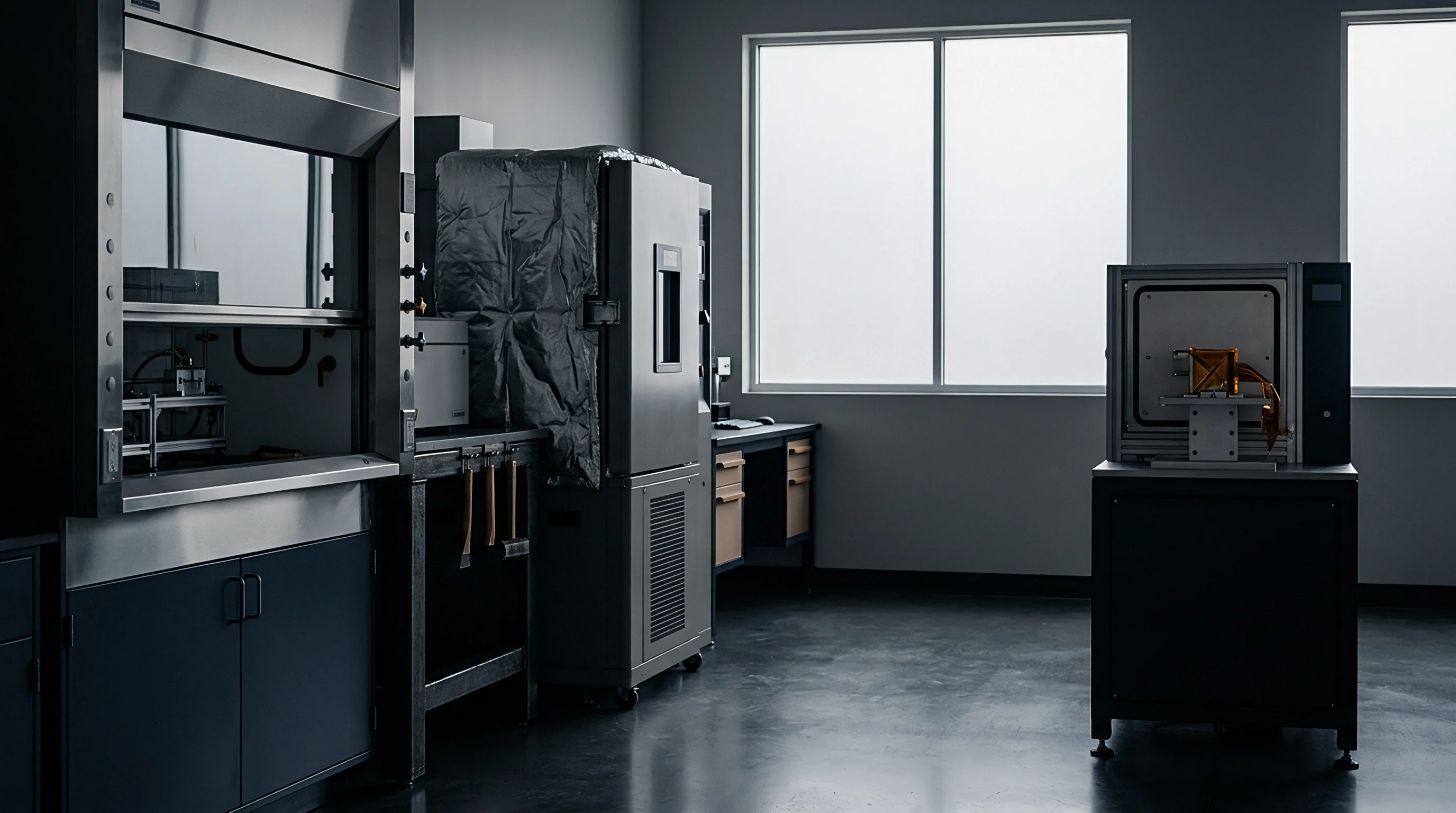
Where Do Standard Test Schedules Fail to Register Slow Degassing?
Standard qualification tests evaluate pristine cells fresh off the line, when cathodes show minimal boundary cracking. Because intergranular cleavage accumulates over hundreds of charge-discharge cycles, a cell design that passes testing when new may exhibit violent off-gassing at much lower temperatures after two hundred operational cycles.
UL 9540A evaluates thermal runaway fire propagation across four hardware tiers. Its cell-level test uses external heating bands to drive cells past venting into self-sustaining decomposition. However, standard screening tracks only surface temperatures and total flammable gas volume, routinely omitting high-resolution speciation of gases released during early venting intervals.
| Standard Designation | Applicable Scope | Maximum Test Temp (C) | Gas Composition Analysis | Aged Cell Testing Mandate |
|---|---|---|---|---|
| UN 38.3 Test T.2 | Transport safety classification | 72 | None required | Not included |
| IEC 62133-2 | Portable commercial equipment | 130 | None required | Not included |
| UL 1642 | Component cell recognition | 130 | None required | Not included |
| UL 9540A | Thermal runaway propagation | Runaway onset | Mandatory gas collection | Optional tier |
| IEC 62619 | Industrial battery systems | Runaway onset | None required | Not included |
Rigorous procurement programs execute independent accelerated thermal screening before accepting incoming production lots. Technicians follow a disciplined sequence when characterizing cathode boundary off-gassing:
- Harvest five cells at random from each fifty-megawatt-hour incoming manufacturing cohort.
- Cycle the sample cells through five hundred full-depth charge-discharge schedules inside climate-controlled chambers.
- Charge cells to the maximum operational cutoff voltage in an inert argon environment.
- Disassemble the cell cans inside an anhydrous glove box maintaining moisture levels below 0.5 parts per million.
- Separate cathode active material from aluminum current collector foils using targeted solvent baths.
- Seal twenty milligrams of dried active material into high-pressure gold-plated calorimetry vessels.
- Execute multi-rate thermal ramps inside accelerating rate calorimeters to calculate exact activation barriers.
Substandard production lots reveal themselves through depressed apparent activation energies and lower onset temperatures. Clause 8.2 of the European Union Battery Regulation requires technical documentation detailing safety qualification across the entire design lifespan. An importer lacking kinetic degradation dossiers for high-nickel products faces immediate customs impoundment under market surveillance checks.

Warranty
Purchase contracts for high-nickel cells dictate how financial liability for delayed thermal failure is divided between cell manufacturers and system integrators. Standard warranties define defects strictly through electrical metrics such as room-temperature capacity retention and internal DC resistance drift. These metrics overlook accumulated grain boundary cleavage; a cell can maintain ninety percent of its nominal capacity even after internal microcracking has lowered its thermal runaway onset temperature by thirty degrees Celsius.
More sophisticated procurement agreements incorporate kinetic stability clauses directly into the Master Services Agreement. These provisions establish clear thresholds for maximum off-gas volumes and minimum activation energies during accelerated thermal ramps. If lot acceptance audits reveal activation barriers falling below ninety kilojoules per mole at maximum operational voltage, the buyer retains the right to reject the entire production run.
Testing costs are negligible compared to potential recall liabilities. Running multi-rate calorimetry sweeps on incoming lots adds roughly four hundred dollars per evaluated batch, whereas a field thermal event caused by unmitigated oxygen release in an automotive pack can push recall expenses past fifty million dollars. Consequently, marine freight carriers increasingly demand certified degassing reports before loading high-capacity containerized storage units, while dangerous goods declarations require verified stability data to satisfy maritime underwriters.
Failing to document boundary degassing behavior exposes the importer of record to full commercial liability under product liability statutes. Technical dossiers must bridge the gap between microscopic cathode grain cleavage and macroscopic enclosure safety venting, requiring sourcing teams to verify that supplier datasheets reflect true kinetic barriers across fully aged states of charge.