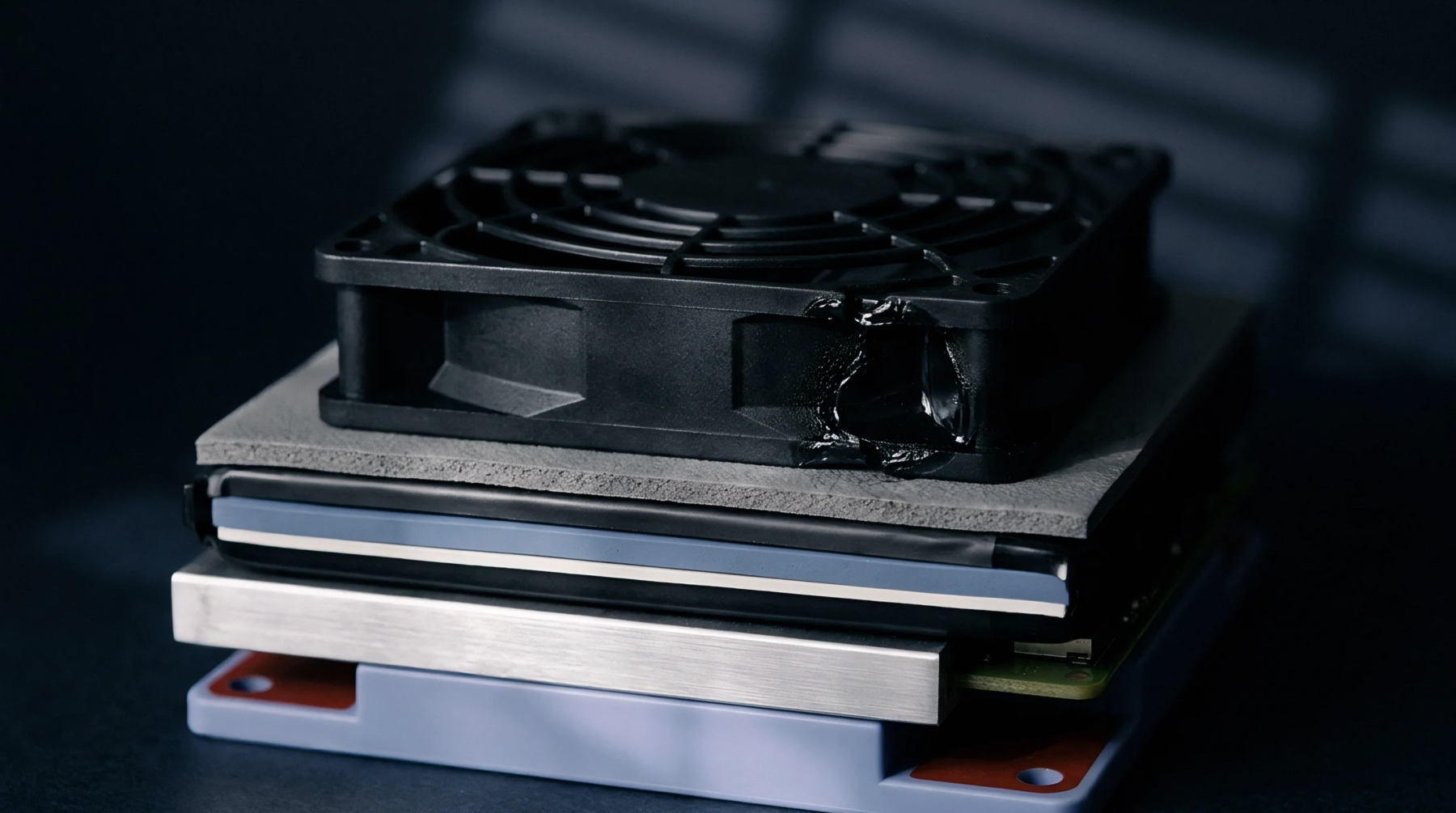
Ultrasonic Testing Protocols for Liquid Cooling Plate Joint Verification
High-frequency ultrasonic C-scan imaging verifies internal cooling plate joints by mapping acoustic impedance mismatches to prevent coolant leaks and bursts.
Deficiencies in the volumetric distribution of filler metal within a pre-designed capillary joint gap lead to incomplete mechanical and thermal bonding across metallic battery assemblies. In pack-level thermal management systems and electrical interconnect fabrication, braze starvation describes the condition where molten liquid filler fails to occupy the entirety of the joint clearance between adjacent substrates. The resulting joint exhibits localized dry patches, hollow interfaces, or interrupted fillets along liquid cooling plate channels, busbars, and cell terminal connections.
This defect limits operational heat transfer surfaces, creates localized thermal resistance spikes, and degrades mechanical shear endurance under dynamic vehicular vibration. The condition stops applying outside capillary liquid-phase joining techniques, excluding solid-state welding or non-brazed structural bonding.
Capillary action governs the flow of melted filler alloy across heated component interfaces, drawing liquid metal into micron-scale clearances between base components. When braze starvation takes place, insufficient filler volume, excessive initial clearance, or non-uniform thermal gradients halt this capillary draw before the seam is filled. Localized surface contamination or stubborn oxide films raise the liquid contact angle, preventing proper wetting and leaving large unbonded voids behind the advancing liquid front.
Flux depletion or non-uniform protective atmospheric gas conditions accelerate surface re-oxidation at elevated temperatures, which actively repels the molten alloy. Capillary gaps widened by thermal distortion exceed the maximum bridging distance of the molten alloy, exhausting the local filler reservoir and starving the adjacent joint structure.
Contact area reductions caused by internal voiding interrupt the conductive pathway required to pull heat away from active pouch or prismatic cells. Localized thermal resistance climbs sharply over starved segments of a liquid cooling cold plate, generating persistent hot spots that trigger uneven cell degradation across module arrays. Mechanical integrity drops concurrently, because missing braze fillets concentrate operational stresses directly on the perimeter of the unbonded pocket during pack expansion and contraction.
Cyclic thermal loading enlarges micro-cracks initiating at these unfilled capillary gaps, threatening coolant leakage into high-voltage electrical enclosures. Unfilled voids also act as condensation traps, initiating localized galvanic corrosion when incompatible dissimilar metals are joined.
Non-destructive evaluation via ultrasonic transmission scanning, acoustic microscopy, or industrial radiography serves as the formal method for detecting internal joint vacancies. Technical delivery conditions for battery heat sinks establish hard rejection limits, frequently restricting total starved interface area to less than ten percent of the planned contact boundary. Individual void dimensions are similarly constrained, forbidding continuous starved pathways across coolant channel dividing ribs to prevent bypass flow.
Purchasing contracts assign scrap liability to the component fabricator whenever non-destructive imaging uncovers starved braze regions exceeding specified defect cluster limits. Destructive metallographic micro-sectioning verifies ultrasonic acoustic signatures during pre-production qualification runs, tying defect sizing thresholds to observable mechanical shear test failures. Ultrasonic echo returns showing zero transmission through heat exchanger walls confirm joining voids.
High-frequency ultrasonic C-scan imaging verifies internal cooling plate joints by mapping acoustic impedance mismatches to prevent coolant leaks and bursts.
Expertise is a utility, not a secret. sentiention™ publishes its working knowledge as open reference: intelligence layer covering the materials it sources, the markets it enters, and the reference that serves both.