Managing Transsemantic Regulatory Noncompliance Liability across Crossborder Battery Supply Chains and Importer Records
Managing transsemantic battery compliance requires direct alignment of cell test summaries, customs records, and shipping labels with destination border laws.


Lexicon
Cross-border shipments of lithium-ion cells often stall because legal frameworks use incompatible technical terms for identical hardware. Chinese GB standards, European Union battery directives, United States Department of Transportation codes, and the UN Manual of Tests and Criteria each define regulatory boundaries differently. A single lithium-ion assembly labeled as a cell under one framework can be classified as a component battery or battery system when entering another port.
These shifts in terminology alter mandatory safety testing thresholds, transport documentation rules, and customs tariffs, even though the underlying cathode, anode, and electrolyte remain completely unchanged. Exposure builds in the gap between manufacturing declarations and destination entry rules. National customs agencies strictly apply the statutory definitions in their own administrative codes.
When export paperwork references Chinese National Standards like GB 38031 for traction packs or GB 31241 for consumer cells, European or US border authorities reclassify the shipment using local terms. EU Regulation 2023/1542 defines an industrial battery by its intended application rather than capacity, whereas 49 CFR Section 173.185 in the United States classifies lithium battery consignments strictly by watt-hour ratings and packaging condition. Any mismatch between declared terminology and local statutory classification triggers immediate customs holds, mandatory warehouse re-inspections, and administrative fines.

Harmonization Disconnects in Transport Codes
Shipping dangerous goods depends on accurate technical taxonomy. UN 38.3 rules divide energy storage hardware into single cells, component cells, and multi-cell battery packs based on internal electrical connections and protective circuits. Exporting factories often list parallel-connected cell pairs as individual cells on dangerous goods declarations to skip pack-level design qualification testing.
International transport regulators reject this convention. Air carriers operating under IATA Dangerous Goods Regulations PI 965 treat parallel cell groups as batteries, invalidating the shipper export paperwork. State-of-charge terminology creates secondary regulatory friction.
UN transport rules cap air shipments of standalone lithium-ion cells at a thirty percent state of charge. Yet standard factory grading charges cells to fifty percent capacity to test open-circuit voltage stability before packaging. When factory shipping records document state of charge using manufacturing voltage metrics rather than calibrated percentage ratios, they fail entry audits, forcing bonded facilities at the destination port to pull physical samples and discharge the cells manually.
- Cell Classification Drift occurs when single cells with built-in protection circuits are misdeclared as basic raw components, nullifying transport hazard exemptions.
- Capacity Rating Divergence arises when nominal cell capacity measured under ambient factory conditions exceeds the statutory maximum rated capacity defined by international test protocols.
- State Of Charge Misalignment develops when factory open-circuit voltage metrics substitute for certified coulometric state-of-charge measurements required on dangerous goods forms.
- Waste Classification Triggering happens when downgraded secondary cells shipped for refurbishment are legally classified as hazardous waste under the Basel Convention.

Regulatory Terminology in Regional Law
Regional legal definitions shift importer accountability depending on the jurisdiction. The European Union Battery Regulation enforces strict producer definitions that automatically apply to any entity placing a battery on the market from a non-EU country. In the United States, Customs and Border Protection classifies battery imports under Harmonized Tariff Schedule subheadings that rely on specific chemical definitions rather than trade names.
A chemistry declared generically as lithium iron phosphate on factory packing lists must match precise tariff entries such as HTS 8507.60.0000. Inaccurate chemical terms lead directly to tariff re-assessment and penalty interest charges under 19 U.S.C. 1592. Terminological precision dictates whether an importer maintains valid regulatory defense rights.
Port authorities reject dialect variations in factory test certificates. When an Asian cell manufacturer issues a safety document citing regional GB test protocols, destination border officials treat the product as uncertified dangerous goods unless explicit cross-referencing to UN 38.3.5 test summaries accompanies the entry filing.


Dossier
Documentation chains determine whether imported energy storage units clear customs entry or face immediate port rejection.
The primary compliance instrument for international movement is the UN 38.3.5 Test Summary, a statutory document that must trace directly to the precise cell batch contained inside the shipping container. Border enforcement agencies cross-reference test summary serial numbers, product model names, and factory facility locations against physical cell markings during routine customs audits. A single typographical mismatch between the physical cell wrapper and the compliance summary halts clearance.
Importer liability expands when test certificates present incomplete technical parameters. UN 38.3 test summaries mandate ten specific data elements, including factory contact details, third-party laboratory accreditation codes, detailed test execution metrics, and explicit signature lines from authorized personnel. Standard manufacturer datasheets do not fulfill these legal requirements.
Importers holding only sales specification sheets remain fully exposed to regulatory noncompliance enforcement actions.

Mandatory Certificate Matching Protocols
Validating cell safety files requires systematic auditing of test report metadata against physical bill of lading manifests. Laboratory test reports must reflect the exact chemical architecture, physical format, and mass of the delivered production cells. When a factory substitutes a high-nickel cathode material or alters separator thickness to reduce costs, the original UN 38.3 test summary becomes legally void.
Delivering modified cells under an older test certificate constitutes false filing under international trade laws.
A test summary issued without matching serial ranges or factory cell designations shifts primary transport liability to the party filing customs paperwork.
Quality management documentation represents another critical tier in the compliance file. Both IATA dangerous goods regulations and international maritime dangerous goods codes mandate that cell manufacturing facilities operate under an audited quality management system such as ISO 9001 or IATF 16949. Border inspectors frequently demand proof of factory quality system certification during port compliance checks.
Failure to produce valid factory quality system documentation invalidates transport safety exemptions, leading to immediate cargo detention.
| Document Type | Regulating Body | Mandated Data Points | Primary Transsemantic Risk Point |
|---|---|---|---|
| UN 38.3.5 Test Summary | UN Sub-Committee / IATA | Test report number, factory location, cell weight, watt-hour rating, test completion date | Mismatched cell model designations between summary and physical cell sleeve |
| Safety Data Sheet (SDS) | OSHA GHS / REACH | 16 structured sections, CAS chemical numbers, UN transport classification, hazard statements | Citing domestic hazard codes instead of destination jurisdiction regulatory classifications |
| Certificate of Conformity | EU Customs / US CBP | Harmonized Tariff code, origin factory, chemical identification, standards declaration | Translating foreign technical standards without explicit regional legal equivalence maps |
| Factory Quality Certificate | ISO / ICAO | Quality management registration, scope of certification, issuing body accreditation mark | Expiration of factory manufacturing certificate prior to consignment departure date |

Audit Protocols for Import Compliance Records
Verification routines must confirm that Safety Data Sheets comply with destination country formats. An SDS formatted under Chinese national GHS standards fails to meet European Union REACH specifications or United States OSHA requirements. Chemical Abstracts Service numbers must match the precise electrolyte salts and cathode active materials listed in the product dossier.
Mismatched chemical listings suggest undisclosed material changes, prompting regulatory authorities to order destructive laboratory testing at the importer’s expense.
- Serial Code Verification matches physical laser-etched cell codes directly to the laboratory test report batch numbers recorded in the compliance dossier.
- Laboratory Accreditation Audit verifies that the testing facility holds active ISO/IEC 17025 accreditation for the specific UN 38.3 test methods.
- Chemical CAS Verification checks all constituent material percentage ranges on the safety data sheet against regulated substance restriction lists.
- Expiration Tracking ensures all design qualification certificates remained valid on the exact date the freight forwarder accepted cargo delivery.
Inaccurate or incomplete safety records result in immediate consignment seizure, mandatory cargo destruction at bonded facilities, administrative fine assessments, and permanent loss of expedited customs clearance privileges.


Crate
Physical transport packaging acts as the primary barrier against catastrophic thermal events and regulatory enforcement actions during crossborder transit. Dangerous goods shipping regulations dictate exact outer packaging specifications, inner cushioning parameters, and fire-retardant liner performance based on cell chemistry and mass.
Lithium-ion cells packed inside non-UN-rated outer containers face immediate refusal by maritime vessel operators and air cargo handlers. UN 4G fiberboard boxes and 50D plywood crates must bear durable, legible specification markings showing approval by a certified national competent authority. Modal transfer points generate severe physical compliance friction.
A consignment packaged for ocean transport under IMDG Code provisions may fail ICAO Technical Instructions when transferred to air freight forwarders. Maritime regulations allow higher state-of-charge limits and larger battery assemblies than air transport protocols permit. Freight forwarders at intermodal hubs inspect cargo outer packaging, state-of-charge documentation, and hazard labeling prior to loading.
Mismatches between ocean bill of lading declarations and air freight requirements ground shipments indefinitely.

What Escalates Local Certification Gaps to Import Seizure?
Regulatory enforcement escalates from minor documentation inquiries to immediate cargo seizure when physical packaging labels contradict declared shipping papers. Class 9 hazard labels, lithium battery handling marks, and UN identification numbers must adhere to precise dimensional and color standards specified in 49 CFR Section 172.400 and IATA DGR Section 7. Hand-drawn labels, obscured UN number markings, or incorrect hazard class signs signal systemic noncompliance to border inspectors.
Customs agents routinely isolate noncompliant crates in hazardous material holding areas.
Marine shipments carried at fifty percent state of charge violate air transport thresholds, invalidating multimodal dangerous goods declarations upon airport transfer.
State-of-charge regulation enforcement requires strict operational control before packing. Air shipments carried under UN 38.3 PI 965 Section IA must not exceed thirty percent state of charge at the time of handoff to the air carrier. Compliance officers verify state of charge using calibrated battery analyzers during random airport ramp checks.
Consignments exceeding the thirty percent threshold incur immediate grounding, operator notification to civil aviation authorities, and substantial civil penalties levied against the listed shipper of record.
| Transport Mode | Governing Standard | Maximum Allowed SoC | Packaging Specification | Hazard Class Markings |
|---|---|---|---|---|
| Air Freight Cargo | IATA DGR / ICAO PI 965 | 30 percent maximum | UN 4G / 4GV tested to Packaging Group II performance standards | Class 9 Lithium Battery Label, UN 3480 identification, Cargo Aircraft Only mark |
| Maritime Vessel | IMDG Code Section 2.9 | Manufacturer specified | UN 4G, 4GV, or 50D packaging with rigid outer framing and thermal insulation | Class 9 Miscellaneous Dangerous Goods mark, UN 3480 label, Marine Pollutant sign |
| Road / Rail Freight | ADR / US DOT 49 CFR | State of charge limits vary | UN certified outer packaging or specialized impact-resistant battery transport boxes | Class 9 Hazard Label, UN 3480 marking, directional orientation arrows |

Sequential Verification for Landed Consignments
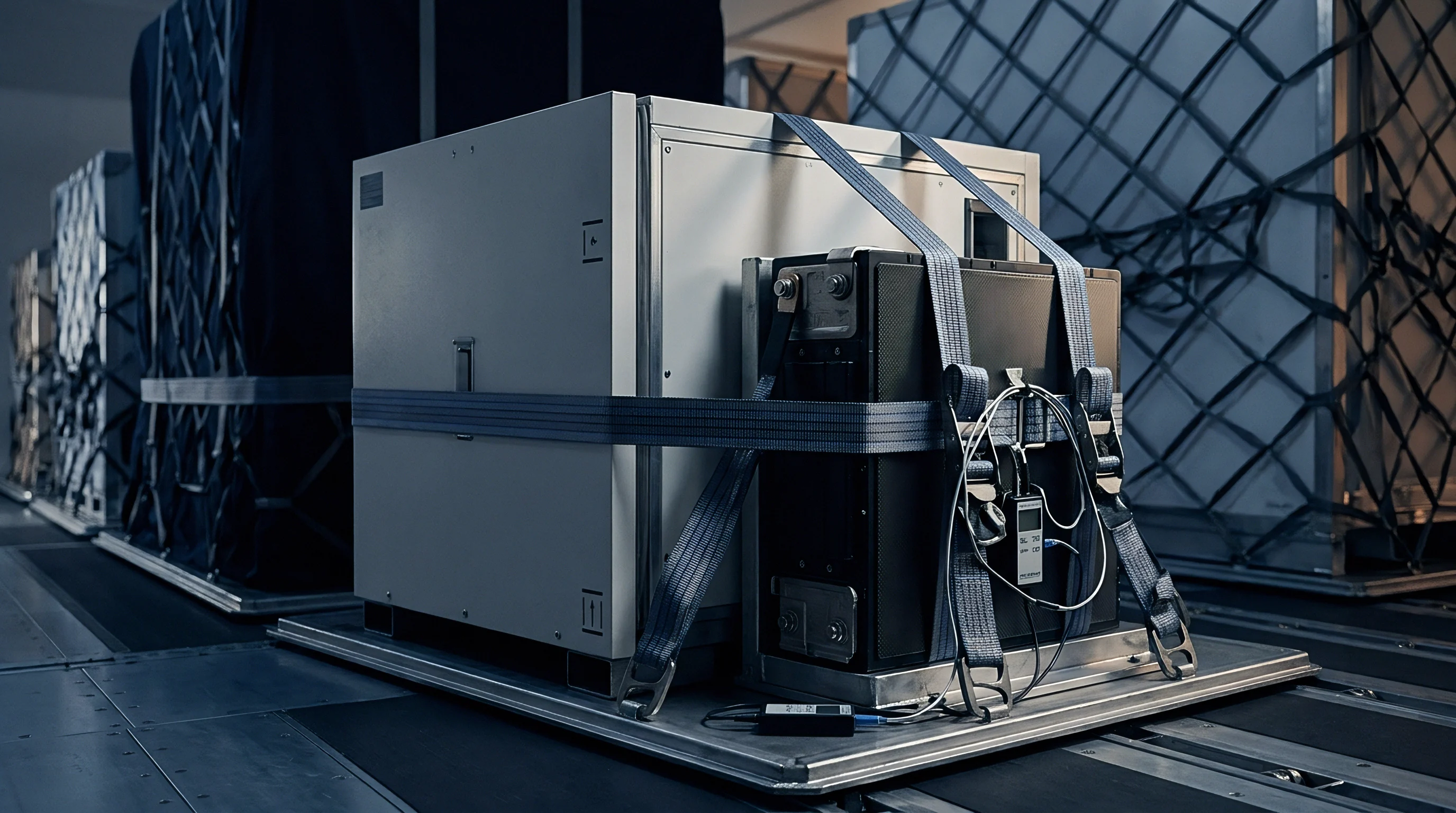
Verification of physical dangerous goods shipments follows a strict operational sequence at port handling facilities. 1. Inspect outer packaging structural integrity, verifying the absence of crushing, moisture damage, or compromised tamper-evident seals.
2.
Confirm that UN packaging code markings etched into the container match the packaging type declared on the dangerous goods certificate.
3. Validate label dimensions, reflectivity, border line thickness, and class 9 symbol placement against dangerous goods regulatory specifications.
4. Measure terminal open-circuit voltage across a statistical sample of cells to calculate actual state of charge against transport declaration limits.
5.
Cross-check container number, seal identification codes, and dangerous goods declaration reference numbers against ship manifest files.
6. Verify inner packaging separation distance, insulation barriers, and flame-retardant absorbent material placement inside opened test units. Packaging integrity remains the primary physical evidence border authorities inspect when evaluating crossborder dangerous goods compliance.

Lien
Customs enforcement mechanisms impose severe financial encumbrances on noncompliant battery imports through statutory liens, customs holds, and retroactive duty reassessments. When border authorities discover transsemantic errors in import paperwork, such as misdeclared tariff codes or invalid safety summaries, they place the consignment under official detention. Storage fees, demurrage charges, and bonded warehouse expenses accrue daily against the importer of record.
These accrued administrative costs constitute an automatic statutory lien against the detained cargo, preventing goods release until all financial claims and regulatory inquiries clear. Tariff misclassification represents a primary source of retroactive financial exposure under national trade law. Importers occasionally declare advanced energy storage packs under generic component tariff lines such as HTS 8507.90 to secure lower duty rates than those assigned to finished lithium-ion batteries under HTS 8507.60.
Customs agencies utilize automated forensic algorithms and physical dock inspections to detect classification discrepancies. Reclassification triggers mandatory back-duty assessments spanning all imports entered within statutory audit windows, augmented by statutory interest rates and civil fraud penalties under 19 U.S.C. 1592.

Financial Exposure Model for Border Holds
Financial losses resulting from customs holds escalate rapidly due to compound administrative tariffs and specialized hazardous material storage rates. Consider an import shipment of 40,000 NMC 21700 cylindrical cells packaged in two 20-foot sea containers held at a ocean port due to an invalid UN 38.3 test summary. Assume a container bill of lading value of $240,000, standard hazardous material port demurrage charges of $800 per container per day, and specialized bonded warehouse hazardous material handling fees of $1,200 per day.
Customs entry declarations containing inaccurate tariff subheadings trigger mandatory audit reviews spanning three preceding calendar years of import activity.
If the regulatory hold persists for 45 days while the overseas factory generates compliant testing documentation, the direct administrative expenses sum to $36,000 in port demurrage and $54,000 in bonded storage fees. Added to a mandatory customs noncompliance penalty assessed at 20 percent of the entry cargo value ($48,000) and third-party legal re-filing expenses ($15,000), total landed penalties reach $153,000. This expenditure represents 63.7 percent of the original shipment value, completely eroding commercial project margins before cell delivery.
Customs Enforcement Action Escalation: Stage 1: Automated paperwork scan flags discrepancies between declared HTS codes and UN test summary chemical descriptions. Stage 2: Customs issues formal detention notice, freezing cargo movement and transferring containers to a hazardous material inspection yard. Stage 3: Port authority initiates daily demurrage accrual and assesses administrative inspection fees against the listed importer of record.
Stage 4: Regulatory officers perform destructive sample testing and issue formal demand for complete factory compliance records. Stage 5: Customs issues formal penalty assessment under trade enforcement statutes, establishing a statutory lien on the cargo pending payment. Importers face the ongoing challenge of establishing binding financial protections against customs liens caused by third-party overseas documentation failures.


Arrear
Regulatory compliance liability extends far past the physical clearance of battery cargo at customs entry points. Post-import enforcement regimes, such as the EU Battery Passport regulations and United States EPA toxic substance reporting rules, create long-term statutory arrears for entities importing energy storage products. European Union Regulation 2023/1542 imposes mandatory carbon footprint declarations, recycled content minimums, and supply chain due diligence obligations that require data retention for ten years post-importation.
Failure to produce verifiable supply chain records during retroactive audits triggers substantial administrative fines and potential market withdrawal orders. Extended Producer Responsibility laws place continuing financial and environmental obligations directly on the importer of record. Importers must join approved producer compliance schemes, pay recycling fees based on imported battery mass, and maintain detailed end-of-life disposal tracking records.
When imported cells contain unverified chemical constituents or unmapped supply chain pathways, recycling schemes assess higher waste disposal surcharges. Retroactive discovery of undisclosed hazardous substances like heavy metals or restricted per- and polyfluoroalkyl substances leads to mandatory product recalls and legal environmental enforcement.

Retroactive Audit Windows and Regulatory Mechanisms
Customs and environmental enforcement agencies retain broad statutory powers to reopen historical import records. The United States Customs and Border Protection operates a standard five-year statute of limitations for civil fraud and negligence investigations under 19 U.S.C. 1592. European customs authorities execute post-clearance audits up to three years after goods release, examining commercial invoices, transport records, and factory quality logs.
Importers unable to substantiate past noncompliance exemptions face retroactive tariff adjustments and statutory penalties across historical import volumes.
Regulatory authorities retain audit windows that survive standard commercial supplier warranty periods by several years.
Data integrity gaps in the battery supply chain generate compound liability over time. When a cell manufacturer updates its bill of materials without issuing updated compliance documentation, every import batch entered under the old compliance dossier inherits latent noncompliance liability. Post-import verification checks conducted by market surveillance authorities expose these historical discrepancies, triggering retrospective enforcement actions across entire product distribution lines.
| Region | Enforcement Body | Record Retention Mandate | Audit Window | Maximum Noncompliance Fine |
|---|---|---|---|---|
| European Union | National Market Surveillance / Customs | 10 years under EU 2023/1542 | 3 years post-clearance | Up to 10 percent of annual global corporate turnover |
| United States | US Customs / EPA / Pipeline Safety | 5 years under 19 CFR Section 163 | 5 years from entry date | Domestic cargo value forfeit plus statutory civil penalties |
| China | State Administration for Market Regulation | 8 years post-production | 5 years from sales date | Confiscation of illegal income plus 5 times product value fine |
### Post-Import Audit Escalation Sequence 1. Initial Notice Of Action formalizes a regulatory demand for complete technical safety dossiers spanning historical import entries over specified audit years.
2. Document Reconciliation Review cross-checks imported cargo entry declarations against factory manufacturing logs, raw material invoices, and transport manifests.
3.
Substance Due Diligence Verification inspects mineral origin certificates and carbon footprint calculation files against statutory environmental standards.
4. Penalty Assessment Issuance calculates retroactive duty adjustments, administrative civil fines, and statutory interest surcharges for identified compliance gaps.
5. Mandatory Remediation Execution requires formal implementation of corrective compliance actions, certified supply chain audits, or commercial market withdrawals.
A standard commercial supply contract clause stating that product specifications comply with all applicable foreign laws fails to protect the importer against post-import statutory liability unless backed by explicit financial indemnity bonds.

Recourse
Allocating crossborder regulatory noncompliance risk requires precise contractual mechanisms that operate across differing legal jurisdictions. Standard Incoterms like Delivered Duty Paid (DDP) do not shield the ultimate buyer from regulatory exposure.
Under national customs statutes, the legal importer of record remains strictly liable for duty calculations, paperwork accuracy, and product compliance regardless of private commercial agreements. Sourcing contracts must incorporate detailed regulatory indemnification provisions, cell specification freeze clauses, and escrow mechanisms tied to compliance validation. Indemnification clauses must address specific transsemantic regulatory failure scenarios.
Sourcing contracts should explicitly define the overseas supplier liability when customs holds, cargo seizures, or civil penalties arise from defective UN 38.3 test summaries, invalid Safety Data Sheets, or misdeclared cell parameters. Contracts should establish immediate offset rights, allowing the buyer to withhold outstanding invoice payments to cover accrued port demurrage, bonded warehouse storage fees, and customs legal defense costs resulting from supplier documentation errors.

Contractual Allocation of Regulatory Liability
Risk transfer provisions must mandate explicit cell specification freeze protocols. Overseas cell manufacturers frequently adjust electrolyte formulas, separator source materials, or electrode coating weights to optimize production yield without notifying international buyers. Sourcing agreements must classify any unapproved material alteration as a material breach of contract that automatically voids supplier payment rights and triggers full financial indemnification. The contract must mandate that the factory issue updated UN 38.3 test summaries and certified chemical composition reports ninety days prior to shipping any altered cell variant. Commercial agreements should establish independent third-party testing and escrow procedures to validate incoming cell shipments before final payment release. Sourcing practices place a percentage of the shipment purchase price into an escrow account pending formal verification of dangerous goods paperwork, state-of-charge limits, and chemical composition metrics upon arrival at destination ports. If independent audit testing reveals transsemantic documentation errors or physical noncompliance, the escrow agent releases funds directly to the buyer to cover compliance remediation, re-testing, and administrative correction expenses. Sourcing contracts must establish clear governing law and jurisdiction clauses that enable crossborder legal enforcement against overseas suppliers. Dispute resolution mechanisms situated in recognized international arbitration centers, such as Singapore or London, provide enforceable channels for recovering financial losses caused by supplier regulatory defaults. Incorporating mandatory compliance verification milestones into purchase orders ensures that financial recourse remains enforceable throughout the battery procurement lifecycle.