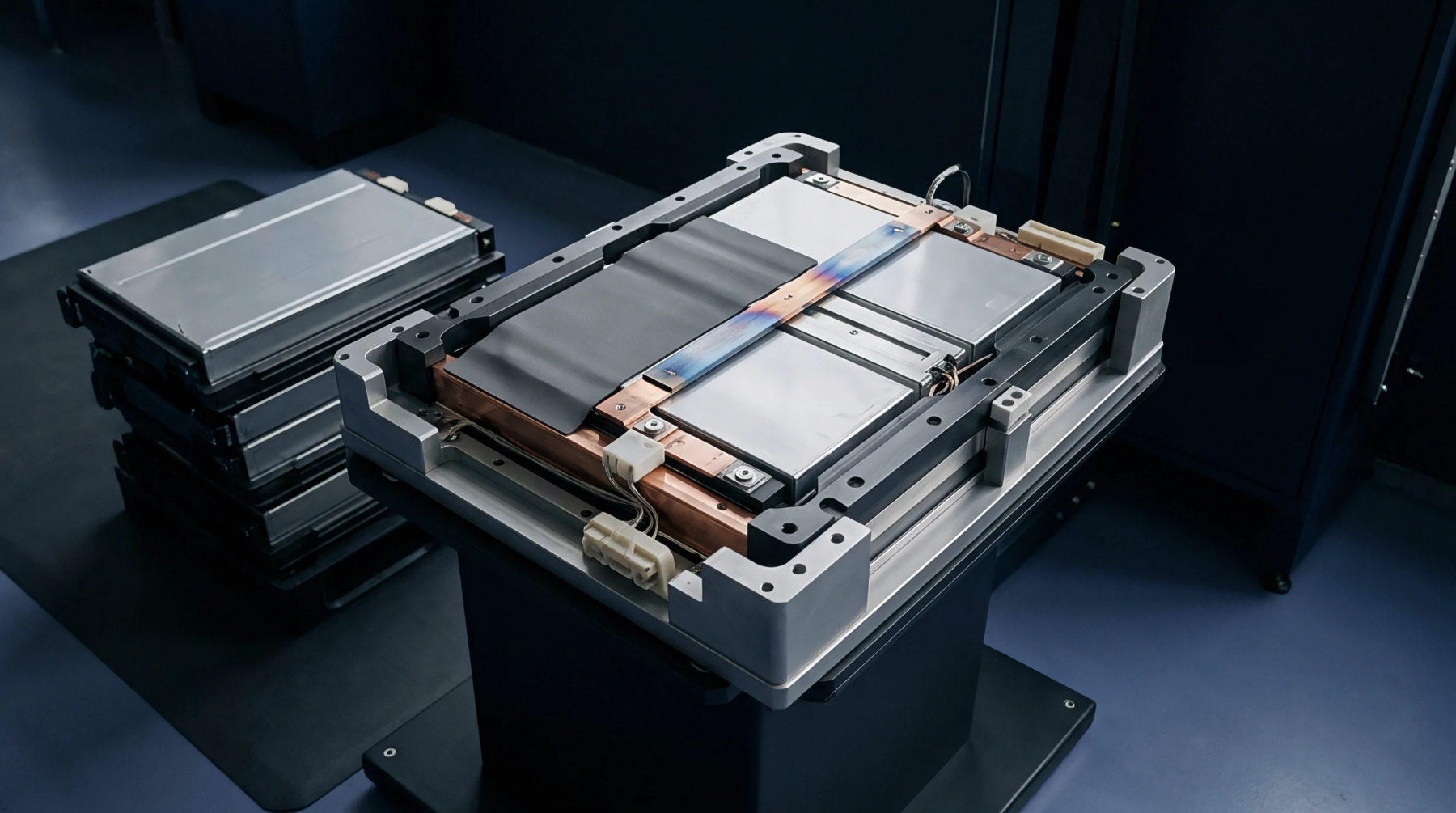
Nonuniform Current Crowding and Active Material Degradation in Prismatic Cells
Prismatic cell current crowding concentrates thermal and kinetic stress near terminal tabs, accelerating localized plating and premature capacity failure.
Physical cross-sectional depth of a dry, compacted active material layer deposited onto a metallic current collector foil defines the basic trade-off between energy storage density and power output. Measured in micrometres using continuous non-contact beta gauge radiation, laser triangulation or micrometer callipers after calendar rolling, electrode thickness governs the length of the diffusion pathway traversed by lithium ions during charging and discharging cycles. Thin layers around forty micrometres deliver high rate capabilities by minimizing ionic transport resistance within the liquid electrolyte, whereas heavy coatings surpassing one hundred micrometres maximize volumetric energy density by reducing the mass ratio of inactive current collectors, separators and casing hardware.
The parameter excludes the current collector substrate thickness and ceases to dictate cell performance when electrolyte wetting is incomplete or binder migration chokes porous channels.
Solid-state and liquid-phase mass transport rates drop exponentially as coating height expands. When electrode thickness increases, lithium ions face tortuous pathways through the porous matrix, leading to concentration polarizations at elevated current densities. Fast charging becomes constrained by lithium salt depletion in deep pores adjacent to the metallic foil, promoting dangerous metallic lithium plating across graphite surfaces.
Ohmic drops through both the active particle network and the liquid phase amplify local heat generation under sustained acceleration cycles. Thicker coatings also present binder migration challenges during convective drying ovens, where volatile solvent evaporation carries polyvinylidene fluoride toward the outer interface. This migration leaves the base layer brittle and prone to delamination under the cycling strain of host particles.
Calendering operations compress the porous coating to a target density, establishing the final dimension through high-pressure steel roll assemblies. Line speed, roll temperature and linear hydraulic nip forces determine the final electrode thickness, balancing density against porosity. Compaction must preserve void networks between active particles to sustain electrolyte wetting without crushing secondary grains.
Variations exceeding two micrometres across the web width induce uneven mechanical pressure fields inside wound or stacked elements, generating localized current bottlenecks that accelerate premature aging. Non-uniformity also creates winding alignment errors on continuous manufacturing lines.
Master supply specifications enforce tight tolerances on dry coating thickness to secure predictable pack-level thermal and electrical matches. Procurement teams verify roll-to-roll uniformity through automated X-ray or optical measurement logs delivered with each production lot. Variations in dry film thickness alter cell balance in factory packs, forcing early capacity derating if serial cells reach end-of-charge voltages unevenly.
Buyers evaluate supplier capabilities using process capability index values above 1.33 for coating cross-profiles. Thicker single-side coatings yield higher volumetric capacity at lower processing costs per kilowatt-hour, but they reduce warranty durations under high-power charging covenants.
Prismatic cell current crowding concentrates thermal and kinetic stress near terminal tabs, accelerating localized plating and premature capacity failure.
Expertise is a utility, not a secret. sentiention™ publishes its working knowledge as open reference: intelligence layer covering the materials it sources, the markets it enters, and the reference that serves both.