Interconnect Parasitic Resistance Impact on High-Power Parallel Cell Strings
Interconnect parasitic resistance forces unequal branch currents and severe thermal gradients across parallel strings, requiring matched micro-ohm path design.
Electrical architectures constructed by bonding two or more electrochemical cell terminals in parallel to a shared positive and negative node multiply total current handling and stored charge capacity at a fixed operating voltage. Connecting units into parallel cell strings establishes an equipotential group where all linked cells charge and discharge simultaneously through common collection busbars. The designation covers parallel configurations within low-voltage battery modules, rack-level stationary blocks, and high-voltage traction packs.
Boundaries apply only across mutually connected parallel branches and do not govern series connections linking adjacent parallel groups together.
Equipotential coupling forces every cell within a parallel grouping to maintain an identical terminal voltage during rest periods. Small open-circuit voltage variations trigger spontaneous self-balancing currents that circulate between cells until electrochemical potential balances out across the entire group. Individual cell capacities can vary slightly without destabilizing the parallel group, as the combined string capacity represents the arithmetic sum of its individual components.
When an internal micro-short develops inside one cell, however, all parallel cells can dump their stored energy into the defective unit unless protected by inline fuse links. Thermal differences across the module alter the internal resistance of individual cells, causing uneven current division under heavy power demand.
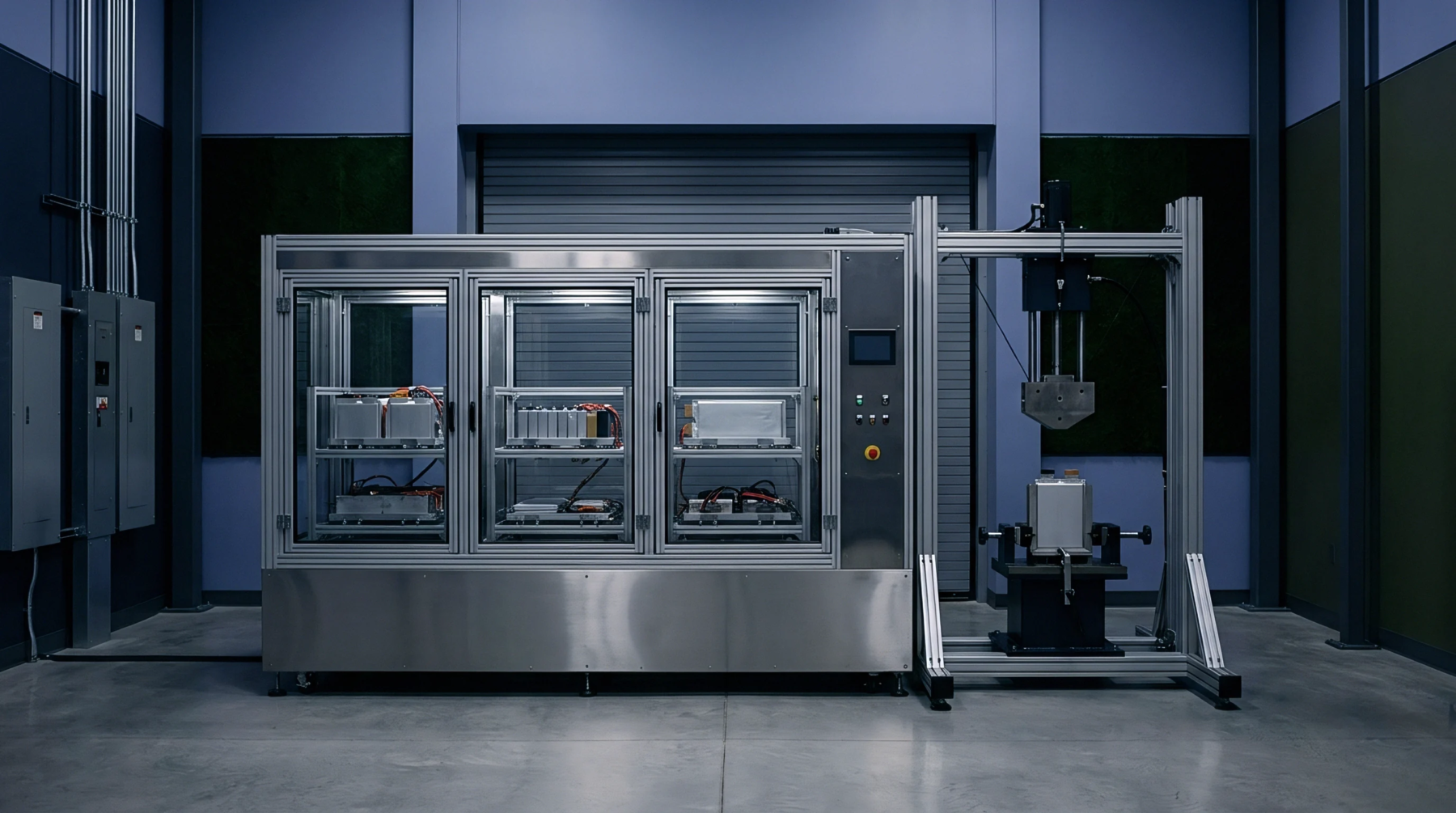
Factory verification inspects parallel sub-assemblies by applying multi-channel current monitors during high-rate charge and discharge pulses. Measuring branch currents confirms that current shares evenly across every parallel position without exceeding single-cell thermal allowances. Module testing runs repetitive cycle life profiles to verify that parallel balancing does not mask premature capacity degradation in individual cells.
Automated inspection checks fuse link continuity across every parallel cell branch to ensure open-circuit protection mechanisms remain functional after module handling. Mechanical shock testing verifies that parallel busbar joints maintain physical integrity without developing hairline fractures. Voltage monitoring lines check for noise spikes caused by loose parallel connections during random vibration sweeps.
Designing high-capacity packs requires selecting a balanced parallel string ratio to optimize manufacturing simplicity against system safety risks. Purchase agreements state the exact string architecture, such as four-parallel or eight-parallel arrangements, restricting unapproved changes to cell count per block. Sourcing engineers demand individual cell fuses or fusible busbar wire bonds when parallel counts exceed three cells to isolate shorted units safely.
Cell matching algorithms enforce strict capacity, internal resistance, and manufacturing date bounds for all cells assigned to a single parallel module. Module warranties require that internal temperature deltas across a parallel string remain under five degrees Celsius during peak operation. Defective modules face complete rejection if circulating balancing currents exceed baseline parameters during factory end-of-line testing.
Interconnect parasitic resistance forces unequal branch currents and severe thermal gradients across parallel strings, requiring matched micro-ohm path design.
Expertise is a utility, not a secret. sentiention™ publishes its working knowledge as open reference: intelligence layer covering the materials it sources, the markets it enters, and the reference that serves both.