Navigating UN Dangerous Goods Regulations for Lithium Cell Importation
Lithium cell importation demands strict UN number classification, verified UN 38.3 test summaries, thirty percent state of charge, and compliant packaging.

Taxonomy
Classifying imported lithium cells starts with assigning the correct United Nations dangerous goods number. The United Nations Model Regulations draw a hard line between lithium ion chemistries ~ built on liquid, gel, or polymer electrolytes with intercalated lithium ~ and non-rechargeable lithium metal chemistries containing metallic or alloyed lithium. Standalone lithium ion cells travel under UN 3480.
If the cells are packed alongside equipment in the same container rather than seated in the circuit, the entry shifts to UN 3481 as lithium ion batteries packed with equipment. Cells already seated inside the host device also move under UN 3481, designated as lithium ion batteries contained in equipment. Lithium metal designs mirror this split: UN 3090 covers loose units, while UN 3091 covers cells packed with or contained in equipment.
The regulatory burden scales directly with cell capacity. Cells exceeding 20 watt-hours and battery packs over 100 watt-hours are treated as Class 9 fully regulated dangerous goods by sea, air, and road. Below those cutoffs, consignments can claim relief under Special Provision 188 of the UN Model Regulations, Special Provision 188 of the International Maritime Dangerous Goods Code, and Section II of International Air Transport Association Packing Instructions 965 through 970.
Operating under Special Provision 188 waives formal dangerous goods declarations, container placarding, and certified Class 9 outer packaging, though shippers must still present manufacturer proof of UN 38.3 testing and satisfy package drop durability thresholds.
Special Provision 188 exempts lithium ion cells rated under 20 watt-hours from standard dangerous goods declarations provided the package carries the required mark and passes a 1.2-meter drop test.
Commercial shipments carry strict liability for accurate chemical classification. Sodium-ion cells, introduced into international schedules under UN 3551 and UN 3552, follow separate packing instructions and cannot be declared alongside lithium ion cargo. Mixing or misidentifying these chemistries brings immediate container impoundment, carrier contract cancellation, and statutory civil penalties assessed per package at the border.
| UN Number | Proper Shipping Name | Chemistry Class | Small Cell Threshold | Fully Regulated Threshold |
|---|---|---|---|---|
| UN 3480 | Lithium ion batteries | Rechargeable Intercalated | Equal to or under 20 Wh | Over 20 Wh |
| UN 3481 | Lithium ion batteries packed with or in equipment | Rechargeable Intercalated | Equal to or under 20 Wh | Over 20 Wh |
| UN 3090 | Lithium metal batteries | Non-rechargeable Metallic | Equal to or under 1.0 g Lithium | Over 1.0 g Lithium |
| UN 3091 | Lithium metal batteries packed with or in equipment | Non-rechargeable Metallic | Equal to or under 1.0 g Lithium | Over 1.0 g Lithium |
| UN 3551 | Sodium ion batteries | Rechargeable Sodium | Equal to or under 20 Wh | Over 20 Wh |
Criteria
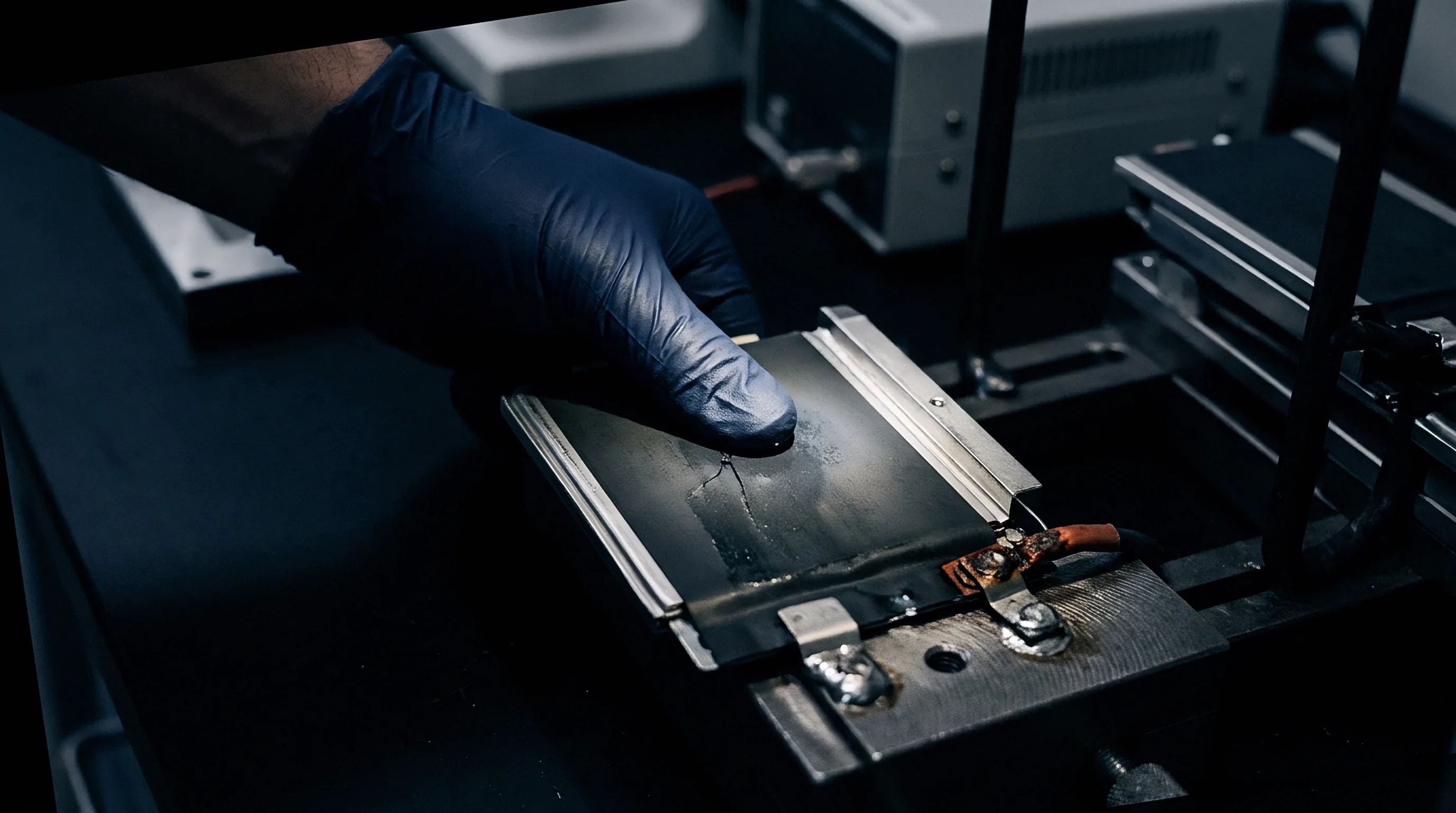
Carriers will not accept a cell without verified proof that the design passed all eight evaluations in Section 38.3 of the United Nations Manual of Tests and Criteria. The standard puts production-intent cells through mechanical, thermal, and electrical loads designed to simulate intermodal shipping environments. Testing runs on fresh production cells and on cells cycled to the end of their rated life, confirming that normal aging does not trigger instability.
A single instance of thermal runaway, casing rupture, venting, or irreversible mass loss across any sample fails the entire qualification run.
The initial sequence divides into four mechanical and environmental stages:
- Altitude simulation test T1 holds unconstrained cells at 11.6 kilopascals for at least six hours to simulate an unpressurized cargo hold, checking seals for electrolyte leakage and monitoring open-circuit voltage.
- Thermal test T2 runs units through ten continuous temperature cycles between negative 40 degrees Celsius and positive 72 degrees Celsius with fixed dwell times, testing internal separator stability against thermal expansion.
- Vibration test T3 sweeps logarithmic frequencies from 7 Hertz to 200 Hertz across three mutually perpendicular axes for three hours per axis to ensure internal electrode tabs resist fatigue.
- Shock test T4 subjects small cells to half-sine acceleration pulses of 150 times gravity, verifying that internal mountings and terminal welds survive sudden physical impact.
The remaining procedures test electrical limits and localized physical damage:
- External short circuit test T5 runs a dead short below 0.1 ohms at 57 degrees Celsius until the cell cools back down, verifying that shutdown separators or current interrupt devices halt current without ignition.
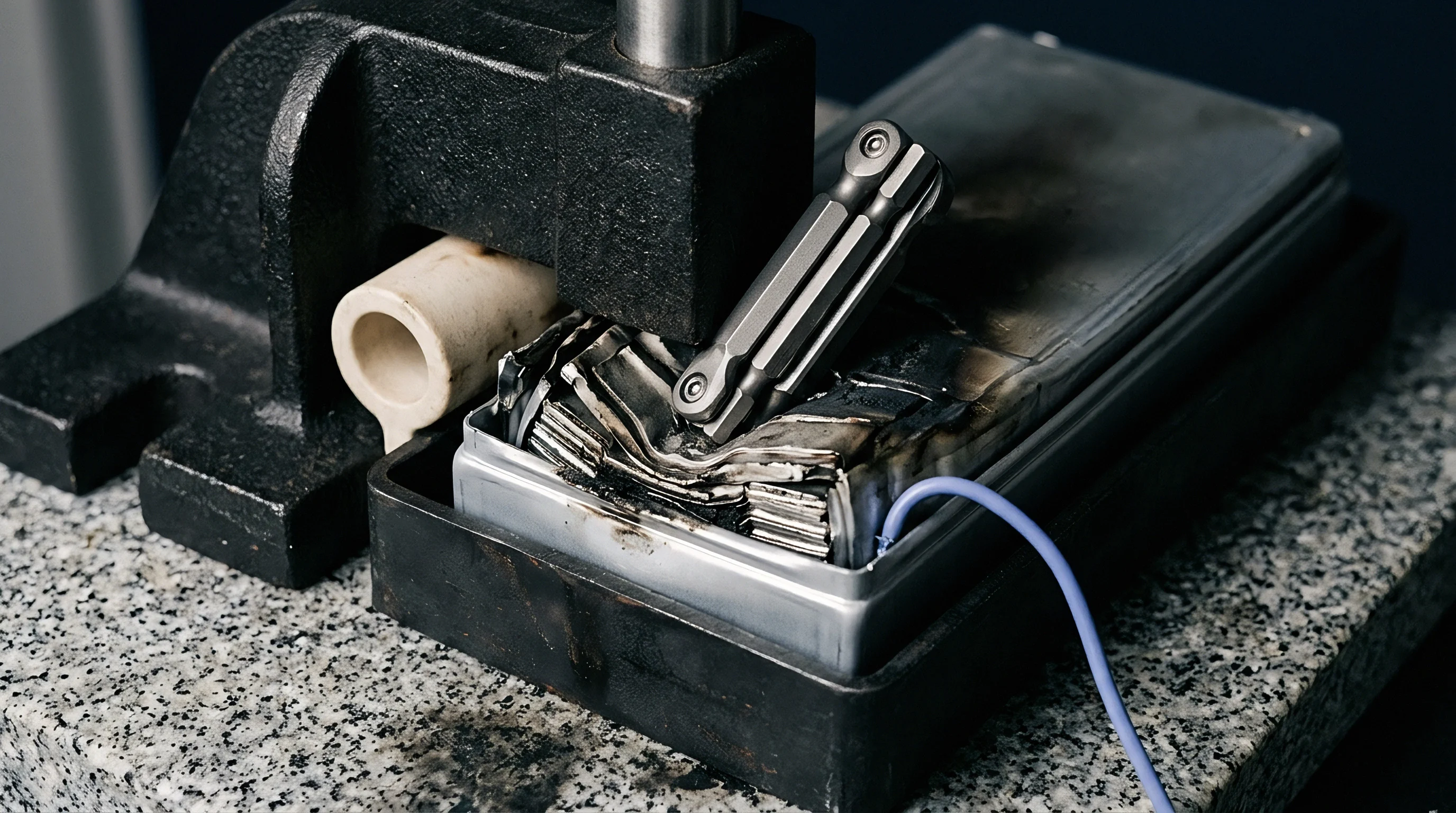
- Impact and crush test T6 crushes cells between steel plates or strikes cylindrical cells with a 9.1-kilogram steel bar dropped from 61 centimeters to confirm casing resistance to impact.
- Overcharge test T7 tests complete battery packs by pushing twice the maximum continuous charge current for twenty-four hours, checking that protection circuitry prevents thermal runaway.
- Forced discharge test T8 forces a discharged cell into reverse polarity at its maximum rated continuous discharge rate, confirming that copper dissolution at the anode will not bridge into an internal dendrite short.
A change exceeding 0.1 grams of cathode active material or a twenty percent shift in cell geometry demands a complete re-execution of tests T1 through T8.
Third-party test reports from earlier product revisions cannot be carried over to updated cell designs. The substitution fails as soon as customs officials cross-check test summaries against incoming part numbers.

Crate
Protective packaging turns an active electrochemical hazard into cargo that can handle transit. Both the International Civil Aviation Organization Technical Instructions and the International Maritime Dangerous Goods Code assign packaging rules according to UN classification. Under IATA Packing Instruction 965 for loose lithium ion cells, requirements split into three tiers: Section IA for fully regulated cells over 20 watt-hours, Section IB for smaller cells shipped in volume, and Section II for small, strictly limited quantities.

Does State of Charge Control Prevent Cargo Hold Refusal?
Air cargo carriers enforce charge limits strictly. Standalone lithium ion cells under UN 3480 cannot be loaded onto an aircraft at more than thirty percent of their rated capacity. Shippers verify compliance on calibrated cyclers before boxing the cells, logging open-circuit voltages in the batch records.
Ground and maritime routes governed by the IMDG Code do not enforce the thirty percent state of charge cap, though several ocean lines now restrict high-density lithium container stowage to weather decks equipped with active cooling access.
Outer packaging for Section IA cargo must meet UN Performance Oriented Packaging criteria. Drums, boxes, or jerricans require certification marks for Packing Group II performance standards, verified through a 1.2-meter drop test, a 24-hour stacking load calculation, and hydrostatic pressure testing if internal receptacles hold liquid electrolyte. Individual terminals must be isolated with non-conductive dividers, blister packs, or individual bags so cells cannot touch each other or any conductive surface.
Packaging that isolates cell terminals prevents short circuits while certified UN boxes absorb external compression during transit.
Passenger aircraft cannot carry standalone lithium ion cells. Every outer box processed under UN 3480 Section IA or Section IB requires the Class 9 Lithium Battery label, the Cargo Aircraft Only label, and an approved UN specification code. Sea freight demands the Class 9 placard along with correct marine pollutant designations on the container exterior.
| Packing Instruction | Applicable Item | Section Category | Maximum Net Mass Per Package | UN Packaging Standard |
|---|---|---|---|---|
| PI 965 | Lithium ion standalone | Section IA | 35 kg | UN PG II Specification |
| PI 965 | Lithium ion standalone | Section IB | 10 kg gross | Strong Rigid Packaging |
| PI 966 | Lithium ion with equipment | Section I | 5 kg | UN PG II Specification |
| PI 967 | Lithium ion in equipment | Section I | 5 kg | Strong Rigid Packaging |
| PI 968 | Lithium metal standalone | Section IA | 35 kg | UN PG II Specification |
A freight forwarder will turn away cargo on the receiving dock if an outer carton shows structural creasing.
Manifest
Compliance comes down to paperwork once shipments reach border inspection. The UN 38.3 Test Summary serves as the baseline proof across international lanes. Since January 2020, manufacturers and distributors have been required to make this summary available along the supply chain without requiring non-disclosure agreements.
Border authorities across the European Union, the United States, and East Asian hubs check dossiers to ensure invoice numbers and serial references match the test sheet exactly.
A compliant test summary includes five standard items:
- Manufacturer corporate identification gives the producer’s legal corporate name, headquarters address, confirmed telephone number, administrative email, and corporate website.
- Testing laboratory credentials identifies the testing facility by name, physical address, accredited phone number, email, and unique laboratory report reference number.
- Cell description parameters details the commercial trade name, internal part number, cell chemistry, physical form factor, and total mass.
- Energy rating specifications lists the watt-hour rating for lithium ion designs or total equivalent lithium content in grams for lithium metal cells.
- Test execution confirmation certifies completion dates and passing results for tests T1 through T8, along with any required pack-level testing.
Shippers moving Class 9 dangerous goods must file a Shipper’s Declaration for Dangerous Goods for air freight or a Dangerous Goods Note for ocean carriage. These forms record the UN number, Proper Shipping Name, Class 9 hazard division, net chemical mass, packaging group, and a 24-hour emergency response phone number staffed by qualified personnel.
Commercial sales agreements routinely bind transport warranties directly to purchase terms. Under standard carriage clauses, the vendor warrants that every cell delivered matches the referenced UN 38.3 test summary and carries valid carrier acceptance certification when loaded.
Indemnity
The Importer of Record carries regulatory, financial, and civil liability the moment cargo enters sovereign territory. If paperwork is flawed, cells are uncertified, or charge levels exceed limits, customs and aviation regulators penalize the importer, not the overseas factory. Container demurrage at major ports mounts quickly while hazardous cargo remains under quarantine, often surpassing the landed value of the cells in a matter of weeks.

Will Contractual Indemnity Protect against Forwarder Seizure?
Commercial agreements divide transport risk using Incoterms and indemnity clauses. Sourcing contracts written as Delivered Duty Paid place transit liability on the seller, but port authorities ignore overseas suppliers and serve seizure or recall notices directly to the domestic consignee. Importers counter that exposure with pre-shipment dossier checks, requiring verified laboratory test reports and on-site state of charge audits before releasing final production payments.
The European Union Battery Regulation broadens producer responsibility through digital battery passport rules. Anyone importing cells into the EU must enroll in national registries, submit verified carbon footprint declarations, and document responsible mineral sourcing alongside baseline transport compliance. Missing either the safety paperwork or the environmental filings stops clearance cold.
Whether digital passport architectures will eventually tie into automated customs processing to eliminate manual dangerous goods reviews remains an open question across freight lanes.