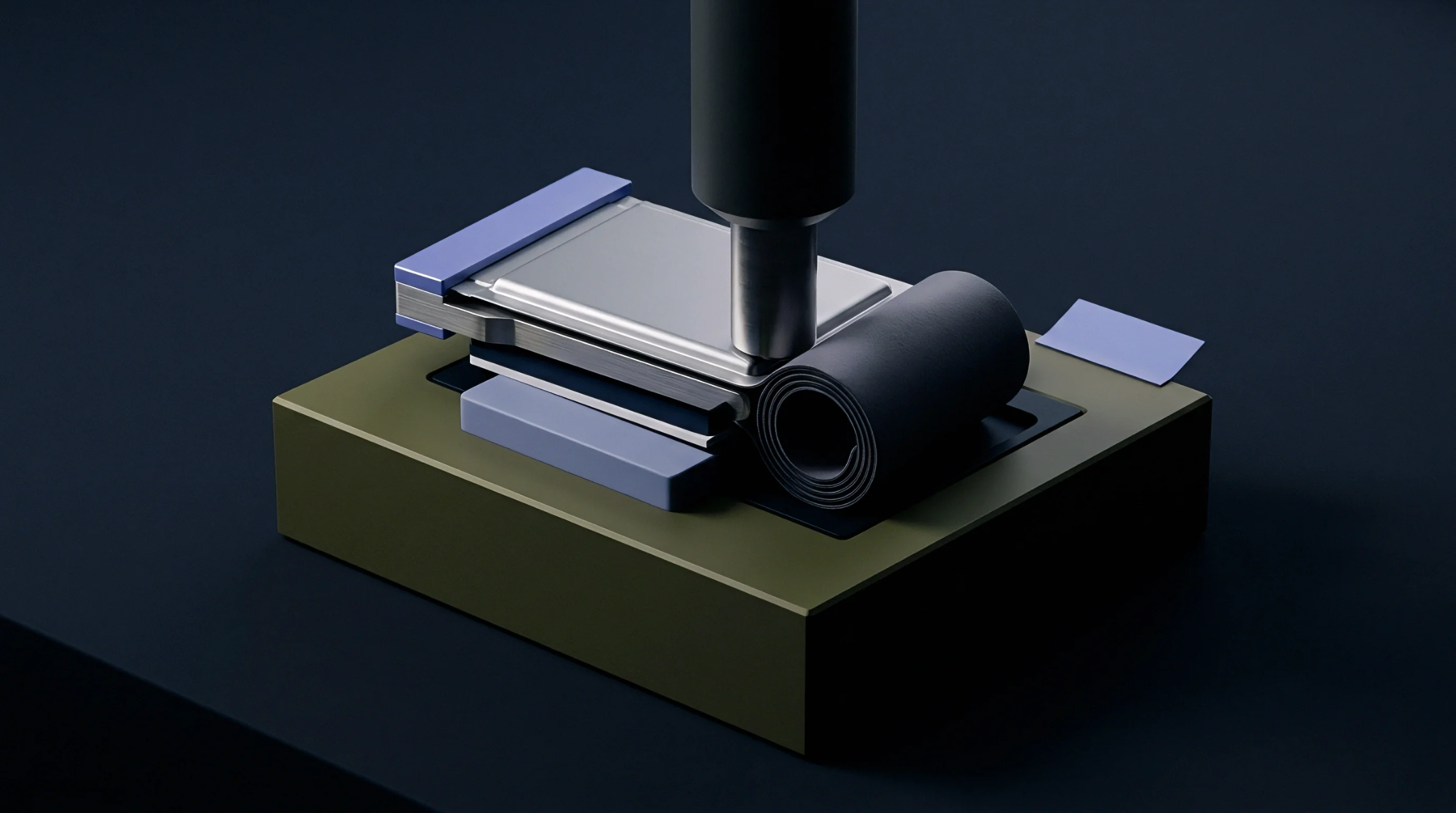
Cylindrical and Prismatic Cell Format Selection Criteria
Format selection dictates tooling capital, cooling architecture, and mechanical containment: cylindrical cells minimize stack stress, while prismatic cells maximize spatial fill.
A resilient elastomeric component maintains structural integrity and provides consistent mechanical pressure between battery cells within a high-capacity energy storage module. This polyurethane compression pad regulates the expansion forces generated during lithium-ion charge and discharge cycles. The material prevents physical deformation of the electrodes by absorbing dimensional changes while maintaining optimal contact pressure across the entire cell surface area.
It remains effective within a specific thermal range determined by the chemical composition of the polymer matrix. The device ceases to function when the structural memory of the elastomer degrades below the threshold required to counter internal stack pressure.
Engineers specify the durometer hardness to match the swelling characteristics of particular cell form factors such as prismatic or pouch configurations. A polyurethane compression pad exerts a restoring force that opposes the natural volumetric growth of the graphite anode and metal oxide cathode. Excessive density in the pad creates too much resistive force, which limits the usable cycle life of the battery by increasing mechanical strain on the internal jelly roll or stacked layers.
Conversely, insufficient density allows the cells to shift, leading to inconsistent contact resistance and potential localized overheating. Procurement teams select specific shore hardness grades to balance these competing mechanical requirements. Suppliers test the hysteresis of the polymer under repeated load cycles to ensure the force-deflection curve stays flat during the lifespan of the energy storage unit.
Thermal stability defines the operational boundary for these synthetic components in an active module environment. A polyurethane compression pad retains physical properties during high current throughput, provided the surrounding heat dissipation management operates within rated parameters. Oxidation and chemical degradation occur if the ambient temperature exceeds the stability limit of the polyether or polyester backbone.
These parts resist chemical swelling when exposed to common electrolyte solvents, which protects the physical dimensions against shrinkage or expansion from contact with internal battery fluids. Long-term durability hinges on the resistance of the molecular chains to scission under continuous static load. Laboratory testing subjects the sample to accelerated aging profiles that simulate the operational duration of a typical vehicle or stationary grid installation.
Proper placement within the module stack allows the uniform distribution of compressive force across the housing. A polyurethane compression pad mitigates vibration and mechanical shock that otherwise damages the delicate internal tabs and current collectors of the individual cells. Installation requires precise alignment to ensure that the compression remains orthogonal to the primary faces of the battery cells.
Misalignment leads to uneven pressure zones, which causes rapid degradation of the energy storage interface due to concentrated lithium plating. Consistent module assembly relies on the ability of the material to compensate for small tolerances in the manufacturing of the metal or plastic cell casing. These components offer a scalable solution for managing the mechanical stresses inherent in modern high-density energy storage systems.
Format selection dictates tooling capital, cooling architecture, and mechanical containment: cylindrical cells minimize stack stress, while prismatic cells maximize spatial fill.
Expertise is a utility, not a secret. sentiention™ publishes its working knowledge as open reference: intelligence layer covering the materials it sources, the markets it enters, and the reference that serves both.