Meaning
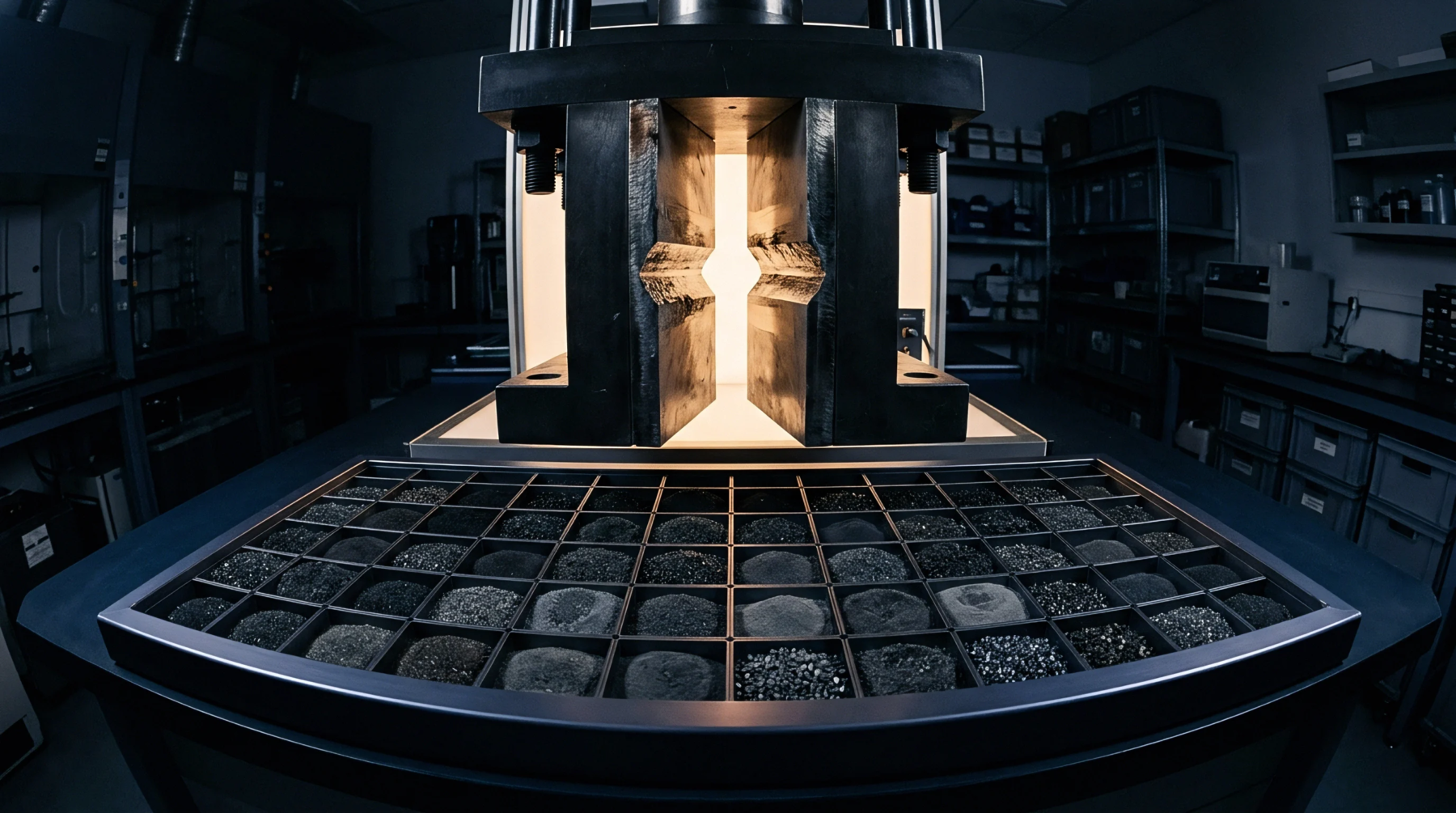
Powder rheology evaluates how particulate solids flow, deform, and consolidate under applied mechanical stress during handling and processing. This measurement discipline determines internal friction, cohesion, and compressibility parameters that dictate behavior inside hoppers, feeders, and pneumatic transport lines. Testing protocols apply shear cells or rotating blades to bulk materials while varying normal loads to map yield loci and flow functions.
Manufacturers rely on these data streams to predict arching or ratholing inside silos and to prevent erratic dosing during continuous manufacturing runs.
Shear Stress
Shear cell geometry measures the force required to fracture consolidated particulate beds along specific failure planes. Normal loads simulate storage pressures at varying depths within industrial silos while rotating vanes quantify the transition from elastic deformation to plastic flow. Unconfined yield strength derived from these traces dictates the minimum arch diameter needed to prevent structural bridging above discharge orifices.
Higher cohesion values demand steeper hopper wall angles to maintain gravity discharge without mechanical assistance. Granular materials exhibit different friction angles depending on moisture content and particle size distribution.
Dynamic Flow
Rotating drum instruments characterize particulate behavior under continuous agitation and low consolidation states. Peripheral sensors track torque resistance and aeration responses while blades traverse beds at controlled velocities. Specific energy values calculated from these traces reflect internal resistance during pneumatic conveying and high-speed mixing operations.
Fluidization velocities emerge from air permeability tests that register pressure drops across porous particulate columns. These metrics separate free-flowing crystal structures from cohesive powders that tend to flood screw feeders.
Compaction Mechanics
Piston compression tests quantify volume changes under progressive mechanical loads to establish bulk density curves. Porosity decreases nonlinearly as interparticle voids collapse and primary particles rearrange into denser configurations. Tensile strength measurements evaluate the structural integrity of cakes formed during roller compaction or tableting operations.
Energy absorption patterns during consolidation separate resilient materials from those prone to brittle fracture under identical stress states. These mechanical profiles govern final product density targets across pharmaceutical manufacturing and battery electrode fabrication lines.