Optimizing Inert Gas Recirculation and Thermal Solidification Profiles for Battery Powder Quality Control
Closed-loop gas purity control and high convective quench rates suppress intermetallics and minimize interstitial oxygen in battery-grade alloy powders.


Nozzle
At the manifold, atomization gas pressure registers 4.2 megapascals while molten silicon-iron alloy enters the ceramic pour tube at 1,580 degrees Celsius. The liquid delivery tip maintains a 2.5-millimeter internal orifice, guiding the melt stream into the supersonic convergence zone of a close-coupled gas atomization ring. Argon exits the annular slit at Mach 2.2, transferring kinetic energy directly into the descending fluid column.
Liquid metal breaks apart through sheet thinning and capillary wave detachment across an initial disintegration zone spanning less than twelve millimeters below the orifice face. Process control at this spatial junction dictates the primary droplet size distribution before thermal dissipation commences.
The gas-to-melt mass ratio governs mean droplet diameter throughout the run. Operating the die below a 1.8 ratio leaves coarse droplets exceeding seventy-five micrometers, loading excess thermal mass into the in-flight cooling zone. Pushing the ratio above 2.8 accelerates droplet velocity and narrows the particle distribution toward the target battery specification of ten to thirty micrometers.
Because higher gas consumption raises operating expenses, pneumatic regulation at the manifold must respond in real time to avoid flow separation at the tip; backpressure inside the feed tube will cause melt freeze-off or aspiration defects that abort the pour instantly.
Gas-to-melt mass ratios above 2.5 at 4.0 megapascals atomization pressure consistently force median powder diameters below twenty-two micrometers.
Mach numbers drop sharply once the gas jet expands into the atomization tower atmosphere. Shock diamonds formed at the annular exit shed their kinetic energy within twenty orifice diameters, with gas velocity falling from 680 meters per second at convergence to 140 meters per second at a distance of three hundred millimeters downstream. Droplet velocity tracks gas deceleration with a slip delay governed by droplet inertia: ultrafines accelerate almost instantaneously, whereas fifty-micrometer droplets lag behind and endure severe shear forces that strip secondary ligaments from their molten surfaces.
Maintaining symmetric gas flow prevents recirculation vortices from throwing semi-molten droplets back against the cold chamber walls.
Ceramic nozzle wear alters gas delivery geometry over extended production runs. Thermal shock and mechanical erosion from liquid alloy wash erode boron nitride and zirconia inserts, widening the melt delivery diameter by up to twelve percent over eight hours of continuous casting. Orifice enlargement increases metal mass flow, depressing the gas-to-melt ratio and shifting the powder distribution toward coarser fractions.
Optical pyrometry and downstream mass balance sensors provide early warning of nozzle erosion, prompting gas pressure compensation at the supply manifold.
Loop
Inert gas recovery systems cycle process argon through cyclones, sintered metal filters, and multi-stage compressors. The returning gas volume leaves the atomization tower base laden with sub-micron metallic dust, thermal energy, and trace atmospheric ingress from chamber seal interfaces. Primary high-efficiency cyclones remove particles larger than five micrometers at 180 degrees Celsius.
Secondary sintered metal candle filters trap the remaining fine particulate down to 0.3 micrometers, preventing impeller abrasion inside downstream root blowers. Pressure drops across the candle filter bank rise as the cake layer builds, signaling automated reverse-pulse nitrogen or argon cleaning cycles to restore baseline flow permeability.
Gas Purification and Contaminant Extraction Trains
Oxygen getter beds operating alongside cryogenic moisture traps strip ambient leaks down to trace levels. Solid-state lithium cell powders demand interstitial oxygen contents below four hundred parts per million to preserve active interfacial contact. Atmospheric air ingress through flange gaskets, feed hoppers, and vacuum seals introduces oxygen and moisture that react with hot metal droplets during flight.
Copper-catalyst deoxo reactors reduce free oxygen levels in the recirculating gas stream down to 1.5 parts per million at 220 degrees Celsius. Molecular sieve desiccant columns lower gas dew points to minus seventy degrees Celsius, preventing surface hydroxide formation on freshly atomized alloy particles.
Contamination vectors within the closed circuit originate from mechanical, chemical, and operational sources:
- Compressor shaft seal degradation introduces synthetic fluorosilicone lubricants directly into the gas stream, depositing volatile hydrocarbons onto cooling powder surfaces during recirculation.
- Elastomer gasket permeation allows atmospheric nitrogen and moisture ingress under transient negative-pressure operations, increasing interstitial nitrogen levels above acceptable alloy tolerances.
- Filter cake breakthrough releases sub-micron fines into heat exchanger tubes, reducing heat transfer coefficients and elevating gas inlet temperatures at the atomization ring.
Can Closed Gas Circuits Prevent Interstitial Contamination?
Purge cycles executed before induction melting reduce background atmospheric components below five parts per million. Vacuum pump-down cycles reach terminal pressures below 0.05 pascals before the system backfills with ultra-high purity argon. Once atomization begins, closed-loop pressure sensors modulate makeup argon injection to compensate for gas trapped within powder collection vessels.
Operating the recirculation circuit at a positive internal gauge pressure of three to five kilopascals prevents ambient atmosphere from entering through moving mechanical joints. Differential pressure transducers across every flange connection monitor seal integrity throughout the casting campaign.
| Carrier Gas Medium | Circuit Dew Point (deg C) | Oxygen Level (ppm) | Blower Power (kW/hr) | Interstitial Oxygen Pickup (ppm) |
|---|---|---|---|---|
| Standard Industrial Argon | -45 | 22.0 | 42 | 780 |
| Purified Recirculated Argon | -72 | 1.8 | 48 | 210 |
| Argon with 5% Helium Blend | -70 | 2.1 | 64 | 195 |
| High-Purity Recirculated Nitrogen | -68 | 4.5 | 38 | 340 |
Gas density shifts alter mass flow delivery through the atomization ring. Thermal heat exchangers maintain steady gas temperatures of twenty degrees Celsius at the booster compressor inlet. Elevated gas temperatures decrease gas density, diminishing the kinetic momentum delivered to the liquid stream and altering droplet breakup mechanics.
Chilled water heat exchangers extract sensible heat from the gas following cyclone separation. Constant mass flow controllers automatically adjust blower rotational speed to maintain uniform mass delivery as filter resistance climbs. Failure to capture sub-micron fines inside the recirculating circuit destroys compressor impellers and elevates interstitial oxygen in the finished powder lot beyond five hundred parts per million, forcing complete batch rejection at the electrode coating plant.

Quench
Cooling rates inside atomization towers exceed one hundred thousand kelvin per second for micro-droplets. Molten alloy particles plunge downward through the inert gas column, transferring thermal energy through convective boundary layers. Droplet diameter establishes the internal thermal gradient and biot number governing solidification kinetics.
Particles smaller than twenty micrometers undergo Newtonian cooling where internal conduction outpaces external convective transfer, preventing thermal shock cracking. Particles larger than sixty micrometers experience internal temperature gradients, generating recalescence events that alter final crystalline phase selection.

Solidification Kinetics across Droplet Diameter Bands
Convective heat transfer dominates thermal dissipation as liquid spheres plunge through cold argon. Relative velocity between falling droplets and surrounding gas drives the Nusselt number from initial supersonic shear down to terminal settling conditions. Helium additions to the recirculating argon stream elevate gas thermal conductivity by up to thirty percent, accelerating in-flight cooling rates without requiring increased gas pressure.
Droplet velocity decays rapidly over the first meter of vertical fall, establishing an asymptotic thermal profile that prevents droplet deformation upon chamber impact.
Droplet size distribution dictates distinct solidification regimes within the descending spray cone:
- Ultrafine micro-droplets below ten micrometers solidify entirely within fifty milliseconds of detachment, yielding fully amorphous or nanocrystalline microstructures that maximize lithiation reversibility.
- Intermediate target fractions between ten and thirty micrometers exhibit cellular solidification patterns with secondary dendrite arm spacings below 0.8 micrometers, suppressing macro-segregation.
- Coarse splatter particles exceeding sixty micrometers remain molten through the primary quench zone, colliding with semi-solid particles and forming agglomerates that must be removed by screening.
ASTM B215 sampling rules declare an entire powder production lot non-conforming if interstitial oxygen exceeds four hundred parts per million at any single extraction port.

Why Do Cooling Rates Dictate Powder Microstructure?
Rapid thermal extraction prevents coarse secondary phases from precipitating within the solidifying matrix. Silicon-alloy anodes incorporate transition metals such as iron or nickel to buffer volumetric expansion during battery charge cycles. High quench rates retain electrochemically active silicon phases within an inactive, conductive silicide network.
Cooling rates below fifty thousand kelvin per second allow coarse, brittle iron disilicide plates to grow, causing mechanical particle fracture during battery cycling. In-flight solidification profiles also suppress surface segregation of low-melting-point eutectic liquids, ensuring uniform surface energy and consistent binder adsorption during electrode slurry manufacturing.
| Droplet Diameter (um) | Calculated Cooling Rate (K/s) | Solidification Time (ms) | Dendrite Arm Spacing (um) | Phase Constitution |
|---|---|---|---|---|
| 12 | 8.5 x 10^5 | 4.2 | 0.28 | Amorphous Silicon + Nanocrystalline FeSi2 |
| 22 | 2.1 x 10^5 | 14.8 | 0.62 | Refined Cellular Silicon + Eutectic FeSi2 |
| 35 | 6.4 x 10^4 | 42.0 | 1.15 | Dendritic Silicon + Interdendritic FeSi2 |
| 55 | 1.8 x 10^4 | 118.0 | 2.40 | Coarse Silicon Platelets + Primary FeSi2 |
Steeper thermal gradients during in-flight droplet cooling yield finer microstructures and suppress coarse intermetallic phase growth.
Chamber height must accommodate the longest solidification distance across the targeted particle size band. A forty-micrometer droplet requires approximately 2.4 meters of vertical descent to reach its solidus temperature under standard argon counter-flow conditions. Introducing secondary gas quench ports along the lower tower perimeter provides supplementary cooling gas, terminating recalescence before particles contact the hopper cone.
Insufficient quench height results in splatting, where semi-molten droplets flatten against steel hoppers, creating irregular plate-like particles that degrade powder flowability. Industry evaluations leave unresolved whether adding five percent helium to an argon circuit creates enough grain refinement in silicon anodes to balance the higher recovery cost across twenty thousand operational hours.
Particle
Morphological inspection through automated dynamic image analysis isolates irregular grains from spherical fractions. Battery powder quality control requires tight sphericity metrics, with aspect ratios exceeding 0.92 and roundness values exceeding 0.88. Highly spherical particles maximize packing density, lower slurry viscosity during electrode casting, and promote uniform calendered coating density.
In contrast, teardrop morphology and irregular fragments arise from premature gas starvation at the atomization nozzle or low melt superheat. Secondary droplet collision creates attached parasitic dust, where fine droplets weld to larger particles before complete solidification occurs.
Interstitial Gas Fusion and Surface Oxidation
Combustion analysis measures bulk oxygen pickup in finished powder lots down to single parts per million. Inert gas fusion according to ASTM E1019 quantifies oxygen, nitrogen, and hydrogen liberated under high-temperature graphite crucible melting. Surface native oxides on silicon alloys form rapidly upon contact with trace moisture or oxygen inside the recovery loop, generating an insulating silicon dioxide shell.
Native oxide shells consume lithium inventory irreversibly during the initial electrochemical formation cycle, depressing first-cycle coulombic efficiency below eighty percent. Controlling closed-loop gas purity keeps total oxygen pickup below three hundred parts per million, preserving electrochemical reversibility.
Incoming powder receiving inspection executes a sequential verification sequence across bulk containers:
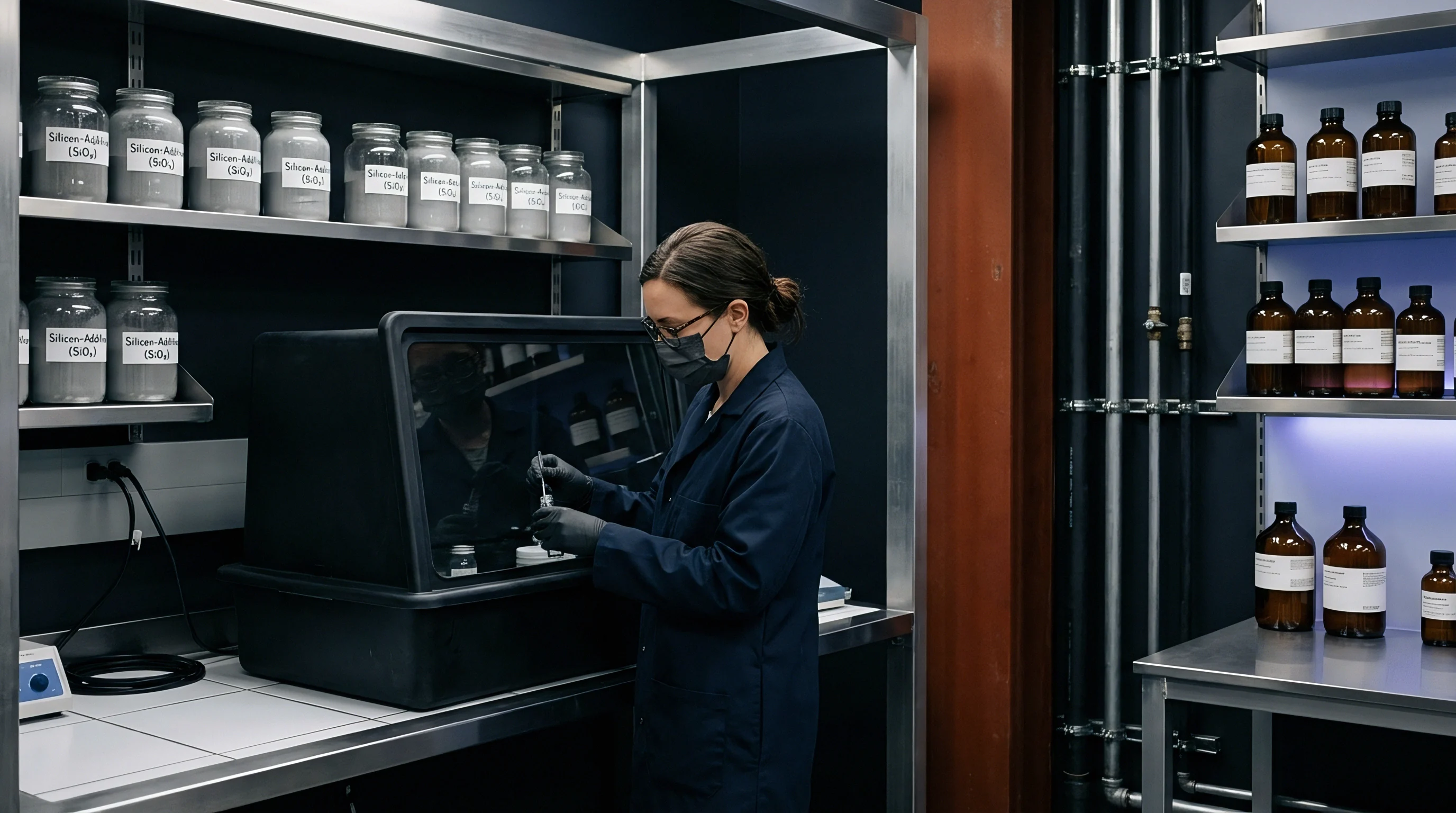
- Thief probe core sampling per ASTM B215 extracts multi-level powder increments from drums under sealed argon blankets to avoid atmospheric exposure.
- Laser diffraction analysis per ISO 13320 establishes D10, D50, and D90 values, confirming particle size distributions remain within specified process envelopes.
- Inert gas fusion testing via impulse furnace determines bulk interstitial oxygen and nitrogen concentrations against certified material limits.
- Automated pycnometry evaluation per ASTM B527 establishes apparent and tap densities, calculating Hausner ratios below 1.18 to ensure feed shoe flowability.
Fine powder fractions adhering to larger particles reduce tap density and increase binder consumption during electrode slurry mixing.
Screening Yield and Economic Loss Arithmetic
Gross powder production splits across usable battery-grade fractions and discarded coarse splatter. Consider a 1,000-kilogram atomization batch of silicon-anode alloy priced at 42 dollars per kilogram raw material input cost. Atomization operating expenses, including power, gas makeup, and labor, total 6,500 dollars per batch run.
Ultrasonic screening classifies the raw atomized powder into three distinct streams: fines below ten micrometers, target battery fractions between ten and thirty micrometers, and oversize splatter above thirty micrometers. Target distribution efficiency governs the economic yield of the atomization line.
| Powder Stream Fraction | Mass Recovered (kg) | Fraction Share (%) | Unit Value ($/kg) | Net Value Recovered ($) |
|---|---|---|---|---|
| Target Battery Cut (10-30 um) | 680 | 68.0 | 85.00 | 57,800 |
| Recyclable Fines (< 10 um) | 140 | 14.0 | 18.00 | 2,520 |
| Scrap Oversize Splatter (> 30 um) | 155 | 15.5 | 12.00 | 1,860 |
| Chamber Wall Dust Losses | 25 | 2.5 | 0.00 | 0 |
| Campaign Total | 1,000 | 100.0 | N/A | 62,180 |
Unoptimized thermal solidification increases scrap generation significantly. When gas recirculation flow rates drift downward by fifteen percent, the gas-to-melt ratio drops, shifting the mass distribution toward the coarse cut. In this defective operating state, the target battery fraction yield falls from 680 kilograms down to 510 kilograms, while the scrap oversize splatter rises to 310 kilograms.
Total revenue drops from 62,180 dollars to 48,270 dollars against identical operating and raw material costs of 48,500 dollars. Operating margins flip from positive 13,680 dollars to a net loss of 230 dollars for the single batch run. Real-time gas recirculation management preserves targeted droplet trajectories, directly protecting operational profitability.
Powders showing high flowability in gravity funnels yield uniform electrode coatings on high-speed casting lines.

Ledger
Procurement agreements for battery-grade atomized alloys fix baseline raw material costs against inert utility consumption. Atomization facilities running once-through open argon configurations consume approximately twenty-five normal cubic meters of gas per kilogram of produced powder. At market rates of four dollars per cubic meter for certified argon, gas consumption alone adds one hundred dollars per kilogram to processing costs, rendering production commercially unfeasible.
Installing a closed-loop recirculation system with ninety-six percent recovery efficiency slashes net gas consumption down to 1.0 normal cubic meter per kilogram, reducing utility expenses to four dollars per kilogram.
Toll Conversion Contracts and Inert Gas Amortization
Buyers negotiating conversion fees separate metal pricing from recycling energy overheads. Toll processing agreements establish baseline utility consumption per ton of atomized metal. Conversion facilities guarantee specific mass yields within the target particle size envelope, typically establishing a floor of sixty-five percent acceptable battery-grade powder.
Yield shortfalls below the contractual threshold trigger scrap penalty credits that reimburse the buyer for damaged feed alloy. The agreement also specifies allowable gas makeup loss limits, insulating the buyer from bearing the financial cost of excessive leak rates across aged compressor seals or damaged filter bags.

Technical Acceptance Boundary Clauses in Supply Agreements
Purchase orders define hard rejection limits for oxygen pick-up, tap density, and flow time. Receiving warehouses sample each incoming lot under inert environmental transfer hoods, testing split samples across external reference laboratories whenever analytical values border rejection thresholds. Contamination disputes center on analytical test conditions, specifically differences in outgassing temperature profiles used during inert gas fusion.
Standardizing test parameters prevents suppliers from masking internal particle oxidation behind low degassing temperatures. Clause 8.3 in international metal powder supply contracts transfers financial liability for inert gas contamination to the conversion facility whenever incoming carrier gas purity registers below five-nines grade.