The Transport Rules and Safety Tests Lithium Cells Must Pass
Lithium cell shipments require UN 38.3 bench qualification, 30 percent state-of-charge air caps, Class 9 packaging, and verified 10-field test summaries.
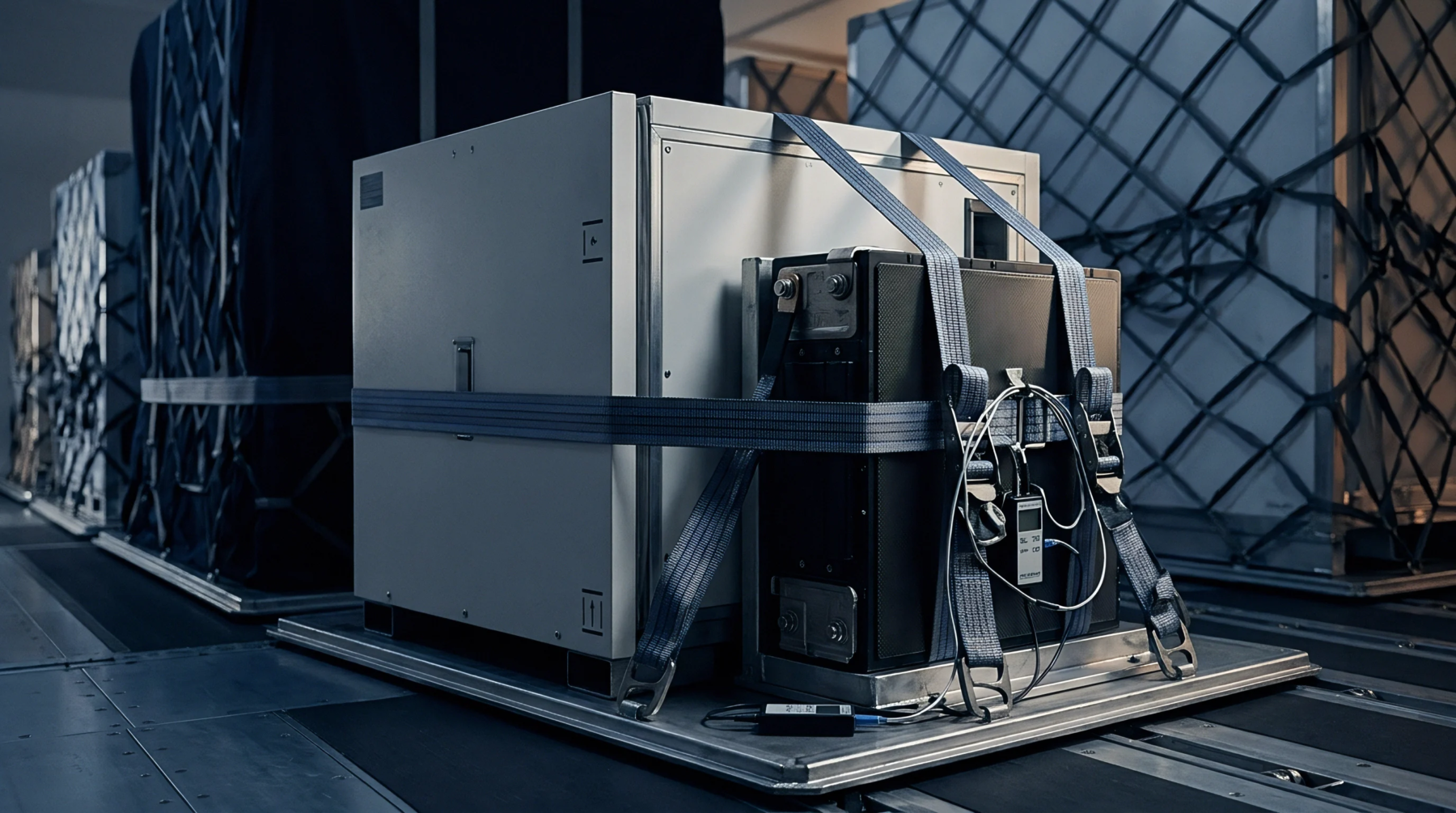
This international aviation regulation mandates that lithium ion batteries shipped as cargo on passenger aircraft must not exceed a 30 percent state of charge. It was established by the International Civil Aviation Organization to reduce the risk of a high energy fire in the cargo hold of an airplane. The state of charge 30 percent rule applies to cells and batteries shipped by themselves and not those that are already installed in electronic devices.
At this lower energy level, the likelihood of a cell entering thermal runaway is significantly reduced and any resulting fire is much easier to contain. This restriction stops applying to ground transportation, although some trucking companies have adopted similar policies for their own safety management.
The decision to implement this limit followed extensive testing which showed that lithium batteries are much more stable when they are mostly discharged. If a short circuit occurs in a cell at 30 percent charge, the resulting heat is often not enough to cause the fire to spread to neighboring cells. In contrast, a battery at full charge contains enough stored energy to trigger a chain reaction that can destroy an entire pallet of goods in minutes.
The state of charge 30 percent rule provides a critical safety buffer that protects the aircraft and the people on board from the dangers of a thermal event that might be impossible to extinguish in flight. This regulation is strictly enforced by airlines and airport authorities around the world. Any shipment found to exceed this limit can be seized and the shipper may face substantial legal penalties.
For manufacturers, this rule requires a change in the final testing and packaging stages of the production line. Every battery must be discharged to the correct level before it is boxed and labeled for air freight. This process adds time to the manufacturing cycle and requires the use of specialized equipment to accurately measure and record the state of charge for every batch.
The state of charge 30 percent rule also means that the batteries will arrive at their destination with very little energy. This can be a problem for customers who need to use the batteries immediately or for retailers who want to sell products that are ready to go out of the box. Shippers must provide a declaration or proof of compliance to the carrier before the goods are loaded onto the plane.
This documentation is a standard part of the dangerous goods paperwork for lithium battery exports.
Managing the shelf life of batteries becomes more complex under this regulation because a mostly discharged battery is more vulnerable to damage from self discharge. If a battery sits in a warehouse for a long time at 30 percent, the voltage can drop below a critical level, causing permanent damage to the internal chemistry. To prevent this, companies must monitor their inventory closely and use a first in first out system to ensure that batteries are not stored for too long.
Sourcing teams must also consider the cost of recharging the batteries once they reach the assembly plant or the final customer. Despite these challenges, the state of charge 30 percent rule remains a cornerstone of the safety protocols that allow the global electronics industry to move products quickly by air. It represents a necessary trade off between logistical speed and the physical safety of the global transport network.
Lithium cell shipments require UN 38.3 bench qualification, 30 percent state-of-charge air caps, Class 9 packaging, and verified 10-field test summaries.
Expertise is a utility, not a secret. sentiention™ publishes its working knowledge as open reference: intelligence layer covering the materials it sources, the markets it enters, and the reference that serves both.