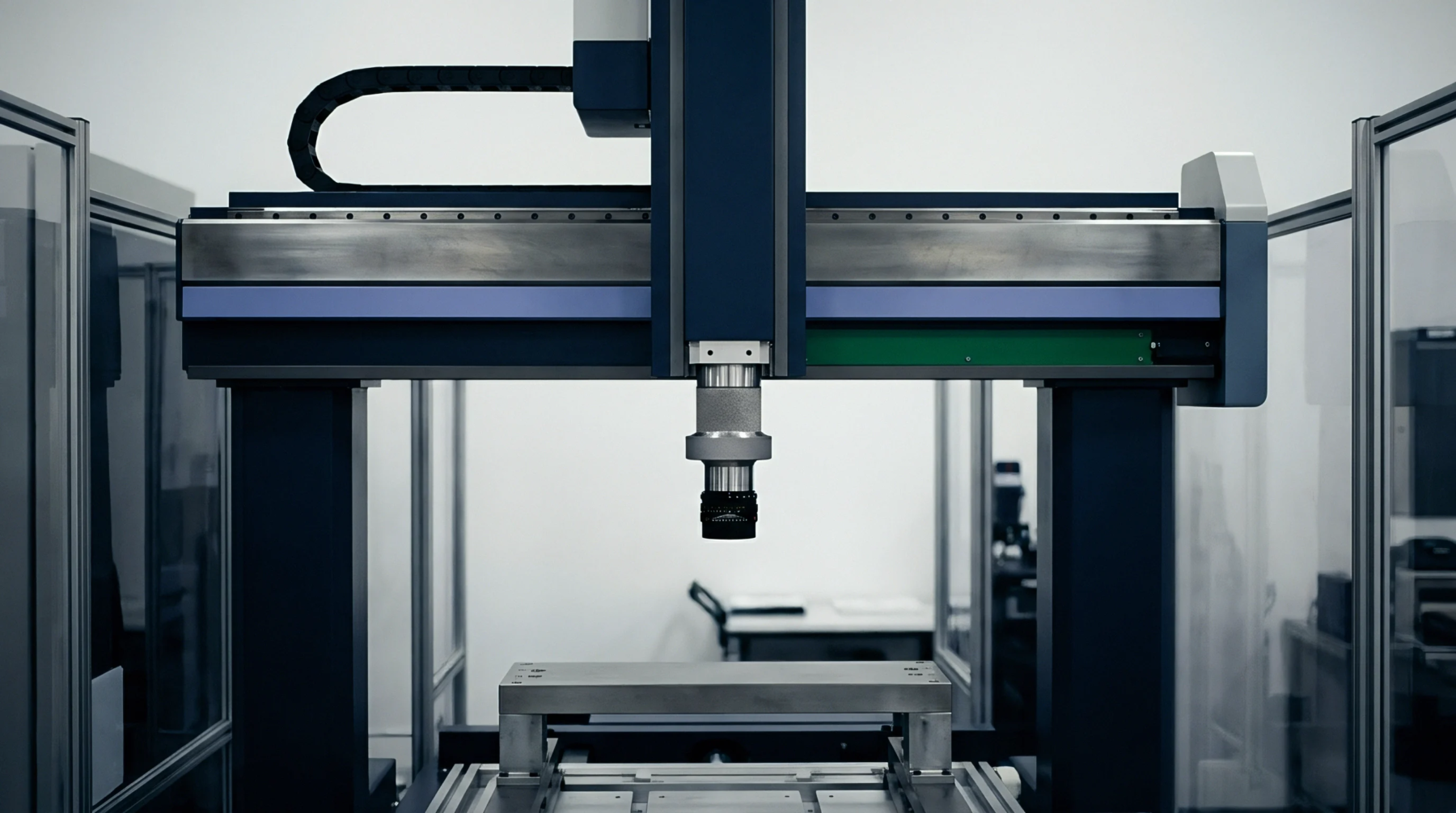
Differential Capacity Signal Distortion under Intra-Cell Thermal Non-Uniformity
Intra-cell thermal gradients skew differential capacity signals, masking true health states and invalidating supply contract warranty baselines.
Regularization mathematics provide a stable method for solving ill-posed inverse problems by introducing a penalty term that suppresses noise amplification during signal recovery. Tikhonov deconvolution stabilizes the inversion of a system matrix by adding a scaled identity matrix to the square of the forward operator. This operation effectively restricts the solution norm, which prevents small singular values from causing the reconstructed image or data set to explode into high frequency oscillations.
It finds application in imaging systems where raw sensor data contains blurring from optical diffraction or detector constraints. The boundary of this approach lies in the bias it introduces, as forcing a smaller norm inherently pushes the estimated values away from the true underlying distribution when the noise floor remains low.
Parameters chosen for the regularization term dictate the outcome of the signal restoration process. A scalar value controls the weight of the penalty, determining the trade off between fitting the observed input and maintaining a smooth reconstruction. When the parameter grows, the fidelity to raw data decreases while the sensitivity to noise drops.
Practitioners often select this scalar through methods that identify the knee of a log-log plot relating residual error to solution norm. Stability remains the primary objective, ensuring that minor fluctuations in measurement do not produce wild swings in the processed output. Automated routines adjust the weight based on the estimated variance of background noise present in the specific hardware channel.
Computational imaging pipelines utilize tikhonov deconvolution to improve resolution in devices with physical aperture limits. The procedure models the blur as a convolution operation, creating an algebraic framework where the original object acts as the unknown vector. By solving the modified least squares problem, the algorithm removes the halo effects and smearing caused by imperfect lens alignment or diffraction.
Each sensor pixel contributes to the final grid, and the matrix inversion accounts for the cross-talk between adjacent capture areas. Processing speed depends on the dimensions of the kernel, as dense matrices demand significant memory for the arithmetic operations involved. High resolution sensors require efficient sparse matrix solvers to maintain throughput during batch processing of heavy frames.
Hardware manufacturers rely on this approach to standardize the output from analog detectors across multiple production lines. By controlling the amount of smoothing, the algorithm compensates for variations in individual sensor sensitivity or dark current levels. Residual noise often survives the initial recovery phase, requiring secondary low-pass filters to clean the signal for downstream machine vision tasks.
This technique minimizes the computational burden compared to iterative statistical methods, making it suitable for real-time applications within embedded control circuits. The method provides a predictable and linear transformation that allows for consistent calibration across different environmental conditions. Superior reconstruction quality depends entirely on the accuracy of the blur kernel measurement and the selection of the correct damping factor for the specific signal frequency range.
Intra-cell thermal gradients skew differential capacity signals, masking true health states and invalidating supply contract warranty baselines.
Expertise is a utility, not a secret. sentiention™ publishes its working knowledge as open reference: intelligence layer covering the materials it sources, the markets it enters, and the reference that serves both.