Acceptable Impurity Thresholds for Recycled Battery Precursor Hydroxides
Acceptable precursor impurity ceilings require copper under 20 ppm and iron under 50 ppm to avoid separator puncture, cell shorts, and severe scrap fallout.

Tanks
Precipitation Feedstock Realities for Recycled Metal Salts
Hydrometallurgical refining of spent lithium-ion battery black mass routes mixed transition metals through counter-current liquid-liquid extraction trains before crystallizing sulfate salts or direct-stripping pregnant leach solutions into mixed hydroxide precursors. When these recycled liquor streams enter continuous stirred-tank reactors for coprecipitation, the residual contaminant profile diverges sharply from virgin, mined ores. Virgin battery-grade nickel, cobalt, and manganese sulfates carry discrete geological backgrounds, primarily zinc, magnesium, and trace silicon.
Recycled streams carry process reagents, incomplete solvent extraction wash remnants, current collector metallics, structural packaging fragments, and electrolyte decomposition byproducts. Hydroxide precipitation forces every element with an insoluble hydroxide phase at pH 10.5 to 11.5 into the solid crystal matrix. Cations whose solubility products exceed this window stay dissolved in the mother liquor or adsorb onto the growing particle boundaries.
The precipitation reactor binds these foreign elements into the crystal bulk. Continuous coprecipitation particle growth relies on balancing ammonia complexation with sodium hydroxide dosing at temperatures held between 50 and 60 degrees Celsius. In typical plant operations, dissolved copper, iron, aluminum, and zinc compete with nickel and cobalt for ammoniacal coordination or precipitate immediately as sub-micron colloidal hydroxides that adhere mechanically to secondary spherical agglomerates.
Sourcing teams look beyond total metallic assay figures to check whether contaminants sit substitutionally on transition metal lattice sites or concentrate at inter-particle boundaries. Inter-granular foreign phases compromise particle fracture toughness under commercial calendering pressures exceeding 150 megapascals.
Copper concentrations above 100 parts per million in coprecipitation mother liquor cause localized particle agglomeration and uncontrolled secondary nucleation.
A procurement specification requires exact elemental thresholds mapped to specific analytical techniques. Inductively coupled plasma optical emission spectrometry handles bulk metallic constituents down to single-digit parts per million, while glow discharge mass spectrometry resolves surface-segregated elements and ultra-trace species. Commercial contracts for recycled precursor materials define acceptable baseline concentrations across both structural cations and electrochemically active poison species.
The baseline target for virgin-grade material sets total metallic impurities below 500 parts per million, with single-element caps for iron, copper, and zinc restricted to 10 to 30 parts per million each. Recycled precursors face practical hydrometallurgical separation costs that tempt refiners to deliver broader allowances, shifting the purification burden onto cathode synthesis calcination stages.

Lattice
Structural Alteration from Extraneous Ingot and Collector Remnants
Foreign metallic ions integrated into precursor nickel-manganese-cobalt hydroxides survive dry-blend lithiation and high-temperature solid-state calcination. Once fired into final layered lithium metal oxide cathodes, these elements redistribute based on their thermodynamic coordination preferences and ionic radii relative to nickel, cobalt, and lithium. Trivalent iron exhibits an ionic radius of 0.645 angstroms, closely matching low-spin trivalent nickel at 0.56 angstroms and trivalent cobalt at 0.545 angstroms.
During calcination at 750 to 900 degrees Celsius, iron integrates directly into the octahedral transition metal layers. This substitution does not disrupt the space group symmetry initially, yet it pins surrounding nickel ions and limits lithium-ion extraction kinetics during initial galvanostatic charging above 4.1 volts versus lithium metal.
Aluminum is often added intentionally to stabilize high-nickel cathode frameworks, but unmanaged aluminum carried over from shredded current collectors leaves patchy compositional pockets. Recycled precursor precipitations containing non-uniform aluminum distributions develop secondary phases during solid-state synthesis. Instead of forming a homogeneous solid solution across the particle bulk, excessive random aluminum creates localized insulating domains that resist electrochemical activation and drive down initial specific capacity.
Silicon carryover from glass seals, fire-suppression additives, or anode composites works along a different pathway, forming orthosilicate structures during high-temperature firing that segregate to primary particle surfaces and block lithium transport channels.
| Element | Source in Recycled Feedstock | Virgin Spec Limit (ppm) | Recycled Tolerable Limit (ppm) | Degradation Mechanism |
|---|---|---|---|---|
| Iron (Fe) | Cell casings, shredder wear, structural plates | < 20 | < 50 | Lattice substitution, domain pinning, gas evolution |
| Copper (Cu) | Anode foil shreds, weld spatter, cable remnants | < 10 | < 20 | Dendritic re-deposition, micro-shorts through separator |
| Aluminum (Al) | Cathode substrate foil, module busbars, packaging | < 30 | < 150 | Electrochemically inactive dead mass, rate capability drop |
| Zinc (Zn) | Galvanized hardware, braze alloys, can coatings | < 20 | < 40 | Site disorder in lithium slabs, rapid impedance rise |
| Silicon (Si) | Sealants, thermal potting, cell insulation tape | < 30 | < 50 | Resistive surface layer formation, particle boundary microcracks |
| Chromium (Cr) | Stainless steel casings, tooling wear, fasteners | < 10 | < 15 | Redox-active electrolyte oxidation, high-voltage breakdown |
Copper contamination presents the most catastrophic failure signature among structural metallics. While iron substitutes into the cathode transition metal slab, copper remains mobile under dynamic cell operating windows. At typical cathode potentials between 3.0 and 4.2 volts, solid copper species oxidize to cupric ions, migrate across the porous separator membrane via the liquid electrolyte, and deposit onto the graphite anode.
Graphite operational potentials hover within 100 millivolts of pure lithium metal during normal charging. Under these reducing conditions, dissolved copper plates out as metallic dendrites. Over prolonged cycling, these metallic copper filaments pierce thin microporous polymer separators, initiating low-impedance internal short circuits.
A batch certificate reporting copper concentrations above 20 parts per million warrants lot rejection.
Zinc behaves as a destabilizing interstitial or substitutional species depending on calcination stoichiometry. Divalent zinc matches the ionic radius of divalent lithium at 0.74 angstroms, allowing zinc to migrate directly into the lithium layer during high-temperature crystal assembly. This cation mixing blocks the two-dimensional percolation paths required for lithium transport during high-rate discharge.
Laboratory cycling demonstrates that every 50 parts per million increase in precursor zinc content accelerates impedance rise by roughly four percent per one thousand full equivalent cycles at 25 degrees Celsius. The engineering cost of secondary zinc removal during solvent extraction remains lower than the downstream commercial warranty exposure caused by field-level capacity dropouts.
Chromium and nickel-iron superalloy contaminants originate from high-shear mechanical shredders used in mechanical pretreatment of battery modules. Hexavalent or trivalent chromium species accelerate liquid electrolyte oxidation at the cathode surface when operating cells above 4.25 volts. This parasitic reaction consumes active lithium from the inventory, thickens the cathode electrolyte interphase layer, and generates carbon dioxide and carbon monoxide gas within hermetically sealed cell casings.
Pouch cells containing elevated chromium precursors exhibit swelling within the initial three hundred cycles at 45 degrees Celsius. Sourcing engineers specify digestion and emission spectrometry protocols specifically tuned to pick up low levels of refractory stainless steel particles that pass through standard leach filters.
Section 6 of the Chinese National Standard GB/T 26300-2020 specifies baseline metallic impurity ceilings for nickel-cobalt-manganese composite hydroxides, setting total heavy metal limits below 100 parts per million.
Particle morphology alterations compound these chemical issues. When iron or aluminum concentrations fluctuate in the continuous stirred-tank reactor, the precipitation kinetics shift. Supersaturation curves change, shifting the balance between nucleation rate and grain growth rate.
The final secondary particles develop irregular tap densities and broad size distributions. High tap density above 2.0 grams per cubic centimeter remains necessary for high volumetric energy density roll-to-roll electrode coating. Batches characterized by excessive foreign elements consistently show depressed tap densities below 1.8 grams per cubic centimeter.
The physical packing limit of the precursor directly governs the active mass loading achievable on the cathode coater.
Precursor hydroxide particles carrying high concentrations of aluminum and silicon develop intra-granular voids during drying. Calcination collapses these voids unevenly, leaving hollow or poorly consolidated primary crystal groupings. Under calendering roll pressures of 180 megapascals, these hollow secondary spheres fracture catastrophically.
The newly exposed fracture planes lack protective surface coatings and immediately undergo phase transformation to rock-salt structures during subsequent electrochemical cycling. The cell degrades through rapid active material loss, elevated gas generation, and continuous impedance growth. Sourcing dossiers must link wet chemical assay data directly with cross-sectional scanning electron microscopy and focused ion beam milling of single precursor particles.

Brine
Residual Reagent Trapping and Phase Disruption
Hydrometallurgical refining relies heavily on sodium hydroxide, ammonium hydroxide, sodium carbonate, and sulfuric acid. Crystallization circuits that produce nickel and cobalt sulfates use extensive volumes of water, leaving residual sodium and sulfur embedded in the final precursor matrix. In complete closed-loop battery recycling plants, process water is recirculated through multi-stage evaporators and mechanical vapor recompression systems to minimize liquid discharge.
This process concentration causes steady-state increases in monovalent alkali metals and halide ions within the coprecipitation make-up tanks. Unless multi-stage washing with heated deionized water removes these ions, residual brine elements precipitate directly into the porous hydroxide cakes.
Sodium ions possess an ionic radius of 1.02 angstroms, significantly exceeding that of lithium at 0.76 angstroms. During lithiation calcination, sodium incorporates into the interlayer spaces of the layered oxide cathode. Because of its large size, low concentrations of sodium act as structural pillars, stabilizing the layered framework during aggressive de-intercalation.
Controlled sodium doping between 100 and 300 parts per million can stabilize capacity retention. Precursor hydroxides derived from recycled feeds, however, frequently contain unwashed sodium levels exceeding 1,200 parts per million. At these concentrations, sodium disrupts the c-axis lattice parameter, drives severe cation disorder, and encourages the formation of electrochemically inactive sodium metal oxide phases that split off as secondary structural defects.
Sulfur represents the primary non-metallic residual element in precursor hydroxides produced from sulfate-based hydrometallurgical routes. Residual sulfate groups adhere electrostatically to the primary crystallite surfaces during continuous precipitation at high pH. Standard washing protocols leave between 0.1 and 0.4 weight percent sulfur in virgin precursor cakes.
In recycled precursor processing, inconsistent washing or overloaded filter presses elevate sulfur fractions above 0.8 weight percent. During solid-state calcination, this sulfur oxidizes and reacts with the input lithium hydroxide or lithium carbonate, forming inert lithium sulfate. This reaction consumes expensive battery-grade lithium input stock, throwing off the intended lithium-to-metal stoichiometric ratio and degrading cathode electrochemical capacity.
Halide contamination presents exceptional corrosion risks. Chlorine enters recycled precursor streams through poorly stripped polyvinyl chloride packaging materials, chlorinated solvents, or low-purity process water used in mechanical shredding facilities. Fluorine enters through incomplete thermal deactivation of the polyvinylidene fluoride binder and lithium hexafluorophosphate electrolyte salt during black mass roasting.
Precursor hydroxide specifications hold chlorine below 50 parts per million and fluorine below 100 parts per million. Elevated halides accelerate corrosion of nickel-alloy calcination saggers and stainless steel processing equipment. Halide ions volatilize during high-temperature thermal processing, redepositing as corrosive condensates that attack downstream heating elements and exhaust ductwork.
Halide concentrations exceeding 80 parts per million cause severe stress-corrosion cracking across stainless-steel calcination kiln ducting within six months of operation.
Potassium mirrors sodium behavior, originating from alkaline neutralizing solutions or raw water contamination. Divalent calcium and magnesium originate from hard water make-up streams, lime neutralization circuits, or slag-forming additives used in pyrometallurgical pretreatments. Magnesium substitutes directly into transition metal sites, functioning as an electrochemically inactive structural stabilizer in modest amounts below 500 parts per million.
Calcium, conversely, separates as calcium sulfate or calcium oxide due to its large ionic radius of 1.00 angstrom. These calcium compounds locate at primary grain boundaries, blocking ionic diffusion pathways and generating localized mechanical stress concentrations during cyclic cathode volume breathing.
Water-soluble alkali species directly accelerate the formation of residual surface lithium species on final calcined cathodes. Precursor hydroxides with high sodium and sulfate loads consistently yield higher concentrations of lithium carbonate and lithium hydroxide on the active cathode powder surface. These basic lithium salts react with trace moisture during electrode slurry preparation, hydrolyzing polyacrylic and polyvinylidene fluoride binders and driving slurry gelation.
Battery assembly plants face production line shutdowns when electrode paste viscosity spikes uncontrollably inside coating feed systems. Sourcing teams enforce strict residual element caps on precursor raw materials to prevent binder cross-linking and preserve slurry rheology downstream.

Clash
How Do Virgin and Recycled Specifications Diverge in Commercial Contracts?
Global cathode active material manufacturers maintain rigid internal acceptance specifications tailored around the low-impurity profiles of primary mined metals. Mining extraction of nickel from laterite or sulfide deposits produces distinct, predictable trace elements that decades of kiln profile engineering have accommodated. Hydrometallurgical recyclers routinely present materials that fail these legacy standards while meeting the total transition metal content requirements.
This dynamic generates sharp commercial tension during contract execution, as recyclers push for expanded tolerance bands on non-critical cations to avoid complex ion-exchange polishing steps. Buyers balancing cell cycle warranties against regulatory recycled-content requirements must determine which specification lines can flex without risking battery safety or longevity.
The core dispute centers on calcium, magnesium, aluminum, and sodium tolerances. Virgin specifications routinely cap calcium and magnesium at 30 parts per million each. Calcium and magnesium levels up to 100 parts per million show no measurable capacity drop over two thousand cycles, with moderate magnesium even acting as a zero-strain stabilizer; calcium, however, introduces boundary resistances and accelerates gas generation during storage tests at 60 degrees Celsius.
Commercial agreements settle the conflict by establishing tiered pricing formulas tied directly to certified elemental assays for each delivered lot.
| Impurity Class | Element | Tier 1 Virgin Spec (ppm) | Recycled Baseline Spec (ppm) | Contract Price Penalty Trigger |
|---|---|---|---|---|
| Structural TMs | Fe | < 20 | < 50 | > 50 ppm: Reject or $250/t penalty |
| Plating Hazard | Cu | < 10 | < 20 | > 25 ppm: Immediate lot rejection |
| Alkali Metals | Na | < 100 | < 300 | > 400 ppm: Re-washing cost backcharged |
| Halides | Cl + F | < 50 | < 100 | > 120 ppm: Sagger wear offset tariff |
| Alkaline Earths | Ca + Mg | < 50 combined | < 150 combined | > 200 ppm: Reject or blending concession |
| Substrate Metals | Al | < 50 | < 200 | > 250 ppm: Active metal price discount |
The price penalty structure governs how risk transfers between precursor supplier and cell integrator. When iron concentrations breach 50 parts per million, downstream cathode manufacturers face reduced line yields. This penalty compensates the cathode producer for the extra blending cycles required to homogenize the high-iron material with virgin feedstocks.
Recycled precursor lots exceeding 25 parts per million copper trigger immediate rejection. No commercial concession or blending strategy offsets the direct safety risk of copper dendrite growth inside pouch or prismatic automotive cells. Sourcing agreements incorporate mandatory third-party referee laboratory testing clauses to resolve analytical disagreements before payment obligations finalize.
Regulatory targets introduced by the European Union Battery Regulation enforce recycled content quotas across newly manufactured automotive traction packs. Automakers must integrate verified minimum percentages of recovered cobalt, lithium, and nickel into their supply chains. This regulatory requirement gives recycled precursor refiners strong pricing leverage, prompting some suppliers to push for broader impurity bands.
The market faces a split structure: high-purity recycled precursor matches or exceeds virgin spot market pricing due to high demand for regulatory compliance, while secondary off-spec lots sell at steep discounts to industrial energy storage assemblers whose cycle life demands and charge rates run lower.
Technical due diligence requires factory-floor auditing of the recycler’s solvent extraction plant. A refiner utilizing outdated pulse columns without automated pH trims will produce wider lot-to-lot elemental variations than an operator deploying modern mixer-settlers equipped with inline multi-element X-ray fluorescence monitors. Sourcing engineers inspect extraction stage numbers, organic phase entrainment traps, and the operational life of ion-exchange polishing resin beds.
When resin beds foul from organic decomposition products, heavy metal slip occurs instantly, contaminating thousands of liters of clean pregnant leach solution. A robust contract enforces supplier-funded third-party assays on composite samples taken every twenty metric tons.
Sampling

Incoming Verification and Mechanical Assay Standards
Precursor hydroxide lots arrive at cathode production facilities as dry, free-flowing powders packed in sealed big bags under nitrogen blankets, or as wet filter cakes destined for direct internal drying. Moisture content in dry precursor powders must remain below 1.0 weight percent to prevent particle caking and localized efflorescence of alkali salts during shipping. When an ocean container arrives, the quality assurance team executes an incoming inspection protocol designed to capture trace contaminants and physical segregation across the bulk volume.
Fine metallic particles tend to segregate toward bag perimeters and bottom seams during road and sea transit, rendering surface spear sampling unreliable.
- Rotary spear composite sampling extracts core increments from five distributed points inside every intermediate bulk container, combining increments into a single gross laboratory sample per metric ton.
- Laser diffraction particle sizing measures the distribution spans, verifying that the ratio of D90 minus D10 divided by D50 stays below 1.2 to guarantee uniform packing density.
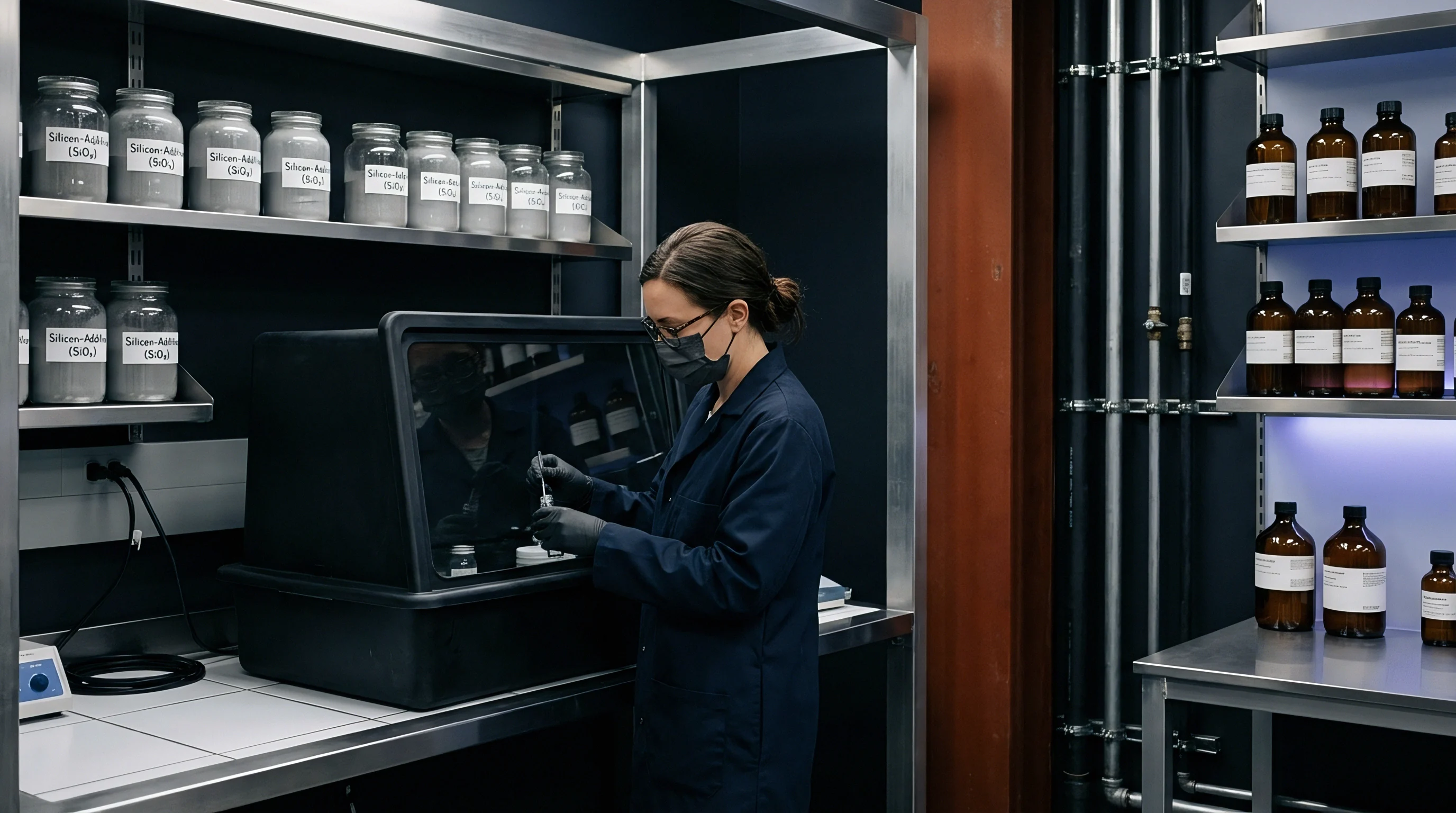
- Multi-acid pressurized digestion dissolves the hydroxide matrix using concentrated nitric and hydrochloric acids inside fluoropolymer microwave vessels to eliminate volatile trace metal losses.
- Inductively coupled plasma analysis quantifies thirty-two trace elements against calibrated matrix-matched standards, holding analytical measurement uncertainty within plus or minus two percent.
- Cross-sectional electron microscopy visualizes inner pore volume, crystallite alignment, and localized phase segregation across focused-ion-beam polished particle cross-sections.
A major testing dispute involves refractory particles like stainless steel fragments, alumina grinding media, and titanium shreds. Standard microwave acid digestions operating at 180 degrees Celsius do not completely dissolve high-alloy particles. As a result, the subsequent emission spectrometry run fails to detect the full metallic contamination load, reporting false compliance.
To prevent un-melted structural metallics from reaching the calcination furnace, quality protocols require slurry screening through three-hundred-mesh magnetic separators followed by gravimetric filter washing and optical particle counting. A single two-hundred-micron metallic particle surviving in a hundred-kilogram batch creates a localized failure zone in finished battery electrodes.
Magnetic impurity testing requires specialized inline extraction loops. Precursor slurries pass through high-gradient magnetic separators operating at magnetic flux densities above 1.2 Tesla. The captured ferrous residue is collected, dried, and weighed.
Industry standards limit total magnetic impurities to less than 50 parts per billion in premium virgin-grade precursor materials. For recycled precursors, this ceiling often relaxes to 100 parts per billion, provided the particle size remains below 20 microns. Any magnetic particle exceeding 45 microns presents a critical hazard, as its size approaches the total separator thickness found in modern high-energy-density automotive battery cells.
Precursor lot acceptance requires magnetic impurity content below 100 parts per billion with zero detected metallic particles exceeding 45 microns in maximum dimension.
Assay documentation must track batch-to-batch consistency alongside single-lot passing limits. A supplier showing shifting impurity values within the acceptable band presents operational challenges for cathode calcination managers. If precursor aluminum fluctuates from 40 to 180 parts per million between consecutive delivery weeks, the cathode production team must adjust their dry-blend lithium carbonate stoichiometry ratios for each batch to preserve phase purity.
Sourcing contracts define statistical process control requirements, establishing minimum process capability indices of 1.33 across all primary contaminant elements. Suppliers unable to prove process stability face mandatory sorting fees and analytical chargebacks.
Consequence

The Full Financial Exposure of Off-Spec Feedstock Adoption
Deploying precursor hydroxides with elevated impurity loads produces downstream financial consequences that extend far beyond initial raw material purchase discounts. A cell manufacturing operation producing high-nickel NMC 811 automotive pouch cells faces substantial scrap liabilities if impure precursor causes line yield drops or field failure escalations. Cathode active material accounts for roughly thirty-five to forty percent of the total manufactured cell cost.
When an un-inspected impurity batch drives cell-level self-discharge or capacity loss, the loss spreads across the entire cell conversion value, including anode foil, separator membranes, electrolyte salts, dry room operational energy, and formation cycle aging overhead.
Consider a baseline production scenario to quantify this risk. A gigafactory produces automotive pouch cells at a run rate of 50,000 units per day, with each cell rated at 60 ampere-hours and utilizing approximately 1.05 kilograms of NMC 811 cathode active material. Cathode synthesis requires 0.98 kilograms of precursor hydroxide per kilogram of finished cathode oxide.
The operation introduces a 100-metric-ton lot of recycled precursor hydroxide purchased at a five percent spot discount, translating to a gross savings of $75,000 on the raw metal salt input. This material carries an undetected average copper contamination of 35 parts per million, alongside an iron concentration of 80 parts per million.
During the fourteen-day post-formation aging and high-temperature storage monitoring window, high copper contamination drives an accelerated self-discharge rate. While standard production lines maintain a baseline formation yield fallout of 0.8 percent, the contaminated precursor batch causes the K-value self-discharge fallout to spike to 4.2 percent. The factory rejects 2,100 completed cells during secondary grading.
Each scrapped 60-ampere-hour cell carries an accumulated manufacturing cost of $48, including pack-ready casing hardware and cell formation test overhead. The direct scrap loss totals $100,800, wiping out the initial $75,000 precursor procurement savings.
Long-term field exposure presents an even steeper financial risk. Cells that clear factory-gate high-voltage screening tests with marginal copper and zinc contamination remain vulnerable to dendrite growth and separator puncture under cold-weather high-rate regeneration charging. If a supplier-side defect drives field returns into warranty channels, the automotive customer backcharges the pack assembler the full replacement labor, logistics, and pack dismantling costs.
Typical automotive recall reserve charges run between $1,500 and $3,500 per vehicle. The financial differential between standard virgin material and low-grade recycled precursor disappears when balanced against these downstream liability provisions.
The landed-cost calculation for precursor procurement must incorporate an integrated yield and risk factor. Sourcing directors who evaluate precursor solely on price per metric ton of contained nickel, cobalt, and manganese expose their organizations to downstream manufacturing losses. Technical qualification of recycled precursors requires a cross-functional audit involving procurement, analytical chemistry, and reliability engineering teams.
Precursor pricing models must reflect the supplier’s investment in multi-stage solvent extraction, automated magnetic separation, and statistical process controls. Without verified verification protocols and enforceable contract penalties, the raw material discount proves insufficient to offset battery assembly risks.
The standard supply agreement balances these financial risks by tying invoice settlements to downstream cell-grade yield performance. Cathode manufacturers hold back twenty percent of invoice values pending composite ICP validation, trace magnetic extraction, and initial formation-channel testing of pilot calcination runs. If the pilot lot exhibits elevated self-discharge or capacity shortfalls, the contract permits the buyer to return the entire lot at the supplier’s expense, including freight, customs clearance, and disposal costs.
High-volume cell manufacturing leaves no margin for untested feedstock variations, and contract enforcement remains the primary safeguard against process contamination.
A persistent operational problem is finding cost-effective methods to blend low-grade recycled precursor lots with high-purity virgin stock without creating localized compositional pockets that trigger cell degradation under fast charging.