Evaluating High Frequency Alternating Current Impedance for Rapid Incoming Cell Sorting
High-frequency 1 kHz AC impedance isolates bulk ohmic and mechanical weld defects within milliseconds, but demands strict thermal control to prevent false scrap.

Dock
Incoming shipments arrive with thermal gradients established across wooden crates during regional transit. Receiving personnel encounter pallets where core cells register twelve degrees Celsius while outer cartons have warmed to eighteen degrees. High excitation rates at one kilohertz compress the response time to a single millisecond.
This brief window allows automated fixtures to screen thousands of cylindrical or prismatic units per hour. The rapid measurement captures purely ohmic series resistance, comprising current collector foils, ultrasonic tab welds, bulk liquid conductivity, and terminal contact interfaces. It bypasses the slower electrochemical kinetics occurring at active material surfaces.
Rapid Incoming Screen Mechanics
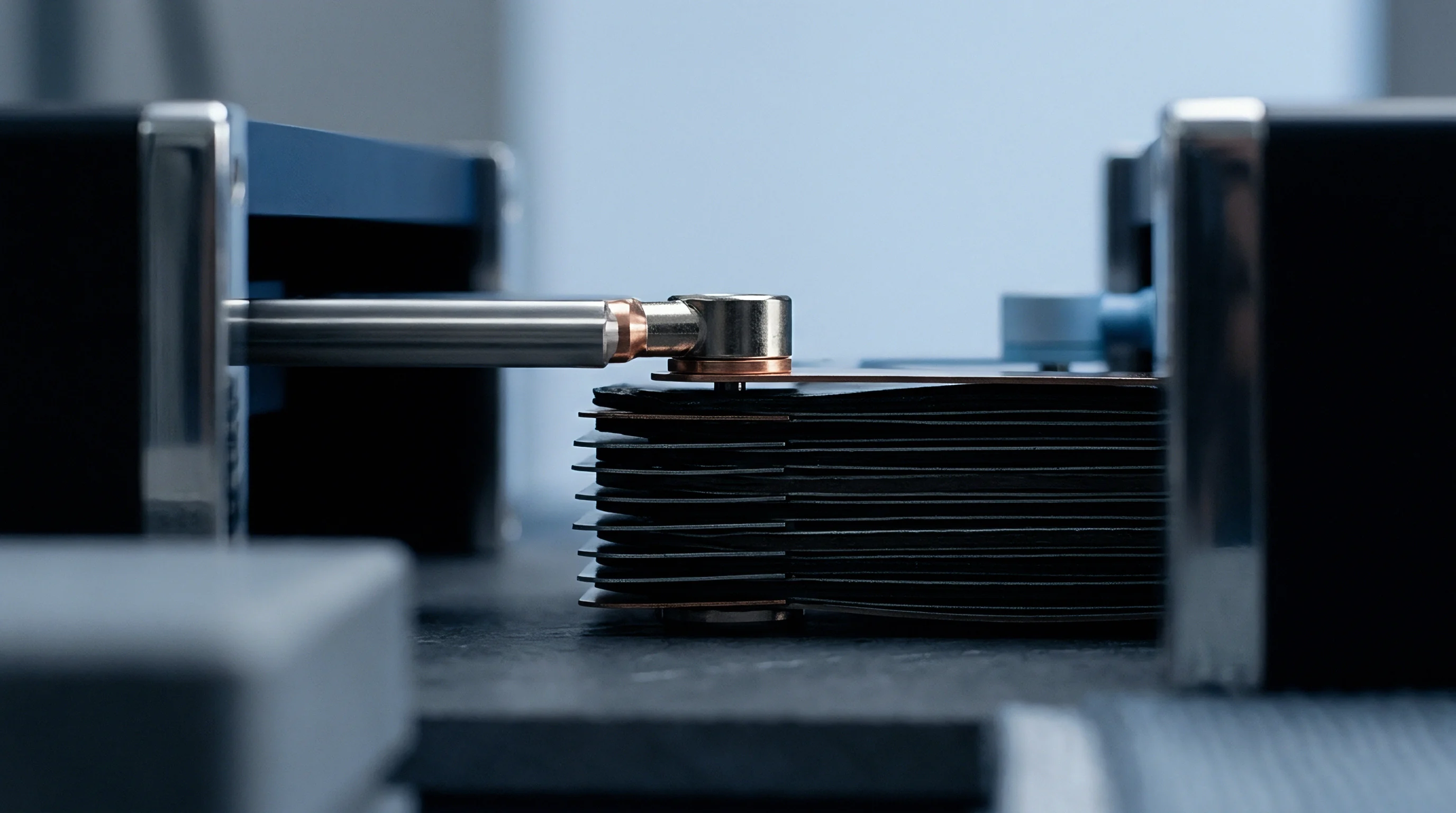
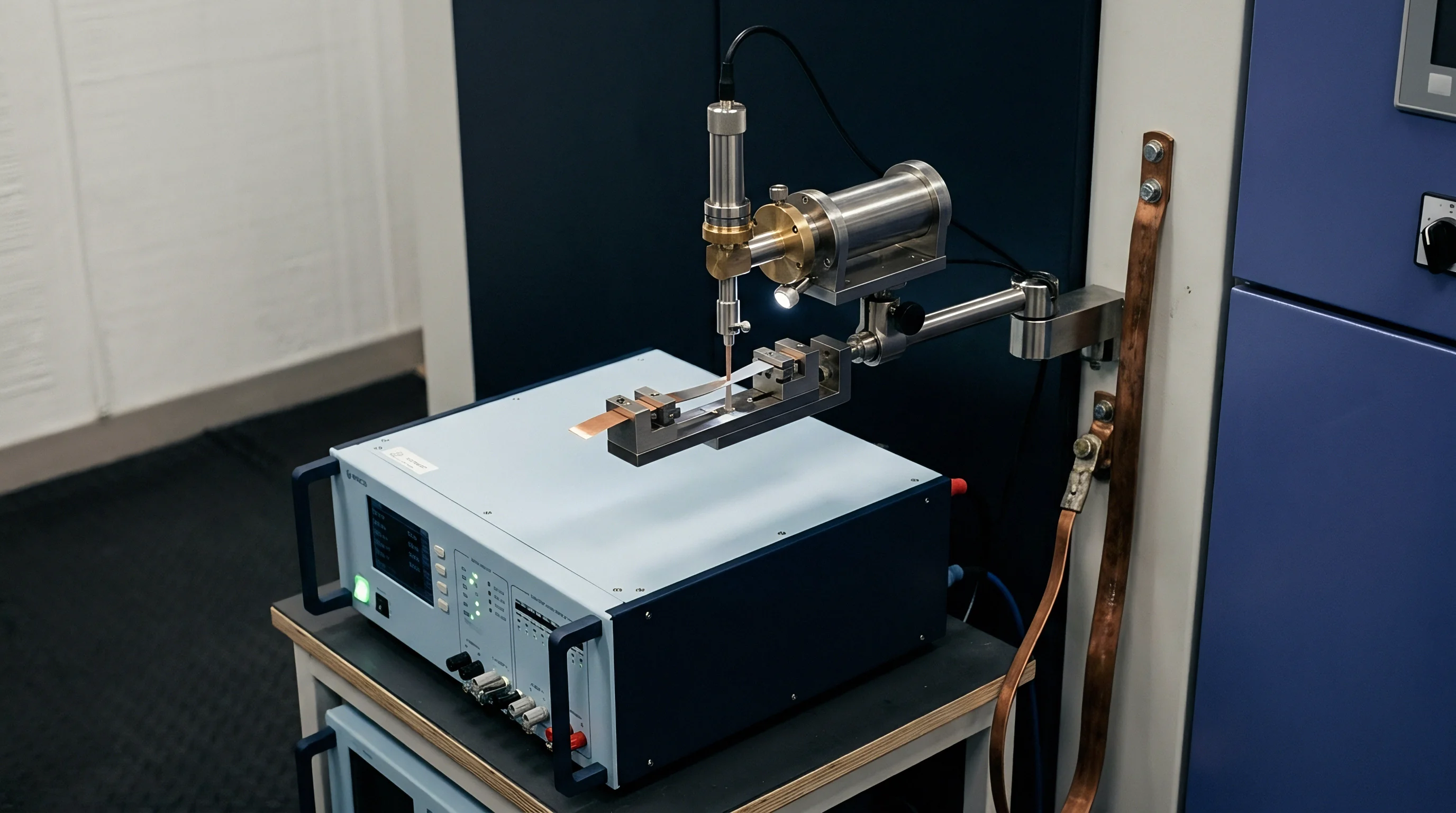
Inspectors place four-point spring probes against terminal faces within two seconds of unboxing. Copper foil conducts electrons readily. The standard 1 kHz alternating current method injects a small sinusoidal current, typically between 100 milliamperes and one ampere, across the outer contacts while measuring voltage drop across the inner pins.
Because the period is one millisecond, double-layer capacitance acts as an electrical short across cathode and anode interfaces. The technique isolates internal bulk conduction from slower diffusion and charge-transfer events.
Prismatic 280 Ah lithium iron phosphate cells exhibit a baseline alternating current resistance of 0.18 milliohms at twenty-five degrees Celsius and thirty percent state of charge.
Production facilities rely on this isolated ohmic number to catch mechanical and assembly defects without committing hours to full galvanostatic cycling. Cold cells read higher resistance. A milliohm discrepancy signals gross internal anomalies that warrant immediate rejection before cells enter module assembly channels.

Distinguishing Pure Resistance from Interfacial Kinetics
High excitation rates bypass the charge transfer resistance governed by the solid electrolyte interphase. Chemical storage capacity remains invisible to a 1 kHz test. Cells with severe cathode degradation or depleted active lithium frequently exhibit identical 1 kHz series resistance to pristine cells from the same production lot.
High frequencies bypass charge transfer mechanisms. The high-frequency metric functions as a mechanical and structural integrity indicator rather than a direct state-of-health confirmation.
- Tab Weld Delamination creates localized constriction resistance across ultrasonic joints, elevating the milliohm reading above batch averages.
- Collector Foil Tearing reduces cross-sectional conductive area along the jelly roll edges, creating pronounced outlier values during incoming qualification.
- Electrolyte Starvation drops bulk ionic transport throughout the porous separator, generating uniform upward resistance drift across dry units.
- Terminal Post Oxidation introduces parasitic interfacial resistance at the probe interface, necessitating pneumatic contact pressure verification.
Tab welds generate localized resistance anomalies. Admitting unverified cells with undetected foil tears leads to thermal imbalances and premature field failure across completed battery modules.
Fixture
Test benches introduce systematic measurement offsets through parasitic magnetic coupling and uneven terminal pin wear. Automated sorting apparatuses operating at line speed depress four-point Kelvin pins against aluminum and copper cell terminals hundreds of times per shift. Terminal surfaces accumulate micro-debris, while spring-loaded probe tips experience mechanical fatigue.
The physical interface geometry dictates measurement repeatability more strictly than the internal resolution of the micro-ohmmeter.

Are Milliohm Shifts Driven by Contact Geometry?
Probe misalignment shifts the effective current path across nickel-plated aluminum terminals. When Kelvin sense pins sit too close to the current injection points, localized potential fields distort the calculated milliohm value. Current lines crowd at tab corners.
The injection pins must supply balanced current density across the post while the sense pins detect voltage drop along equipotential lines. Symmetrical probe placement prevents false positive rejections caused by geometric current crowding.
Misaligned Kelvin pins produce artificial resistance shifts that exceed the natural batch variance of automated manufacturing lines.
Pneumatic cylinders delivering twenty newtons of contact force stabilize the contact boundary. Pure aluminum oxidizes on exposure. The hardened crown-point or serrated probe tips must displace non-conductive native oxide layers without piercing the thin terminal plate.
Gold plating prevents interfacial galvanic decay. Wear cycles exceeding fifty thousand touchdowns cause pin blunting, which increases contact resistance and injects artificial noise into batch sorting distributions.

Parasitic Inductance Mitigation in Four-Point Benches
Coaxial cable routing suppresses mutual inductive reactance between adjacent current and voltage loops. At 1 kHz, alternating current flowing through test leads generates magnetic flux that couples into adjacent voltage sensing circuits. Inductive loops distort milliohm phase angles.
Twisting the voltage sense pair and shielding the excitation lines eliminates stray induced voltages that otherwise register as artificial resistance increases.
| Format and Chemistry | Nominal Capacity (Ah) | 1 kHz AC Resistance (mΩ) | 100 Hz AC Resistance (mΩ) | Direct Current Resistance 1s (mΩ) | Inductive Zero Crossing (Hz) |
|---|---|---|---|---|---|
| Prismatic LiFePO4 | 280 | 0.17 to 0.22 | 0.28 to 0.35 | 0.45 to 0.60 | 1200 to 1800 |
| Prismatic NMC 811 | 150 | 0.31 to 0.38 | 0.42 to 0.52 | 0.68 to 0.85 | 1500 to 2200 |
| Cylindrical 21700 NMC | 5.0 | 11.5 to 13.5 | 13.8 to 16.2 | 22.0 to 28.0 | 8500 to 12000 |
| Cylindrical 18650 LFP | 1.5 | 22.0 to 26.0 | 25.5 to 31.0 | 38.0 to 48.0 | 9500 to 14000 |
| Pouch Cell NMC 622 | 60 | 0.55 to 0.68 | 0.72 to 0.90 | 1.10 to 1.45 | 3200 to 4500 |
Cylindrical cells exhibit higher zero-crossing frequencies than large prismatic blocks because their wound geometries and compact current collectors reduce internal inductive loops. Prismatic cans flex under internal pressures. In heavy prismatic formats, internal inductive effects intersect the real impedance axis near one kilohertz, making strict cable dress imperative for incoming sorting accuracy.
The factory technical director claimed that the observed five percent variance stemmed from oxidation on dock test pins rather than uneven electrode coating thickness.


Electrolyte
Hexafluorophosphate salts dissolved in carbonate solvent blends govern bulk ionic conduction inside pristine jelly rolls. Salt concentration, solvent viscosity, and separator tortuosity set the baseline ohmic resistance that a high-frequency alternating current screen detects. Variations in liquid wetting or solvent composition manifest as broad shifts in bulk conduction.
These bulk properties respond aggressively to ambient thermal changes, complicating sorting criteria when incoming pallets carry uneven thermal storage histories.

Thermal Drift in Bulk Conductance Channels
A five-degree shift in cell skin temperature alters liquid phase ionic mobility by nearly eight percent. Liquid electrolytes lose ion mobility quickly. Lithium ions migrating through ethyl methyl carbonate and ethylene carbonate mixtures encounter higher viscous drag at lower temperatures, depressing conductivity without any mechanical flaw present in the cell.
Testing cells directly from cold freight containers generates elevated milliohm values that mimic manufacturing defects.
Cell temperature equilibration always takes longer than surface probe readings suggest.
Incoming pallets retain ambient transit temperatures. The exterior metal casing reaches ambient dock temperature hours before the densely packed jelly roll core equilibrates. Establishing valid sorting criteria demands either temperature-compensated measurement algorithms or strict thermal staging in climate-controlled quarantine zones.

Worked Sensitivity Analysis for Stage Warehousing
Take an incoming lot of twenty thousand 280 Ah lithium iron phosphate prismatic cells conditioned at seventeen degrees Celsius. The engineering specification defines the acceptable series resistance threshold at 0.20 milliohms measured at twenty-five degrees Celsius. At seventeen degrees, the bulk electrolyte resistance increases by roughly 1.8 percent per degree Celsius.
The average cell resistance rises from 0.19 milliohms to 0.217 milliohms purely due to solvent viscosity. Screening this lot immediately upon arrival without thermal compensation causes an artificial failure rate exceeding forty percent. Stabilizing the pallets in a twenty-five degree warehouse for forty-eight hours lowers the measured lot average to 0.188 milliohms, returning the scrap rate below 0.5 percent.
- Quarantine unopened freight containers in a tempered receiving bay held at twenty-two to twenty-five degrees Celsius.
- Insert calibrated thermocouple probes into core cartons to track core jelly roll temperature equilibration.
- Record ambient barometric pressure and cell skin temperatures at fifteen-minute intervals during high-speed sorting.
- Apply Arrhenius-based temperature correction coefficients to all recorded 1 kHz values before binning decisions occur.
Frozen cells disguise separator defects. Whether sub-zero storage histories permanently alter bulk ionic resistance without displaying immediate room-temperature impedance shifts remains disputed among pack builders.

Batch
Production lot variance exhibits Gaussian distribution in well-controlled manufacturing runs while multi-line blending produces multi-modal distributions. Receiving engineers use distribution width to evaluate supplier process control. A tight bell curve reflects consistent slurry mixing, uniform foil coating thickness, and repeatable laser tab welding.
Bimodal distributions betray shipments mixed from distinct production lines, aging inventories, or differing formation schedules.
Do Single Point Metrics Overlook Latent Degradation?
Micro-shorts arising from burred current collectors create localized self-discharge without immediate 1 kHz resistive deviations. The high-frequency screen captures bulk conduction along the primary electron path, ignoring high-resistance ionic leak paths across damaged separators. Combining 1 kHz resistance screening with open-circuit voltage monitoring over a twenty-four-hour rest period identifies cells with internal micro-shorts that evade alternating current detection.
| Screening Parameter | Prismatic 280 Ah Target | Prismatic 280 Ah Reject Window | 21700 5.0 Ah Target | 21700 5.0 Ah Reject Window |
|---|---|---|---|---|
| 1 kHz AC Resistance | 0.19 ± 0.02 mΩ | Greater than 0.23 mΩ | 12.5 ± 0.8 mΩ | Greater than 14.2 mΩ |
| Delta Resistance to Mean | Less than 8 percent | Greater than 12 percent | Less than 6 percent | Greater than 10 percent |
| Open-Circuit Voltage Drop (72h) | Less than 1.5 mV | Greater than 3.0 mV | Less than 2.0 mV | Greater than 5.0 mV |
| K-Value (mV/day) | Less than 0.50 | Greater than 1.00 | Less than 0.65 | Greater than 1.50 |
Cell temperature shifts baseline readings fast. Automated sorting machines classify cells into fine milliohm sub-bins to optimize module performance. Balancing cells inside high-voltage modules requires matching series resistance to prevent localized thermal hot spots during heavy discharge cycles.
Screening Bands for Production Cell Admission
Qualified integrators establish upper and lower admission windows pegged to three standard deviations from verified factory pilot distributions. Tight bands prevent module thermal runaway. Cells falling beyond these boundaries enter quarantine for secondary diagnostic screening at lower frequencies or complete galvanostatic capacity verification.
- Direct Admission Bins contain cells falling within two standard deviations of the verified lot mean with zero open-circuit voltage drift.
- Thermal Re-Test Bins isolate cells showing marginal resistance elevation attributable to temperature gradients across incoming shipping pallets.
- Secondary Diagnostic Bins hold statistical outliers destined for 0.1 Hz electrochemical impedance spectroscopy to inspect interfacial charge transfer resistance.
- Immediate Scrapping Bins capture units showing extreme milliohm deviations caused by fractured internal tabs or missing electrolyte volumes.
Module balance collapses under mismatched resistance. Cells displaying identical high-frequency resistance can diverge sharply in usable life under continuous heavy discharge.
Margin
Financial exposure shifts downstream when sorting thresholds admit cells with subtle internal tab weld defects. Module assembly lines weld nickel or copper busbars across hundreds of terminals, creating rigid electrical networks where single defective units cannot be excised without scrapping entire modules. A false acceptance on the receiving dock results in costly pack teardowns, degraded cycle life, and early warranty claims in commercial vehicle or stationary storage deployments.

False Rejection Costs versus Field Warranty Exposure
Scrapping three percent of delivered inventory adds direct replacement expense to the landed unit price. Suppliers refuse warranty credit for rejected cells unless the buyer proves the measurement followed international verification standards under controlled ambient temperatures. Setting sorting criteria too tight increases inventory carrying costs and creates contentious supply chain friction.
Setting sorting thresholds too broad passes assembly risks to the final pack warranty reserve fund.
Clause 4.2 of the international shipping agreement reallocates quarantine warehousing fees to the manufacturer whenever incoming impedance exceeds certified limits.
Rejection rates must balance direct material write-offs against long-term liability reserves. High-frequency screening catches gross assembly failures at minimal processing cost, providing initial risk reduction on the factory floor.

Contract Specifications for Disputed Impedance Values
Master supply agreements specify binding third-party laboratory arbitration when factory origin data diverges from receiving dock records. Contracts define the exact excitation current amplitude, probe tip metallurgy, fixture clamp force, and ambient stabilization period required for valid claims. Including four-wire Kelvin fixturing standards inside procurement annexes prevents suppliers from dismissing elevated resistance findings as customer measurement error.
Incorporating IEC 61960-3 clause 7.3 impedance test conditions into purchase terms obligates suppliers to credit disputed lots before freight accounts clear.