Cross Border Incoming Cell Quality Verification Protocol Baseline
Verify cross-border cell shipments at receiving docks using standardized DCIR pulse tests, platen compression gauges, and strict AQL sampling before invoice payment.


Dock
Before any electrical testing begins, imported lithium-ion cells go straight into physical and thermal quarantine. Freight containers routed through the tropics frequently reach 52 °C internally over multi-week ocean crossings. Sustained exposure at that level accelerates chemical aging, damages electrode interfaces, and shifts resting open-circuit voltage well before crates are uncrated.
The intake protocol serves as the initial barrier against latent thermal runaway, transit impact damage, and moisture ingress.
Moisture degrades unformed cell lots quickly: if atmospheric humidity breaches vacuum packaging, water vapor reacts with residual lithium hexafluorophosphate salt on terminal headers, generating corrosive hydrofluoric acid. Receiving inspectors examine secondary foil barriers for loss of vacuum, pinholing, or delaminated heat seals prior to crate breakdown. A compromised seal puts the entire pallet lot on hold, as electrolyte evaporation or moisture absorption distorts impedance profiles long before formation checks take place.
Prior to placing probes on terminal posts, inspectors evaluate mechanical integrity using calibrated gauges. Pallet-mounted shock and tilt sensors provide the first indicator; a trigger above 15g points to rough handling during stevedoring, which can warp internal current-collector tabs, breach microporous separators, or abrade outer insulation wraps. Every incoming lot undergoes dockside sampling for pouch swelling, sleeve abrasions, and terminal corrosion against contract threshold limits.
Open-circuit voltage drift exceeding 1.8 mV per 30 days at 23 °C indicates self-discharge driven by micro-shorts rather than baseline SEI maintenance.
Electrical screening establishes the baseline state of the shipment. Technicians record open-circuit voltage (OCV) and verify insulation resistance between active terminal poles and the bare metal can. Damaged shrink sleeving or scratched aluminum-laminate pouch foil exposes low-resistance conductive paths to pack enclosures, presenting a high-voltage hazard during module assembly.
Minimum acceptable insulation resistance is 100 MΩ under a 500 V DC potential applied for 60 seconds.
- Inspect container seal numbers against maritime bills of lading and verify environmental data logger files for transit temperature spikes exceeding 45 °C.
- Examine pallet shock and tilt indicators, documenting any mechanical impact events exceeding supplier baseline limits.
- Stage pallet crates in a temperature-controlled intake zone at 23 °C ± 2 °C for 24 hours to eliminate thermal gradients before electrical recording.
- Extract sample cells from outer foil bags, checking for vacuum seal retention, electrolyte odor, or liquid residue on terminal headers.
- Measure open-circuit voltage and outer casing insulation resistance across sample units, flagging any cell deviating by more than 3 mV from batch mean OCV.
Uniform resting voltage across crates provides an early marker of lot consistency. Cells pulled from the same line and stabilized at identical state-of-charge before export should fall into a narrow voltage band. When a 2,000-cell pallet exhibits a standard deviation beyond 1.2 mV, the root cause typically traces to incomplete formation cycling or contaminated electrode slurry.
Voltage drops reached 42 millivolts across eight pallets during ocean transit from Shenzhen, forcing a complete quarantine of the container shipment.
A breached container seal allowed moist marine air into the crate voids over a three-week crossing, producing visible oxidation on nickel-plated copper terminals within forty-eight hours of de-vanning. Terminal oxidation introduces high contact resistance during wire bonding or laser busbar welding, generating severe localized hotspots under module discharge. Quality procedures require immediate surface roughness profiling and four-wire contact resistance checks on affected batches before releasing any material to pack lines.
Holding eighty pallets of unvented prismatic cells on an isolated apron following container seal failure ran up twenty-four thousand dollars in freight demurrage.
Polarization
Electrochemically assessing cells at receiving requires isolating pure ohmic resistance from polarization effects. Standard high-throughput line testers apply a 1 kHz AC perturbation to measure AC internal resistance (AC-IR). While this identifies broken tab welds or loose mechanical joints, it cannot capture charge-transfer resistance or solid electrolyte interphase (SEI) dynamics.
Direct current internal resistance (DCIR) pulse characterization is required to measure voltage drop under dynamic current draw.
Electrochemical impedance spectroscopy (EIS) yields a detailed diagnostic profile of electrode condition. Sweeping frequencies from 10 kHz down to 10 mHz isolates the high-frequency ohmic intercept, the mid-frequency charge-transfer semicircular arc, and the low-frequency Warburg diffusion slope. An enlarged charge-transfer arc points to passive film thickening or transition metal dissolution triggered by excessive transit heat.
A distorted Warburg impedance tail indicates lithium plating or solvent loss, both of which degrade discharge performance at low temperatures.
DCIR characterization applies discrete current steps at set state-of-charge points, typically a 1C discharge pulse for 10 seconds at 50% SOC, logging voltage every 0.1 seconds. Dividing instantaneous and transient voltage drop by applied pulse current yields the 10-second DCIR value, consolidating ohmic and diffusion polarization into an empirical value for thermal management models.
| Cell Format & Chemistry | Nominal Capacity | 1 kHz AC-IR Range | 10s DCIR Pulse Range | OCV Drift Threshold | Thermal Storage Upper Bound |
|---|---|---|---|---|---|
| Prismatic LFP (LiFePO4) | 280 Ah | 0.18 – 0.25 mΩ | 0.45 – 0.60 mΩ | < 1.5 mV / 30 days | 35 °C |
| Cylindrical 21700 NMC811 | 5.0 Ah | 11.5 – 13.5 mΩ | 22.0 – 26.0 mΩ | < 2.5 mV / 30 days | 45 °C |
| Pouch NMC622 | 60 Ah | 0.60 – 0.80 mΩ | 1.20 – 1.50 mΩ | < 2.0 mV / 30 days | 40 °C |
| Prismatic LFP (High-Power) | 100 Ah | 0.30 – 0.40 mΩ | 0.70 – 0.90 mΩ | < 1.5 mV / 30 days | 35 °C |
Receiving capacity verification resolves discrepancies between manufacturer claims and delivered energy. Overseas documentation frequently reports capacity measured at C/3 or C/5 under elevated 45 °C ambients, yielding higher nominal values. Intake inspection requires testing at 23 °C ± 2 °C using a standard C/2 discharge down to contractual end-of-discharge cutoffs.
Deviations wider than 1.5% between incoming sample averages and the factory Certificate of Analysis (CoA) signal accelerated aging or relaxed end-of-line binning.
State-of-charge relaxation directly influences OCV stability measurements. Cells landed at 30% SOC require at least 48 hours of static rest in the receiving bay before delta-OCV tracking begins. Taking readings while internal lithium concentration gradients equilibrate across thick porous electrodes yields inaccurate self-discharge figures.
Monitoring resting potential over seven days calculates the true self-discharge slope (K-value), isolating defective cells with internal micro-dendrites prior to pack integration.
Electrolyte dryout strips cell capacity when severe self-discharge or elevated temperatures drive solvent decomposition at the anode, thickening the passivation layer and depressing ionic conductivity. Line multimeters fail to isolate these micro-ohm shifts from lead resistance, making four-wire Kelvin fixtures essential for reproducible incoming characterization.
Whether short-pulse DCIR shifts below fifteen percent over forty-five transit days stem from electrode relaxation or irreversible active material loss remains an open question across high-nickel pouch lots.


Gauge
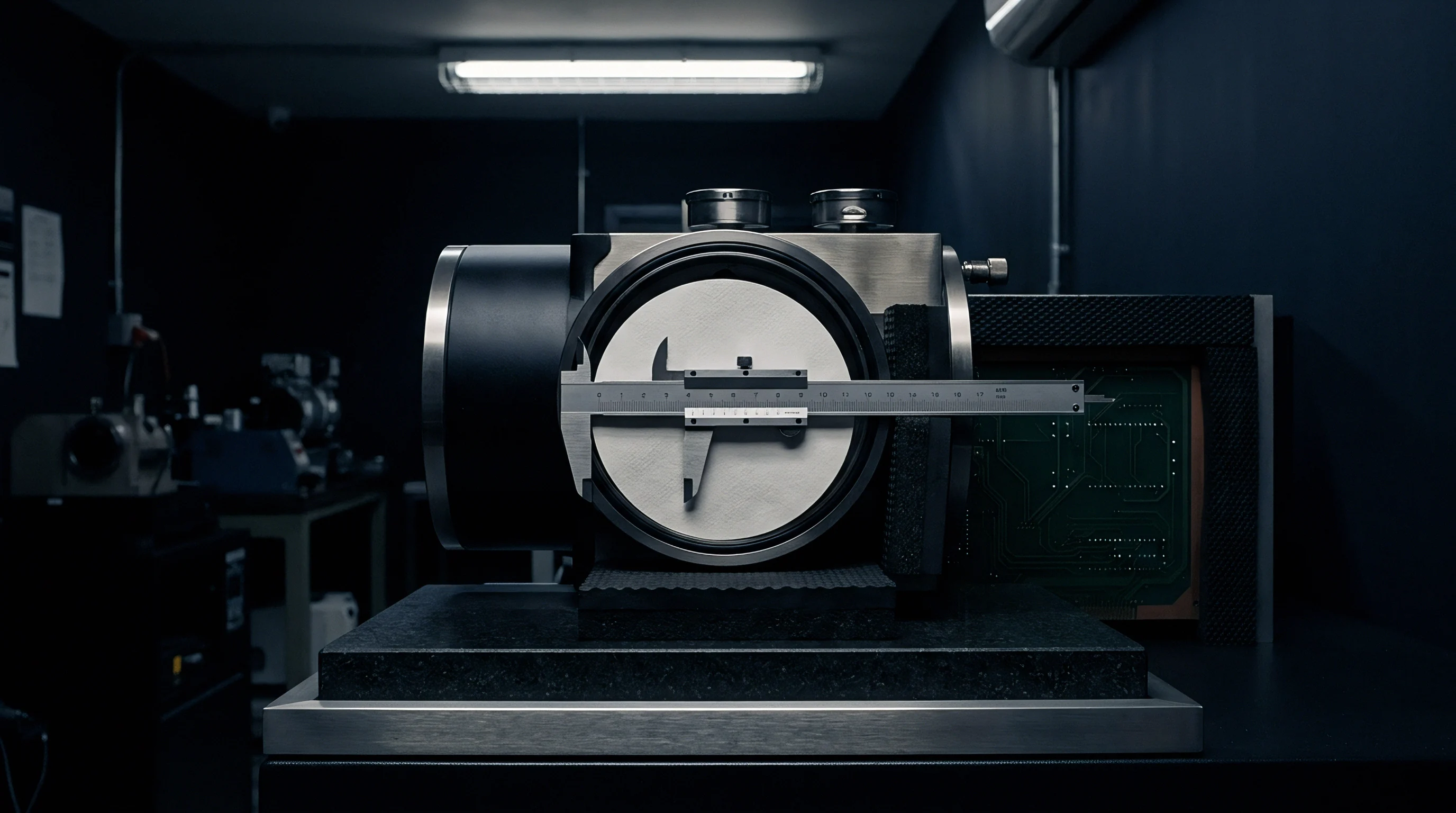
Verifying dimensional tolerances ensures mechanical fit inside structural modules and limits mechanical stress during cycling. External dimensions vary across state-of-charge and temperature due to graphite electrode dilation during lithium intercalation. Prismatic and pouch formats expand significantly perpendicular to the electrode stack, requiring incoming metrology fixtures with controlled compression to simulate installed pack pressures.
Pouch cell metrology relies on pneumatic platen fixtures to obtain repeatable thickness values. Free-state measurements pick up minor gas pockets and packaging wrinkles, producing inconsistent results. The inspection procedure applies 300 kPa of uniform surface pressure across the active area while digital LVDTs capture thickness at five points.
Variations exceeding 0.3 mm across a single pouch body indicate localized electrode swelling or pouch gassing.

What Dimensional Variations Require Immediate Batch Quarantine?
Prismatic can inspection focuses on side-wall bulging, top header planarity, and terminal alignment. Thin aluminum casings deform under internal gas expansion and ambient heat; allowable unconstrained bulge is generally capped at +1.0 mm for a 280 Ah cell at 30% SOC. Terminal centerlines must stay within ± 0.2 mm of production drawings to maintain busbar fitment.
Angular tilt on terminal pads degrades laser focus during automated welding, creating incomplete weld fusion or thermal damage to internal header seals.
Under IEC 62619 clause 6.4, an unvented prismatic cell expanding beyond 1.5 percent of nominal thickness during 1C discharge invalidates the pack enclosure structural analysis.
Cylindrical formats demand strict checks on outer diameter, overall length, and positive cap projection. High-speed pack lines operate with minimal clearances when inserting cells into molded carriers or extruded liquid-cooling channels; a diameter expansion of 0.08 mm on a 21700 cell can stall pick-and-place gantry systems. Shrink-sleeve thickness and overlap require optical inspection, as variable sleeve thickness alters thermal conductive paths to cooling fins.
| Feature Metric | Prismatic Aluminum Case | Cylindrical Steel Can | Flexible Pouch Foil | Inspection Instrument / Tooling |
|---|---|---|---|---|
| Face Bulge / Swell | +1.0 mm / -0.2 mm | +0.05 mm / -0.02 mm | +0.4 mm / -0.1 mm | Pneumatic Platen Fixture (300 kPa) |
| Terminal Pitch Tolerance | ± 0.20 mm | N/A (Coaxial) | ± 0.30 mm | Optical Comparator / CMM |
| Header Flatness | 0.15 mm Max TIR | 0.08 mm Max TIR | N/A (Sealed Edge) | Laser Surface Profilometer |
| Tab Thickness Deviation | ± 0.05 mm | N/A | ± 0.02 mm | Digital Micrometer (Ratchet Stop) |
| Sleeve Insulation Breakdown | > 2.0 kV DC | > 1.5 kV DC | > 1.0 kV DC | High-Potential Insulation Tester |
Tooling drift distorts dimensions as stamping dies wear down over multi-million-unit production runs, gradually expanding cell cases across batches. Tracking impedance across three thermal stages provides comparison values against growth profiles from initial lot validation. When incoming dimensions crowd upper tolerance limits, pack lines experience insertion jamming and uneven clamping pressure against thermal interface materials.
- Anode Face Bulge Excessive thickness expansion across the central area of prismatic cases caused by internal gas buildup or high SOC storage during transit.
- Terminal Header Tilt Angular misalignment of positive or negative terminal posts relative to the top cover plane, compromising busbar contact pressure.
- Pouch Seal Delamination Separation of the aluminum-laminate foil layers along the heat-seal perimeter, leading to moisture exposure and electrolyte leakage.
- Can Bottom Dome Deformation Convex bowing of cylindrical cell bottom plates resulting from elevated internal pressure, disrupting low-side busbar contact.
- Insulation Sleeve Punctures Microscopic tears or thin spots in outer plastic wraps that bypass die-electric isolation barriers inside module frames.
Cell thickness measured without calibrated platen pressure yields misleading dimensional data that fails to predict pack enclosure fit.
Sampling
Acceptance sampling isolates non-conforming lots while avoiding the overhead of 100% receiving inspection across multi-megawatt-hour shipments. Quality operations implement ISO 2859-1 (ANSI/ASQ Z1.4) single sampling plans indexed to contractual Acceptable Quality Limits (AQL).
Defects fall into three tiers. Critical defects involve core safety risks: case leakage, insulation resistance below 10 MΩ, internal shorts, or compromised burst vents. Major defects impair electrical performance or automation compatibility, including capacity shortfalls, elevated DCIR, or shifted terminal centers.
Minor defects cover non-functional flaws like misprinted lot codes or sleeve discoloration that do not degrade assembly.
High internal resistance at incoming inspection correlates directly with localized busbar overheating during peak discharge.
Process capability indices (Cpk) reflect ongoing manufacturing discipline at the supplier plant. Procurement contracts mandate minimum Cpk levels across key sample metrics; a Cpk of 1.33 on 1 kHz AC-IR confirms that supplier process variation stays well within specification bounds. If intake sampling produces a Cpk below 1.0, the shipment enters quarantine, and secondary screening costs revert to the vendor.
- Critical Defect AQL 0.010 Zero defects allowed in sample size; any safety violation triggers immediate rejection of the entire container shipment.
- Major Defect AQL 0.40 Tight statistical control on electrical performance metrics, requiring sample batch rejection if more than two units exceed DCIR limits.
- Minor Defect AQL 1.50 Commercial allowance for minor cosmetic flaws that do not impact mechanical fitment or electrical performance during pack assembly.
- Destructive Sample Fraction Controlled sacrifice of 0.05% of incoming lot volume for internal weld tear-down, separator thickness verification, and chemical analysis.
Receiving follow a strict decision path on arrival. Destructive evaluations ~ including tab peel tests, separator thickness mapping, and ICP-OES electrolyte analysis ~ draw from a dedicated statistical sub-sample. Inspectors require double-seal foil bags for pouch cells to prevent moisture pick-up when pulling samples outside cleanroom spaces.
Micro-shorts pull down open-circuit voltage, creating abnormal self-discharge rates over a 7-day quarantine that reveal lot contamination on K-value distributions. Plotting these rates on a Weibull probability chart separates normal background discharge from bimodal distributions caused by foreign metallic particulates in the electrode coating, which mandate 100% sorting of the delivery.
Clause 8.2 of the master supply agreement assigns full financial responsibility for return logistics and lot re-testing to the vendor whenever the lot Cpk on 1 kHz internal resistance drops below 1.33.

Dossier
Importing cells requires documentation connecting every pallet back to factory formation records, chemical declarations, and safety certs. Port authorities, customs brokers, and marine insurers demand authenticated records before clearing hazardous cargo. An omitted UN 38.3 summary or defective dangerous goods manifest holds freight at port terminals for weeks, triggering severe demurrage and starving production lines.
The UN 38.3 compliance dossier is mandatory for cross-border transit of dangerous goods. The standard details eight thermal and mechanical stress tests: altitude simulation, thermal cycling, vibration, mechanical shock, external short circuit, impact/crush, overcharge, and forced discharge. Importers must hold an authentic UN 38.3 Test Summary from an ISO/IEC 17025 accredited laboratory, with cell model designations, chemistries, weights, and dimensional ratings matching physical lot markings precisely.
| Document Name | Mandatory Data Field | Verification Method | Tolerance / Compliance Standard | Commercial Consequence of Defect |
|---|---|---|---|---|
| Certificate of Analysis (CoA) | Batch AC-IR & Capacity Distribution | Cross-check with incoming lab sample tests | Mean capacity within ± 1.0% of CoA | Lot quarantine; supplier-funded re-test |
| UN 38.3 Test Summary | Model ID, Weight, Wh Rating, Test Dates | Validate against UN Manual Criteria section 38.3.5 | Exact match to cell markings | Customs seizure; carrier shipment refusal |
| SDS (Safety Data Sheet) | Chemical Composition & GHS Hazards | Review electrolyte solvent percentages | OSHA / REACH standard compliance | Hazardous material import hold |
| Bill of Lading / DG Dec | UN Number (UN 3480 / UN 3481), Net Mass | Physical weight verification at apron | Class 9 Dangerous Goods alignment | Port authority fines; delayed customs clearance |
Customs classification errors create immediate operational friction. While lithium-ion cells fall under HS code 8507.60.00, border officers frequently question whether shipments constitute bare cells, sub-assemblies, or unfinished modules. Misclassification triggers tariff adjustments, administrative penalties, or cargo detention.
The intake packet must contain clear drawings, chemical inventories, and per-unit customs valuations.
Cell manufacturers shift grade definitions between batch lots when raw material spot prices spike.
Traceability relies on matrix codes linking individual cells to electrode coating runs, slurry batches, and formation channel logs. Cell cans carry laser-etched 2D codes applied prior to electrolyte filling. Scanning arriving units enables direct validation of supplier CoA distributions against bench measurements, exposing whether a supplier blended secondary-grade inventory or combined multiple unverified production runs into a single delivery.
Capacity disputes often stem from factory certificates generated under non-standard test conditions. Supplier sheets frequently quote figures recorded at elevated room temperatures or depressed cutoff voltages that cannot be reproduced under standard conditions. Receiving teams audit dock receipts before approving payments to verify that documentation matches bench test results.
Elevated self-discharge rates upon arrival pointed either to thermal spikes inside the marine shipping container or to incomplete formation cycling at the factory.

Arbitration
Resolving quality claims with international manufacturers requires binding verification protocols embedded directly into purchase contracts. When delivered cells fail AQL limits or exhibit transit degradation, commercial leverage depends entirely on agreed jurisdiction and payment milestones. Without defined technical test gates, buyers face lengthy overseas arbitration while inventory remains impounded in quarantine.
Supply agreements must designate an ISO-accredited third-party laboratory for binding technical arbitration. If receiving inspection flags a batch failure that the vendor disputes, split samples from the quarantined lot ship to the neutral facility under unbroken chain of custody. The non-prevailing party bears all arbitration testing, freight, and interim storage expenses.
Reclaiming duty credits on defective cell lots destroyed or returned under customs supervision depends on certified lab records proving non-conformance before assembly, without which customs treats rejected material as imported inventory.
Scrap allowances and formal chargeback schedules prevent minor batch variance from shutting down assembly. Agreements typically include a 0.3% scrap allowance, allowing the buyer to scrap up to three cells per thousand without entering formal dispute. Beyond that rate, chargeback provisions debit sorting labor, testing fees, and replacement airfreight directly from outstanding invoices.
The contract bound both sides to pre-agreed testing parameters, eliminating subjective interpretations of capacity performance. Establishing clear technical baselines, defined sampling limits, and explicit document requirements ensures that cross-border sourcing operations maintain total control over cell quality, landed costs, and downstream manufacturing reliability.
Setting explicit technical thresholds in the purchase order remains the best defense against cross-border quality disputes, forcing the vendor to acknowledge bench data logged at entry before invoices are paid.