Operando Characterization of Spatial Salt Precipitation Dynamics in Sub-Zero High Loading Anodes
Sub-zero charging drives localized LiPF6 supersaturation and salt crystallization, clogging porous anodes and triggering severe metallic lithium plating.

Depth
When an energy storage cell operates at negative fifteen degrees Celsius, ion movement through dense porous matrices slows dramatically. Standard electrolyte formulations based on cyclic organic carbonates lose bulk conductivity, while ionic migration pathways inside high-loading anode structures face severe physical micro-environmental constraints.
Tortuous Transport Pathways at Cryogenic Temperatures
Commercial anodes specified for high volumetric energy density feature active mass loadings above four milliamperes-hour per square centimeter. Achieving this density demands heavy calendering, compressing graphite coatings to porosities below twenty-five percent. Reduced void space increases macroscopic pore tortuosity from room-temperature baselines of two point five to values exceeding four point five, making ionic transport through convoluted liquid channels the dominant rate-limiting process during sub-zero operation.
Liquid phase diffusion coefficients for lithium cations drop by more than an order of magnitude when ambient conditions transition from twenty-five degrees Celsius to minus twenty degrees Celsius. Standard lithium hexafluorophosphate in ethylene carbonate and ethyl methyl carbonate exhibits an ionic conductivity of roughly ten millisiemens per centimeter at room temperature, but drops below one millisiemens per centimeter at minus twenty degrees Celsius. The effective diffusion coefficient within the tortuous pore space scales inversely with tortuosity and directly with bulk liquid diffusion, leaving cation movement unable to keep pace with electron flux delivered through the metallic current collector network during charging.

Local Concentration Polarization across Electrode Thickness
During fast galvanic charge cycles at sub-zero conditions, cation diffusion rates fall two orders of magnitude below room temperature baselines. Lithium ions entering the anode structure from the separator face severe transport bottlenecks as they migrate inward toward the copper current collector. An ionic flux mismatch establishes an extreme spatial concentration gradient along the electrode thickness direction.
Operando characterization reveals that lithium salt concentration near the separator depletes toward zero while concentration near the current collector spikes dramatically. Transport dynamics force salt accumulation in the deepest pore regions, eventually exceeding saturation localized at the back of the electrode. When local salt concentration exceeds the thermodynamic solubility limit at a given sub-zero temperature, liquid electrolyte transitions into a regime of salt precipitation.
Precipitated solid salt phases accumulate within electrode pores, reducing accessible void volume and triggering complete local mass transport shutdown.
| Temperature (°C) | Bulk Conductivity (mS/cm) | Transference Number (t+) | Critical Current Density (mA/cm²) | Saturation Concentration (M) |
|---|---|---|---|---|
| 25 | 10.8 | 0.38 | 8.50 | 3.20 |
| 0 | 5.2 | 0.32 | 3.10 | 2.40 |
| -10 | 2.9 | 0.27 | 1.40 | 1.95 |
| -20 | 1.2 | 0.21 | 0.45 | 1.50 |
| -30 | 0.4 | 0.14 | 0.12 | 1.15 |
Interface passivation impedance is frequently cited as the primary cause of sub-zero capacity loss, rather than internal physical salt accumulation.


Probe
Synchrotron energy-dispersive X-ray diffraction maps chemical phase distributions across operating battery electrodes without destroying the cell housing. Operando measurement techniques quantify exact spatial concentrations of liquid-phase lithium salts and identify solid-state precipitation fronts in real time.
Operando Synchrotron X-Ray Radiography and Diffraction
Transmission beamlines operating at high photon energies above twenty-five kiloelectronvolts penetrate pouch cell aluminum packaging. Spatial resolution down to two micrometers enables cross-sectional mapping of high-loading anodes during active sub-zero charge acceptance. Synchrotron radiography measures absorption contrast variations caused by local density shifts in the liquid electrolyte, directly tracking salt migration across the anode thickness.
Operando X-ray diffraction isolates the precise crystallographic signatures of solid salt phases precipitating out of solution. When localized salt concentration exceeds saturation, crystalline solvates such as lithium hexafluorophosphate ethylene carbonate complexes precipitate within anode pore structures. High-energy diffraction maps these crystal peak intensities as a function of electrode position and state of charge, recording spatial salt nucleation dynamics within sub-minute temporal windows.
Synchrotron measurements at minus twenty degrees Celsius confirm salt concentration spikes exceeding two point eight molar near current collectors within twelve minutes of charge start.

Neutron Imaging and Spatially Resolved NMR Micro-Imaging
Cold neutron radiography offers exceptional sensitivity to light elements within dense metallic environments. Because neutrons interact strongly with lithium and hydrogen nuclei while passing through heavy current collector metals like copper and aluminum, neutron attenuation maps provide quantitative spatial profiles of lithium ion distribution in liquid and solid phases.
Spatially resolved nuclear magnetic resonance micro-imaging complements neutron data by isolating specific chemical environments. NMR frequency shifts distinguish between free lithium ions in liquid solvent, solvated lithium salt clusters, solid salt precipitates, and metallic lithium deposits. Combining operando synchrotron diffraction with magnetic resonance imaging creates a continuous profile of phase transitions occurring inside sub-zero porous anodes.
- Beam damage artifact ~ High photon flux induces localized electrolyte radiolysis, forming artificial gas pockets during extended operando scans.
- Thermal divergence ~ X-ray beam absorption increases internal cell temperature by three degrees Celsius, masking true sub-zero precipitation dynamics.
- Spatial resolution blur ~ Detector frame rates below ten seconds blur the advancement of salt crystallization fronts during aggressive current steps.
- Cell compression bias ~ Custom operando optical windows alter pressure distributions across the electrode stack, distorting natural liquid diffusion paths.
Whether dynamic thermal pulsing can redissolve localized salt crystals before metallic lithium nucleation initiates remains an unresolved research target.

Gradient
Decreasing ambient temperatures shift the binary phase diagram of lithium salts dissolved in organic carbonate solvents. Liquid phase stability narrows as temperature falls, converting homogenous liquid electrolytes into biphasic systems composed of salt-depleted solvent and crystalline solvate structures.
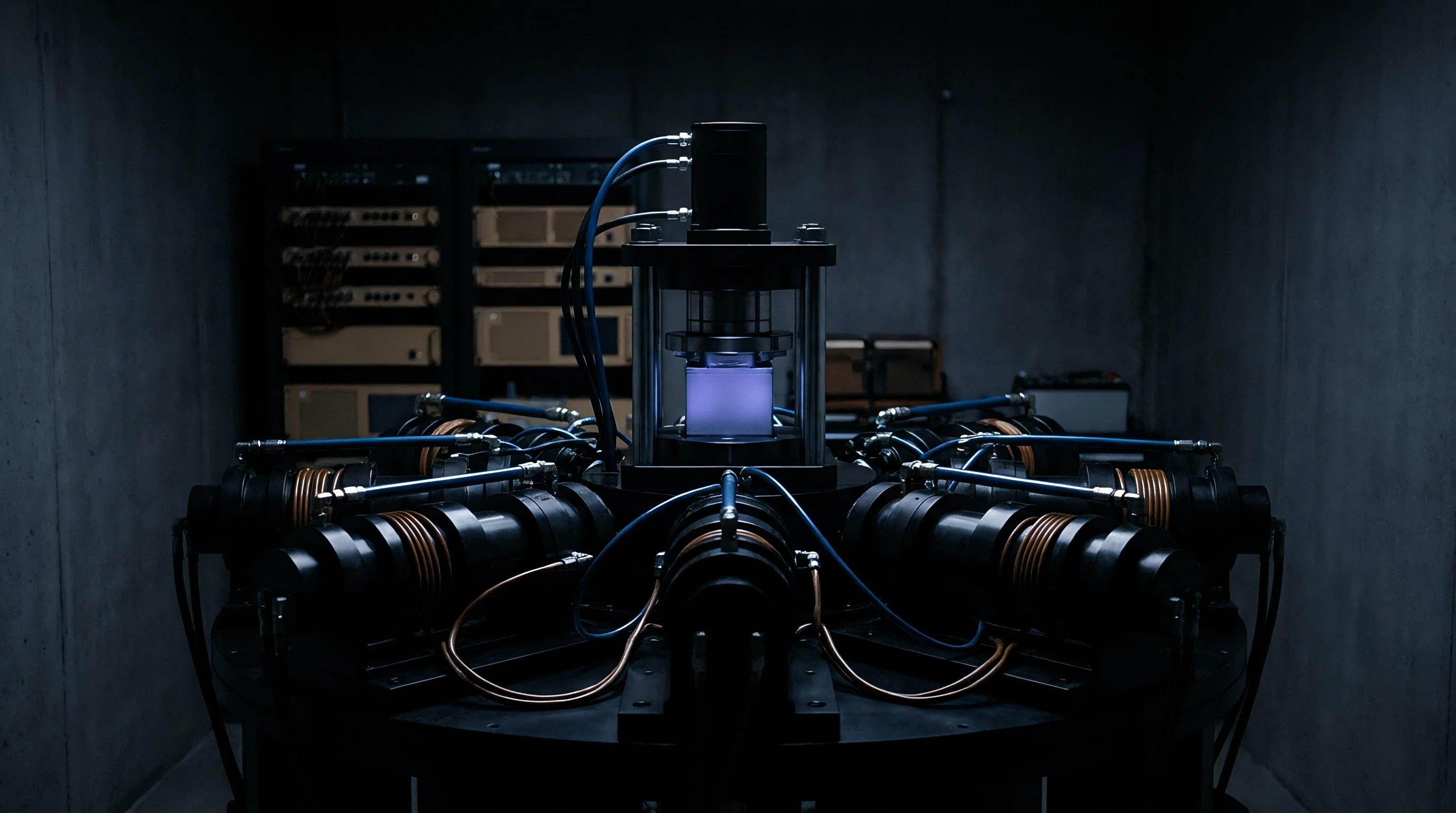
Thermodynamics of Solvate Phase Separation and Crystal Nucleation
Ethylene carbonate molecules form tight coordination shells around lithium cations at nominal room temperatures. Lowering ambient thermal energy alters solvation free energy parameters. Cation desolvation energetic barriers escalate sharply below minus ten degrees Celsius, encouraging lithium ions to retain their bulky solvation shells rather than intercalating into graphite host lattices.
When current flow drives local salt concentrations past liquidus lines on sub-zero phase diagrams, homogeneous crystal nucleation begins within microscopic pore niches. The desolvation barrier increases ionic migration resistance at active particle boundaries, compounding localized concentration polarization. Salt precipitation proceeds via heterogeneous nucleation on graphite particle surfaces, filling open void volumes and isolating active material from further electrochemical reaction.

Pore Clogging and Cascading Lithium Plating Mechanics
Solid salt precipitates physically fill the open void space within graphite active particle networks. Blocked pore channels increase effective internal tortuosity toward infinity, completely halting liquid phase ionic transport to deeper electrode regions.
Consider a worked construction evaluating mass transport inside a high-density anode during cold charging. Take a one-hundred-micrometer-thick graphite anode with an initial porosity of twenty-two percent, operating at minus twenty degrees Celsius under a charge current density of two milliamperes per square centimeter. Mass balance equations govern liquid phase species transport:
Faradaic current forces lithium cation flux from the separator interface into the anode pore network. Flux balanced against Fickian diffusion establishes local concentration profiles according to the Nernst-Planck transport equation:
Flux = -D_eff (dC/dx) + (t+ I) / F
Where D_eff represents effective diffusion coefficient (0.05 10^-6 cm²/s at -20°C), C represents salt concentration, x represents electrode depth, t+ represents transference number (0.21), I represents applied current density (2.0 mA/cm²), and F represents Faraday’s constant (96,485 C/mol).
Integrating across electrode thickness x from zero at the separator interface to one hundred micrometers at the current collector interface yields local concentration values. Assuming a bulk initial concentration of 1.0 M, calculated salt concentration at the current collector boundary reaches 2.65 M within eight minutes. The saturation limit at minus twenty degrees Celsius sits at 1.50 M. Precipitation occurs immediately when local concentration reaches 1.50 M.
Solid salt density (LiPF6 · EC complex) equals 1.82 g/cm³. Precipitating excess salt out of solution reduces local pore volume from twenty-two percent down to under four percent within forty micrometers of the copper foil boundary. Pore volume reduction reduces effective electrolyte conductivity from 1.2 mS/cm down to 0.08 mS/cm.
Local liquid phase ohmic drop escalates by a factor of fifteen, driving the local anode potential below zero volts versus Li/Li+. Incoming electrons are forced to reduce surface lithium cations into metallic lithium rather than intercalating into graphite, causing metallic lithium plating to cascade rapidly across the blocked region.
| Electrolyte System | Viscosity at -20°C (mPa·s) | Freezing Point (°C) | Liquidus Saturation at -20°C (M) | Plating Onset C-Rate at -20°C |
|---|---|---|---|---|
| Standard EC/EMC (3:7) + 1.0M LiPF6 | 12.4 | -28 | 1.50 | 0.12C |
| Fluorinated EC/DEC + 1.2M LiFSI | 6.8 | -42 | 2.20 | 0.35C |
| Ester-Rich EA/EMC + 1.0M LiFSI | 2.1 | -65 | 2.85 | 0.80C |
| Low-Viscosity DME/Fluoroether + 1.5M LiFSI | 1.1 | -85 | 3.40 | 1.40C |
- Calculate maximum safe sub-zero charge current density based on electrode thickness and tortuosity values measured via X-ray computed tomography.
- Monitor cell skin temperature and electrochemical impedance spectroscopy intercept changes during the initial five minutes of current application.
- Terminate constant current charging when cell terminal voltage exhibits an anomalous inflection indicative of severe concentration polarization.
- Apply periodic zero-current relaxation pulses every sixty seconds to allow salt concentration gradients to equilibrate across anode depth.
Standard cell supply agreements exclude field failures caused by sub-zero charging when recorded telemetry shows temperature readings below minus ten degrees Celsius.
Inadequate management of sub-zero salt accumulation leads directly to internal short circuits, permanent capacity loss, and sudden battery pack thermal failures.

Remedy
Chemical formulations targeted at sub-zero performance alter solvation structures and lower kinetic activation barriers for ion transfer. Solvents retain liquid phase fluidity across broad sub-zero thermal operational windows.
Low Viscosity Solvents and Weakly Solvating Salt Chemistry
Substituting high-melting-point ethylene carbonate with low-viscosity carboxylate esters preserves liquid phase fluidity down to minus forty degrees Celsius. Formulations incorporating ethyl acetate, methyl propionate, or ethyl propionate lower solution viscosity by up to eighty percent at sub-zero regimes, accelerating liquid phase diffusion rates.
Replacing lithium hexafluorophosphate with weak-solvating salts like lithium bis(fluorosulfonyl)imide alters ion pair thermodynamics. LiFSI displays higher solubility limits at extreme sub-zero temperatures and exhibits higher bulk ionic conductivity. Weak binding energy between bis(fluorosulfonyl)imide anions and lithium cations facilitates rapid desolvation at electrode particle surfaces, maintaining low charge-transfer resistance during cold charging steps.

Does Sub-Zero Pulse Charging Prevent Localized Salt Saturation?
Intermittent current interruption provides time windows for concentrated lithium species to diffuse away from current collector interfaces. Modulated pulse charging applies short high-current pulses followed by zero-current rest periods. Resting permits concentration relaxation across tortuous anode pores before localized saturation thresholds are breached.
Advanced electrode structural engineering modifies pore geometry directly. Laser-patterned vertical channels created through ultrafast laser ablation form direct low-tortuosity ion highways through dense graphite coatings. Vertical micro-channels decrease macro-tortuosity values from four point five down to under one point eight, suppressing concentration polarization during sub-zero operations.
Electrolyte formulations with bulk ionic conductivities above two millisiemens per centimeter at minus twenty degrees Celsius consistently prevent sub-zero salt precipitation during low-rate charging.
- Porosity grading profile ~ Select electrodes featuring higher surface porosity near the separator and reduced tortuosity along ionic migration paths.
- Solvent freezing threshold ~ Require binary or ternary electrolyte blends with liquidus transition temperatures below minus forty-five degrees Celsius.
- Lithium salt composition ~ Specify lithium bis(fluorosulfonyl)imide co-salts to maintain high ionic conductivity and prevent solid solvate formation.
- Laser patterning density ~ Mandate vertical micro-channels in high-loading anodes exceeding three point five milliamperes-hour per square centimeter to relieve transport bottlenecks.
Anodes engineered with decreasing tortuosity toward the separator boundary consistently outperform uniform density electrodes in sub-zero charge acceptance.

Margin
Purchasing specifications for lithium-ion cells often hide significant gaps between lab ambient ratings and actual sub-zero operating parameters. Unqualified cold charging capabilities result in premature field degradation, unexpected safety exposure, and expensive warranty liabilities.

Cell Datasheet Deceptions in Low Temperature Specifications
Manufacturer data sheets frequently report low-temperature discharge performance while omitting charge acceptance boundaries under sub-zero conditions. A standard cell datasheet might claim operational functionality down to minus thirty degrees Celsius based solely on low-rate discharge energy retainment. Subjecting that same cell to charging at minus fifteen degrees Celsius often induces lithium plating within minutes due to localized salt crystallization.
Procurement teams verify low-temperature capabilities by requiring complete operando test dossier documentation. Cell specifications must explicitly define maximum allowable continuous and pulse charge currents across five-degree temperature increments from twenty-five degrees Celsius down to minus thirty degrees Celsius. Lacking these empirical boundary conditions, incoming inspection protocols cannot detect underlying sub-zero mass transport vulnerabilities.
Landed Cost Calculations for Cold Chain Battery Deployment
Designing active thermal heating systems into battery enclosures increases baseline system bill of materials costs and introduces continuous parasitic energy drains. Integrating active internal heating elements and heater jackets adds weight and roughly twelve percent to total pack fabrication expenses, while consuming up to fifteen percent of available pack energy solely for pre-heating during sub-zero operational starts.
Specifying cells built with low-temperature optimized electrolytes and micro-structured high-loading anodes eliminates heating system requirements. Cell unit costs rise by approximately eight percent due to specialized LiFSI salts and laser patterning processes, but overall pack landed cost drops by seven percent through heating hardware removal. Cold-climate reliability improves substantially when cell chemistry inherently resists localized salt precipitation dynamics.
Adding a mandatory low-temperature charge acceptance clause tied to UN 38.3 test report revisions transfers financial liability for sub-zero lithium plating degradation back to the cell manufacturer.