Operando NMR Analysis of Interfacial Lithium Encapsulation Dynamics under Cryogenic Fast Charging
Operando NMR isolates trapped dead lithium during sub-zero fast charging, enabling quantitative plating prevention and dynamic charging algorithm design.

Nuclei
Nuclear magnetic resonance spectroscopy provides non-destructive, element-specific observation of atomic environments inside active electrochemical cells under operating currents. During aggressive charging of lithium-ion batteries, standard voltage measurements cannot separate structural intercalation into graphite matrices from parasitic metallic lithium deposition on anode surfaces. Both occur together once interfacial overpotentials drive local anode potential below zero volts against lithium.
High-field solid-state magnetic resonance resolves this ambiguity by targeting differences in local electron environments around atomic nuclei.
In operando setups, radiofrequency pulses penetrate the cell to excite lithium nuclei across solid phases and the liquid electrolyte. A nucleus’s resonance frequency depends directly on local magnetic shielding from surrounding orbital electrons and conduction bands. Diamagnetic species like lithium fluoride, lithium carbonate, organic alkyl carbonates, and intercalated lithium shield the nucleus, producing chemical shifts between minus ten and plus fifteen parts per million relative to standard aqueous solutions.
Metallic lithium, by contrast, contains conduction electrons exhibiting Pauli paramagnetism. Coupling between nuclear spins and these conduction electron spins creates a distinct frequency shift ~ the Knight shift ~ pushing metallic lithium signals downfield to between two hundred forty and two hundred seventy parts per million.
Operando Resonance Detection in Solid State Batteries
Tracking metallic deposition in real time requires fast pulse sequences capable of capturing transient phase changes without thermal distortion from excitation. Cell geometry itself poses a signal barrier: in standard cylindrical or pouch cells, metallic current collectors and conductive carbon additives shield electromagnetic fields, attenuating incoming radiofrequency pulses and outgoing free induction decay signals. Quantitative fidelity depends on maintaining adequate skin depth penetration through active material layers.
At a magnetic field strength of seven tesla, the Larmor frequency of lithium-seven sits near one hundred sixteen megahertz, where the radiofrequency skin depth in metallic lithium measures about twelve micrometers. Deposits thicker than this suffer amplitude distortion from phase shifts and signal loss in their interior. Interpreting spectra collected during fast charging thus requires mathematical attenuation models tailored to deposit morphology.
Mossy metallic lithium ~ with its high surface area and fine filaments under two micrometers ~ allows full radiofrequency penetration and yields linear signal scaling with deposited mass. Dense planar sheets cause non-linear attenuation that underestimates total metallic mass if left uncorrected.
At minus twenty degrees Celsius and a two-C charging rate, operando magnetic resonance deconvolution demonstrates that lithium plating initiates when the total cell overpotential exceeds three hundred fifteen millivolts across commercial graphite-silicon composite anodes.
Cell orientation within the magnetic field also alters peak positions and linewidths. Bulk magnetic susceptibility variations across planar electrode stacks generate demagnetization fields, causing orientation-dependent line shifts up to fifteen parts per million. Aligning electrode surfaces parallel to the static magnetic field minimizes broadening at susceptibility interfaces, maximizing spectral resolution between mossy structures and dense planar deposits.
Precise probe positioning then allows real-time discrimination between reversible plating that strips during discharge and irreversible lithium trapped inside the expanded solid electrolyte interphase.

Radiofrequency Field Attenuation and Electrode Geometry
Optimizing signal-to-noise ratios without disrupting cell function requires specialized internal RF coils. Standard solenoidal coils wrapped around pouch cells experience heavy electrical losses from conductive current collectors, dropping coil quality factors below twenty. Flat micro-strip resonators and surface coils placed directly against thin single-layer pouch cells recover quality factors above seventy, allowing pulse sequences to run with high temporal resolution.
Evaluating spectral line shapes continuously during charge-discharge cycling quantifies structural transformation rates. Quadrupolar interactions further assist phase identification: lithium-seven has a nuclear spin of three-halves, making its electric quadrupole moment sensitive to local electric field gradients. Amorphous or disordered interphase components yield broad quadrupolar satellite transitions, whereas symmetric metallic domains give narrow central resonance lines.
Tracking variations in quadrupolar coupling constants reveals mechanical stress accumulating in interfacial layers as lithium ions force into tight grain boundaries under high current density at sub-zero temperatures.
Radiofrequency attenuation worsens at lower temperatures as electrolyte conductivity drops.
Quantitative operando measurement provides the baseline data needed to establish real thermal boundaries for commercial cells. Relying solely on voltage relaxation curves masks severe internal plating during low-temperature fast charging. A cell showing acceptable terminal voltage can still accumulate metallic lithium, leading to rapid capacity fade, loss of active lithium, and increased risk of internal short circuits.
A steady shift in resonance frequency indicates uniform metallic growth across active graphite sites.
Frost
Low temperatures severely impair mass transport kinetics across every component in a lithium-ion cell. As ambient temperatures approach minus forty degrees Celsius, electrolyte viscosity rises by nearly two orders of magnitude, driving liquid-phase ionic conductivity down from ten millisiemens per centimeter at room temperature to less than zero point two millisiemens per centimeter. At the same time, lithium-ion desolvation at the electrode-electrolyte interface becomes the main bottleneck limiting reaction rates.
Charge transfer resistance rises exponentially as temperature drops, following Arrhenius behavior with activation energies between fifty and seventy kilojoules per mole depending on solvent and salt. Stripping the primary solvation shell ~ usually four to six ethylene carbonate molecules coordinated around a central lithium cation ~ presents a high energy barrier that drives interfacial overpotentials deep into negative territory under applied current. When incoming charge outpaces desolvation and solid-state intercalation into graphite, thermodynamic conditions force direct reduction of solvated lithium ions to metallic lithium on the electrode surface.

Thermodynamic Overpotentials at Subzero Operational Limits
Extreme polarization alters the thermodynamic driving force across the active electrode surface. At room temperature, lithium insertion into graphite moves through distinct staging phases, with the lowest-potential stage-one compound forming near eighty millivolts positive of metallic lithium equilibrium. Cryogenic temperatures shift these equilibrium potentials slightly via entropic contributions, but kinetic polarization remains the main driver of plating.
Ohmic drop through liquid-filled pore networks, combined with charge transfer overpotentials and solid-state diffusion limits, drives local anode potentials below zero volts within seconds of starting high-rate charge.
| Electrolyte Solvent Composition | Temperature (°C) | Ionic Conductivity (mS/cm) | Desolvation Resistance (Ω·cm²) | ⁷Li Knight Shift Peak Width (Hz) |
|---|---|---|---|---|
| EC/EMC (3:7 vol) + 1.2M LiPF₆ | 25 | 10.8 | 12 | 140 |
| EC/EMC (3:7 vol) + 1.2M LiPF₆ | -20 | 1.4 | 185 | 420 |
| EC/EMC (3:7 vol) + 1.2M LiPF₆ | -40 | 0.18 | 1420 | 1150 |
| EC/DEC/FEC (2:7:1 vol) + 1.0M LiFSI | -20 | 2.9 | 84 | 310 |
| EC/DEC/FEC (2:7:1 vol) + 1.0M LiFSI | -40 | 0.52 | 460 | 780 |
Plated lithium distribution across electrode depth reflects concentration profiles inside the porous structure. High current densities deplete ions in shallow surface pores, creating steep concentration gradients. Low salt concentrations near the current collector increase local resistance, channeling incoming current toward outer electrode surfaces near the separator.
Under cold conditions, plating starts almost entirely at the electrode-separator interface, creating a region vulnerable to dendrite growth that can puncture polymeric separators.
Desolvation Impedance and Solvation Shell Reorganization
Adjusting electrolyte solvents changes the coordination strength of the inner solvation sheath, providing a chemical path to lower desolvation resistance at sub-zero temperatures. Low-viscosity co-solvents like ethyl acetate, methyl propionate, or fluorinated ethers decrease bulk viscosity and reduce activation energies for ion release. Weakly coordinating solvents lower the thermodynamic barrier for stripping solvent molecules from lithium ions before charge transfer.
Interfacial transport limits trigger distinct chemical and mechanical failure modes in cells charged under sub-zero conditions.
- Mass Transport Infiltration Failure leads to severe ion depletion deep in anode pores, stopping intercalation and driving metallic deposition on the surface.
- Solvation Shell Entrapment increases charge transfer resistance, producing high local overpotentials that accelerate parasitic reactions.
- Solid Interphase Cracking happens when localized, dense metallic deposits exert mechanical stress on brittle inorganic SEI layers.
- Chemical Electrolyte Depletion accelerates as freshly plated metallic surfaces consume free solvent and lithium salts to rebuild damaged interphase layers.
Sub-zero fast charging without temperature-compensated current throttling routinely causes irreversible damage within fifty cycles. Non-uniform plating blocks pore entrances and damages graphite particle structure, creating local current density spikes that increase thermal runaway risks when warmed. Electrodes subjected to repeated cold plating show severe delamination from copper current collectors as mossy metallic deposits between active particles generate volume expansion stress.

Shift
Deconvoluting operando magnetic resonance spectra requires precise baseline modeling and line-shape analysis to separate overlapping chemical signatures. During cryogenic fast charging, single-pulse excitation spectra show broad composite peaks from zero to three hundred parts per million. These signals combine contributions from diamagnetic electrolyte species, intercalated lithium, mossy metallic deposits, and dense dendritic structures.
Line-fitting routines using mixed Gaussian-Lorentzian Voigt functions isolate individual phase components, resolving the exact resonance shifts associated with distinct chemical and structural environments.
Cold charging pushes cell polarization into extreme regimes.
The Knight shift of metallic lithium is proportional to the local density of electronic states at the Fermi energy level. Small movements in the metallic resonance peak reflect structural differences in deposited lithium domains. Filaments with nanometer-scale diameters show a subtle upfield shift toward two hundred forty-five parts per million because of quantum confinement and higher surface area where conduction electron density falls.
Bulk planar deposits yield characteristic Knight shifts near two hundred sixty-five parts per million. Tracking these peak shifts during continuous current shows how morphology evolves from initial mossy nuclei into dense columnar or dendritic networks.
Knight Shift Deconvolution of Plated Metallic Lithium
Quantitative integration of deconvoluted spectral peaks establishes a mass balance for lithium distribution during current flow. The integrated area in the diamagnetic region (minus ten to plus fifteen parts per million) tracks electrolyte salt concentration and interphase accumulation. Decreases in the intercalation region (forty to ninety parts per million) correlate with lithium extraction from the host matrix, while growth in the Knight-shifted region (two hundred forty to two hundred seventy parts per million) measures the mass of active metallic lithium on the anode.
Plated lithium morphology directly dictates nuclear magnetic relaxation times, where mossy deposits display spin-lattice relaxation rates nearly double those of bulk planar metallic sheets due to enhanced surface conduction coupling.
Transverse relaxation times offer another dimension for separating structural morphologies. Spin-spin relaxation measurements using operando spin-echo sequences reveal distinct decay rates for different metallic forms. Mossy metallic lithium, with its high surface-to-volume ratio, shows rapid transverse relaxation from local magnetic field inhomogeneities at solid-electrolyte boundaries.
Planar sheets have noticeably longer transverse relaxation times, allowing full spectral isolation through time-domain filtering before Fourier transformation.

Can Knight Shift Broadening Isolate Encapsulated Lithium?
Inhomogeneous broadening of the metallic Knight shift signal increases noticeably over extended cryogenic fast-charge cycles. This stems from microscopic magnetic field gradients across irregular deposit structures. As filaments grow, local susceptibility variations create micro-environments with differing internal magnetic fields.
Fitting algorithms must use magnetic susceptibility distribution models to capture total peak area accurately, avoiding underestimation of plated metallic mass during fast growth phases.
An irreversible capacity decay of 14 percent occurs when metallic lithium signals remain detectable at the end of discharge.
The spectral signature of encapsulated metallic lithium retains its characteristic Knight shift position, showing that the metallic phase remains intact inside an insulating chemical shell. Without electronic connection to the current collector, however, it cannot release electrons during oxidation. Operando spectroscopy tracks how fast this dead lithium phase accumulates cycle by cycle, providing a metric for battery degradation long before capacity loss shows up in standard terminal voltage profiles.
Interfacial impedance rises sharply under sub-zero operation.
Unresolved spectral features near two hundred thirty parts per million point to organometallic transition phases with electronic structures sitting between diamagnetic salts and fully metallic clusters. These species appear transiently during early nucleation at sub-zero temperatures, suggesting intermediate reduction states prior to stable metallic lattice formation. Determining whether these transient states contribute directly to dead lithium entrapment or serve as nucleation precursors remains a primary focus in low-temperature fast-charge research.
Trap
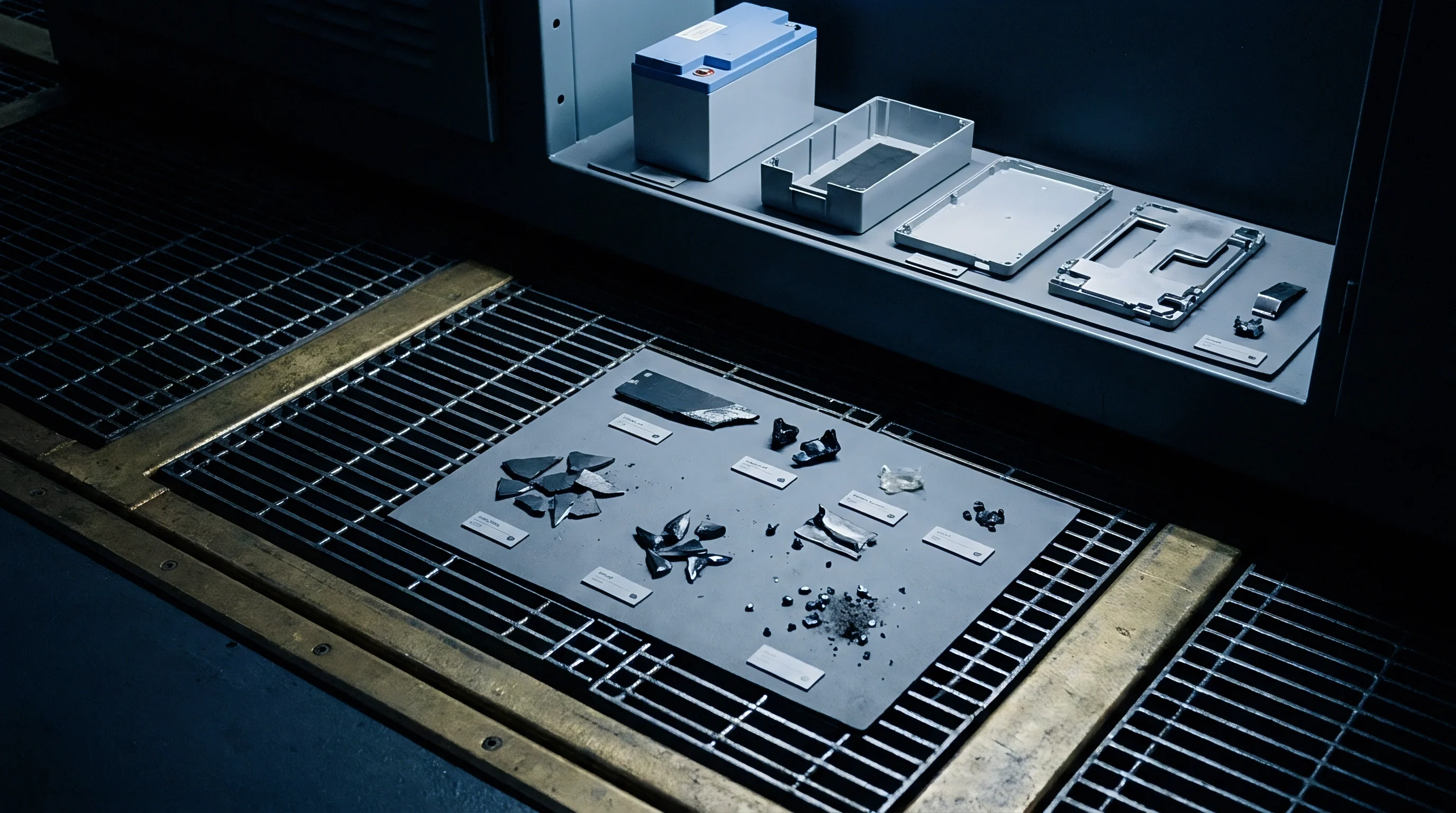
Interfacial encapsulation of metallic lithium stems from coupled mechanical and electrochemical failure during stripping after low-temperature fast charging. As temperature drops, the solid electrolyte interphase loses elasticity, growing brittle and prone to micro-cracking under local volume changes. Plated lithium forms irregular mossy or dendritic roots that penetrate deep into the passive interphase layer.
During subsequent warming or discharge, electrochemical oxidation removes lithium primarily from the narrow necks or bases of these filaments where current density is highest, rather than uniformly across their surface.
This localized dissolution ~ preferential root stripping ~ severs electronic contact between the upper metallic filament and the conductive anode substrate. Once detached, the isolated metallic segment stays embedded in an insulating matrix of organic and inorganic decomposition products. Unable to transfer electrons to the anode network, the cluster cannot be electrochemically stripped, permanently reducing the cell’s active lithium inventory.
The trapped metallic core remains chemically reactive, continuing to consume electrolyte through slow reduction reactions across its surrounding interphase shell.
- Subzero Metallic Nucleation begins when local interfacial overpotentials push anode potential below zero volts, forming high-aspect-ratio lithium filaments through cracked interphase boundaries.
- Interphase Encapsulation Stress develops as ongoing parasitic electrolyte reduction deposits thick layers of insoluble lithium fluoride and alkyl carbonates over new metallic surfaces.
- Preferential Base Dissolution occurs during discharge as high current density concentrates at high-curvature filament roots, severing the conductive metallic path.
- Permanent Inventory Isolation finishes as the isolated metallic core is enclosed by an electrically insulating, ionically conductive chemical matrix, creating irreversible dead lithium.
Physical Mechanisms of Electronic Isolation at Grain Boundaries
Structural characterization of the insulating matrix around dead lithium reveals high concentrations of inorganic salt phases ~ mainly lithium fluoride and lithium oxide ~ intermingled with polymeric carbonate species. High interfacial energy between metallic lithium and inorganic interphase components promotes dewetting during partial stripping, accelerating the detachment of metallic pockets from active current paths. Cryogenic temperatures slow lithium diffusion within metallic filaments, preventing surface relaxation that might otherwise preserve structural continuity during high-rate stripping.
| Charge Profile & Temperature | Intercalated Phase Fraction (%) | Reversible Plated Phase (%) | Encapsulated Dead Li Phase (%) | Irreversible SEI Loss (%) |
|---|---|---|---|---|
| 1C Charge at 25°C | 98.2 | 0.0 | 0.0 | 1.8 |
| 2C Charge at 0°C | 88.4 | 7.2 | 1.8 | 2.6 |
| 2C Charge at -20°C | 62.1 | 19.5 | 12.8 | 5.6 |
| 3C Charge at -20°C | 44.3 | 28.1 | 18.4 | 9.2 |
| 2C Charge at -40°C | 21.8 | 36.4 | 28.9 | 12.9 |
Encapsulated lithium accumulation correlates strongly with the ratio of charging current density to stripping current density. Rapid low-temperature charging followed by slow ambient discharging maximizes dead lithium formation by leaving extended chemical reaction time to build thick interphase shells around severed filaments. Conversely, higher discharge temperatures speed up chemical side reactions between trapped metallic cores and surrounding electrolyte, accelerating active lithium loss and electrolyte drying.

Quantitative Tracking of Dead Lithium Accumulation
Differentiating active metallic lithium from trapped dead lithium relies on operando spectra recorded over complete charge-discharge-rest cycles. Continuous tracking of the Knight shift resonance integral across a cycle yields three distinct values: peak metallic mass at end of charge, residual metallic mass at end of discharge, and permanent metallic loss after extended thermal resting.
Capacity declines without recovering original electrode structure.
The residual signal at the end of discharge corresponds directly to trapped metallic lithium cores isolated from current collectors. Monitoring this residual peak over multiple cycles shows initial linear growth followed by exponential acceleration once the outer interphase structure saturates with dead metallic debris. Saturated interphase layers increase cell tortuosity, compounding mass transport resistance and driving higher plating overpotentials on subsequent cycles.
Plating onset occurs before reaching nominal zero volts.
Low-temperature capacity fade is often attributed entirely to temporary kinetic slowdown and electrolyte resistance growth that recovers at room temperature. Quantitative operando magnetic resonance demonstrates otherwise: up to forty percent of capacity loss under cryogenic fast charging stems from permanent metallic encapsulation that remains unrecoverable upon thermal equilibration.

Channel
Translating operando NMR insights into practical battery testing requires custom test channels equipped with precise RF resonance monitoring and fast-response temperature control. Standard commercial channels deliver regulated current and voltage profiles but lack the analytical hardware needed to detect physical phase changes inside the cell envelope. Integrated channels put micro-coaxial RF sensing probes directly inside the environmental chamber, combining electrical testing with real-time resonance acquisition.
Maintaining stable magnetic resonance signals inside operating environmental chambers requires strict thermal decoupling between the RF probe assembly and the chamber airflow. Temperature fluctuations inside the RF coil body shift coil impedance and tuning, causing artificial amplitude variations that ruin quantitative accuracy. Specialized probes use evacuated double-walled quartz jackets with independent thermal fluid circulation, holding the RF resonator at a constant temperature while the inner sample space cycles between minus forty and plus sixty degrees Celsius.

Resonator RF Tuning under Cryogenic Thermal Cycles
Automated RF tuning and matching networks compensate for dynamic impedance changes caused by structural cell variations during charge-discharge cycles. As temperature drops and state of charge shifts, changes in dielectric constant and high-frequency conductivity detune the RF circuit. Real-time automatic tuning systems adjust varactor diode capacitance within milliseconds, keeping probe sensitivity high throughout fast-charge testing sequences.
Skin depth attenuation distorts quantitative signal ratios in thicker electrodes.
Quality control protocols for fast-charge cell selection need quantitative interfacial metrics alongside standard terminal voltage parameters. Standard qualification relies on post-test capacity checks and end-of-life cycle counting, which detect degradation only after significant structural damage has occurred. In situ resonance monitoring detects initial metallic nucleation within seconds of onset, enabling fast screening of cell designs, electrolyte formulations, and charging profiles before committing to multi-month cycle testing.

In Situ Screening Procedures for Fast Charge Qualification
Implementing operando screening routines in cell qualification lines involves a structured calibration protocol designed to isolate temperature-dependent plating thresholds.
- Mount the target cell within the temperature-controlled RF probe jacket, ensuring precise physical alignment relative to the static magnetic field vector.
- Perform high-frequency impedance spectroscopy sweeps across the RF coil circuit to adjust tuning and matching networks to optimum resonance conditions at ambient temperature.
- Chill the environmental chamber to the target sub-zero operating temperature at a controlled cooling rate not exceeding one degree Celsius per minute.
- Execute an automated baseline pulse sequence to record reference diamagnetic spectra for the fully discharged cell under thermally equilibrated conditions.
- Apply the target fast-charging current profile while acquiring continuous single-pulse NMR spectra at intervals not exceeding thirty seconds.
- Monitor the Knight shift spectral region in real time using automated peak deconvolution software to detect the immediate onset of metallic lithium plating.
- Apply a voltage step-down current limit instantly upon detecting metallic signal growth exceeding zero point five percent of total active lithium mass.
- Execute a full discharge step to zero point five C, tracking residual Knight shift signal intensity to quantify the exact fraction of trapped, dead metallic lithium formed during the charge cycle.
In accordance with UN 38.3 transport safety documentation and IEC 62133 cell qualification standards, cells exhibiting persistent metallic lithium Knight shift signals exceeding two point five percent of total lithium inventory post-discharge shall be classified as compromised and rejected for shipment.
Incorporating resonance-derived plating thresholds into battery management system algorithms allows dynamic current adjustment based on real-time physics rather than conservative lookup tables. Standard battery management units rely on static current maps derived from offline testing. Algorithms reading real-time interfacial impedance and polarization throttle charge current at the onset of metallic reduction, maximizing charging speed while preventing irreversible metallic trapping.
A procurement contract specifying sub-zero operational capabilities must include an explicit clause defining maximum allowable irreversible metallic plating mass fractions as measured by verified operando analytical methods, or the buyer assumes full financial liability for field failures resulting from low-temperature fast charging.

Claim
Deploying lithium-ion battery packs into unheated cryogenic fast-charging environments carries substantial financial risk across warranty, liability, and operational efficiency. Cell datasheets routinely pair room-temperature cycle life figures with low-temperature discharge specs while omitting cycle-life degradation curves under low-temperature charging. When buyers deploy standard cells in sub-zero fast-charging applications based on room-temperature data, early field failures quickly erase operating margins.
Dendritic filaments sever electronic contact rapidly.
The financial impact of sub-zero capacity loss is driven by the rapid accumulation of dead lithium. This creates a double loss: it permanently reduces usable pack energy while consuming liquid electrolyte, driving up cell resistance. Higher internal resistance increases Joule heating during subsequent operation, forcing thermal management systems to work harder and consume auxiliary power.
The true cost of energy delivered over a pack’s lifetime depends directly on preserving active lithium inventory across all operating temperature windows.

Landed Cost Arithmetic for Low Temperature Fast Charge Packs
Calculating the landed cost per delivered kilowatt-hour over a pack’s lifetime requires factoring in degradation rates driven by thermal charging profiles. Consider a commercial transport application using a one hundred kilowatt-hour battery pack costing fifteen thousand dollars at the cell level. With an expected lifetime of three thousand cycles under standard twenty-five degree Celsius conditions, the base cell-level energy delivery cost comes to five cents per kilowatt-hour cycled.
| Operating Thermal Profile | Reversible Retention at 500 Cycles (%) | Accumulated Dead Lithium Mass (g/cell) | Retained Pack Cycle Life (to 80% EOL) | Landed Cost per Delivered kWh ($) |
|---|---|---|---|---|
| 25°C Continuous 1C Charge | 96.2 | 0.02 | 3100 | 0.048 |
| 0°C Continuous 1.5C Charge | 88.5 | 0.48 | 1420 | 0.105 |
| -10°C Continuous 1.5C Charge | 74.1 | 1.85 | 680 | 0.220 |
| -20°C Continuous 1.5C Charge | 52.4 | 4.12 | 240 | 0.625 |
| -20°C Dynamic Dynamic Throttled Charge | 84.2 | 0.82 | 1150 | 0.130 |
When this same pack undergoes unheated fast charging at minus twenty degrees Celsius without current throttling, continuous metallic encapsulation drops effective cycle life from three thousand cycles to two hundred forty cycles. This accelerated degradation raises the cell-level energy delivery cost from five cents to sixty-two point five cents per delivered kilowatt-hour ~ a twelve-fold increase that ruins the operating economics of an electrified fleet.

Warranty Contract Metrics and Capacity Retention Thresholds
Protecting capital investments in battery equipment requires writing quantitative physical metrics into procurement agreements and warranty contracts. Standard warranty language covers defects in materials and workmanship while excluding capacity loss from operational misuse ~ frequently defining any charging below zero degrees Celsius as misuse unless explicitly pre-approved in writing. Procurement engineers need detailed technical schedules that tie warranty coverage to specific physics-based performance criteria.
Field warranty claims regarding low-temperature capacity loss are legally unenforceable unless the purchase agreement explicitly references verified operando spectroscopy limits for interfacial lithium encapsulation under stated C-rate and temperature parameters.
Contractual terms must define exact parameters for capacity retention verification testing, including mandated rest periods, thermal equilibration protocols, and specific procedures to separate temporary cold-induced capacity drops from permanent dead lithium inventory loss. Specifying third-party analytical arbitration using operando magnetic resonance spectroscopy ensures objective resolution of warranty disputes over whether observed performance loss stems from manufacturing defects or non-compliant field operation.
Solvation shells resist rapid charge transfer under cold conditions.
Integrating clear physical degradation limits into procurement documentation transforms technical risk into manageable commercial terms. Buyers who set clear technical boundaries compel suppliers to deliver realistic low-temperature fast-charge performance data backed by robust cell designs, optimized electrolyte chemistries, and validated battery management controls. Warranties built on explicit physical parameters protect long-term capital deployments against unrecoverable field failure costs in cold climates.