Close Coupled Gas Atomization Gas-to-Metal Ratio Optimization for Battery Powder Yield
Optimize close-coupled gas atomization gas-to-metal ratio between 3.5 and 4.0 to maximize 5 to 25 micrometer battery powder yield while limiting fines.


Melt
Liquid alloy stream stability sets the baseline for downstream aerodynamic fragmentation in a close-coupled gas atomizer. When atomizing reactive battery materials like lithium-silicon master alloys, pure lithium, or specialized sodium formulations, the molten feed leaves the guide tube directly into a supersonic gas field. Guide tube diameter, melt superheat, and tundish metallostatic head determine the liquid mass flow rate.
Raising melt superheat from 75 Kelvin to 150 Kelvin lowers viscosity and surface tension, enabling aerodynamic forces to break up the core stream at lower dynamic pressures.
Stream disruption progresses through distinct hydrodynamic regimes dictated by Weber and Ohnesorge numbers. High surface tension fluids resist early ligament formation, pushing mean droplet sizes toward coarser fractions. For battery powders, holding a tight particle size distribution between 5 and 25 micrometers depends on efficient kinetic energy transfer at the nozzle apex.
Excess superheat, however, accelerates refractory erosion on boron nitride or zirconia nozzles, shedding ceramic inclusions into the active material. These eroded ceramic particles degrade cell cycling performance and trigger micro-shorts during electrode calendering.
An expansion of 0.2 millimeters in melt orifice diameter increases metal mass flow by eighteen percent under a two-hundred-millimeter static head.
The gas-to-metal mass ratio compares the atomizing gas mass flow rate to the molten metal flow rate. Industrial close-coupled nozzles typically operate between 1.2 and 6.5, depending on gas selection and target powder size. Low ratios yield coarse distributions filled with primary breakup fragments, whereas higher ratios create dense sprays of fine droplets that freeze rapidly in flight.

Should Subambient Gas Temperatures Alter Pressure Settings?
Cooling gas within the high-pressure manifold increases its density while lowering acoustic velocity. Chilling argon or nitrogen supply lines to 230 Kelvin boosts dynamic pressure at the interaction zone by fifteen percent for the same manifold supply pressure. That acoustic shift changes the supersonic jet expansion angle, shifting the focal point relative to the melt tip.
Base feed characterization illustrates how gas thermodynamics, melt delivery parameters, and fluid properties interact during atomization.
| Alloy Composition | Liquid Density (kg/m³) | Surface Tension (N/m) | Dynamic Viscosity (mPa·s) | Optimal Superheat (K) | Target D50 (µm) |
|---|---|---|---|---|---|
| Li-99.9% Pure | 460 | 0.398 | 0.58 | 85 | 18.5 |
| Li-5Al Alloy | 510 | 0.440 | 0.66 | 110 | 22.0 |
| Si-20Al Master | 2340 | 0.820 | 1.25 | 140 | 12.0 |
| Na-99.8% Pure | 880 | 0.191 | 0.68 | 60 | 24.0 |
| Sn-15Cu Anode | 6850 | 0.560 | 1.85 | 120 | 14.5 |
Running outside these target superheat windows risks premature freezing around the nozzle rim ~ known on the shop floor as freeze-off. A freeze-off stops the run immediately, welds molten metal inside the delivery tube, and destroys the ceramic tip assembly.

Delivery
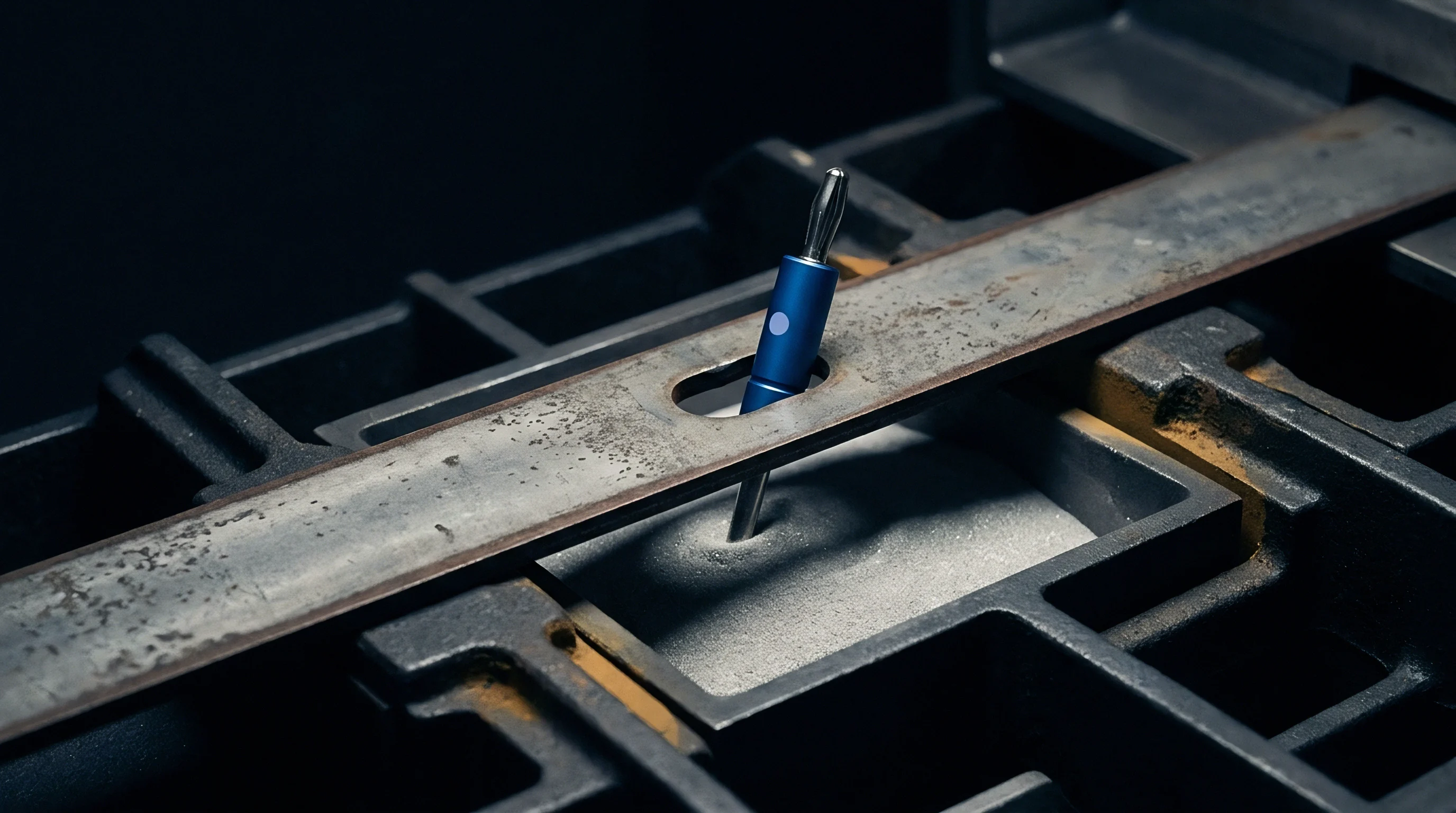
Gas nozzle geometry sets up the shock bottle structure and aspiration pressure right below the ceramic guide tube. Nozzle protrusion ~ the distance from the melt tip edge to the annular gas orifice ~ determines whether the stream sees positive backpressure or negative suction. Negative aspiration pulls liquid metal smoothly into the expansion zone, preventing backflow and skulling across the nozzle face.
Convergent-divergent jet nozzles reach gas velocities above Mach 2.2 at manifold pressures between 3.5 MPa and 7.0 MPa. As these supersonic jets expand and intersect, they create a recirculation zone enclosed by oblique shocks. Droplets slow rapidly after primary breakup, transferring energy into secondary breakup where aerodynamic stripping shears ligaments into spheres.
Could Overpressure Inversion Suppress Satellite Formation?
Pushing manifold pressure past design limits drives the Mach disk downstream, collapsing aspiration into positive backpressure. Instead of atomizing cleanly into free flight, molten metal splashes against the gas ring face. Droplets caught in the boundary layer then drift back into the spray cone, colliding with semi-solidified particles to form persistent satellites.
Operating with suction weaker than negative five kilopascals causes melt fountaining and uncontrolled droplet welding at the delivery orifice.
Managing secondary atomization relies on controlled execution across each operational phase:
- Chamber Inerting requires three sequential evacuation cycles down to fifty pascals followed by ultra-high purity argon backfilling to hold residual oxygen below five parts per million.
- Manifold Pressurization ramps gas delivery lines to target pressure within twelve seconds before stopper rod actuation to establish a stable aerodynamic shock structure.
- Melt Stream Injection retracts the ceramic stopper rod at a controlled velocity of twenty-five millimeters per second, initiating steady-state metal discharge into the suction zone.
- Aspiration Monitoring tracks real-time differential transducers at the nozzle tip, signaling immediate emergency gas venting if suction pressure rises above positive two kilopascals.
Instability during this sequence skews the particle size distribution and throws off powder packing density. Electrode coating lines require spherical particles with a span below 1.2 to maintain uniform slurry rheology and achieve target volumetric energy density.

Recovery
Downstream classification separates solidified powder into usable battery fractions and out-of-spec tailings. Powders for silicon-alloy anodes or pre-lithiated electrodes must fall strictly between 5 and 25 micrometers. Anything coarser than 32 micrometers can puncture thin separator membranes, whereas ultra-fines below 2 micrometers cause rapid gelation during slurry mixing due to high surface area.
The recovery circuit pairs primary gravity drop-out chambers with high-efficiency reverse-flow cyclones and secondary metal filters. Gas-to-metal ratio settings dictate yield distribution across these points: higher ratios drop the median particle diameter, improving cyclone recovery but driving more pyrophoric fines into downstream baghouses.
Under ISO 9276-2 standards, powder lots with a particle size span exceeding 1.45 face immediate rejection by cylindrical cell packaging lines.
Balancing yield requires tracking particle distribution against gas-to-metal mass ratio, as shown in atomization runs for lithium battery raw materials.
| Gas-to-Metal Mass Ratio | Melt Rate (kg/min) | Target Fraction 5-25 µm (%) | Oversize >25 µm (%) | Pyrophoric Fines <5 µm (%) | Specific Gas Use (Nm³/kg) |
|---|---|---|---|---|---|
| 1.8 | 4.2 | 28.5 | 64.2 | 7.3 | 1.02 |
| 2.6 | 3.1 | 46.2 | 41.5 | 12.3 | 1.48 |
| 3.8 | 2.0 | 67.8 | 14.8 | 17.4 | 2.16 |
| 4.9 | 1.4 | 58.2 | 6.1 | 35.7 | 2.79 |
| 6.2 | 0.9 | 41.0 | 2.2 | 56.8 | 3.53 |
Target yield drops off sharply on either side of the 3.8 gas-to-metal ratio peak. When auditing supplier dossiers, sourcing engineers check cyclone differential pressures and inline laser diffraction logs to confirm declared yields. Gaps between reported gas usage and powder output usually indicate blinded sieves or unrecorded re-screening passes.
Classification also exposes fine powders to atmospheric risks. High-surface-area battery powders react exothermically with trace moisture, forming oxide skins that increase cell internal impedance.
- Cyclone Choke Velocity must stay at twenty-two meters per second to prevent powder re-entrainment and crusting in the lower cone.
- Inert Sieve Blinding happens when elongated satellites bridge stainless mesh openings, cutting throughput by seventy percent within twenty minutes.
- Passivation Layer Formation feeds a controlled three-hundred parts per million oxygen stream during collection, stabilizing reactive lithium powders before final packing.
Poor passivation control leads to rapid self-heating when drums are opened inside dry rooms during cell assembly.

Invoice
Margins in gas-atomized powder production depend heavily on balancing argon consumption against saleable yield. Without closed-loop gas recovery, pure argon makes up forty to sixty percent of variable batch conversion costs. For example, in a 500-kilogram run of silicon-tin alloy, shifting the gas-to-metal ratio from 4.0 to 5.5 burns an extra 750 normal cubic meters of argon ~ a direct cost penalty if target fraction yield stays flat.
Recycling compressors clean, deoxygenate, and re-pressurize atomizing gas, cutting unit costs on volume orders. However, closed recovery loops carry cross-contamination risks during alloy changes. Powder residual trapped in heat exchangers or valves can contaminate subsequent lots, triggering quality disputes during cell qualification.
Yield losses below fifteen micrometers reflect normal aerodynamic variance rather than uncalibrated nozzle geometry.
Procurement agreements should base pricing tiers strictly on certified target yield rather than total unclassified powder mass. Without explicit scrap-credit clauses, buyers end up bearing the cost of off-spec coarse fractions and unrecovered fines.