Inbound Hazardous Goods Certificate Audit and Validation Procedure
Inbound hazardous goods certificate validation requires cross-checking UN 38.3 test summaries, SDS Section 14, and dock voltage readings against shipper declarations.
Manifest
Proper document validation for inbound lithium-ion cell shipments is the single best defense against transport holds and supply disruptions. International regulations classify secondary lithium cells as Class 9 Dangerous Goods, requiring strict physical and paperwork compliance before border entry or carrier acceptance. Freight forwarders, port authorities, and airline safety personnel enforce mandatory checks on every shipment under UN 3480 for standalone cells or UN 3481 for cells packed with or contained in equipment.
An incomplete safety file leads directly to cargo holds, compounding demurrage fees, and potential fines. System integrators and buyers safeguard their supply chains by auditing these documents before freight leaves the factory.
Name discrepancies between suppliers come up constantly during inbound cell documentation audits for high-volume energy storage projects. Transport safety regulations stem from the United Nations Manual of Tests and Criteria, specifically Section 38.3. Subsection 38.3.5 sets out a mandatory ten-point test summary format that must travel with every commercial shipment.
Authorities no longer accept generic certificates of conformity or basic lab declarations. Handling agents check that the entity named on the test summary matches the manufacturer listed on the bill of lading and outer package labels. Mismatches between lot codes, sub-brand names, and test certificate model numbers account for most origin port rejections.
A complete dangerous goods compliance dossier needs three distinct documents: the UN 38.3 test summary, a sixteen-section Safety Data Sheet conforming to the Globally Harmonized System of Classification and Labelling of Chemicals, and the Shipper Declaration for Dangerous Goods. Technical metrics across all three must align across the entire consignment chain without conflicting numbers or nomenclature.

Standardized Documentation Requirements for UN 38.3 Compliance
Any commercial lot of lithium-ion cells offered for international transport requires a valid test summary under Section 38.3.5 of the United Nations Manual of Tests and Criteria. Revision 7 and its amendments mandate ten specific technical data points in this document. Auditors look for the full legal name, address, phone number, email, and website of the cell manufacturer or product holder.
The issuing lab must supply matching contact details along with its accreditation identifier, establishing clear legal accountability for the test results.
The product description in the test summary defines the exact scope of transport approval. Auditors check the specific model designation, mass, chemistry, and form factor. For cylindrical cells like 21700 or 4680 formats, or large prismatic cells over 100 Ah, the summary specifies the watt-hour rating for lithium-ion or lithium content for primary lithium metal.
For example, a prismatic cell rated at 3.2 V and 280 Ah equals 896 Wh, placing it firmly into heavy commercial transport tiers with rigorous packaging rules.
Auditors cross-reference the date on the underlying test report against the production date of the shipped batch. A UN 38.3 summary referencing a test from 2018 cannot cover a cell batch produced in 2024 if the cathode active material, separator thickness, or internal structure changed in between. The document must explicitly list sub-tests T.1 through T.8, confirming a pass for every parameter.
| Summary Element | Regulatory Requirement (UN 38.3.5) | Audit Validation Check | Common Non-Conformance Defect |
|---|---|---|---|
| Manufacturer Details | Legal name, physical address, phone, email, website | Match against Bill of Lading and commercial invoice | Use of offshore trading entity without manufacturing link |
| Laboratory Identity | Name, address, contact, ISO 17025 accreditation number | Verify active accreditation scope on ILAC MRA portal | Unaccredited internal factory self-certification |
| Unique Report Number | Traceable test report number and date of issuance | Cross-check with complete laboratory test report | Mismatched numbers between summary and master report |
| Product Description | Format, mass, nominal energy (Wh), chemistry designation | Validate cell datasheet and physical sample mass | Discrepancy in watt-hour calculation or model code |
| Sub-Test Matrix | Confirmation of T.1-T.8 results with pass/fail status | Ensure all applicable cell tests show explicit passing marks | Omission of T.6 impact/crush or T.8 forced discharge |
| Authorized Signature | Name, title, and signature of company official | Confirm legal authorization of signatory within entity | Unsigned documents or generic corporate stamps |

Safety Data Sheet Cross Verification and GHS Alignment
Safety Data Sheets submitted by suppliers provide the hazard classifications and emergency response details required for customs clearance and storage. Compliance requires the strict sixteen-section format standardized under GHS Revision 9, enforced locally through OSHA HCS 2012 in North America and REACH Regulation EC 1907/2006 in Europe. Auditors pay closest attention to Section 9 for physical and chemical properties and Section 14 for transport information.
Section 14 of the SDS sets the international dangerous goods classification for the shipment. For secondary lithium-ion cells, the entry must state UN 3480, Proper Shipping Name LITHIUM ION BATTERIES, Class 9 Dangerous Goods. If cells are installed in or packed with equipment, the designation shifts to UN 3481.
Auditors verify that the hazard label matches the Class 9A standalone lithium battery mark required for air and ocean freight since 2019.
Cell state of charge remains restricted to a maximum of 30 percent of nominal capacity during air transport under Packing Instruction 965 Section IA.
The chemical composition listed in Section 3 of the SDS must match the cell electrochemistry tested under UN 38.3. A file claiming Lithium Iron Phosphate (LFP) chemistry in the test summary cannot list a nickel-manganese-cobalt (NMC) formulation in Section 3 of the SDS. Discrepancies in active material ratios, electrolyte solvents like ethylene carbonate or dimethyl carbonate, or lithium salts like lithium hexafluorophosphate (LiPF6) point to unverified design changes or swapped documentation.
Customs authorities routinely flag these mismatches and quarantine entire containers for chemical analysis.

Shipper Declaration Verification and Packing Instruction Compliance
Air freight regulations for standalone lithium-ion cells impose strict limits on state of charge and net package weight. The International Air Transport Association Dangerous Goods Regulations, following International Civil Aviation Organization Technical Instructions, require Packing Instruction 965 for UN 3480 shipments. Section IA covers cells over 20 Wh, while Section IB applies to cells rated at 20 Wh or less shipped in commercial volumes.
Both sections cap cell state of charge at 30 percent of rated capacity when tendered to the air carrier.
Carrier agents check paperwork carefully. Air Waybills for PI 965 Section IA shipments must include the explicit compliance statement “Lithium ion batteries in compliance with Section IA of PI 965” along with “Cargo Aircraft Only”. Standalone lithium-ion cells under UN 3480 are completely banned on passenger aircraft.
Auditors also verify that package net weight stays within the 35 kg limit for cargo aircraft packaging under PI 965 Section IA.
Ocean transport under the International Maritime Dangerous Goods Code follows parallel rules in Packing Instruction P903. While maritime transport allows states of charge above 30 percent, commercial buyers usually demand lower charge levels to mitigate thermal runaway risks inside sealed shipping containers. The ocean Bill of Lading and dangerous goods manifest must show the UN number, Proper Shipping Name, Class 9 hazard designation, outer packaging code like UN 4G for fiberboard boxes, and a 24-hour emergency contact number.

Gate
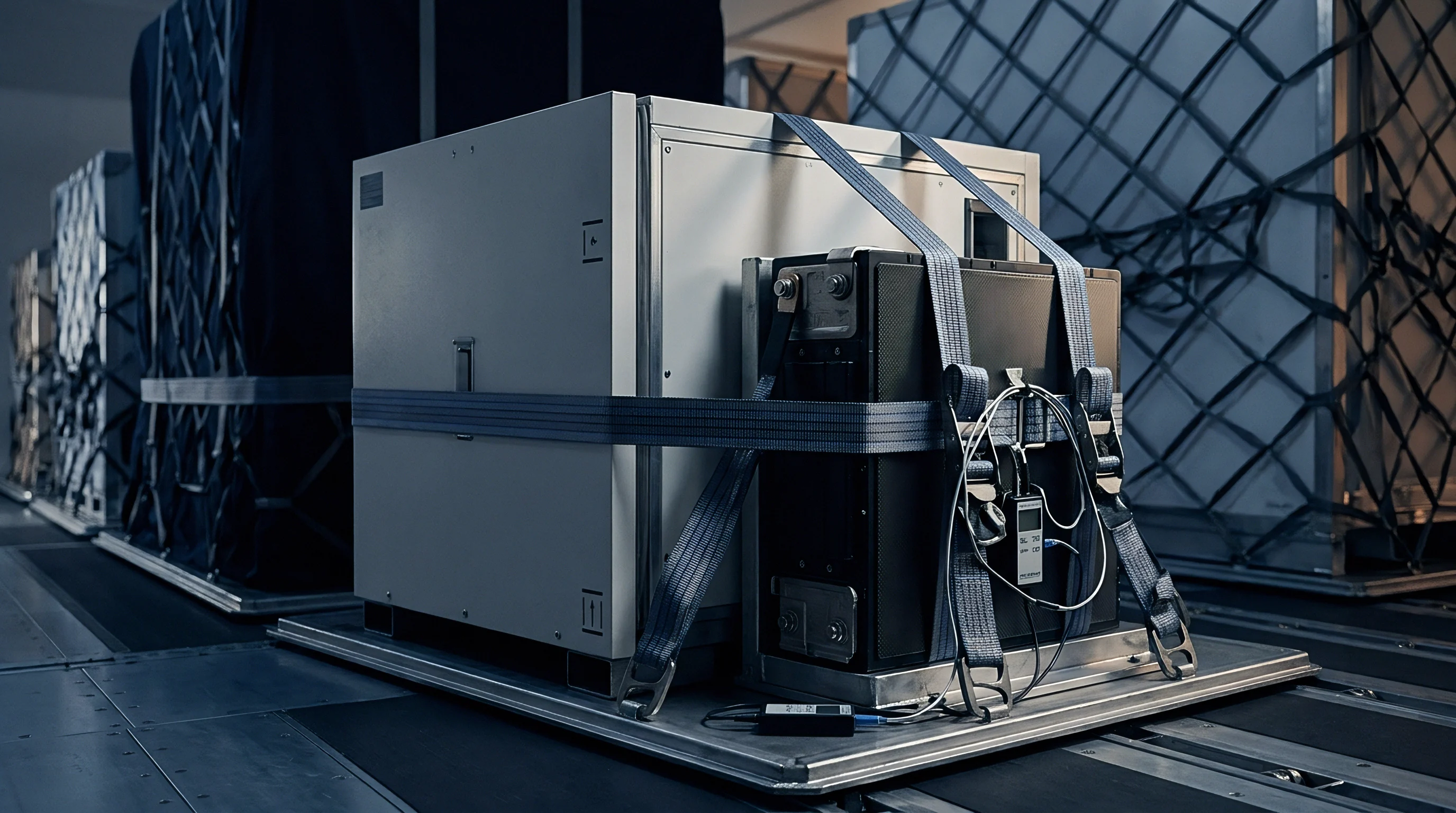
Inbound facilities face serious risks when unverified hazardous cargo hits the receiving dock. Physical inspection has to happen before offloading or logging inventory. The dock is where documentation claims meet physical reality: inspectors check outer package condition, dangerous goods labels, UN packaging specification marks, and internal battery condition before taking custody.
Catching issues here stops damaged or non-compliant cell lots from ever reaching storage areas or assembly lines.
Inspection begins with a visual and structural check of the packaging. Pallets must be structurally sound ~ no crushing, corner damage, water stains, or torn shrink wrap. Fiberboard containers need legitimate UN packaging marks stamped on the outer wall.
For example, the code UN 4G/Y25/S/23/CN/12345 indicates a rigid fiberboard box (4G), certified for Packing Group II hazards (Y) up to a gross weight of 25 kg (25), holding solid inner packagings (S), approved in 2023 (23), certified in China (CN), under authorization number 12345.
Any mismatch between total package weight and the rating stamped on the UN mark invalidates compliance. If boxes certified for 25 kg weigh in at 29 kg on dock scales, the package violates dangerous goods transit laws. Inspectors stop offloading immediately, log the discrepancy, and move the shipment to a dedicated hazardous materials staging area.

Physical Package Inspection and UN Marking Audit
Receiving teams examine outer cartons for required dangerous goods markings before offloading pallets. Every box of standalone lithium-ion cells must display the Class 9A hazard label ~ seven vertical black stripes on top, with a battery cluster icon over a thermal hazard graphic on the bottom. Packages shipped by air also require the rectangular red-and-black “Cargo Aircraft Only” label.
The UN 3480 mark must sit on the package face within a line-hatched border measuring at least 100 mm by 100 mm, displaying the UN number and a working emergency phone number.
Unwrapping pallets exposes the inner packaging structure mandated by transport rules. Cells cannot sit loose inside outer cartons. Manufacturers must isolate individual cells using thermoformed plastic trays, rigid divider grids, or protective sleeves that prevent direct terminal contact.
Insulating covers or non-conductive tape must shield terminals from contacting conductive materials. For pouch cells or moisture-sensitive cylindrical cells, inspectors also verify the presence of desiccant packs, humidity indicator cards, and vacuum-sealed moisture barrier bags.
If outer packaging shows punctures, moisture, or thermal discoloration, receiving teams stop the inspection immediately. Suspect containers are transferred to an exterior, explosion-proof isolation room fitted with thermal imaging cameras and automatic fire suppression. Staff never attempt to open damaged boxes inside the main warehouse.

Electrical Screening Procedure for Incoming Cell Batches
Measuring electrochemical parameters at the receiving dock gives an immediate read on cell lot stability. Standard receiving protocols pull a representative sample from each lot for open-circuit voltage (OCV) and AC internal resistance (ACIR) screening. Measurements are taken with a four-wire Kelvin bridge meter operating at 1 kHz.
The four-wire setup cancels out lead resistance errors, delivering the milliohm-level precision needed for high-capacity cells.
Cell state of charge correlates directly to open-circuit voltage. For standard LFP chemistry, a cell shipped at 30 percent state of charge shows a resting voltage between 3.25 V and 3.28 V at 25°C. For NMC chemistry, that rest voltage sits between 3.60 V and 3.68 V per cell. Readings outside these windows mean factory charge levels were set incorrectly before packing.
Air freight showing NMC voltages above 3.75 V violates the mandatory 30 percent state of charge cap, triggering an immediate non-conformance report.
ACIR measurements highlight structural issues and tab welding defects inside the cell. A typical 280 Ah LFP prismatic cell registers an ACIR between 0.15 mΩ and 0.25 mΩ at 1 kHz. Cells with resistance values 20 percent above the lot median signal weak tab welds, insufficient electrolyte, or current collector damage.
Conversely, readings near zero point to an internal micro-short caused by separator punctures or metallic debris from winding.
Calculating the K-value provides the ultimate test for internal self-discharge rates driven by micro-shorts. The K-value represents the rate of voltage drop over time, expressed in millivolts per day:
K = (OCV1 – OCV2) / Δt
Receiving teams take initial voltage readings (OCV1) at entry, hold the sample lot at 25°C ± 2°C for 72 hours in temperature-controlled storage, and take a second reading (OCV2). Standard LFP cells settle at a K-value under 0.5 mV per day after initial stabilization. Anything over 2.0 mV per day points to active self-discharge that will cause premature module failure or localized overheating in service.

Lot Acceptance Sampling and Statistical Defect Criteria
Receiving teams use statistical sampling plans to determine batch acceptance without testing every single container. Sampling follows ISO 2859-1 (ANSI/ASQ Z1.4) standards for attribute inspection, applying General Inspection Level II under Single Sampling Plans for Normal Inspection. The Acceptable Quality Limit (AQL) sets the maximum allowable defect percentage across severity tiers.
Incoming inspection splits defects into three risk tiers. Critical defects are safety hazards or outright regulatory failures ~ things like active electrolyte leaks, swelling beyond dimensional tolerances, reversed polarity, or missing UN 38.3 test summaries. Major defects impair performance or long-term reliability, such as OCV/ACIR values outside spec or elevated K-values.
Minor defects cover cosmetic paint scratches, faded printing on cartons, or torn packaging tape.
Dock non-conformances follow clear physical criteria:
- Short Circuit Terminal Vulnerability Terminals lack individual insulating covers, creating short-circuit risks between stacked layers.
- Non-Compliant Outer Packaging Rating Fiberboard cartons carry UN 4G ratings too low for the actual gross weight of the packed cells, risking box collapse.
- State of Charge Drift Exceedance Measured open-circuit voltage shows a state of charge above 35 percent, violating air freight rules.
- Discrepant Batch Serialization Serial numbers on cell cans do not match the manufacturing lot identifiers on the packing list.
- Moisture Ingress and Seal Failure Sealed pouch cells show swelling or vacuum loss from electrolyte leaks or moisture ingress.
For a shipment of 10,000 prismatic cells packed 20 to a carton, General Inspection Level II assigns Sample Size Code Letter M, calling for 315 cells sampled randomly across all pallets. Under an AQL of 0.15 for Critical Defects, the acceptance threshold is zero and the rejection number is one. Finding a single critical defect during testing rejects the entire 10,000-cell lot.
Omission of the authorized signature under UN Manual Section 38.3.5 sub-clause g invalidates freight acceptance at carrier transfer hubs.
| Screening Parameter | Measurement Method | LFP Nominal Range | NMC Nominal Range | Action Limit / Rejection Threshold |
|---|---|---|---|---|
| Open Circuit Voltage (30% SOC) | 4-wire Kelvin digital multimeter | 3.25 V – 3.28 V | 3.60 V – 3.68 V | Deviation > ±0.05 V from lot median |
| AC Internal Resistance (1 kHz) | 4-wire AC milliohm meter | 0.15 mΩ – 0.25 mΩ | 0.30 mΩ – 0.50 mΩ | Reading > 120% of lot median value |
| Voltage Decay Rate (K-value) | 72-hour differential voltage check | K-value > 2.0 mV / day at 25°C | ||
| Dimensional Thickness (Pouch/Prismatic) | Digital vernier caliper / optical gauge | Spec nominal ±0.3 mm | Spec nominal ±0.4 mm | Swelling > 0.8 mm beyond spec limit |
| Package Gross Weight | Calibrated platform scale | Carton spec ±1.5% | Carton spec ±1.5% | Mass exceeds UN 4G container rating |
An inbound container of prismatic cells incurred forty-two thousand dollars in demurrage and repacking fees after sitting impounded for three weeks because the outer cartons carried incorrect UN specification markings.

Proof
Validating cell safety means digging into the underlying laboratory test data rather than taking summary sheets at face value. A UN 38.3 test summary states that a cell passed, but the actual lab report provides the physical proof. Technical auditors examine test methods, sample sizes, sensor calibration records, and environmental conditions across the T.1 through T.8 series to verify the testing was executed rigorously rather than rubber-stamped on paper.
Lab testing under Section 38.3 of the UN Manual subjects cells to severe mechanical, thermal, and electrical stress. A complete compliance dossier must include the full report from an accredited lab. Auditors check that sample sizes defined in UN Manual Section 38.3.4 were maintained: for cell-level testing, that means 10 fully charged and 10 fully discharged cells for specific sub-tests to evaluate behavior across the full operating window.
Technical teams cross-check test sample specs against actual production drawings. If a test report covers a cell with an 0.8 mm aluminum casing, but production units drop to 0.6 mm to save weight, the original test report is invalid. Mechanical shock and altitude pressure test results for the thicker shell cannot guarantee the performance of the redesigned cell.
Laboratory Accreditation and ISO 17025 Validation
Testing labs issuing certification reports must hold active accreditation from recognized calibration bodies. Technical auditors verify that the lab holds valid ISO/IEC 17025 accreditation with an explicit scope covering dangerous goods and battery transport testing. National bodies like NVLAP or A2LA in the US, CNAS in China, or DAKKS in Germany all participate in the International Laboratory Accreditation Cooperation Mutual Recognition Arrangement (ILAC MRA).
Laboratory audits cross-reference accreditation stamps directly against global registry databases. Reports from unaccredited factory labs or facilities with expired scopes are rejected immediately. The audit confirms that the facility maintains independent calibration records for all environmental chambers, vibration shakers, and high-current discharge equipment.
Auditors pull calibration certificates for the exact data acquisition channels used during testing. Temperature logs recorded during thermal cycling and short-circuit tests must rely on thermocouples calibrated to within ±0.5°C. Voltage logging equipment requires calibration traceable to recognized standards; uncalibrated instruments render temperature and voltage logs meaningless, easily masking thermal spikes or voltage drops during testing.

Deep Audit of UN 38.3 Test Parameters and Boundary Conditions
A technical audit of sub-tests T.1 through T.8 verifies whether stress testing matched the target cell’s actual physical configuration. Each sub-test isolates specific structural, thermal, or electrical failure modes likely to occur during transport.
Test T.1 (Altitude Simulation) simulates unpressurized aircraft cargo holds. Samples sit at an ambient pressure of 11.6 kPa or lower for at least six hours at 20°C ± 2°C. This pressure drop stresses cell seals and pouch seams. To pass, cells must show no mass loss over 0.1 percent, no leakage, venting, disassembly, rupture, or fire, and retain at least 90 percent of their pre-test open-circuit voltage.
Test T.2 (Thermal Test) evaluates seal integrity and internal structure under extreme temperature swings. Cells undergo ten thermal cycles, holding at 72°C ± 2°C for at least six hours then shifting to -40°C ± 2°C for at least six hours, with transitions kept under thirty minutes. After cycling, samples rest for twenty-four hours at 20°C ± 2°C. Rapid expansion and contraction test the seals and internal tab welds; auditors review temperature logs to confirm transition times stayed within the thirty-minute limit.
Test T.3 (Vibration) simulates transit across rough roads and engine vibration. Cells undergo a logarithmic sinusoidal sweep from 7 Hz to 200 Hz and back over fifteen minutes, repeated twelve times for a total of three hours in each of three orthogonal axes. The profile applies a peak acceleration of 7 gn from 7 Hz to 18 Hz (holding a 0.8 mm amplitude) before ramping to 8 gn at 200 Hz. Auditors review spectral acceleration logs to confirm peak forces were maintained across all three axes.
Test T.4 (Mechanical Shock) measures resistance to heavy impacts and drops. Cells are hit with three half-sine shocks across six mounting directions (along three orthogonal axes). Small cells face a peak acceleration of 150 gn for 6 milliseconds, while cells over 12 kg take 50 gn for 11 milliseconds.
Passing requires no mass loss, leakage, venting, or voltage drop exceeding 10 percent.
Test T.5 (External Short Circuit) evaluates thermal stability under direct short conditions. Samples stabilize at 55°C ± 2°C before a short circuit (<0.1 ohms) is applied across the terminals. The short is held until at least one hour after case temperature returns to 55°C ± 2°C. Casing temperature must stay below 170°C, with no thermal runaway, explosion, or fire during the test or within six hours after.
Test T.6 (Impact / Crush) evaluates resistance to mechanical crushing. Cylindrical cells over 18 mm in diameter take an impact from a 9.1 kg weight dropped from 61 cm onto a 15.8 mm steel bar laid across the cell. Pouch and prismatic cells are crushed with a force between 13 kN and 13.4 kN using an 18 mm bar or plate.
The force is applied until it hits the target load, voltage drops by 100 mV, or the cell deforms by 50 percent. Internal shorting from the crush must not push case temperatures above 170°C or cause fire or rupture.
Test T.7 (Overcharge) applies to battery packs, running twice the maximum continuous charging current through the unit for twenty-four hours. Test T.8 (Forced Discharge) checks a cell’s ability to handle reverse charge conditions when wired in series. Each cell is forced-discharged at ambient temperature at its maximum continuous discharge current for a duration equal to its rated capacity.
Neither test may cause fire or explosion within seven days.
Design Revision Thresholds Triggering Mandatory Re Testing
Modifications during production runs can alter cell safety enough to void transport certifications. Section 38.3.2.2 of the UN Manual sets out clear thresholds for design changes that require full re-testing under T.1 through T.8.
Full re-qualification is required if a manufacturer shifts cathode active material composition by more than 0.1 mass fraction, changes the anode material, or modifies the electrolyte solvent. Structural changes requiring new testing include thinner separators, different separator substrates (like switching from polyethylene to polypropylene or changing ceramic coating thickness), or reducing shell thickness by more than 10 percent.
Weight or dimensional increases over 20 percent require a completely new test dossier. Jumping prismatic cell capacity from 230 Ah to 280 Ah within a similar footprint significantly alters energy density and thermal dynamics; a summary for the 230 Ah cell cannot validate shipments of the 280 Ah version. Auditors flag these issues by checking incoming dock dimensions and mass against baseline laboratory reports.
The qualification workflow follows a rigid verification sequence:
- Request the full UN 38.3 test report from the manufacturer alongside the one-page test summary.
- Cross-reference the lab name and accreditation number against the official ILAC MRA online directory.
- Compare the cell dimensions, mass, and cathode chemistry in Section 3 of the report against the invoice spec.
- Verify that sample counts under T.1 through T.8 meet UN Manual Section 38.3.4 requirements.
- Confirm that the test completion date precedes the manufacturing date of the shipped batch.
Discrepancies between manufacturing lot codes and test report execution dates indicate unverified production runs.
| Sub-Test ID | Test Name | Applied Environmental / Mechanical Stress | Acceptance Pass Criteria | Audit Red Flag / Failure Mode |
|---|---|---|---|---|
| T.1 | Altitude Simulation | 11.6 kPa absolute pressure, 20°C, 6 hours | No mass loss >0.1%, OCV retention >90% | Mass loss from volatile electrolyte leakage |
| T.2 | Thermal Test | 72°C (6h) to -40°C (6h), 10 cycles, transition | No venting, no disassembly, no fire | Seal fracture from thermal expansion differential |
| T.3 | Vibration | 7 Hz to 200 Hz sinusoidal sweep, 3 hours per axis (3 axes) | Stable OCV, no mechanical breakage | Internal tab weld fatigue or disconnect |
| T.4 | Shock | 150 gn 6 ms (small) or 50 gn 11 ms (large), 18 total shocks | No structural collapse, no voltage drop | Electrode stack shifting or internal shorting |
| T.5 | External Short Circuit | Case temp | Thermal runaway driven by internal melt | |
| T.6 | Impact / Crush | 9.1 kg drop 61 cm (cylindrical) or 13 kN crush (pouch/prismatic) | Case temp | Separator puncture leading to rapid combustion |
| T.7 | Overcharge | 2x max continuous charge current for 24 hours (packs) | No fire or disassembly within 7 days | BMS protection bypass or plating thermal runaway |
| T.8 | Forced Discharge | Reverse charge at max discharge current for rated capacity duration | No fire or disassembly within 7 days | Copper dendrite formation and cell rupture |
| Methods note: All sub-tests must utilize calibrated sensors with calibration certificates dated within twelve months of test execution. Data acquisition frequency must capture peak temperature and transient voltage dips down to millisecond resolutions. | ||||
Writing Section 38.3.5 validation into Section 8.2 of the master supply agreement as a condition precedent shifts all demurrage and disposal costs back to the vendor if documents are rejected.


Exposure
Financial exposure in battery supply chains spikes at customs entry and port discharge. When dangerous goods arrive with defective, falsified, or missing paperwork, enforcement agencies can seize cargo, levy civil fines, and revoke import privileges. Buyers, integrators, and importers of record face liabilities that can dwarf the purchase price of the cells.
Understanding enforcement mechanisms and building contract protections is essential.
Regulators in key markets actively cross-check dangerous goods dossiers against incoming freight. In the United States, the Hazardous Materials Regulations ~ enforced by PHMSA and CBP ~ carry heavy penalties. Under 49 CFR Part 107, civil fines reach up to $89,778 per violation per day, jumping to $209,478 per day if a violation leads to severe injury, death, or major property damage.
On top of statutory penalties, terminals charge daily demurrage and detention when containers sit in quarantine. A single hazardous cargo container held at a West Coast port racks up $300 to $800 a day in storage and chassis fees. Over a two-month document dispute, those charges can erase project margins and derail installation schedules.
Regulatory Sanctions and Customs Detention Mechanics
Enforcement agencies move aggressively against non-compliant imports. Under 19 U.S.C. 1595a, CBP officers can seize and forfeit cargo that violates transport safety rules. If an import lot lacks a valid UN 38.3 summary or carries questionable ISO 17025 lab credentials, border officials issue formal Notices of Detention under 19 CFR 133.21.
Once cargo is detained, the importer of record gets thirty days to produce valid compliance files. If the supplier fails to deliver verifiable lab reports, customs orders the shipment re-exported or destroyed at the importer’s expense. Discharging, neutralizing, and crushing non-compliant battery lots through licensed hazardous waste facilities often costs up to 40 percent of the original purchase price.
Customs holds also trigger wider administrative issues. Flawed paperwork on one container bumps an importer’s risk rating in customs monitoring systems. Subsequent shipments face mandatory 100 percent physical and document checks, causing systemic delays across the company’s entire supply chain.

EU Battery Regulation Compliance and Due Diligence Obligations
European market entry requires supply chain mapping and carbon footprint reporting alongside standard transport testing. Regulation EU 2023/1542, which took effect in August 2023, overhauled battery compliance across EU member states. Replacing the 2006 Battery Directive, it shifts enforcement from national laws to directly applicable EU statutory requirements.
Under Article 38 of EU 2023/1542, importers are legally responsible for verifying that manufacturers complete all conformity assessment procedures. Cells must carry the CE mark, have a valid EU Declaration of Conformity, and include technical files demonstrating compliance with safety, durability, and substance limits. Specific caps restrict heavy metals: mercury is capped at 0.0005 percent, cadmium at 0.002 percent, and lead at 0.01 percent by weight.
Articles 47 through 52 require supply chain due diligence for anyone placing batteries on the European market. Importers must establish traceable audits for raw material sourcing ~ specifically cobalt, natural graphite, lithium, and nickel. These due diligence policies face third-party audits by notified bodies, with non-compliance triggering sales bans, product withdrawals, or fines pegged to global corporate turnover.
A digital battery passport system rolls out across the EU by February 2027 for industrial and electric vehicle batteries over 2 kWh capacity. Each pack will carry a QR code linked to a central database containing performance specs, recycled content ratios (with mandatory targets for recovered cobalt, lead, lithium, and nickel), carbon footprint metrics, and transport test history.

Contractual Risk Allocation and Import Liability Mitigation
Purchase contracts define the legal obligations between manufacturers, logistics providers, and system integrators. A well-structured agreement translates dangerous goods requirements into clear commercial terms, protecting buyers if suppliers default on documentation.
Explicit indemnity clauses for dangerous goods non-compliance belong in every purchase order. Supply contracts must specify Incoterms 2020 to establish the exact point where dangerous goods liability transfers. Buying under Delivered Duty Paid (DDP) places responsibility for hazardous material declarations, customs clearance, and import duties on the seller.
Buying under Free on Board (FOB) or Ex Works (EXW) transfers compliance liability to the buyer the moment cargo crosses the ship’s rail or leaves the factory floor.
Contract terms should tie final invoice payment to dock inspection approval and technical verification of the UN 38.3 file. Holding back a 15 to 20 percent retention payment until sample electrical screening and document audits pass protects against late or deficient documentation.
Contractual risk controls follow clear commercial structures:
- Importer of Record Designation Explicitly name the party legally responsible for customs clearance and hazardous material declarations in the destination country.
- Transportation Warranty Conditions Require the vendor to guarantee UN 38.3 test summary validity for every shipped lot.
- Customs Seizure Indemnification Require the supplier to reimburse all demurrage, storage, and disposal costs if customs rejects the documentation.
- Design Change Notification Window Require sixty days’ advance notice for any material or dimensional changes that trigger UN 38.3 re-testing.
Freight forwarders reject cell shipments missing valid test summaries at origin ports prior to loading.
Whether transport authorities will eventually link digital battery passports directly to real-time customs declarations remains an open question for global logistics networks.