Regularized Spatial Matrix Inversion for Multi-Zone Lithium Cell State Monitoring
Regularized spatial matrix inversion reconstructs internal cell gradients from boundary sensors while suppressing noise amplification on embedded hardware.


Mesh
A 314-ampere-hour lithium iron phosphate prismatic cell operating under a 1C continuous discharge profile develops an 8.4 Kelvin thermal differential between the tab base and the geometric center of the jellyroll. Copper foils sink heat unevenly. External surface thermistors mounted to the aluminum casing register this excursion with a phase lag of 114 seconds, attenuated by the composite transverse thermal conductivity of the electrode stack.
That transverse conductivity rarely exceeds 1.2 watts per meter-Kelvin, while the planar conductivity along the copper and aluminum current collector foils runs between 160 and 380 watts per meter-Kelvin. Core temperatures remain physically unmeasurable directly. Inserting physical thermocouples through the hermetic seal of a commercial cell voids the manufacturer warranty, breaches the ingress protection rating, and introduces electrolyte leak paths that fail safety certifications under international transport testing.
Monitoring the internal state of large-format cells requires decomposing the continuous electrochemical volume into a discrete spatial network. When the cell volume splits into distinct coordinate blocks along the height, width, and thickness axes, each partition represents an individual zone characterized by localized state of charge, overpotential, current density, and temperature. Current collectors distribute incoming power across these regions, but localized impedance variations produce non-uniform current splitting.
Heat builds quickly. The discrete zones interact via thermal conduction matrices and parallel electrical interconnects. The mathematical forward model maps these distributed internal state vectors to a limited array of measurable surface boundary points, such as tab voltages, casing surface temperatures, and local mechanical expansion strains measured by external fixtures.
- Tab terminal boundary zones capture direct ohmic heating from current concentration. They respond immediately to high-amplitude load steps.
- Core jellyroll interior sectors exhibit delayed thermal responses due to low transverse thermal conductivity. These zones conceal localized thermal excursions during short-duration power pulses.
- Lateral casing flanks provide ambient convective dissipation points where surface thermistors measure attenuated thermal signatures. These regions reflect balanced bulk dynamics rather than acute local stresses.
- Bottom enclosure plates interface with liquid cold plates, creating steep vertical thermal gradients across electrode layers. This boundary interface establishes the dominant thermal sink for the entire internal volume.
The forward mapping operator couples discrete internal states to boundary sensor observations through linear or linearized governing equations. For thermal monitoring, finite volume discretization of the transient heat diffusion equation yields a continuous-time state-space representation. The observation equation extracts boundary temperatures via an observation matrix determined by sensor placement coordinates.
For electrical overpotential and current distribution, the Poisson equation governing potential fields across the current collector foils resolves into an admittance network matrix. In both formulations, the number of internal state zones substantially exceeds the number of practical boundary sensor locations. A standard automotive or stationary energy storage module accommodates four to eight surface sensing channels per cell, whereas capturing meaningful internal spatial gradients demands sixteen to sixty-four discrete volumetric zones.
This dimensional disparity creates an underdetermined inverse problem governed by the structure of the spatial transfer matrix.
Coarse partition schemes hide localized thermal runaways until heat reaches external surfaces.


Kernel
The discrete lead operator mapping internal volumetric states to boundary sensor readings behaves as a spatial low-pass filter. Thermal diffusion and electrical conduction smooth out sharp spatial variations as energy moves from the cell core toward external monitoring boundaries. Consequently, the forward operator attenuates high-frequency spatial modes.
When the system of governing partial differential equations resolves into a forward sensitivity matrix linking internal zonal states to boundary measurements, this attenuation manifests as rapid decay in the singular values of the forward matrix. The ratio between the largest and smallest singular values defines the condition number of the spatial transfer matrix.

Does Boundary Sensing Resolve Spatial Gradients?
Resolving localized core conditions from external sensor arrays confronts severe mathematical ill-conditioning. As the spatial discretization grid becomes finer, the condition number of the forward sensitivity matrix escalates exponentially. Boundary thermistors read delayed responses.
The spatial sensitivity profiles of neighboring interior zones overlap heavily when observed from distant external casing surfaces. If four surface thermistors monitor thirty-two internal thermal zones, the rows of the forward sensitivity matrix become nearly linearly dependent. The matrix condition number explodes.
Direct matrix inversion attempts to invert these near-zero singular values, which scales tiny measurement uncertainties into massive, unphysical state estimation errors.
| Discretization Zones | Boundary Sensors | Dominant Singular Value | Smallest Singular Value | Condition Number | Unregularized Noise Gain |
|---|---|---|---|---|---|
| 8 Zones | 4 Sensors | 1.842 | 1.21e-2 | 1.52e2 | 43.6 dB |
| 16 Zones | 4 Sensors | 2.105 | 4.35e-4 | 4.84e3 | 73.7 dB |
| 32 Zones | 6 Sensors | 2.418 | 8.12e-6 | 2.98e5 | 109.5 dB |
| 64 Zones | 8 Sensors | 2.783 | 1.05e-7 | 2.65e7 | 148.5 dB |
Noise dominates small singular values. A real-world analog front end in an industrial battery management system exhibits voltage quantization noise, thermal drift, and electromagnetic interference from power electronics switching. Typical automotive-grade thermistor measurement circuits exhibit an effective noise floor of 0.2 Kelvin, while voltage taps on busbars pick up millivolt-level switching ripple from pulse-width-modulated inverters.
A boundary noise level of two millivolts distorts unregularized core potential estimates by forty-two percent under standard C-rate steps.
When the unregularized pseudoinverse operates on noisy measurement vectors, components aligned with the smallest singular values receive amplification factors proportional to the reciprocal of those singular values. Inversion amplifies high frequency sensor noise. The reconstructed internal state profile displays wild spatial oscillations, alternating between negative overpotentials and impossibly high temperatures across adjacent discrete zones.
The physical laws of energy conservation and heat diffusion reject these oscillating profiles, yet the direct algebraic inversion produces them because it fits sensor noise rather than true electrochemical states.
Unchecked condition growth in the lead operator produces false state-of-charge balancing commands that trigger localized overcharging and subsequent cell venting during aggressive fleet charging cycles.
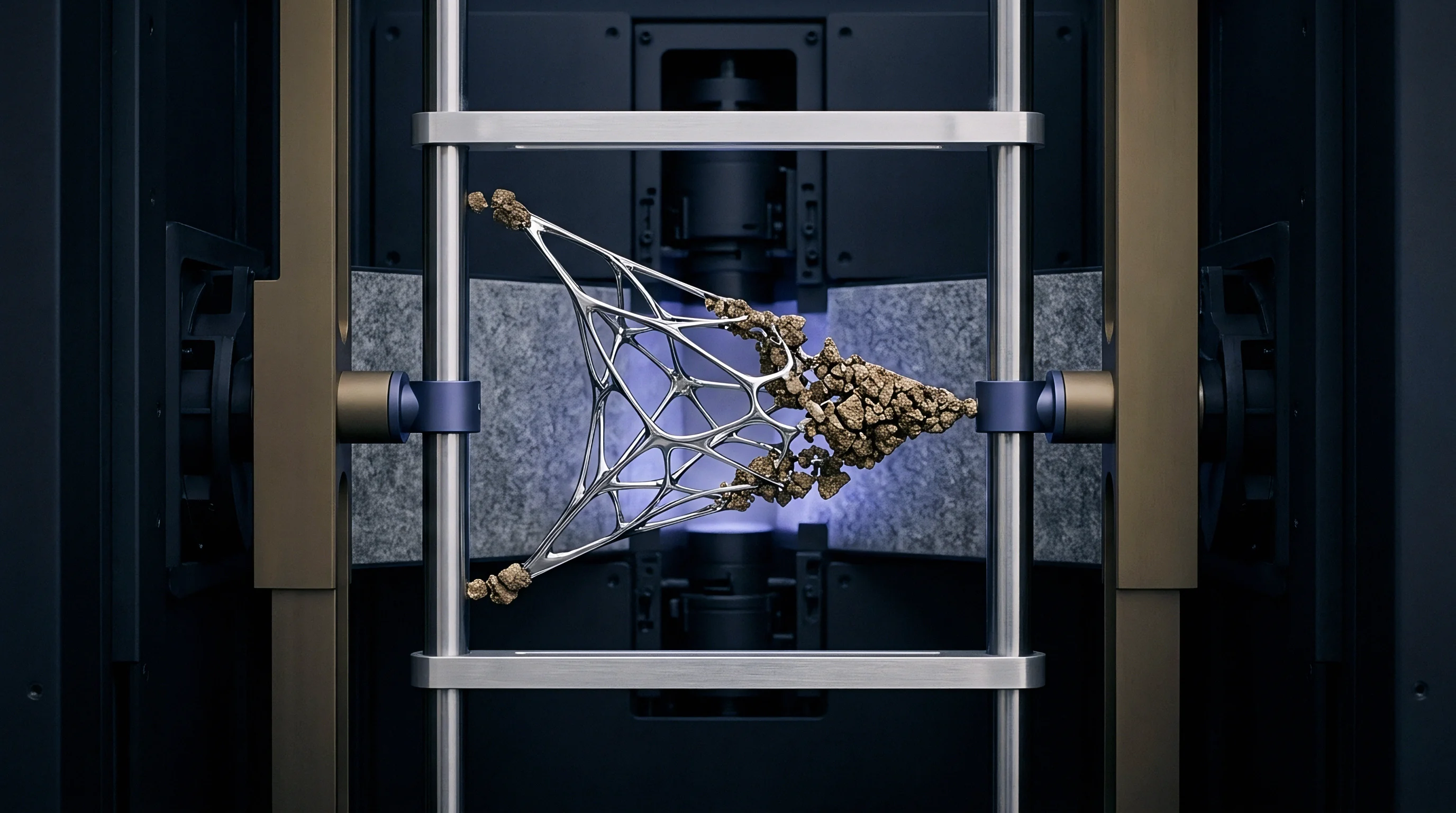
Damping
Stabilizing the spatial inversion requires introducing mathematical constraints that penalize unphysical spatial variance while preserving fidelity to physical boundary measurements. Tikhonov regularization transforms the ill-conditioned inversion into a well-posed optimization problem by augmenting the least-squares residual norm with a weighted penalty term. The regularized state estimate minimizes the sum of the squared measurement prediction error and the squared norm of a regularized state transformation.
The damping parameter balances measurement fidelity against state smoothness. Setting this parameter to zero returns the unstable direct pseudoinverse, while driving it toward infinity flattens all spatial gradients into a uniform, uninformative bulk average.
Consider a one-dimensional spatial thermal model of a 280-ampere-hour prismatic cell discretized into eight equidistant transverse zones from the central core layer to the outer casing wall. Let the true core temperature equal 328.15 Kelvin and the casing boundary thermistor measure 318.15 Kelvin under a steady cooling regime, representing a 10.0 Kelvin internal gradient. An unregularized matrix inversion subject to a 0.5 Kelvin Gaussian measurement noise spike yields an estimated core temperature of 354.85 Kelvin, overshooting the physical state by 26.7 Kelvin due to a condition number of 152.
By applying zeroth-order Tikhonov regularization with a damping coefficient calculated via the Morozov discrepancy principle, the inversion bounds the state estimation error within 1.1 Kelvin of the true internal profile. The algorithm rejects unphysical thermal spikes.
Spatial regularization penalizes unphysical zone-to-zone state oscillations without damping actual thermal excursions.
The choice of regularization operator determines the structural characteristics of the estimated spatial profile. Zeroth-order Tikhonov uses an identity matrix as the regularization operator, penalizing the absolute magnitude of the internal states. This approach prevents extreme values but introduces an artificial bias toward zero deviations from nominal baselines.
First-order and second-order formulations substitute discrete gradient or discrete Laplacian operators for the identity matrix. A discrete Laplacian penalty matrix penalizes sharp differences between adjacent spatial zones rather than the states themselves. This operator reflects the physical reality of thermal diffusion, which naturally enforces spatial continuity and smooth gradients across adjacent electrode layers without suppressing uniform bulk temperature rises.
- Underdamped inversion regimes amplify high-frequency measurement noise, producing erratic spatial oscillations across adjacent zones. These oscillations trigger spurious diagnostic threshold violations during normal driving cycles.
- Overdamped penalty matrices wash out genuine localized hot spots, yielding deceptively smooth state profiles during thermal runaway initiation. The monitoring system misses early micro-short detection windows as a result.
- Static regularization coefficients fail across broad temperature ranges because electrolyte conductivity and cell heat capacity vary nonlinearly with temperature. Operational state estimators must adapt damping weights to operational cell temperatures.
- Boundary mismatch artifacts arise when thermal contact resistance at the sensor interface changes under pack mechanical vibration. The inversion algorithm misinterprets contact degradation as an internal core temperature shift.
Determining the optimal regularization parameter in real-time execution demands automated criteria. The L-curve method plots the log-norm of the regularized solution against the log-norm of the residual constraint across a spectrum of damping values. The optimal parameter sits at the corner of maximum curvature, identifying the balance point where residual reduction ceases to justify solution variance.
Truncated singular value decomposition offers an alternative stabilizing approach by discarding singular values below a noise-floor cutoff threshold. This truncation projects the state estimation exclusively onto spatial modes that boundary sensors observe with acceptable signal-to-noise ratios, discarding undetectable spatial frequencies before inversion takes place.
Whether dynamic adaptation of the regularization parameter across varying ambient operating temperatures can function reliably without compromising real-time execution guarantees remains undetermined across the battery management sector.


Silicon
Automotive microcontrollers and industrial battery management processors operate under strict memory and computational throughput constraints. Standard embedded units feature 32-bit floating-point or fixed-point arithmetic cores running at clock frequencies between 80 and 300 megahertz. Flash memory limits storage tables.
Inverting a dense matrix online at every monitoring sample interval consumes unacceptable processor cycles and risks execution timeouts. Practical implementations precompute the regularized inverse operator offline, storing the resulting reconstruction matrix in non-volatile program memory. Online state reconstruction then collapses to a single matrix-vector multiplication executed at each sensor sampling tick.

Will Truncated Inversion Suppress Floating Point Jitter?
Fixed-point arithmetic architectures introduce numerical errors that distort regularized state reconstruction. When an embedded digital signal controller performs matrix-vector products using 16-bit or 32-bit fixed-point representations, quantization noise alters the effective regularized inverse coefficients. Low-magnitude matrix elements undergo severe truncation, which shifts the effective regularization parameter and compromises the noise-suppression properties established during offline floating-point tuning.
Fixed point truncation introduces static offsets. Inverting matrices with high condition numbers on fixed-point hardware causes significant limit-cycle oscillations in estimated core temperatures.
Precomputing inverse kernel matrices preserves processor headroom while runtime parameter adjustments drain execution budgets.
| Processor Architecture | Arithmetic Format | Zonal Mesh Size | Execution Latency | SRAM Allocation | Peak Reconstruction Error |
|---|---|---|---|---|---|
| Cortex-M4 (120 MHz) | 32-bit Float | 16 Zones | 42 microseconds | 1.2 Kilobytes | 0.35 Kelvin |
| Cortex-M4 (120 MHz) | 16-bit Fixed | 16 Zones | 14 microseconds | 0.6 Kilobytes | 1.82 Kelvin |
| Cortex-M7 (400 MHz) | 32-bit Float | 64 Zones | 78 microseconds | 8.4 Kilobytes | 0.28 Kelvin |
| Automotive DSP (200 MHz) | 32-bit Fixed | 64 Zones | 29 microseconds | 4.2 Kilobytes | 0.41 Kelvin |
Temporal filtering cascades must accompany spatial matrix inversion to reject dynamic measurement disturbances. While spatial regularization stabilizes inversion across the coordinate grid, recursive temporal filters, such as extended Kalman filters or moving horizon estimators, smooth state trajectories over time. The regularized spatial matrix inversion acts as the observation update step inside the temporal state estimator.
This combination decouples the spatial smoothing of the physical diffusion operator from the time-domain tracking of electrochemical dynamics. Field failures concentrate near tabs. If the boundary sensor sample rate drops below the thermal diffusion cutoff frequency of the cell casing, temporal estimators diverge regardless of spatial regularization quality.
- Fixed-point truncation noise accumulates rapidly during recursive matrix-vector multiplications on sixteen-bit digital signal controllers. This error shifts estimated core values by several degrees under steady-state loads.
- Static lookup table saturation prevents the state estimator from tracking extreme off-nominal thermal excursions outside pre-computed parameter grids. Estimators lock at boundary values during acute thermal runaway events.
- Interrupt latency starvation occurs when full singular value decomposition operations monopolize the control microcontroller core during fast cell balancing cycles. Critical safety interlocks experience delayed trigger windows as a consequence.
- Memory bus bandwidth bottlenecks delay boundary vector updates whenever the algorithm accesses uncompressed dense inverse matrices from external flash storage. Real-time deadlines fail when bus contention spikes.
Tier-one pack vendors argue that basic single-point tab thermistors capture sufficient thermal dynamics because internal cell heat conduction stabilizes quickly enough under automotive drive cycles.

Filing
Transport classification and stationary storage certification regimes increasingly scrutinize internal thermal monitoring algorithms. Regulators penalize opaque monitoring logic. Standard UN 38.3 transport testing subjects lithium cells to altitude simulation, thermal cycling, vibration, shock, external short circuit, and impact testing.
Under UN Manual of Tests and Criteria subsection 38.3.4.2, cells undergo thermal testing between 345.15 Kelvin and 233.15 Kelvin. Packaging instructions 965 and 968 under IATA Dangerous Goods Regulations govern the air carriage of standalone lithium cells, where undetected internal damage during transit risks catastrophic in-flight thermal runaway. Air carriers refuse undocumented thermal monitoring.
Testing under UN Manual subsection 38.3.4.4 invalidates cell packs when localized internal heating triggers unmonitored venting.
Thermal gradients accelerate separator breakdown. When internal short circuits initiate in large-format cells, localized self-heating begins tens of minutes before casing temperatures rise significantly. Safety validation standards, including UL 9540A for thermal runaway fire propagation and IEC 62619 for industrial lithium cells, require functional safety mechanisms to detect thermal abuse and initiate mitigation protocols before propagation across neighboring cells occurs.
If an energy storage system relies on regularized matrix inversion to prove early internal fault detection, the entire algorithm, including condition number boundaries, regularization parameters, and numerical stability limits, becomes part of the mandatory safety dossier submitted to accredited test laboratories.
| Standard Designation | Test Protocol Clause | Monitored Parameter | Compliance Metric | Algorithm Audit Requirement |
|---|---|---|---|---|
| UN 38.3 | Subsection 38.3.4.4 | Surface/Tab Temperature | Peak temp under 443.15 K | Documented estimation bounds |
| IEC 62619 | Clause 8.2.2 | Internal Over-Temperature | Protection trip before venting | Validation against thermocouple teardown |
| UL 1973 | Clause 24.2 | Cell Balancing Gradients | Maximum 5.0 K zonal delta | Fault tolerance under sensor loss |
| UL 9540A | Section 7 | Propagation Precursor Heat | Early venting detection time | Full mathematical model disclosure |
Auditing the safety file requires tracing the validation evidence back to physical cell teardowns and instrumented validation hardware. Type certification mandates physical proof that regularized boundary inversion accurately matches actual internal temperatures. Cell manufacturers fabricate specialized development units containing embedded fiber-Bragg grating optical sensors or micro-thermocouple arrays embedded directly into the jellyroll layers.
These instrumented test cells validate the forward sensitivity matrix and calibrate the regularization damping factors on laboratory test benches across varying C-rates, ambient temperatures, and states of health. Test summaries submitted under UN 38.3 Clause 38.3.5 must reflect this documented testing chain to survive freight forwarder scrutiny and customs inspections at import borders.
Commercial contracts place direct product liability on battery pack integrators who sign the Dangerous Goods Declarations and provide warranty covenants to project financers. If an integrator deploys an unvalidated spatial inversion algorithm that suppresses legitimate thermal alarms via excessive regularization damping, insurance policies exclude coverage under gross negligence clauses following a facility fire. Technical procurement agreements must explicitly specify the mathematical verification standards, test channel resolutions, and model validation boundaries required for embedded state estimation software before unit acceptance.
UN Manual of Tests and Criteria subsection 38.3.4.4 specifies uninterrupted surface and core temperature logging during thermal shock profiles, shifting testing liability directly to pack packagers who substitute unvalidated matrix estimation models for physical thermocouple instrumentation.