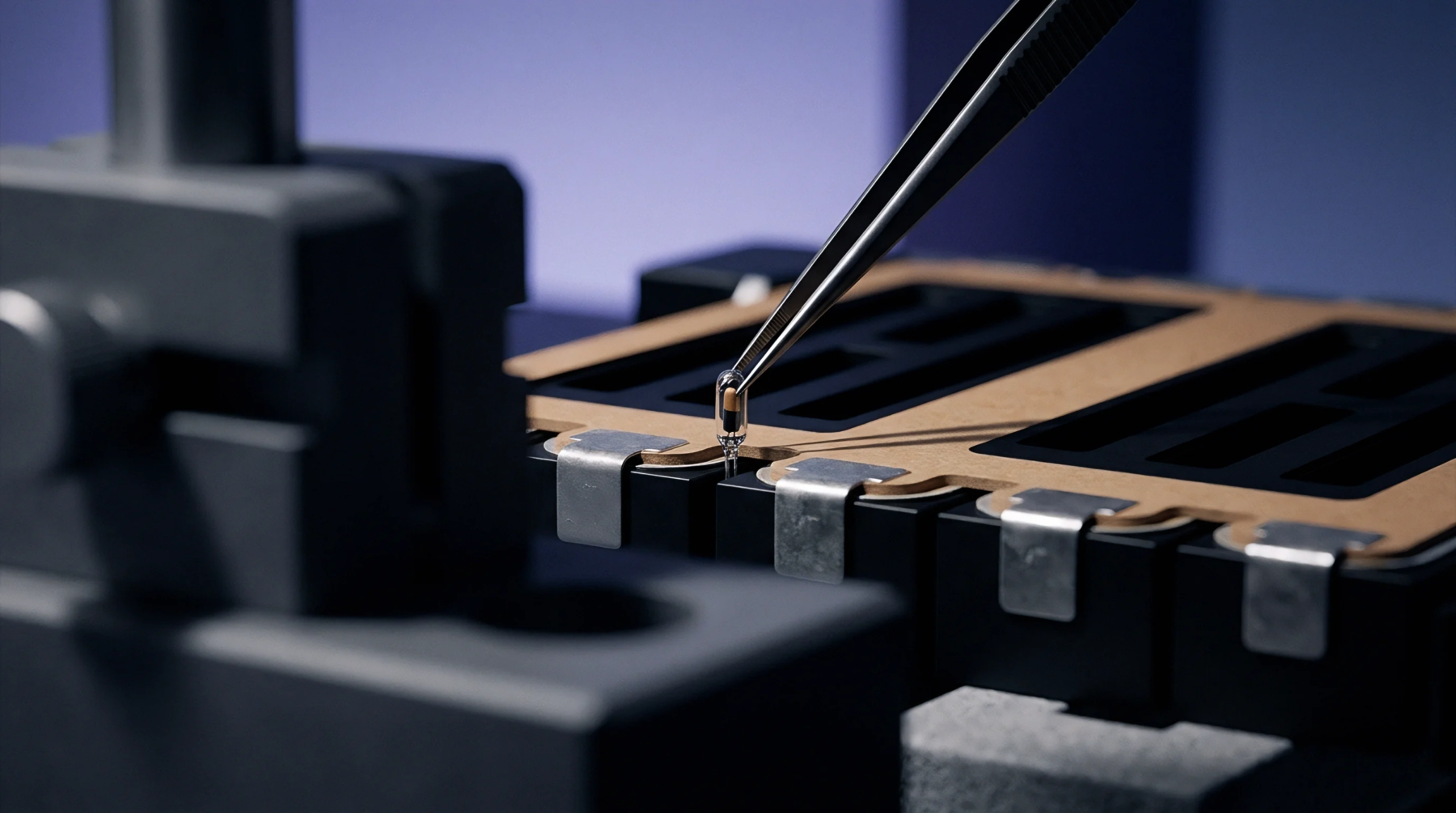
Differential Capacity Curve Distortion Caused by Surface Temperature Gradients
Surface temperature gradients distort differential capacity curves by desynchronizing parallel electrode phase transitions, causing false capacity fade signals.
Electrochemical analysis monitors the half-width of diffraction signals during battery electrode transitions to quantify structural disorder and phase inhomogeneity within active material lattices. Intercalation peak broadening describes the physical spread of diffraction intensity across an angular range when guest ions migrate into host structures. This measurement focuses on lattice strain and domain size variations that occur during ion insertion or extraction processes.
It provides a diagnostic for quantifying kinetic bottlenecks and localized non-uniformity in solid-state host materials. The metric remains valid until the material enters a complete phase transformation, where new peaks replace the broadened signal altogether.
Crystalline systems experience local distortion as guest ions push into inter-layer spaces or vacant sites. Intercalation peak broadening captures this mechanical consequence because the incoming ions exert pressure on the surrounding chemical bonds. These distortions shift the diffraction angle for individual unit cells in the material, resulting in a collective signal that occupies a wider angular region than a perfectly periodic lattice would produce.
High charge rates typically force a larger distribution of guest ion concentrations across the particles, which increases the breadth of observed signals. Material engineers track these changes to identify where mechanical failure initiates before catastrophic fracture occurs in the bulk electrode.
Fast ion transport requires low energy barriers for diffusion throughout the internal particle channels. When internal diffusion paths become constrained, the ion concentration gradient across an individual particle grows steep. This gradient creates a distribution of states that causes intercalation peak broadening as different parts of the crystal lattice display slightly shifted diffraction patterns.
A smaller breadth suggests that ions reach equilibrium quickly throughout the particle, which indicates superior rate capability. Manufacturers use this dependency to assess the efficacy of surface coatings designed to improve ion flux into the structure. Stable diffraction signals during high current discharge demonstrate that the material architecture maintains consistent electrochemical potential throughout the entire volume of the electrode.
Quantitative evaluation of this phenomenon requires high-resolution radiation sources to distinguish between thermal effects and actual strain-induced widening. Intercalation peak broadening relies on the assumption that the instrumental contribution remains constant across the measured range. Instrumental parameters often hide narrow signals, so corrections must account for the beam optics and detector sensitivity in every experimental setup.
The technique loses accuracy when multiple phases with similar lattice spacings coexist, as the overlapping signals distort the width calculation beyond reasonable bounds. Practitioners distinguish between broadening from finite domain sizes and broadening from lattice strain by measuring the variation of the signal at different diffraction orders. Mathematical separation of these two sources provides the exact structural insight needed for optimizing battery cycle life.
Stable peak widths throughout extended cycling denote the absence of cumulative structural damage in high-performance electrode materials.
Surface temperature gradients distort differential capacity curves by desynchronizing parallel electrode phase transitions, causing false capacity fade signals.
Expertise is a utility, not a secret. sentiention™ publishes its working knowledge as open reference: intelligence layer covering the materials it sources, the markets it enters, and the reference that serves both.