Decoupling Cross-Plane Thermal Gradients from Operando Intercalation Creep Metrics in High-Density Lithium-Ion Modules
Decoupling thermal expansion from operando intercalation creep separates reversible lattice breathing from irreversible structural degradation across modules.


Swell
In a constrained lithium-ion pack, mechanical displacement stems from two forces operating at the same time: active material phase expansion and internal thermal flux. As lithium ions shuttle between host sites in high-nickel cathodes and silicon-graphite anodes, the lattice parameters physically expand and contract. Simultaneously, resistive heating and electrochemical entropy generate core heat fluxes, driving sharp thermal gradients through the jelly roll or electrode stack.
An unconstrained pouch cell with an NMC811 cathode and an eight percent silicon oxide graphite anode expands seven to ten percent in total thickness over a zero to one hundred percent state of charge cycle. Pure silicon swells crystallographically by over two hundred percent during lithiation. The graphite matrix absorbs part of that volume swing, but the remaining bulk electrode strain pushes outward, perpendicular to the current collector foil.
A constrained module experiencing five Kelvin internal temperature spreads generates forty percent of its total measured face force through thermal expansion of aluminum hardware and electrolyte phase dilation.
When modules use rigid endplates and tension bands to restrict outer boundaries, this free expansion converts directly into mechanical face stress. Assembly lines preload cells at zero point two to zero point five megapascals to preserve layer contact and prevent delamination. Once charging begins, internal compressive loads climb quickly, often hitting two to three megapascals at full charge.
Cooling through base or side cold plates introduces steep temperature deltas across the electrode layers. Liquid organic electrolyte expands with temperature at roughly ten times the rate of dry active material. A pocket sitting at forty-five degrees Celsius swells far more than a twenty-five degrees Celsius zone near the chill plate.
Load cells capturing total module force or displacement record a blended signal: crystallographic breathing, volumetric electrolyte dilation, and structural compliance from the module frame.
Thick electrode coatings compound these gradients. Areal capacities above four milliampere-hours per square centimeter run with higher tortuosity, crowding current density and resistive heat toward the separator face. The resulting overpotentials create uneven state of charge distributions through the depth of the cell, driving localized mechanical strain across the active stack.
Rapid charging against cold boundary plates yields mechanical stress fields that do not track with bulk state of charge readings.

Gauge
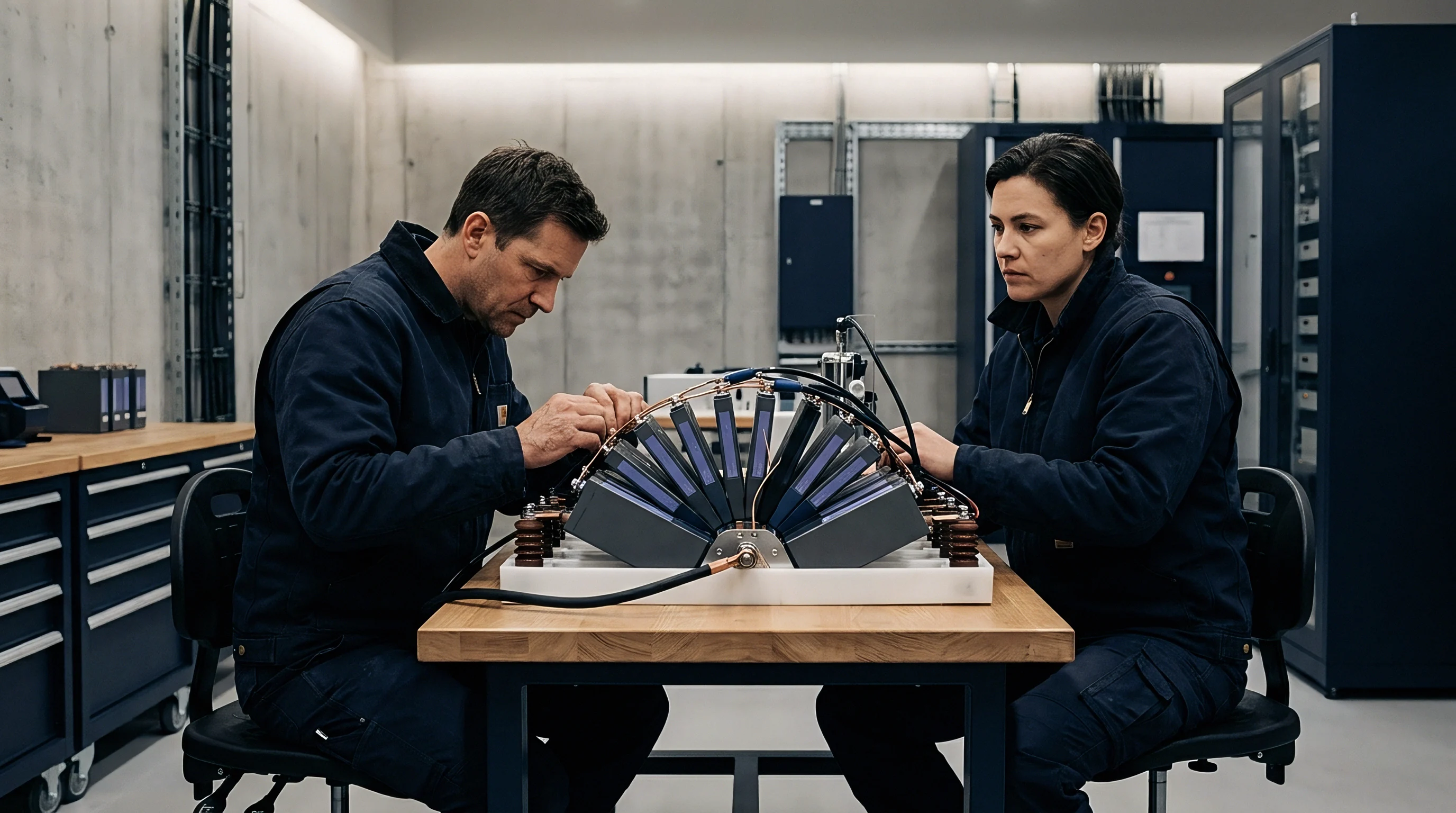
Sensor selection dictates whether operando instrumentation records actual cell mechanics or environmental noise. Piezoresistive bridges, miniature quartz washers, linear variable differential transformers, and capacitive displacement sensors respond differently to parasitic thermal swings. Normal chamber cycling and rapid internal pack transients can generate measurement artifacts larger than the physical degradation signals under study.
Can Mechanical Displacement Isolate Phase Transitions?
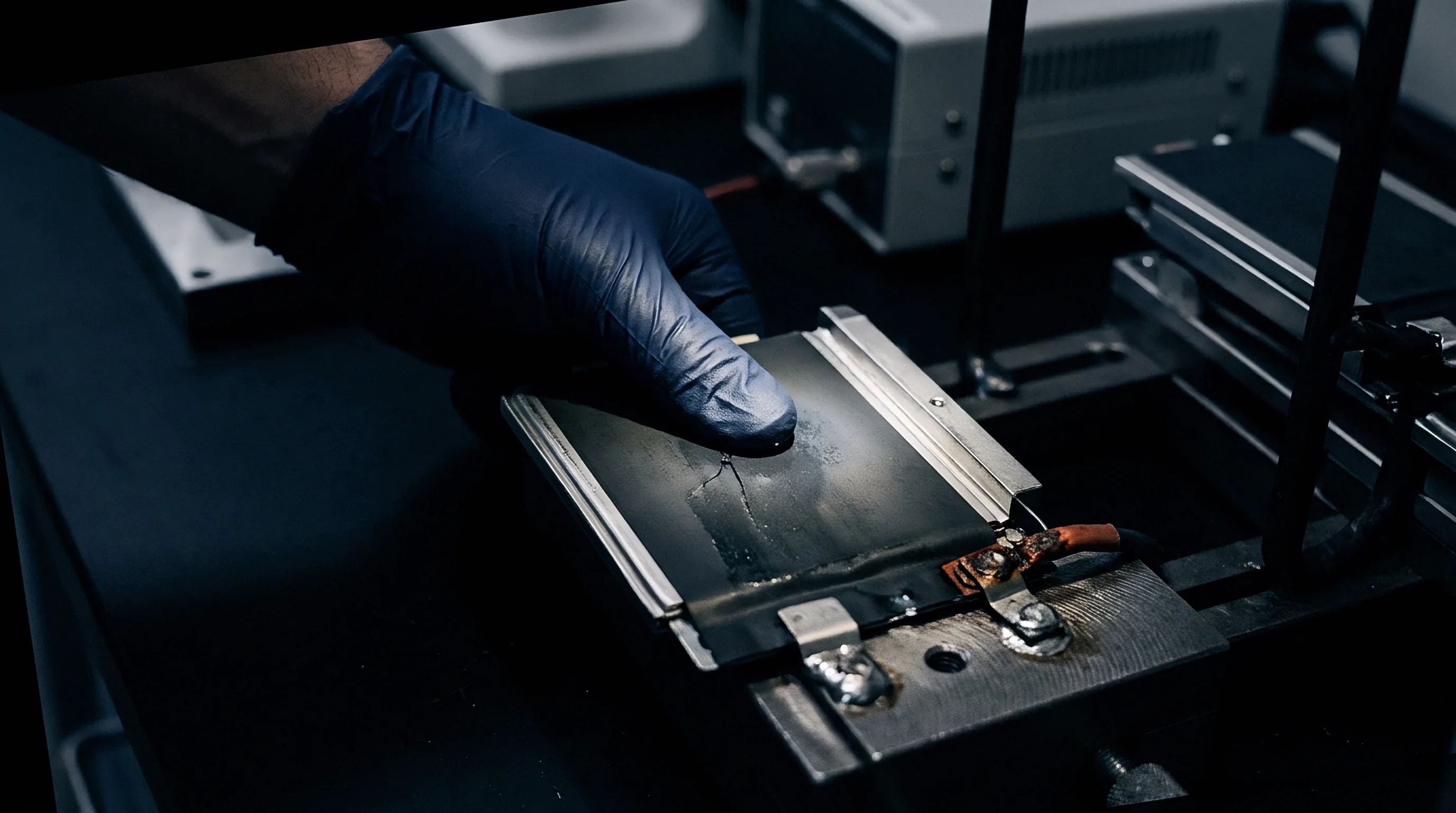
High-resolution displacement sensors on module endplates can detect microscopic plateau features tied to crystallographic phase changes in the active materials. The hexagonal-to-monoclinic transition in NMC811, for instance, produces distinct slope inflections in load curves between forty and sixty percent state of charge. If internal temperatures shift during high-current pulses, however, bulk thermal expansion smooths out these differential peaks and hides the early mechanical markers of phase fatigue.
| Sensor Topology | Thermal Drift Coefficient | Measurement Bandwidth | Cross-Plane Sensitivity | Long-Term Zero Shift |
|---|---|---|---|---|
| Piezoresistive Bridge | 0.08 percent span per Kelvin | 2000 Hertz | 0.05 Megapascal | 1.2 percent per 1000 hours |
| Quartz Piezoelectric Washer | 0.02 percent span per Kelvin | 10000 Hertz | 0.01 Megapascal | 0.3 percent per 1000 hours |
| Capacitive Proximity Probe | 0.01 percent span per Kelvin | 500 Hertz | 0.002 Millimeter | 0.1 percent per 1000 hours |
| Fiber Bragg Grating Array | 0.005 percent span per Kelvin | 100 Hertz | 0.001 Millimeter | 0.05 percent per 1000 hours |
Fiber Bragg grating sensors decouple mechanical strain from thermal effects by reading shifted reflection wavelengths across several discrete points on a single fiber core. Embedding alternating strain-isolated and strain-coupled nodes inside module foam pads allows real-time thermal drift correction. Standard foil strain gauges drift under dynamic thermal gradients unless compensated by identical dummy gauges on zero-expansion invar reference blocks.
Endplate stiffness shapes the raw data just as much as sensor drift. Aluminum pack structures bow under load, taking up a portion of the cell stack expansion. Measuring endplate travel without compensating for that frame elasticity leads engineers to underestimate internal cell pressure by fifteen to thirty percent.
Stiff qualification fixtures use cast iron or tool steel containment blocks to suppress rig deflection.
Test bench compliance drifts when thermal chambers heat or chill the clamping bolts, altering preload through differential thermal expansion between steel tie rods and aluminum spacers.
Standard IEC 62619 abuse testing conditions leave operando mechanical strain unmonitored during thermal propagation events.
Discussions surrounding force growth during rapid cycling must separate reversible cell breathing from progressive internal structural breakdown.
Relaxation
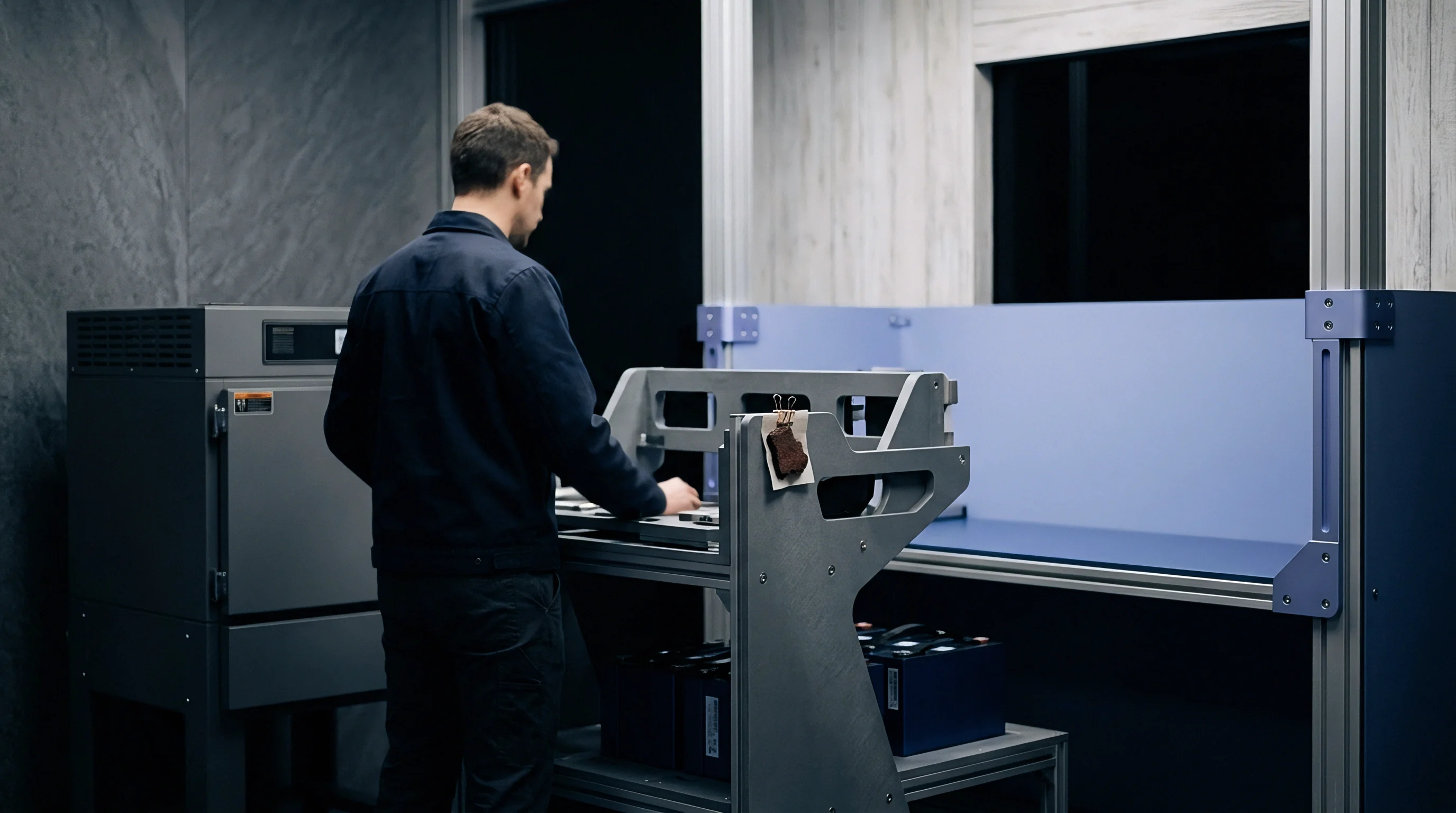
Under continuous compressive load, electrode assemblies undergo time-dependent yield regardless of state of charge. This mechanical creep combines polymer separator thinning, binder yield, and structural realignment in the composite active layers. Polypropylene and polyethylene microporous separators compress permanently over hundreds of operating hours, altering internal electrolyte wetting across the jelly roll.
Irreversible thickness growth runs parallel to reversible cyclic breathing. Active material particles microcrack under localized contact stresses, exposing fresh surface area to the liquid electrolyte. Continuous solid electrolyte interphase formation on these exposed facets consumes cyclable lithium and causes unrecoverable pack swelling.
Separating this cumulative mechanical damage from reversible thermal and intercalation swelling is necessary if lifetime models are to generate valid warranty projections.
Test protocols tracking mechanical degradation must distinguish multiple overlapping phenomena:
- Reversible crystallographic breathing occurs proportionally to lithium concentration gradients within active host lattices during normal charge and discharge cycles.
- Thermo-mechanical bulk expansion scales directly with module temperature increases generated by internal Joule heating and ambient thermal variations.
- Viscoelastic separator thinning proceeds under sustained mechanical preload, reducing inter-electrode spacing and increasing cell face compliance over operational life.
- Plastic particle rearrangement creates permanent structural shifts within electrode coating pores as silicon particles undergo cyclic volume swings.
- Interfacial parasitic layer accumulation drives linear and square-root-of-time irreversible module expansion through continuous electrolyte consumption and gassing.
Thermal cycling speeds up viscoelastic relaxation in polymer pack hardware. Silicone and polyurethane foam pads seated between cells lose their spring recovery over thousands of operational hours. As the foam takes a permanent compression set, initial module preload drops off.
That loss of clamping force allows localized electrode delamination on subsequent discharge cycles, accelerating capacity loss and concentrating current unevenly across the active faces.
The degree to which prolonged mechanical creep alters separator tortuosity during aggressive fast-charging regimes remains unsettled across high-nickel formats.
Model
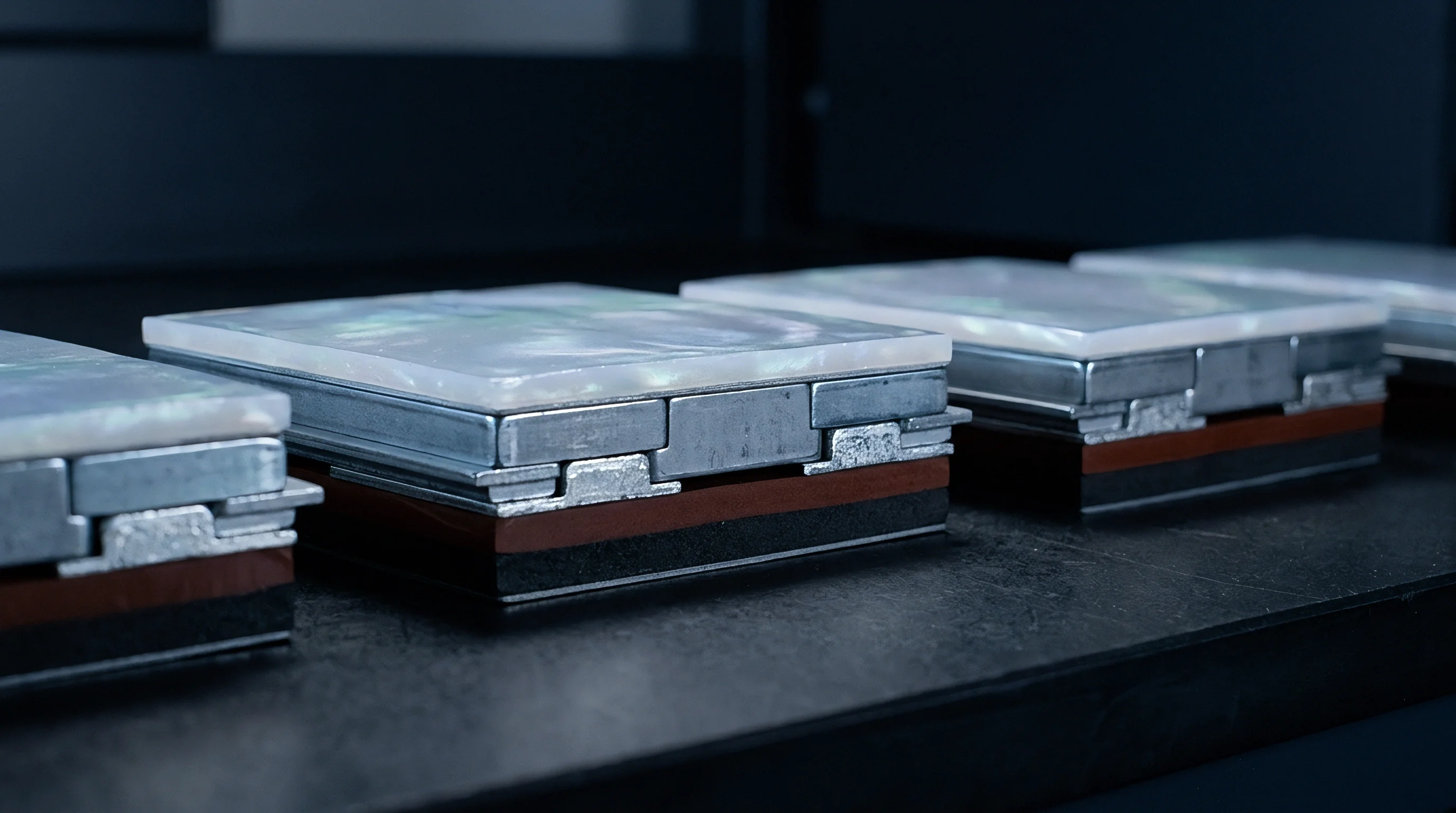
Separating through-plane temperature fields from true electrochemical strain requires multi-parameter estimators built on detailed physical models. Thermal resistance networks across the cell stack estimate internal core temperatures using surface thermistors and real-time current data. These calculated fields feed thermal correction routines that strip out volumetric expansion terms from the raw module force data.
Whose Model Resolves Thermal Expansion Overlaps?
Coupled electrochemical-mechanical-thermal solvers capture cell behavior by tying Newman porous electrode theory to structural finite element formulations. The model calculates lithium concentration gradients through the positive and negative electrode thicknesses, yielding theoretical lattice strain vectors. Concurrently, thermal routines estimate heat generation from charge-transfer overpotentials and entropic heat coefficients.
| Component Layer | Thermal Expansion Coefficient (ppm/K) | Cross-Plane Thermal Conductivity (W/m·K) | Youngs Modulus (GPa) | Lithiation Volumetric Strain (percent) |
|---|---|---|---|---|
| NMC811 Cathode | 14.2 | 1.4 | 135.0 | -2.1 (delithiation) |
| Silicon-Graphite Anode | 22.5 | 0.9 | 12.5 | +8.5 (lithiation) |
| Polypropylene Separator | 110.0 | 0.2 | 0.8 | 0.0 |
| Liquid Electrolyte Phase | 650.0 | 0.15 | N/A | +1.8 (thermal dilation) |
| Aluminum Current Collector | 23.1 | 237.0 | 70.0 | 0.0 |
| Copper Current Collector | 16.5 | 401.0 | 110.0 | 0.0 |
Correcting operando force traces requires isolating the thermal force term from the raw transducer reading. That thermal component is calculated from the effective module stiffness, cumulative thermal expansion coefficient, and average cross-plane temperature rise. The remaining signal tracks pure electrochemical intercalation and permanent mechanical creep.
High-current pulses leave thermal relaxation tails that linger for thirty to forty minutes after current stops, requiring baseline correction before force changes are attributed to electrode phase transitions.
State of charge estimation models that use force telemetry achieve error margins below one percent once thermal components are properly isolated. Force data flags the onset of lithium plating earlier than terminal voltage readings can. When metallic lithium plates onto graphite surfaces instead of intercalating, the mechanical growth curve diverges sharply from theoretical intercalation slopes.
Decoupling thermal noise prevents false plating alarms triggered by pack heating during hard acceleration.
Module compliance models that ignore cross-plane thermal gradients miscalculate internal cell face pressure by up to thirty-five percent under two-C fast charging.
Incoming quality control relies on force response curves gathered during standardized reference cycles to verify mechanical consistency. Cell lots with anomalous hysteresis loops often carry manufacturing defects, such as uneven slurry coatings or binder migration. Logging these decoupled mechanical metrics during receiving inspection establishes quality baseline records before cells are packaged into production battery enclosures.
Test engineers apply Kalman filters across current, voltage, surface temperature, and load cell channels to isolate mechanical drift in real time on long-term cycling stands.

Covenant
Cell supply contracts routinely overlook mechanical force growth over warranty life. Procurement agreements typically lock down capacity retention and internal resistance metrics while neglecting swell limits that can buckle pack structures. Once cells expand past the mechanical allowances of an enclosure, internal pressures pinch separators, trigger lithium plating, and invalidate pack homologation filings.
Transport safety regulations for lithium-ion packs tie directly to structural stability. UN 38.3 protocols subject modules to thermal shock, cyclic vibration, and low-pressure altitude profiles. Cells weakened by uncontrolled internal swelling fail subsequent shock and vibration sequences through internal shorting.
A warranty dispute over pack degradation fails in arbitration when technical dossiers lack decoupled thermal and mechanical baseline data.
Procurement contracts for high-energy automotive cells manage commercial and warranty risk by defining explicit mechanical boundaries:
- Standardized mechanical preload specifications defining initial assembly torque, endplate stiffness requirements, and permissible compression pad elasticity over operational temperature ranges.
- Decoupled force growth limits restricting irreversible cell thickness increases to less than five percent over one thousand equivalent full cycles under defined thermal boundaries.
- Operando testing data deliverables obligating suppliers to provide synchronized voltage, current, temperature, and dilatometry logs for all design verification test lots.
- Incoming lot mechanical screening criteria establishing non-destructive force hysteresis acceptance bands for cell batch qualification prior to pack integration.
- Warranty liability allocation terms assigning cost responsibility for pack structural redesign if cell expansion forces exceed agreed envelope limits during warranty periods.
Stipulating clear mechanical swell limits within purchase contracts prevents disputes over whether field failures are caused by severe thermal duty cycles or defective cell lots.
Section 8.4 of typical high-voltage module master supply agreements establishes that cell expansion forces exceeding three megapascals under standard operating conditions trigger full lot rejection and shift remediation costs entirely to the cell manufacturer.