Graphite Anode Polarization Limits during Low Temperature Lithium Intercalation
Low temperature charging shifts graphite potential below zero volts against lithium, initiating destructive metallic plating when polarization exceeds kinetic intercalation limits.


Threshold
Lithium intercalation into synthetic or natural graphite occurs within a narrow potential window near the equilibrium potential of metallic lithium. Under standard ambient conditions of twenty-five degrees Celsius, the thermodynamic plateau for the formation of fully lithiated graphite sits between two hundred millivolts and eighty millivolts positive of metallic lithium potential. As ambient operational temperatures drop toward sub-zero regimes, kinetic barriers within the cell escalate dramatically.
Total anode polarization reflects three distinct overpotential contributions: ohmic drop across the electrolyte and solid matrix, charge transfer resistance at the solid electrolyte interphase, and solid-state diffusion gradients within the graphite particles.
Under these conditions, the working potential of the anode drops rapidly.
Charge transfer overpotential scales exponentially with decreasing temperature according to Arrhenius kinetics. When high current densities pass through the cell at low temperatures, the sum of these overpotentials shifts the operational potential of the graphite anode below zero volts relative to the lithium reference electrode. Once local graphite potential drops below zero volts, the thermodynamic driving force flips, favoring the electrodeposition of metallic lithium over intercalation into the graphite host structure.
At minus twenty degrees Celsius, charge transfer overpotential accounts for sixty-five percent of total anode polarization under zero-point-five C charging rates.
The transition from intercalation to surface plating depends heavily on the charge rate and the local state of charge in the graphite active material. As graphite fills with lithium, its equilibrium potential drops closer to zero volts, narrowing the allowable overpotential margin. Because lower temperatures impair mass transport and overpotential increases with current density, a cell capable of accepting a two C charge rate at room temperature polarizes rapidly at minus ten degrees Celsius, triggering lithium plating even under modest currents.
| Temperature (°C) | Ohmic Overpotential (mV) | Charge Transfer Overpotential (mV) | Diffusion Overpotential (mV) | Anode Potential vs Li/Li⁺ (mV) |
|---|---|---|---|---|
| 25 | 12 | 25 | 18 | +65 |
| 0 | 35 | 85 | 45 | -15 |
| -10 | 68 | 162 | 98 | -178 |
| -20 | 145 | 340 | 210 | -545 |
Quantifying these limits requires distinguishing transient polarization spikes from steady-state concentration gradients. Peak overpotentials occur during the initial stage of constant-current charging, caused by high charge-transfer impedance before internal resistive heating slightly warms the cell. Exactly how local current density hot spots at particle edges contribute to localized potential drops below zero volts remains uncertain.


Pore
Electrolyte mass transport through the electrode matrix becomes the primary bottleneck when ambient temperatures drop below freezing. Liquid electrolyte viscosity increases exponentially as temperature falls, while ionic conductivity drops by more than an order of magnitude between twenty degrees Celsius and minus thirty degrees Celsius. Solvated lithium ions migrating through tortuous micro-channels face increased hydraulic resistance, creating sharp concentration gradients between the bulk electrolyte and the interior of the porous electrode layer.
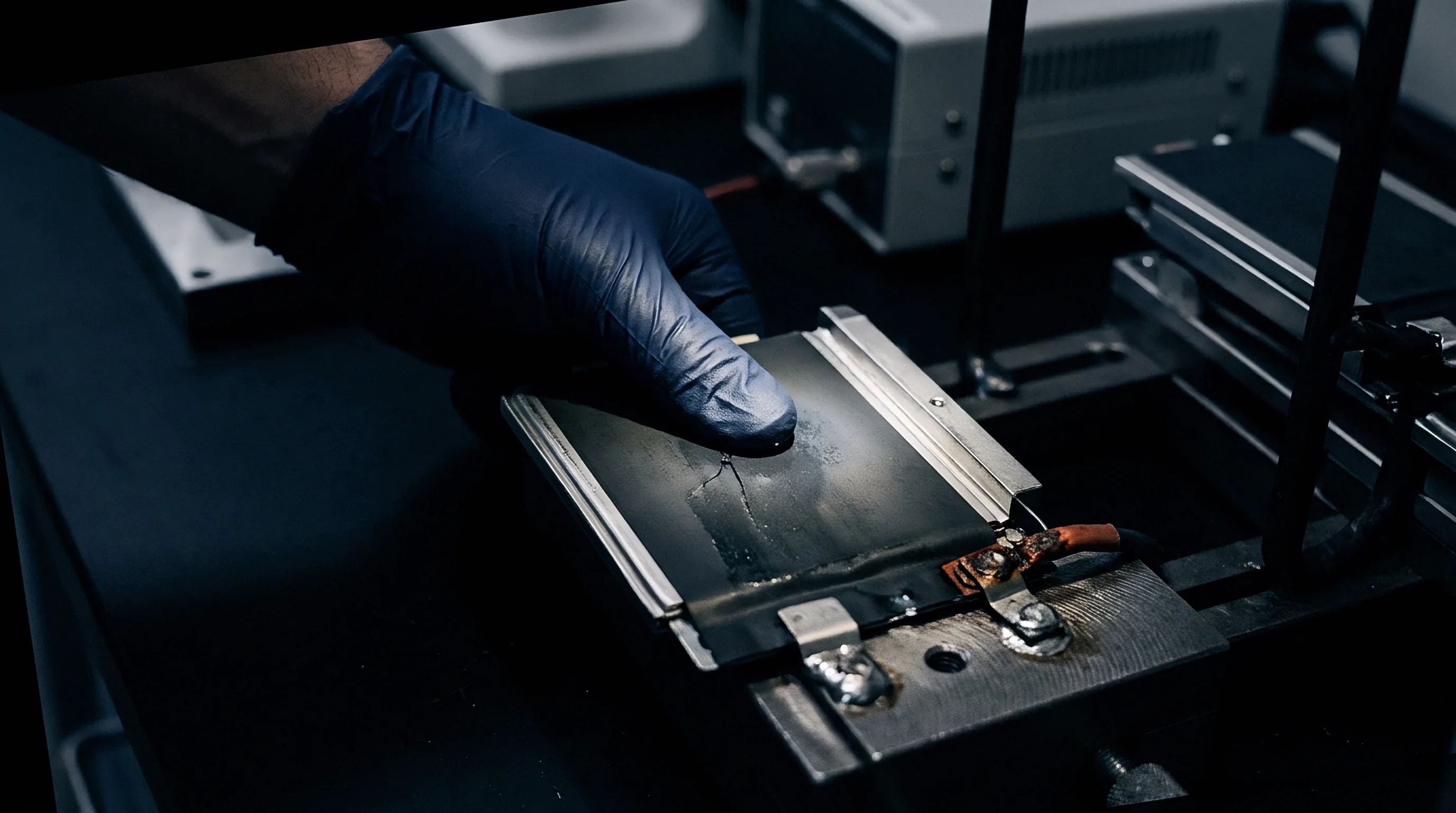
Electrolyte Salt Depletion in Electrode Microstructures
During cold charging, the rate of lithium-ion consumption at active particle surfaces exceeds the migration rate of fresh ions from the separator zone. Salt depletion occurs within the internal pore structure of high-density graphite anodes. Local electrolyte conductivity falls precipitously when salt concentration approaches zero, further escalating the local ohmic drop.
This localized polarization forces the front face of the graphite anode, nearest the separator, to bear a disproportionate share of the applied current, driving its potential far below zero volts while deep interior graphite remains under-utilized.
As viscosity spikes in sub-zero cold, diffusion constraints come to dominate total charge acceptance.
- Desolvation Energy Barrier High activation energy required to strip the solvation sheath off lithium ions before entering the graphite lattice creates severe charge-transfer overpotential at low ambient temperatures.
- Tortuosity Resistance Complex geometric pathways in highly calendered graphite electrodes severely attenuate the effective liquid-phase diffusion coefficient of solvated ions.
- Salt Precipitation Risk Elevated salt concentrations designed for high-temperature stability risk localized precipitation at sub-zero limits, clogging accessible micro-porosity.
- Solid Electrolyte Interphase Degradation Cracking of low-temperature interphase layers under non-uniform current distributions consumes active lithium and exposes fresh graphite surfaces to continuous side reactions.
Thicker electrodes increase the diffusion distance for solvated lithium ions, causing severe concentration gradients across the composite layer during sub-zero operation.
Managing liquid-phase transport requires balancing active material coating density against electrode porosity. Increasing the volume fraction of open micro-channels reduces tortuosity, facilitating faster salt redistribution during continuous low-temperature charge steps. Maintaining low electrode tortuosity and high electrolyte salt concentration serves as an absolute prerequisite for sub-zero charge acceptance.


Deposition
Nucleation of metallic lithium on the outer surface of synthetic graphite particles occurs when local equilibrium potential drops below zero volts against metallic reference standards. Once nucleation commences, metallic lithium formation competes directly with intercalation kinetics. Lithium electrodeposition exhibits significantly lower kinetic activation energy than lithium desolvation and intercalation into the graphite lattice at low temperatures, causing metallic dendrites and mossy structures to grow preferentially once plating initiates.

How Does Voltage Relaxation Reveal Lithium Plating?
Differentiating between pure electrochemical intercalation and simultaneous metallic deposition relies on non-destructive relaxation diagnostics. Upon interrupting a cold charging process, the open-circuit voltage of a cell containing plated metallic lithium displays a distinct voltage plateau. This plateau corresponds to the thermodynamic stripping and re-intercalation of metallic surface lithium back into the graphite host, driven by the chemical potential gradient between the surface metal and the partially lithiated graphite sub-layer.
Plating risk surges below zero degrees Celsius, where high overpotential directly drives lithium nucleation.
Consider a fifty ampere-hour pouch cell featuring a synthetic graphite anode with a areal capacity of three-point-five milliampere-hours per square centimeter. Under a constant current charge rate of zero-point-five C at minus ten degrees Celsius, three-electrode diagnostic measurements reveal that the anode potential falls to minus fifty millivolts relative to a reference standard within ninety seconds of current initiation. Assuming thirty percent of the total passed charge contributes to metallic deposition under these conditions, fifteen ampere-hours of current converts to active surface plating over a full charge cycle.
Upon entering a rest phase, the mixed potential plateau persists for forty-two minutes, during which approximately twelve-point-six ampere-hours re-intercalate slowly into the host lattice. The remaining two-point-four ampere-hours undergo chemical reactions with the organic electrolyte, forming irreversible dead lithium and thick secondary solid electrolyte interphase layers.
Solid-state diffusion within the graphite particles remains extremely slow under these conditions.
- Anode Potential Monitoring Real-time measurement using integrated three-electrode cells ensures charging currents adjust dynamically to keep anode potential positive relative to reference standards.
- Multi-Step Current Profiles Progressive reduction of charge current as cell state-of-charge increases prevents severe polarization driven by rising internal intercalation resistance.
- Intermittent Pulse Conditioning Short high-current pulses interspersed with rest periods equalize electrolyte pore concentration profiles and prevent critical salt depletion.
- Temperature-Compensated Cutoff Voltages Adjusting upper pack charging voltage limits prevents forced polarizations near the end-of-charge cycle during low-temperature operation.
Voltage relaxation curves recorded during rest periods directly indicate the presence of metallic lithium re-intercalating into the graphite host structure.
| Method | Measurement Type | Detection Sensitivity | Implementation Complexity |
|---|---|---|---|
| Three-Electrode Potentiometry | Direct Anode Potential | High (< 1 mV) | Laboratory / Qualification Only |
| Voltage Relaxation Differential Analysis | Post-Charge OCV Decay | Moderate (> 2% Plated Li) | In-Situ BMS Firmware |
| Acoustic Emission Spectroscopy | Mechanical Wave Echo | Moderate (Density Shift) | Pack-Level Sensor Array |
| Differential Capacity (dQ/dV) | Derivative Voltage Profiles | High (Stripping Peak) | End-of-Line / Bench Testing |
Selecting aggressive fast-charging protocols at sub-zero temperatures leads directly to active material loss, internal micro-short circuit risks, and rapid cell failure.
Screening
Laboratory evaluation of cold charge acceptance requires precise environmental controls and three-electrode cell architecture to isolate anode polarization from cathode effects. Standard two-electrode terminal voltage measurements obscure individual electrode contributions, masking critical anode potential drops under cathode polarization changes. Validating cell operating limits involves mapping the exact current-temperature-voltage boundaries where metallic lithium deposition begins.
Reference electrodes are necessary to resolve the true working potential of the anode.
- Thermally equilibrate the target cell in an environmental chamber at the specified test temperature for a minimum of six hours.
- Record baseline electrochemical impedance spectra across a frequency range from ten kilohertz to ten millihertz to quantify initial charge transfer and electrolyte resistance.
- Apply a constant-current charge step while monitoring the reference electrode potential to determine the precise time required for anode potential to cross zero millivolts.
- Terminate charging immediately upon reaching eighty percent state of charge or when anode potential reaches a safe minimum cutoff threshold.
- Switch the cell to open-circuit rest conditions and monitor differential voltage decay for ninety minutes to detect characteristic stripping plateaus.
- Perform differential capacity analysis on subsequent discharge steps to quantify reversible capacity loss versus irreversible plating fractions.
Promoting internal cell heating helps limit the accumulation of metallic lithium on the anode.
Observed capacity fade at low temperatures is often attributed entirely to reversible kinetic impedance rather than irreversible metallic lithium accumulation.
Tariff
Operating battery systems under sub-zero conditions introduces severe commercial choices between cell lifetime degradation and thermal management capital expenditure. Integrating resistive heating elements or direct immersion thermal management systems increases initial pack manufacturing costs and parasitic energy draw. Allowing unconditioned cold charging avoids thermal hardware costs but accelerates capacity fade, triggering early warranty replacement claims and severe field service liabilities.
Active thermal management protects cycle life, while battery management systems enforce temperature cutoffs. Uncontrolled cold charging voids warranty coverage, and sub-zero fast charging rapidly destroys cell capacity.
| Regime | Hardware Capital Cost Shift | Parasitic Energy Overhead | Retained Capacity at 3,000 Cycles | Total Landed Energy Cost per kWh |
|---|---|---|---|---|
| Unheated Cold Charging (0.5C at -10°C) | Baseline ($0) | 0% | 42% | $0.38 |
| Pre-Heating Blanket Integration | +$18 per kWh | 8.5% | 81% | $0.22 |
| Active Immersion Liquid Heating | +$42 per kWh | 4.2% | 87% | $0.19 |
| Pulse-Current Internal Self-Heating | +$8 per kWh | 3.1% | 84% | $0.17 |
Standard warranty provisions void cell performance guarantees if charging occurs below zero degrees Celsius without continuous thermal conditioning.
Calculating the true landed cost per delivered kilowatt-hour over total system service life dictates that thermal management hardware pays for itself within eighteen months of sub-zero operation. Standard supply agreement clause twelve point four explicitly cancels capacity retention warranties if battery management logs show charging events below zero degrees Celsius with anode potential below five millivolts.