Meaning
Thermal property quantifying the opposition to heat flow across the boundary between two contacting solid surfaces in a cooling system. Minimizing the interface thermal resistance is essential for ensuring that heat generated by cells during rapid charging reaches the cooling plate efficiently. This evaluation excludes the internal bulk resistance of the materials themselves.
Contact Mechanics
Microscopic surface roughness creates air gaps that block heat conduction at the boundary of the mating parts. Lowering the interface thermal resistance requires applying a specific clamping pressure to compress the thermal interface material into these microscopic voids. Mechanical engineers calculate the optimal assembly torque to maximize surface contact.
Material Selection
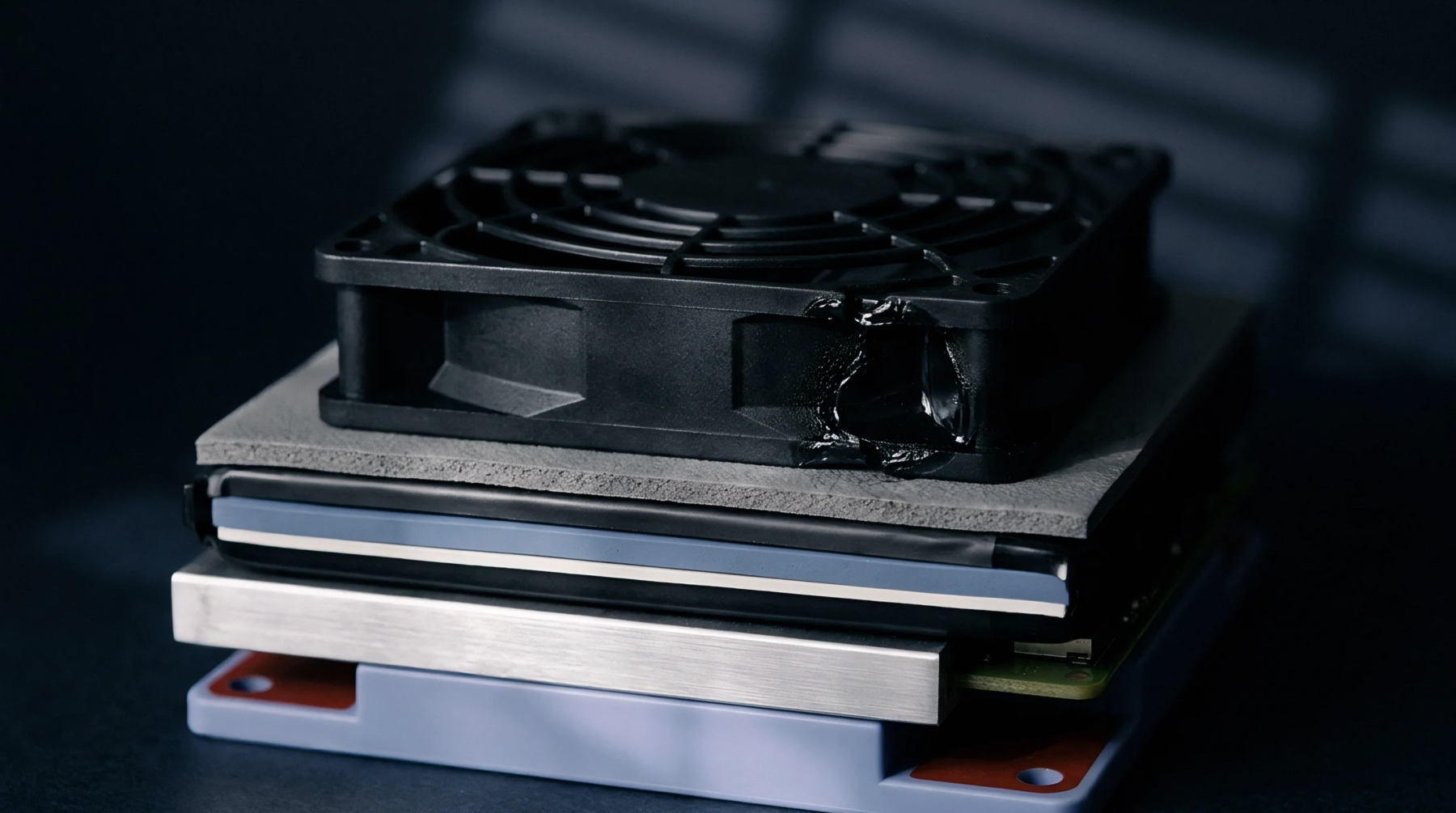
High-performance greases, pads, or gap fillers are applied between the cell and the heatsink to displace air. The chosen material directly controls the interface thermal resistance by providing a highly conductive pathway. Choosing a softer pad can decrease this value by conforming better to irregular surfaces, although it may have lower bulk conductivity than a rigid sheet.
This trade-off requires careful calculation of both surface contact and material thickness.
Performance Metric
Analytical modeling teams use this parameter to predict the maximum temperature of the battery pack under peak load. A high interface thermal resistance leads to localized hot spots that can trigger thermal runaway if left unchecked. Testing verifies that the selected cooling configuration keeps the pack below its maximum operating temperature.