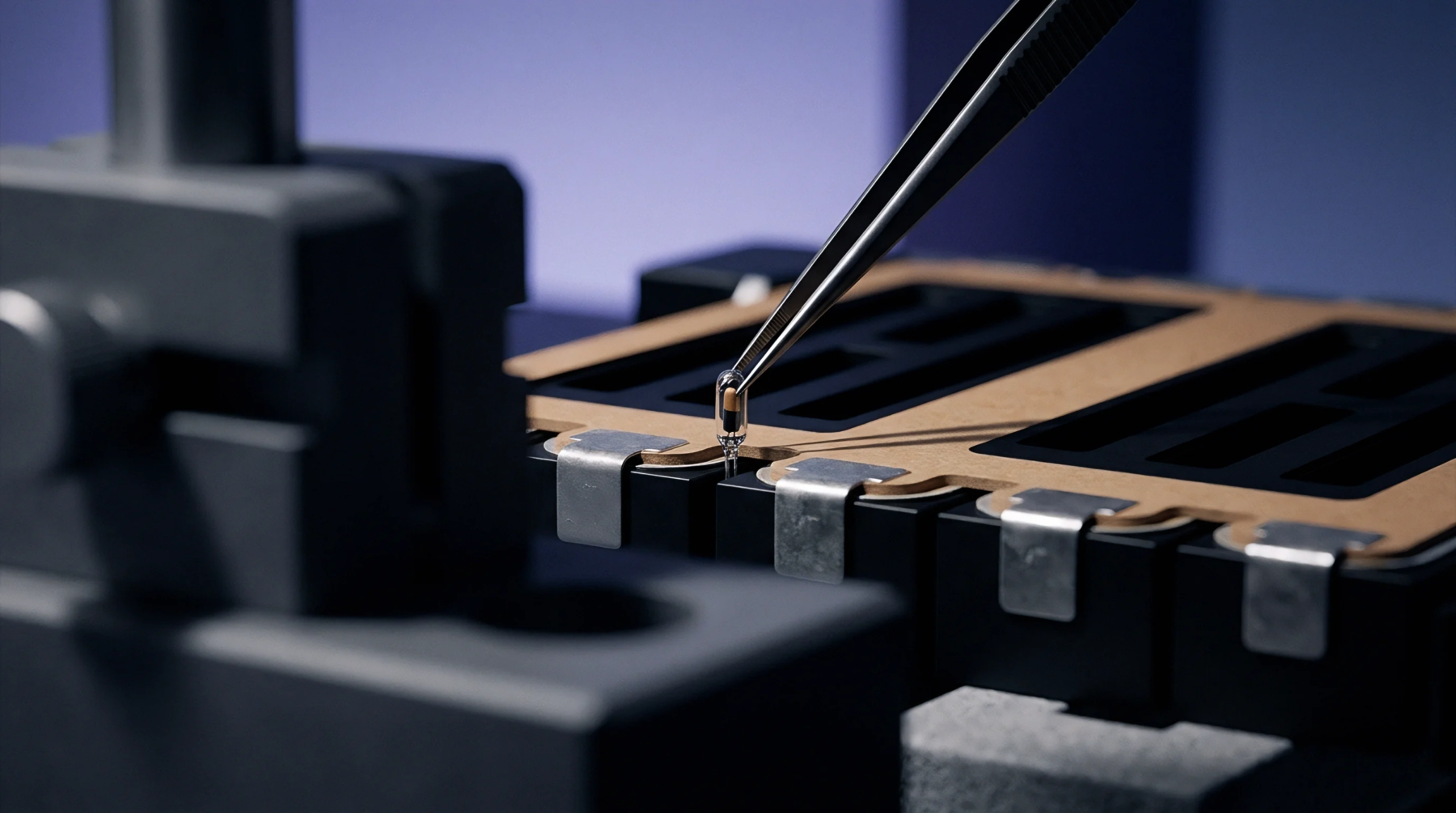
Capacity Grading Tolerances inside a Tier One Factory
Capacity grading accuracy depends on controlling thermal soaking windows, pneumatic pin resistance, and strict four-wire Kelvin probe calibration on the line.
Spatial arrangement and design of four independent electrical contacts used to perform precise resistance measurements on battery terminals or electrochemical components. Kelvin probe geometry refers to the configuration where current and sense points are held in close proximity but kept electrically distinct until they touch the target surface. This specific physical layout minimizes the voltage drop at the contact point and eliminates errors from probe lead resistance during fast cell testing.
By integrating these four points into a single mechanical housing, manufacturers achieve high repeatable precision in automated production lines. The probe head typically features spring loaded pins that provide constant pressure to maintain stable electrical contact regardless of surface irregularities. This design is foundational for accurate impedance spectroscopy in lithium ion cell research.
Design choices for these contact heads vary based on whether the cell format is cylindrical, prismatic or a thin flexible pouch. Modern Kelvin probe geometry uses a coaxial arrangement where the voltage sense pin sits inside the larger current delivery tube for optimal signal clarity. If the probes are spaced too far apart, the measurement might include unwanted lateral resistance from the terminal material itself.
Strategic placement ensures that current spreads evenly through the collector plates to provide a representative figure for the whole cell internal resistance. Hardened materials such as tungsten or gold plating prevent probe tip wear from causing fluctuations in measured impedance values. Automated testers adjust the approach speed of these heads to prevent mechanical damage to soft aluminum or copper tabs.
Consistent contact pressure is verified by load sensors integrated into the testing armature.
Maintaining the exact distance between the sense pins allows for precise comparison of data across millions of individual production units. Effective Kelvin probe geometry prevents the measurement artifacts that occur when simple two point probes shift slightly during high volume grading sequences. Errors caused by oxidation or thin electrolyte films on terminal surfaces are overcome by the dedicated voltage sense pathway.
Engineers rely on this stability to identify cells with poor welding between the internal electrode stack and the external cap. Differences in alignment that exceed specified tolerances can trigger false rejections of high quality inventory during the binning process. Regular cleaning of the probe tips is mandatory to ensure that debris does not create parallel conductive paths between current and sense leads.
Precise geometry supports the detection of micro milliohm differences between batches of energy storage devices.
Precision in measurements depends on how well the contact head conforms to the unique shape of the cell current collector. Variations in Kelvin probe geometry help technicians adapt their test equipment for the differing needs of high voltage power cells and large format storage units. The specific geometry stops being effective if the contact area becomes too small to carry the required excitation current without overheating the terminal.
Buyers examine the probe designs used in supplier factories to ensure test data validity matches their own secondary verification measurements. Successful electrical coupling at the interface allows for the capture of clean data even in noisy industrial environments. Advanced setups use multi probe arrays to gather impedance data from different quadrants of large busbars simultaneously.
Reliability in the physical test interface ensures that downstream quality metrics remain accurate for safety modeling.
Capacity grading accuracy depends on controlling thermal soaking windows, pneumatic pin resistance, and strict four-wire Kelvin probe calibration on the line.
Expertise is a utility, not a secret. sentiention™ publishes its working knowledge as open reference: intelligence layer covering the materials it sources, the markets it enters, and the reference that serves both.