Meaning
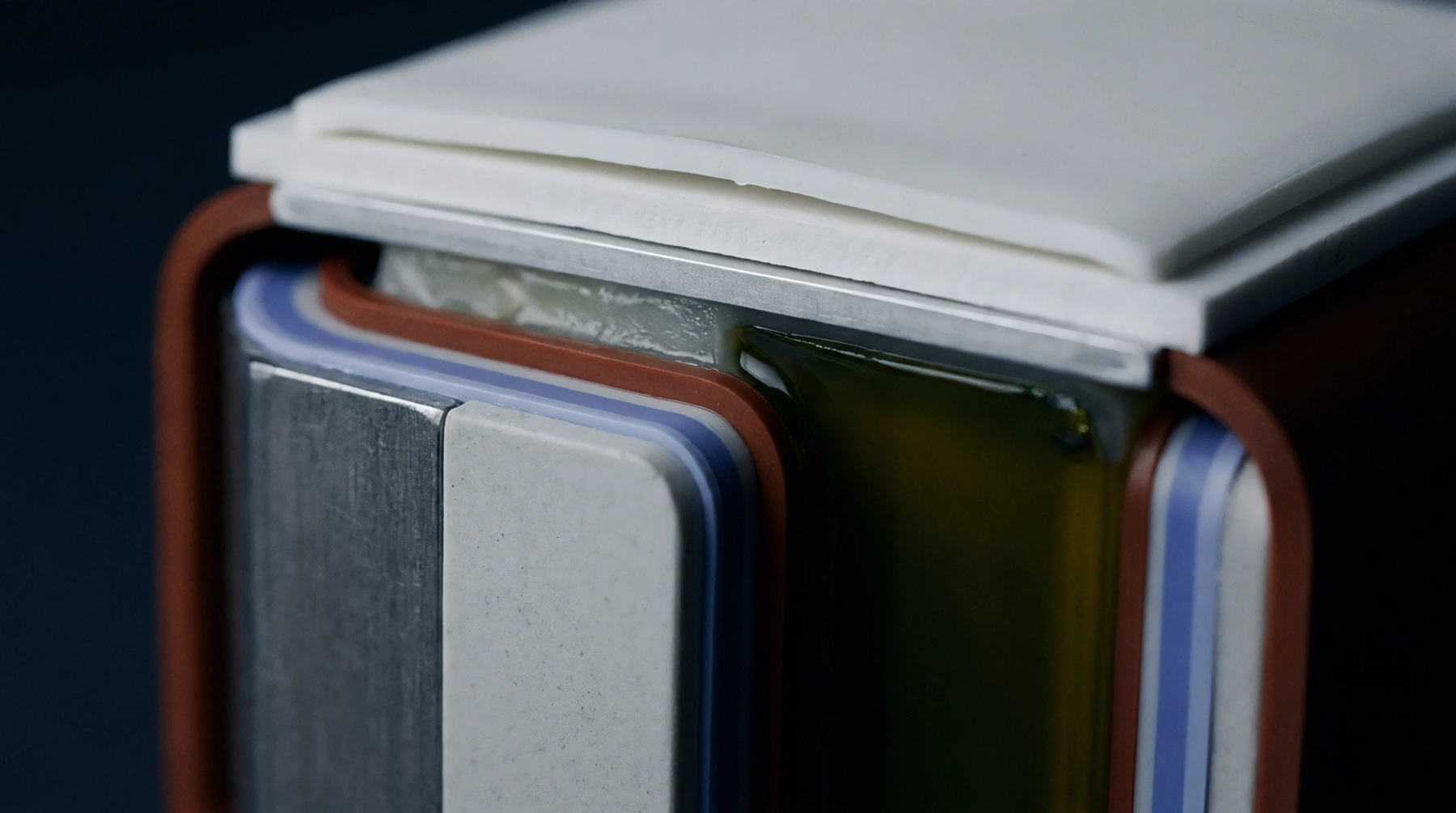
Rigid, rectangular-cased secondary electrochemical cells utilizing lithium intercalation host compounds maximize structural packaging efficiency within modular battery packs. The industrial form factor designated as prismatic lithium-ion features either wound or stacked electrode assemblies enclosed within welded aluminum or steel cans. It governs structural stability, volumetric space utilization, and thermal dissipation pathways across electric vehicle and grid-scale storage systems.
The classification stops applying to flexible polymer-laminated pouch configurations, cylindrical wound packages, or non-lithium electrochemical systems lacking equivalent planar rigid shells.
Internal Architecture
Manufacturers arrange positive and negative electrode foils either through continuous z-folding techniques or by winding flattened jelly rolls into the rectangular container. Modern prismatic lithium-ion units favor stacked layouts, which yield uniform current density profiles and eliminate mechanical stress points along tightly bent foil edges. Laser-welded top covers contain isolated positive and negative terminals, along with integrated pressure relief systems.
Thick metallic walls provide structural containment that resists internal pressure fluctuations during high-rate cycling routines.
Procurement Logistics
Tier-one automotive suppliers prefer the prismatic lithium-ion architecture because its straight planar geometry simplifies pack assembly, busbar connection, and cooling integration. Sourcing teams enforce dimensional standards, such as VDA-compliant exterior footprints, to ensure cross-supplier modularity across multi-vehicle platforms. Battery buyers require rigorous cell quality guarantees, focusing on casing seam integrity, terminal co-planarity, and consistent impedance profiles across large cell shipments.
Structural robustness reduces the need for heavy internal module framing, lowering total pack assembly costs.
Thermal Dynamics
Planar metal walls establish large flat thermal interfaces, facilitating conductive heat extraction via liquid-chilled cold plates situated beneath or alongside the cells. Uneven temperature gradients across internal wound rolls can still trigger non-uniform current distribution, accelerating degradation near the center of thick cell designs. Stacking technologies resolve these local variations, maintaining uniform temperatures across large-capacity footprints.
Prismatic structures balance mechanical durability against volumetric energy density within constrained system geometries.