Prismatic Cell Acceptance Quality Limit Metric Foundations
Prismatic cell acceptance hinges on dockside AQL sampling that isolates electrochemical variance and mechanical header tolerances before pack welding commits cost.


Dock
Incoming inspection begins the moment freight container seals break on the receiving apron. Receiving technicians verify pallet banding tension, carton condition, and humidity indicator cards before anything moves to an environmental stabilization bay. High-volume prismatic deliveries require rigorous statistical screening because physical and electrochemical anomalies immediately depress pack build yields.
Large cells ~ including 50 Ah, 105 Ah, 280 Ah, and 314 Ah formats ~ come off continuous automated lines where slight slurry inconsistencies or slitting burrs generate distinct defect clusters across a run.
Acceptance Quality Limit (AQL) standards, drawn from ISO 2859-1 and ANSI/ASQ Z1.4 sampling methodologies, set the allowable defect ceilings for incoming lots. Supply agreements establish inspection severity levels, batch thresholds, and explicit criteria for critical, major, and minor non-conformances. Critical defects create thermal hazards, severe electrical leakage, or complete functional failure.
Major defects interfere with mechanical assembly or shorten operational life past warranty limits, while minor defects are limited to superficial cosmetic blemishes that do not alter dimensions, safety, or cell performance.
Annex A of IEC 62660-1 assigns lot compliance strictly to the delivered capacity at ambient room temperature rather than the manufacturer formation room logs.
Once pallet seals are verified intact, technicians execute sampling plans under General Inspection Level II single-sampling regimes. For a production lot of 10,000 cells of 280 Ah lithium iron phosphate (LFP) units, Level II calls for sample code size L, requiring 200 cells pulled across randomly designated pallets. Technicians distribute this pull throughout the entire delivery rather than sampling solely from top tiers.
Receiving Inspection Mechanics
Selected crates move into testing bays held at 25 degrees Celsius within a tolerance of plus or minus 2 degrees. A twenty-four-hour thermal soak precedes any electrical screening, ensuring ambient temperature fluctuations do not distort baseline open circuit voltage (OCV) data. During unboxing, technicians scan DataMatrix barcodes against the factory shipment dossier to verify serial number sequences and trace matching electrode batches.
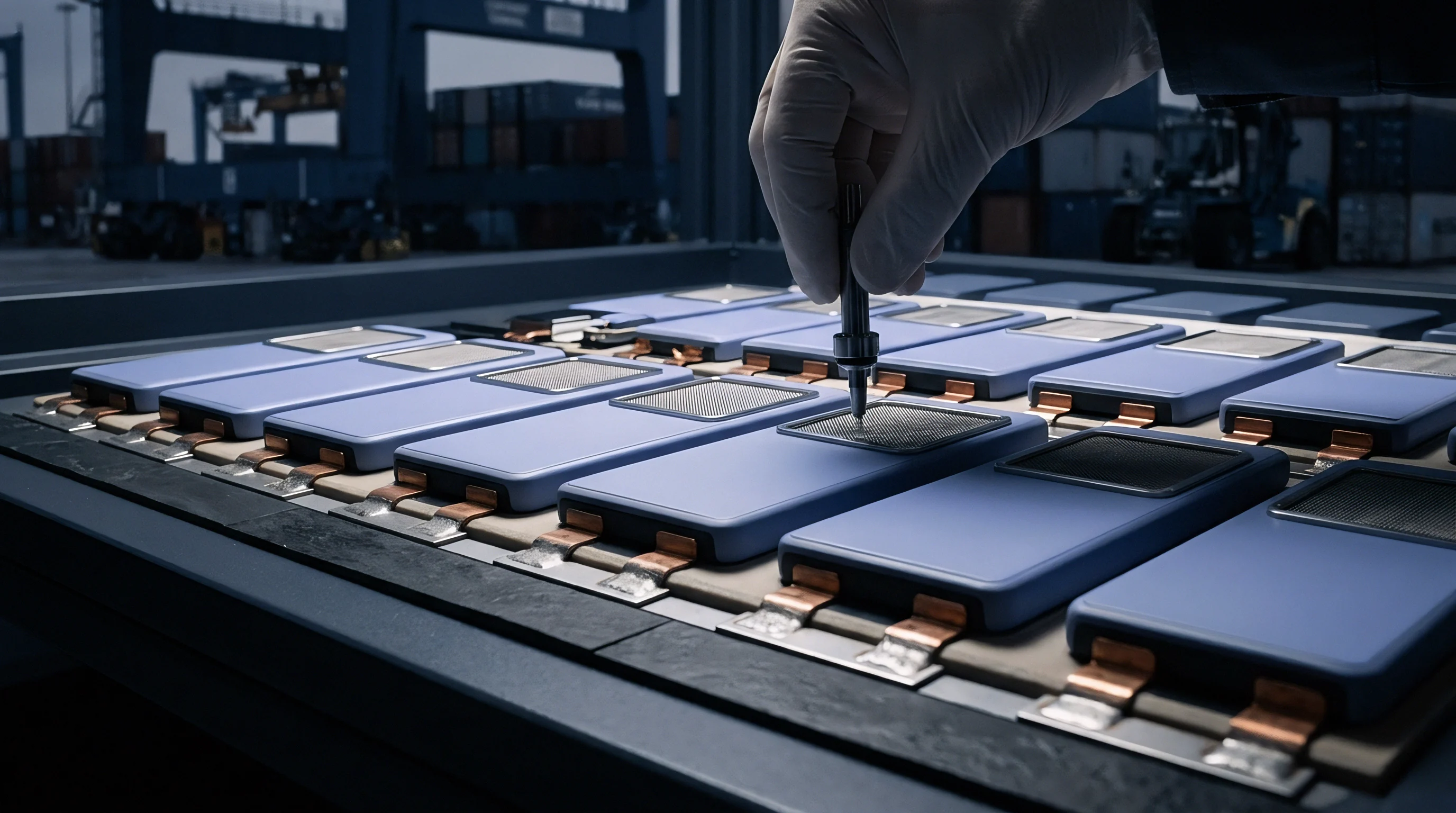
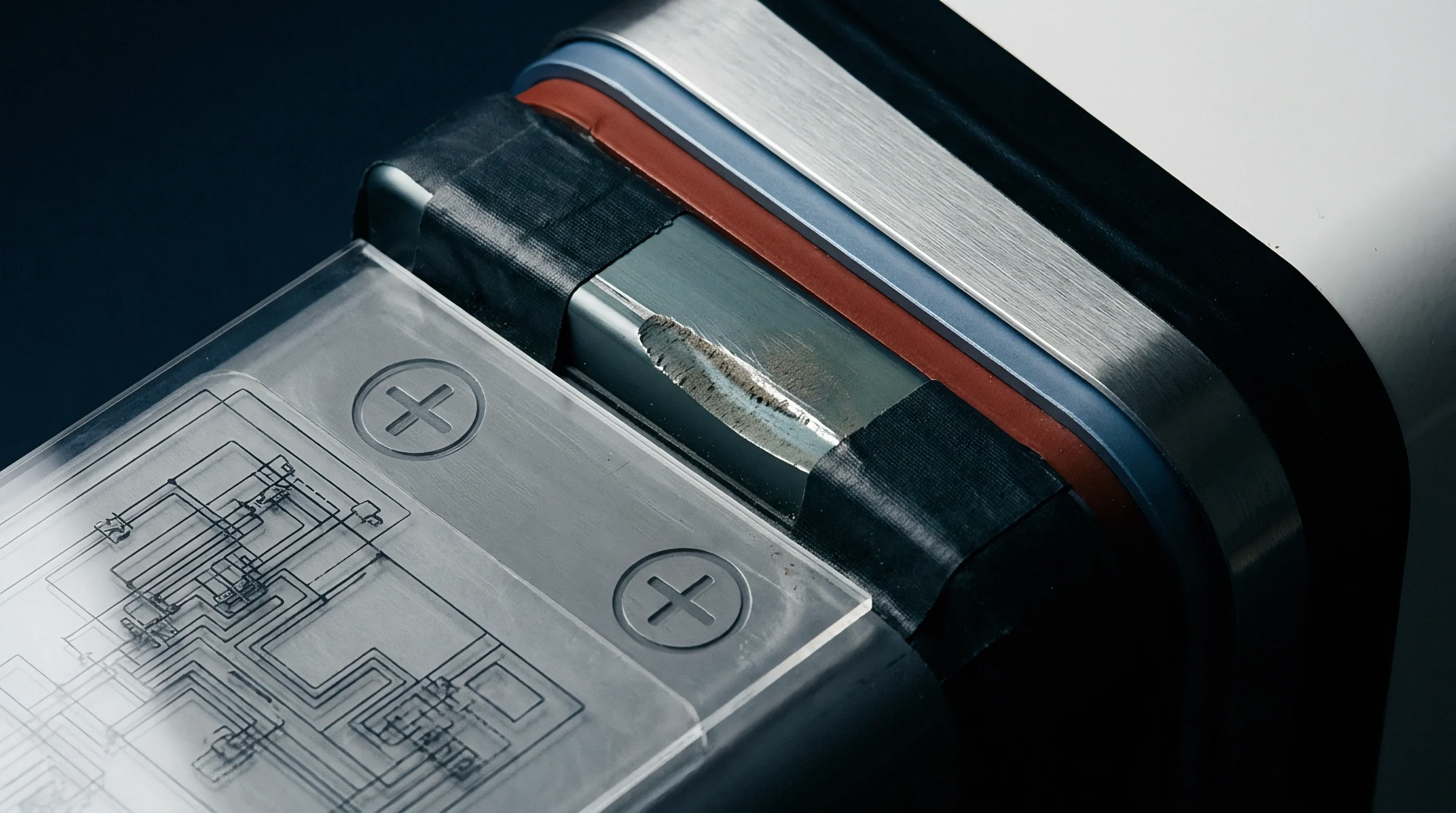
Visual inspection screens for can dents, misaligned terminal posts, scratched top headers, and electrolyte crystallization along seal rings. Ultraviolet lamps reveal organic electrolyte residue that escapes overhead warehouse lighting, while automated gauges verify stud concentricity and thread depth on laser-welded M4 or M6 internal bosses. Any cell showing visible bulging or fluid residue is routed directly into isolation drums.
Defect Categorization Thresholds
How incoming anomalies are categorized dictates lot disposition. Procurement agreements demand zero acceptance (c = 0) for safety hazards, while allowing defined tolerances for cosmetic variance.
- Critical defects include fractured explosion-proof vent score lines, insulation resistance dropping below 100 megaohms at 500 volts direct current, or open-circuit voltages falling below storage floors. A single defect in this tier rejects the entire shipment.
- Major non-conformances cover terminal height runout exceeding 0.3 millimeters, internal resistance more than 0.25 milliohms above ceiling, or capacity falling more than two percent short during incoming discharge cycles. Supply contracts typically pin this threshold to an AQL of 0.40 percent.
- Minor variances encompass scuffed blue polyethylene terephthalate (PET) wrap, blurred batch ink markings, or minor labeling discrepancies that leave geometry and traceability unaffected. Contracts generally set this gate at an AQL of 1.50 percent.
While buyers often treat plating micro-scratches on terminal faces as handling defects, such superficial marks regularly stem from automated tray indexing and show no measurable impact on ultrasonic busbar weld pull strength.

Variance
Electrochemical spreads within prismatic lots reflect variations in electrode slurry coating, electrolyte fill accuracy, and formation aging. Screening cells purely against mean values obscures wide standard deviations that can overwhelm BMS active balancing circuits during commissioning. Effective receiving protocols establish tight population bands for open-circuit voltage, 1 kHz alternating current internal resistance (ACIR), and self-discharge K-values calculated across fixed storage intervals.
A consistent delivery of lithium iron phosphate cells displays an OCV distribution with a three-sigma spread narrower than 3.0 millivolts once stabilized at fifty percent state of charge. Parasitic leakage through separator flaws or metallic iron particles steepens this decay curve. Subtracting incoming open-circuit voltage from the factory end-of-line test record yields the total storage drop, which, divided by elapsed calendar days, gives the K-value in millivolts per day.
A nominal 280 Ah cell delivering below 278.5 Ah under 0.5C discharge at 25 degrees Celsius triggers immediate lot quarantine under standard procurement terms.
Because cold storage can mask internal microshorts, evaluating cells at slightly elevated ambient temperatures accelerates reaction kinetics, uncovering latent faults that pass inspection at 20 degrees Celsius. Receiving benches apply four-wire Kelvin fixtures directly to the bare aluminum positive terminal and the copper-aluminum composite negative terminal using calibrated ACIR meters.

Electrochemical Distribution Gates
Tracking ACIR variation isolates manufacturing outliers early. A 3.2V 280 Ah cell typically exhibits a nominal 1 kHz internal resistance near 0.18 milliohms. Setting an upper acceptance cutoff at 0.23 milliohms catches units suffering from incomplete foil-to-tab laser welds or localized dry spots deep inside the wound or stacked electrode assembly.
Capacity audits rely on multi-channel formation cyclers. Cycling sample cells through full charge and discharge profiles confirms coulombic efficiency and delivered amp-hour output at specified C-rates. A standard receiving test charges at 0.5C under constant-current, constant-voltage (CCCV) parameters to 3.65 volts until current tapers to 0.05C, rests for thirty minutes, and discharges at 0.5C down to 2.50 volts.
Cells delivering under 100 percent of nominal rating at 25 degrees Celsius fail standard warranty covenants.
Self-Discharge Screening Formulas
Tracking self-discharge involves dedicated bench runs across fixed stabilization windows.
- Stabilize sample cells inside an environmental chamber at 25 degrees Celsius plus or minus 0.5 degrees for twenty-four hours to equalize core temperatures.
- Record baseline open circuit voltage using an 8.5-digit digital multimeter with input impedance exceeding 10 gigaohms.
- Store the evaluated cells in a clean, non-condensing atmosphere at 25 degrees Celsius for fourteen consecutive days without electrical connections.
- Measure final open circuit voltage under identical thermal conditions and probe placements.
- Calculate the daily voltage decay coefficient by subtracting final voltage from initial voltage and dividing the difference by fourteen.
Accepting cell populations with excessive internal resistance or voltage variance forces battery management systems to dissipate higher balancing loads across passive resistors, creating local hot spots that degrade adjacent cells.


Tolerance
Housing geometry dictates structural fit and long-term module enclosure constraints. Prismatic cells rely on deep-drawn or extruded 3003-series aluminum alloy cans sealed with laser-welded top covers. While the form factor offers high volumetric efficiency, broad flat sidewalls bow under internal gas pressure and cyclic intercalation swelling.
An incoming AQL audit inspects both nominal unconstrained dimensions and constrained thickness under specified mechanical compression fixtures.
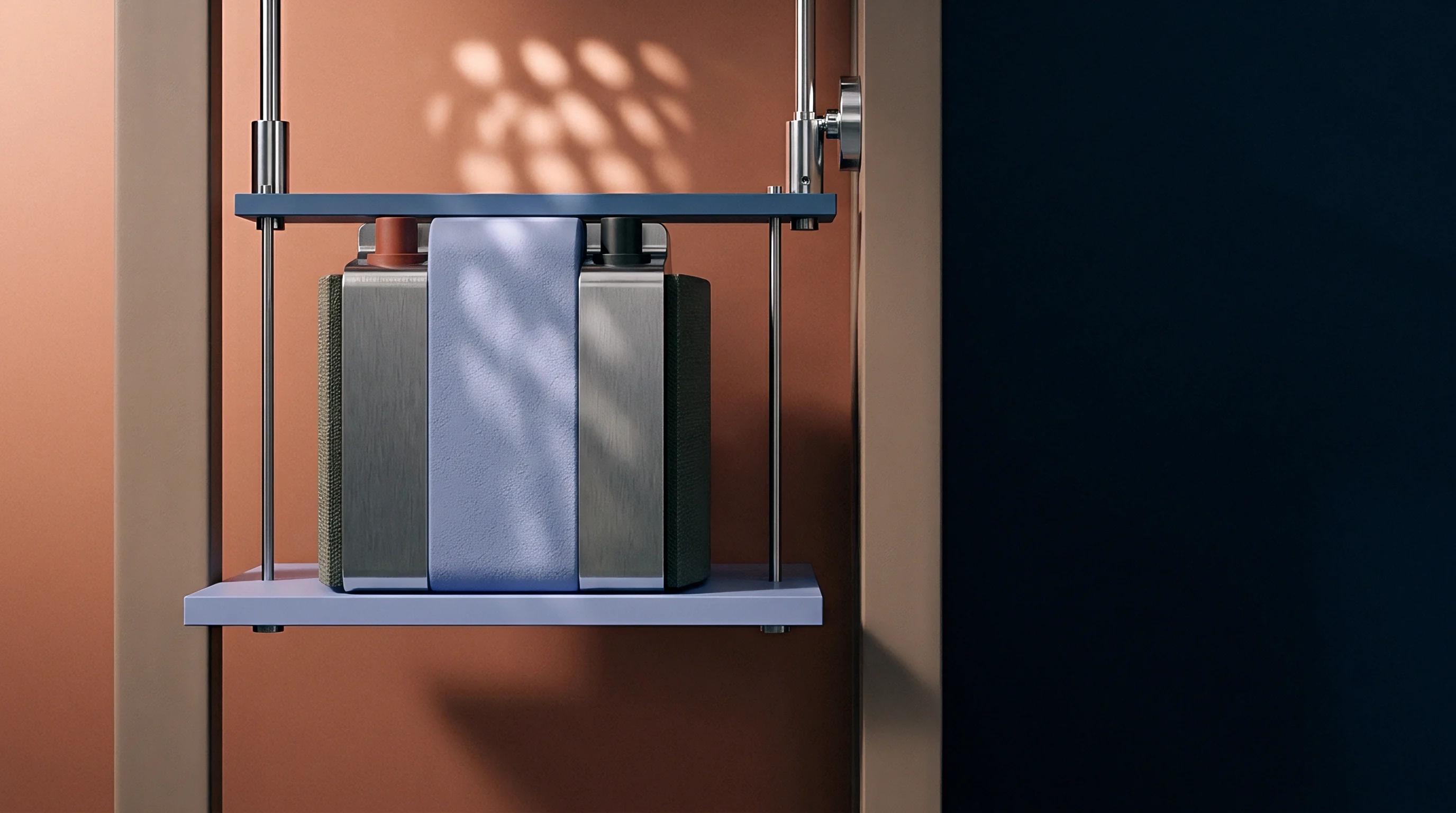
Aluminum shell walls measure between 0.6 and 1.2 millimeters in thickness depending on total cell volume and design pressure targets, with dimensional swelling concentrating normal to the electrode stacking plane. Incoming inspection utilizes granite surface plates, digital height indicators, and pneumatic compression platens to measure cell thickness under 300 kilograms-force (approximately 0.3 megapascals), which matches nominal pack clamping conditions. Thickness measurements taken on unconstrained cells show wider variance caused by minor internal pouch relaxation.
Incoming inspection benches find more vent seal anomalies than factory outbound certificates record.
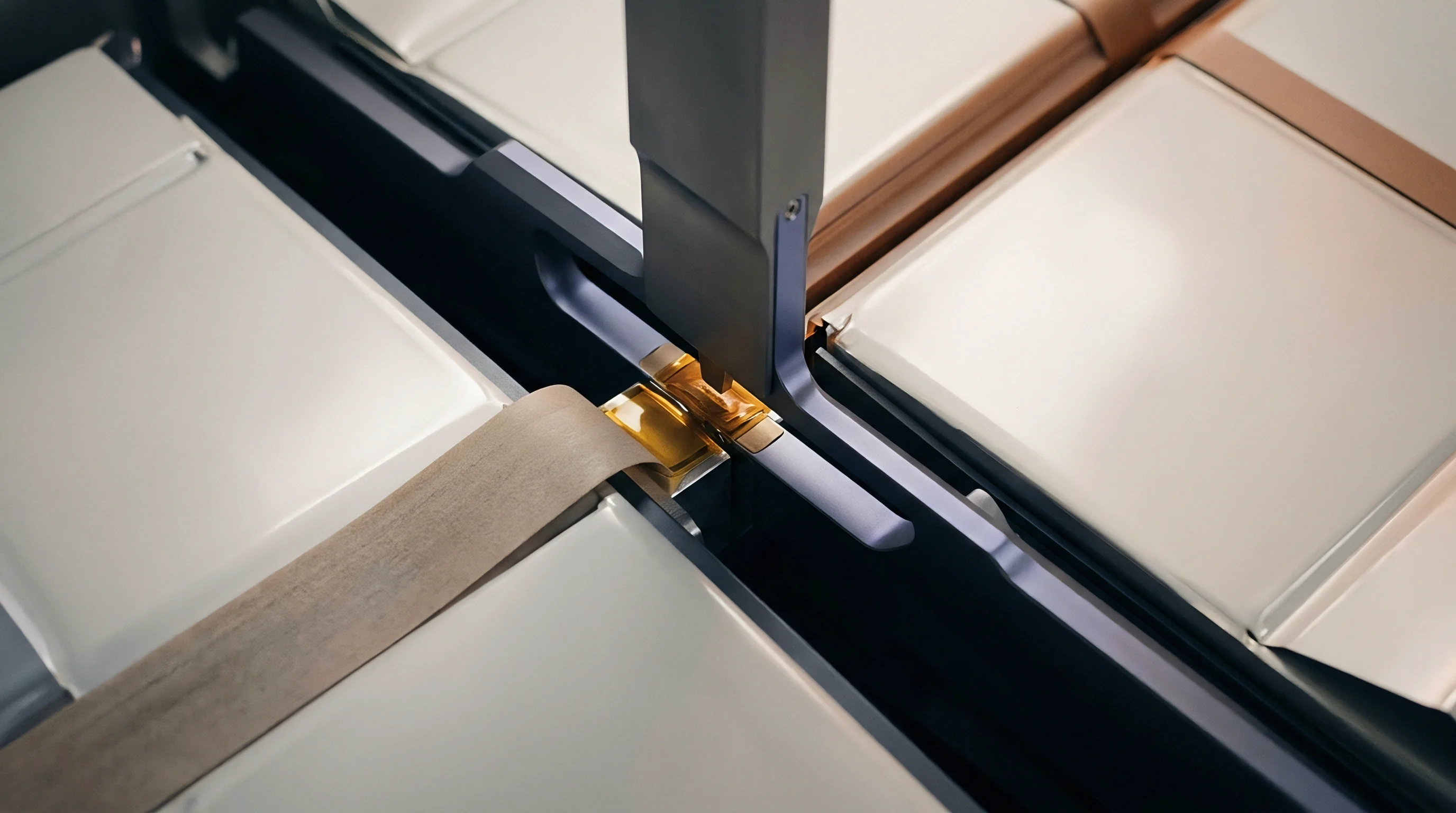
Header assembly tolerances directly dictate automated busbar welding yields. Automated laser welders depend on precise optical focal distances; a variation in terminal height exceeding 0.2 millimeters alters the laser spot diameter, leading to weld splatter, shallow penetration, or casing perforation. Inspection stations use automated optical profilometry to map terminal post flatness, polarity mark depth, and vent score line residual thickness.

Are Casing Deflection Thresholds Structurally Reversible?
Permanent plastic deformation of the aluminum enclosure signals abnormal internal pressure events during transit or excessive formation gas generation. Standard acceptance envelopes allow up to 0.8 millimeters total face deflection on unconstrained 280 Ah cells at the dock. When cells display bulging beyond this threshold, internal gas generation has strained the aluminum container past its elastic limit, misaligning internal jelly rolls and impairing thermal transfer paths to module cooling plates.
The integrated safety vent disk on the cell top cover contains precision laser-etched score lines designed to burst between 0.6 and 1.0 megapascals, relieving internal pressure before catastrophic can rupture occurs. Inspecting vent geometry involves non-contact optical triangulation. Score lines must retain a residual aluminum membrane thickness of 60 to 80 micrometers.
Scratches, corrosion pits, or tooling dents inside the vent zone lower the burst pressure, triggering premature venting under heavy operational cycling.

Header Envelope Stack Analysis
The top cover envelope integrates terminal bushings, ceramic-to-metal seals, electrolyte injection hole seal balls, and explosion-proof vents. Dimensional drift across these components introduces mechanical stresses during module busbar bolting or laser welding.
| Inspection Parameter | Nominal Dimension | Upper Specification Limit | Lower Specification Limit | Sampling Level (ANSI/ASQ Z1.4) | AQL Category |
|---|---|---|---|---|---|
| Cell Width (mm) | 173.70 | 174.20 | 173.20 | General Level II | Major (0.40) |
| Cell Thickness, Unconstrained (mm) | 71.70 | 72.50 | 71.20 | General Level II | Major (0.40) |
| Cell Height with Terminals (mm) | 207.20 | 207.60 | 206.80 | General Level II | Major (0.40) |
| Terminal Center Distance (mm) | 90.00 | 90.30 | 89.70 | Special Level S-4 | Major (0.40) |
| Terminal Surface Coplanarity (mm) | 0.00 | 0.15 | -0.15 | Special Level S-4 | Major (0.40) |
| Vent Score Line Depth (mm) | 0.32 | 0.35 | 0.29 | Special Level S-3 | Critical (0.00) |
| Insulation Resistance at 500V (MΩ) | 500.00 | No Ceiling | 100.00 | General Level II | Critical (0.00) |
| Measurements valid at 25 degrees Celsius after twenty-four-hour thermal soak. Casing thickness measured at center of wide face without compression platens. | |||||
Pack designs incorporating continuous copper busbars cannot absorb height variations exceeding 0.3 millimeters across adjacent cells without inducing shear stresses on internal terminal collector tabs. Checking co-planarity before cell staging prevents premature mechanical failure at terminal welds.
Rigid pack side plates transfer swelling loads directly into corner tie rods rather than absorbing displacement, leaving zero margin for out-of-spec cell thickness.

Arbitration
Disputes over incoming test results stem from mismatches between supplier factory conditions and buyer receiving laboratory environments. Cell manufacturers log end-of-line performance using multichannel cyclers calibrated under continuous industrial cooling with high-current probe clamps. Incoming test benches often employ manual fixtures, differing test lead impedances, and ambient warehouse temperature swings that systematically distort capacity and resistance readings.
Resolving batch rejections requires transparent technical arbitration protocols built directly into the original procurement agreement.
Electrode formulations show marked sensitivity to ambient thermal boundaries during discharge testing. A lithium iron phosphate cell exhibits a positive capacity temperature coefficient of approximately 0.2 percent per degree Celsius between 20 and 30 degrees Celsius. A cell tested at 22 degrees delivers roughly 1.8 Ah less than an identical cell tested at 26 degrees.
Sourcing contracts eliminate ambiguity by standardizing test bath conditions, defining four-wire Kelvin sensing probe positions, and designating independent accredited testing laboratories for third-party re-testing.
Wider incoming capacity spreads burn excess energy through passive balancing resistors and shorten module operating life.
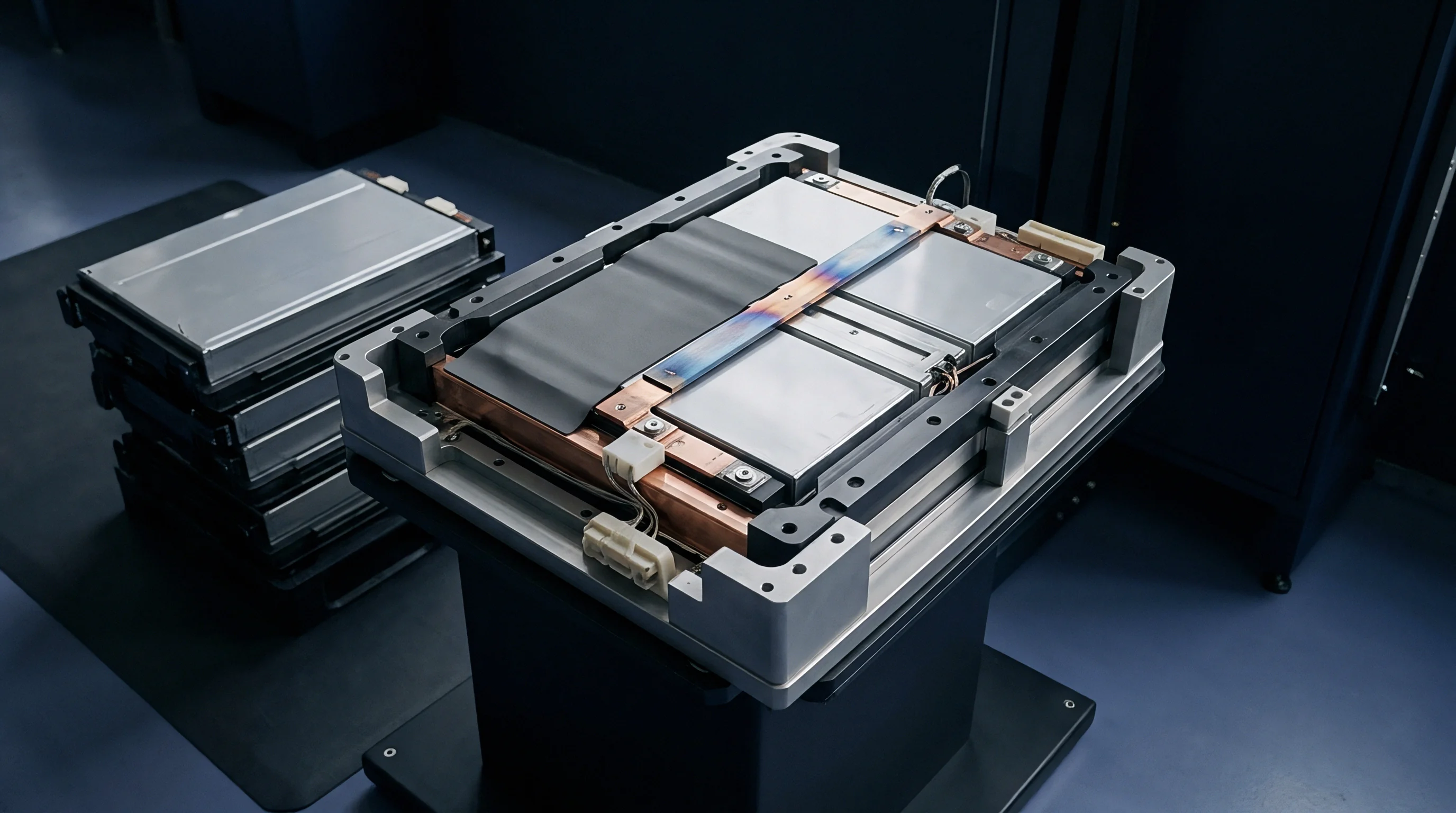
When initial sampling yields non-conformances exceeding the contract AQL, the buyer issues a formal Notice of Quarantine. The supplier holds the right to witness secondary screening runs or dispatch technical staff to review incoming test channel calibration records. Shunt calibration drift on buyer cyclers represents a common source of contested rejections, where a 0.5 percent ammeter error across a 140-ampere discharge channel shifts a conforming cell into the reject bin.
Will Secondary Discharge Cycles Settle Grading Disputes?
Factory formation routines charge cells to exact storage states before ocean container shipment. During four to eight weeks of transit and customs clearance, minor chemical reduction reactions cause solid electrolyte interphase (SEI) relaxation and reversible capacity loss. An incoming test that discharges the cell immediately upon arrival registers this shelf-life relaxation as permanent degradation.
Standard arbitration protocols enforce a three-cycle conditioning procedure at 0.5C before recording official acceptance capacity.
Conditioning cycles strip away reversible passive films and fully wet internal micro-pores with electrolyte. If the cell fails to achieve its warranted capacity rating on the third cycle, the defect is confirmed as irreversible active lithium loss or low electrode active material loading, leaving the supplier responsible for freight charges while sourcing teams enforce pre-agreed liability schedules covering secondary cycling energy expenses, test bay labor hours, and warehouse holding fees.
Chamber Temperature Boundary Audits
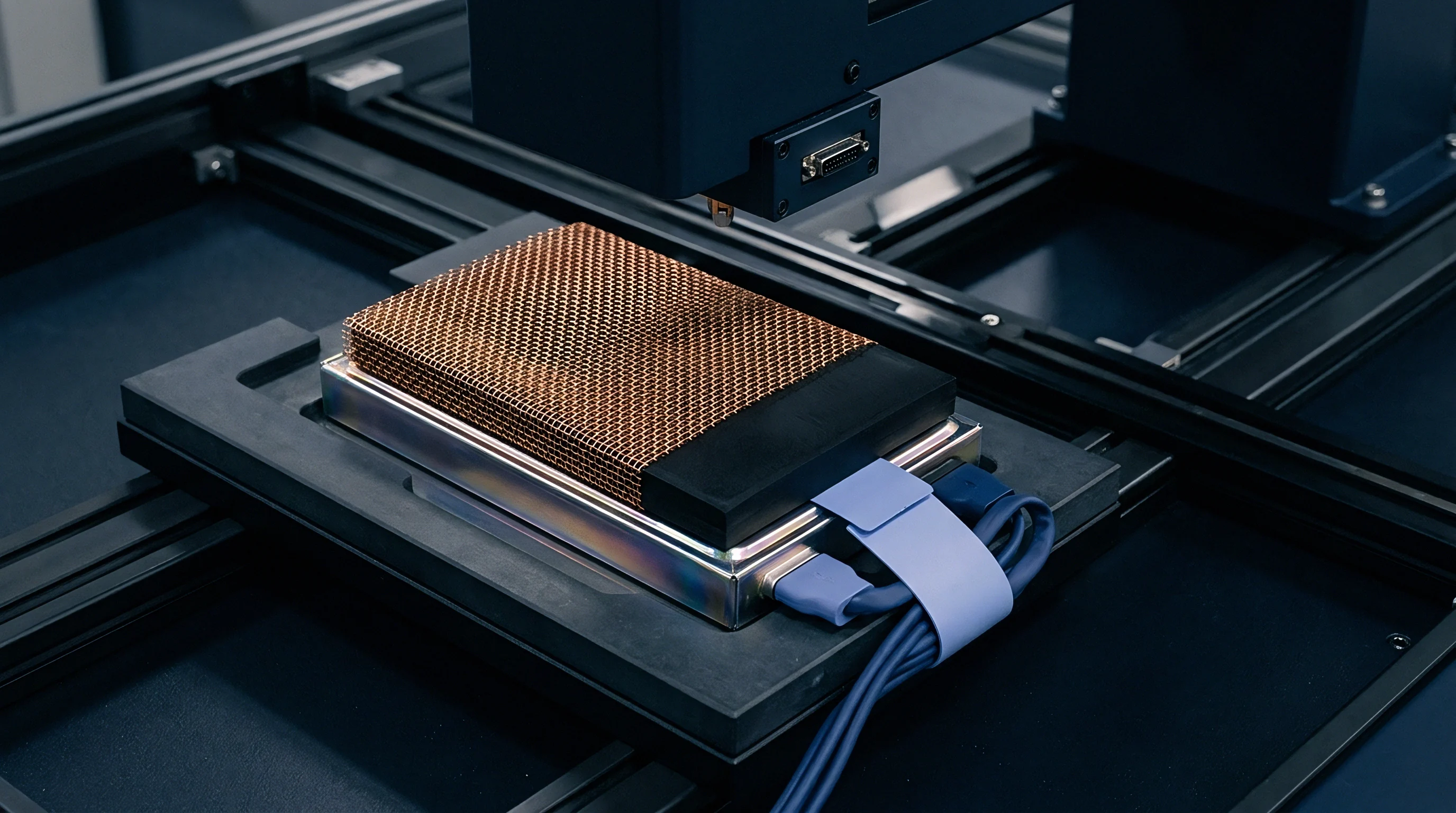
Laboratory temperature variation during cycling invalidates comparison with factory birth certificates. Verification audits map spatial temperature distributions across cell holding racks. Cells situated near chamber fan exhausts experience higher convective heat dissipation, depressing surface temperatures compared to units located in stagnant dead zones.
An accurate incoming assessment demands thermocouple attachment to the geometric center of both wide aluminum faces and the negative terminal stud.
| Measurement Metric | Supplier Factory Method | Buyer Receiving Method | Underlying Mechanism of Variance | Commercial Impact on AQL Gate |
|---|---|---|---|---|
| Delivered Capacity | Single pulse cycle directly off formation line at 35°C | Cold chamber soak, 0.5C CCCV cycle at 23°C | Electrochemical kinetics drop delivered Ah at lower temperatures | False rejection of conforming production lots |
| 1 kHz ACIR | Spring-loaded gold multi-pin probes on bare foil | Pneumatic flat-faced copper clamps on polished terminal | Contact resistance delta and oxide film barrier impedance | Apparent resistance inflation beyond upper AQL limit |
| Cell Thickness | Automated laser displacement under 300 kgf load | Manual digital vernier calipers under zero applied load | Free-state aluminum shell relaxation and elastic springback | Out-of-envelope rejections causing line assembly halts |
| Insulation Resistance | Dry room test at 15% relative humidity, 500V DC | Standard dock ambient at 65% relative humidity, 500V DC | Moisture condensation bridging terminal gasket surface | False critical defect calls for casing dielectric failure |
Whether factory test benches calibrate their shunts against certified national metrology standards remains an ongoing friction point during cross-border quality disputes.

Settlement
Commercial resolution following a rejected cell lot depends on contractual mechanisms designed into the supply framework agreement. When an incoming shipment breaches established AQL limits for major or critical classifications, title and risk allocations dictate the remedy sequence. Sourcing teams choose between batch sorting by supplier-funded third parties, full-lot return for credit, or downward commercial re-grading into stationary storage streams.
Pack manufacturing schedules cannot tolerate indefinite delays while lawyers negotiate factory credit memos.
Batch sorting segregates marginal cells from production-ready units. If a 10,000-cell lot contains an unacceptable cluster of height variances, the buyer initiates a 100 percent sorting protocol. Specialized third-party quality containment firms install automated dimensional sorting gauges inside the receiving warehouse.
The cell vendor covers containment labor, fixture amortization, and warehousing overhead via direct invoice deductions against outstanding letters of credit.
Re-grading offers a financial alternative when non-conformances involve small capacity shortfalls rather than structural or safety failures. Cells exhibiting delivered capacities between 97 and 99 percent of nominal rating transition into secondary product categories. A tier-one industrial traction pack demands tight cell-to-cell capacity matching within 1.0 percent.
Cells failing this gate can serve stationary energy storage applications where battery management systems handle wider balance spreads. Sourcing agreements assign discounted per-kilowatt-hour pricing schedules for re-graded cells accepted under deviation permits.

Commercial Batch Disposition Rules
Contractual settlement clauses govern the disposal of rejected lots to prevent defective units from contaminating gray markets. When a lot fails on critical safety defects, including breached explosion vents or internal micro-shorts, the buyer prohibits overseas return shipment due to maritime hazardous materials transport restrictions. Dangerous goods shipping rules under IMDG Special Provision 376 restrict the transport of damaged or defective lithium cells.
Scrap-in-place agreements resolve this logistics deadlock. The buyer contracts a certified domestic recycling facility to shred the quarantined cells, extract black mass, and provide certified mass-balance recycling documentation to both parties. The cell manufacturer issues a full commercial invoice credit upon receipt of the destruction certificate.
If the non-conformance remains unverified, sorting costs fall back upon the party whose laboratory equipment displayed calibration non-compliance.

Warranty Boundary Allocations
Incoming acceptance closes the factory-gate quality window and opens the operational performance warranty phase. Signing off on an incoming lot receipt confirms that mechanical dimensions, initial capacity, terminal coplanarity, and self-discharge metrics matched contract specifications at delivery. Once cells are welded into modules, diagnosing whether an individual cell failure resulted from raw material contamination or module assembly stress becomes technically difficult.
Laser welding introduces thermal stress into terminal headers. Mechanical pack clamping introduces compressive sidewall creep. If the pack manufacturer fails to record incoming serial numbers and matching inspection data, the cell supplier routinely disclaims warranty coverage for subsequent field failures, asserting that pack integration processes damaged the cell seals.
Maintaining a linked digital dossier containing incoming AQL inspection results, automated barcode scans, and initial OCV measurements preserves the chain of custody needed to enforce supplier warranty commitments.
A standard Incoterms DAP destination clause specifying incoming lot rejection rights within thirty business days shifts overseas transit damage risk entirely onto the cell manufacturer.