Meaning
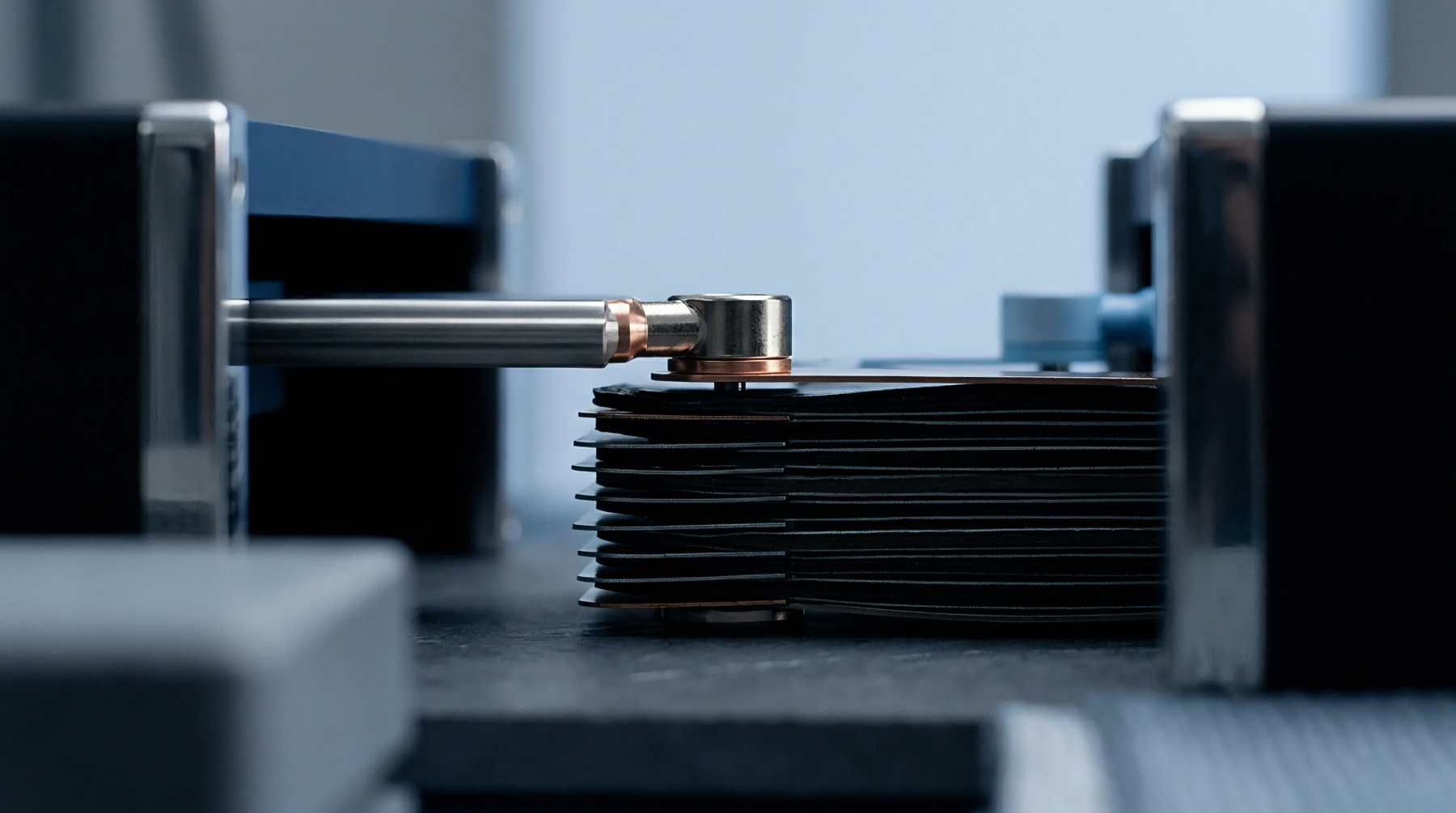
Precision mechanical setup procedures ensure that parallel clamping surfaces apply uniform forces to a test cell. Verifying swelling fixture alignment prevents the introduction of twisting forces or bending moments during pouch cell expansion. This maintains a purely uniaxial stress state during electrochemical cycling.
Calibration Method
A metal gauge block of certified flatness is compressed between the plates to check the parallelism of the setup. In a proper swelling fixture alignment, pressure sensors on the perimeter of the block register identical force values. Technicians adjust the leveling screws of the platens to eliminate any angular discrepancy.
This mechanical correction is checked periodically to prevent measurement drift.
Data Quality
Accurate displacement measurements depend on the sensor axis being perfectly parallel to the direction of cell expansion. When swelling fixture alignment is incorrect, off-axis movements cause the sensor to register false displacement values. This angular error can lead to a severe overestimation or underestimation of the electrode expansion rate.
High-precision displacement curves are necessary to model the mechanical behavior of silicon-containing anodes. Correct alignment guarantees that the displacement data correlates directly with the chemical state of charge. Development teams use these accurate curves to validate finite element models of the swelling cell.
Mechanical Limit
Thermal contraction of the fixture components at low testing temperatures can misalign the pre-set plates. If the mounting screws of the swelling fixture alignment are made of mismatched metals, thermal gradients will twist the assembly out of parallel. This mechanical distortion occurs when cycling cells inside environmental chambers.
Using low-expansion materials like Invar or quartz prevents these temperature-induced shifts.