Zero Knowledge Telemetry Proof Systems for Multi Vendor Battery Liability Settlement
Zero knowledge telemetry proofs verify battery operating envelope compliance without exposing trade secret load curves, enabling automated multi-vendor liability settlement.


Duty
Commercial contracts governing grid-scale energy storage and electric vehicle fleets split financial risk across several corporate entities. Cell manufacturers guarantee cycle life under strict environmental limits, which pack integrators enforce through cooling manifolds and battery management modules. Asset operators schedule daily charging to supply competitive power markets.
When early capacity fade or thermal failure occurs, financial claims move among these parties.
Data privacy complicates these disputes. Telemetry from battery management microcontrollers contains trade secrets: charging current curves, thermal relaxation profiles, and discharge cycles expose algorithm logic, vehicle routing, and commercial dispatch schedules. Fleet managers refuse to send unencrypted raw sensor dumps to cell suppliers, while cell suppliers reject claims that lack a verifiable continuous operating history.
Without verified telemetry, financial settlements stall.

Commercial Liability Allocation across Distributed Battery Ownership
Sourcing agreements divide risk among cell manufacturers, pack integrators, platform developers, and asset operators. A cell datasheet promises a cycle life curve under standardized factory conditions: 25 degrees Celsius ambient temperature, 0.5C continuous charge, 1.0C continuous discharge, and an operating voltage window between 2.5 volts and 3.65 volts for lithium iron phosphate chemistry. Real field operations rarely match factory test benches.
Fast charging at 2.0C in sub-zero temperatures induces metallic lithium plating on graphite anodes, while prolonged resting at 100 percent state of charge at 50 degrees Celsius accelerates solid electrolyte interphase breakdown and transition metal dissolution in nickel manganese cobalt cathodes.
Determining whether capacity loss stems from manufacturing defects or operator thermal overstress requires granular operational data. Table 1 outlines the operating boundaries, warranty claim conditions, and financial risks across the supply chain.
| Entity Role | Warranted Operating Boundary | Dispute Trigger Condition | Unverified Data Liability Risk |
|---|---|---|---|
| Cell Manufacturer | 25°C baseline, ≤ 1.0C charge, 2.5V ~ 3.65V limits | Capacity drops below 80% prior to contracted cycle count | Absorbs warranty claims caused by operator overcharge or thermal abuse |
| Pack Integrator | Thermal gradient across pack ≤ 5°C, cell balancing active | Localized thermal degradation or micro-short circuiting | Faces secondary liabilities due to inadequate cooling channel design |
| Fleet Operator | Charge profile within C-rate envelope, thermal controls active | Asset downtime, unexpected cell capacity degradation | Forfeits legitimate warranty payouts due to trade secret withholding |
| Asset Financier | State of health degradation tracking contracted linear curve | Residual value collapse, battery replacement threshold breached | Carries unhedged capital risk on balance sheet reserves |
Resolving disputes requires verifiable computational artifacts. Neither side trusts raw CSV files pulled from an opponent’s database, since altering timestamps or filtering out overtemperature events takes minimal effort. The fundamental commercial conflict pits data verifiability against corporate IP protection.
Commercial warranty settlements stalled by unverified telemetry default to shared loss allocations that penalize pack integrators disproportionately.

Warranty Enforcement Mechanics
Contractual remedies depend on validating that operating parameters stayed within agreed environmental and electrical limits. Traditional legal disputes rely on forensic cell teardowns in third-party electrochemistry labs. While physical examination of harvested electrodes identifies lithium plating, cathode cracking, or electrolyte dry-out, post-mortem testing cannot prove precisely when or how often an operator crossed thermal or C-rate boundaries over three years of operation.
Cryptographic proof structures solve this diagnostic impasse. Zero-knowledge systems allow an asset owner to prove mathematically that battery telemetry stayed within specified voltage, current, and temperature limits over 5,000 charge cycles without exposing the underlying data. The proof simply confirms boolean statements: maximum temperature never exceeded 45 degrees Celsius, minimum voltage never dropped below 2.0 volts, and maximum continuous charge current never exceeded 120 amperes.
Standard supply clause 18.4 replaces manual engineering tribunals with cryptographic validity proofs, cutting dispute resolution timelines from nine months to three minutes.

Gauge
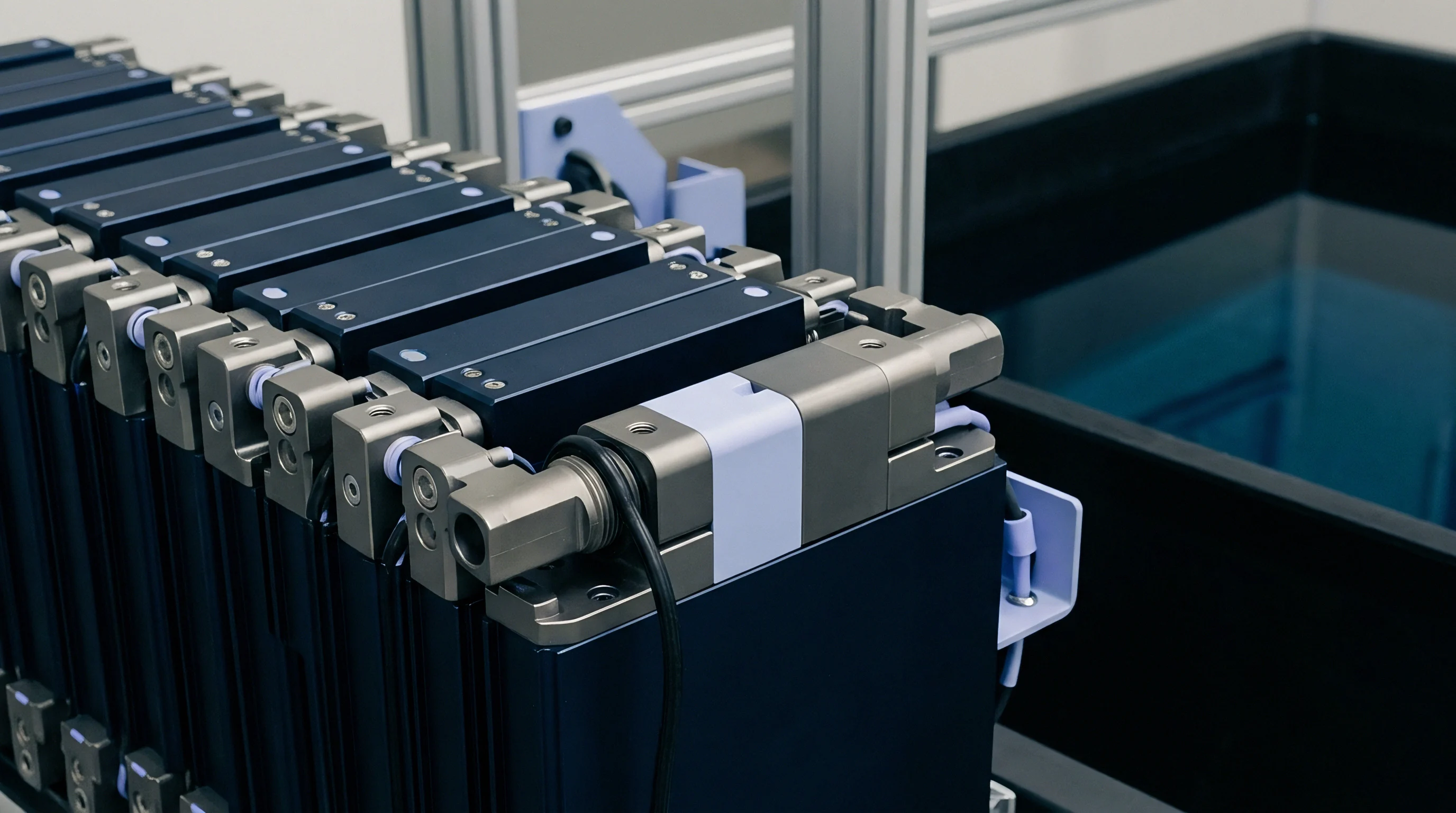
Field sensors in battery management systems record voltage, current, and temperature at regular sampling intervals. A typical grid battery running 1,000 individual cells at 1 hertz generates 259.2 million data points daily. Edge microcontrollers lack the storage capacity and cellular bandwidth to stream this volume to remote servers, forcing local cryptographic aggregation inside the pack enclosure before transmission.
Zero-knowledge systems convert raw operational metrics into cryptographic polynomial commitments. The battery management system routes local sensor ticks through lightweight hashing primitives designed for zero-knowledge arithmetic circuits; Poseidon, Rescue-Prime, and Anemoi hash functions replace legacy SHA-256 algorithms to minimize constraint counts during proof execution.

Battery Sensor Sampling and Cryptographic Data Compression
Microcontrollers in current pack architectures ingest continuous readings from thermistors and voltage taps. Analog-to-digital converter channels filter electrical noise before sensor logs enter an edge hash engine to build a daily Merkle tree. Each leaf contains a packed binary payload covering cell index, timestamp, voltage vector, current magnitude, and skin thermistor value.
- Continuous analog-to-digital conversion samples individual cell voltage channels at 100 millisecond sampling periods.
- Edge filtering algorithms aggregate raw values into 1-second normalized telemetry records containing instantaneous power, temperature, and pack voltage.
- Poseidon algebraic hash functions compress 1-second telemetry records into 256-bit cryptographic digest leaves.
- Sequential digest leaves accumulate inside a binary Merkle tree structure to compute a daily cryptographic root hash.
- The battery management system writes the daily Merkle root hash into non-volatile memory and broadcasts the root digest over local CAN bus interfaces.
This sequential tree structure guarantees immutable historical ordering. Changing a past temperature reading invalidates every subsequent node up to the root. The root hash acts as a permanent commitment to that day of battery operation while exposing no underlying telemetry to outside observers.

Edge Proof Generation Mechanics at the Battery Management System
Modern embedded silicon includes dedicated hardware acceleration blocks for elliptic curve operations and polynomial evaluation. Hardware-based zero-knowledge provers run within high-tier automotive domain controllers or dedicated security microcontrollers, though proof generation still demands significant compute.
Prover runtime depends directly on circuit size. A circuit evaluating 86,400 daily sensor ticks against three operating boundaries contains roughly 2.5 million multiplicative gates. Edge automotive hardware executing PLONK or Halo2 proof systems generates a succinct zero-knowledge proof in under 15 seconds.
Cell manufacturers argue, however, that sensor drift on low-cost voltage lines can trigger artificial boundary breaches that improperly void factory performance guarantees.


Circuit
Zero-knowledge proof systems express electrochemical boundaries as mathematical constraints in finite field arithmetic. Proving compliance requires showing that continuous operational variables stay within defined numerical limits. An arithmetic circuit converts these physical limits into Rank-1 Constraint Systems or Plonkish custom gates.
Proof systems process constraints across large prime finite fields. A scalar variable V for cell voltage in millivolts must satisfy Vmin le V le Vmax. To enforce this in zero-knowledge circuits without revealing V, the prover decomposes the differences (V – Vmin) and (Vmax – V) into binary bit vectors, proving that every bit is strictly zero or one.

Zero Knowledge SNARK Polynomial Bounds for Electrochemical Degradation
Translating physical aging formulas into arithmetic constraint systems enables non-interactive verification of cumulative wear. Battery degradation involves complex, non-linear electrochemistry ~ capacity drops due to irreversible lithium inventory loss, active material dissolution, and electrolyte oxidation. Empirical models quantify this degradation by accumulating effective throughput amp-hours weighted by stress factors.
The mathematical representation of accumulated stress S over discrete operational steps t in 1, dots, N maps to an arithmetic accumulator gate:
S = sumt=1N left( α · |It| + β · efracEaR · Tt + γ · (Vt – Vnom)2 right)
Where It represents instantaneous current, Tt represents cell skin temperature in Kelvin, Vt represents terminal voltage, R is the universal gas constant, Ea is the activation energy for SEI growth, and α, β, γ are empirically derived weighting coefficients. Arithmetic zero-knowledge circuits approximate the exponential temperature term using lookup tables or polynomial Taylor expansions, keeping total gate counts manageable.
| Physical Variable | Electrochemical Degradation Mechanism | Circuit Implementation Method | Gate Count Per Telemetry Tick |
|---|---|---|---|
| Cell Voltage (Vt) | Cathode phase transition, lithium plating | Bit-decomposition range check (16-bit) | 32 gates |
| Cell Current (It) | Joule heating, concentration polarization | Absolute value & square scalar multiplication | 12 gates |
| Skin Temperature (Tt) | Arrhenius SEI layer growth acceleration | Pre-computed Poseidon lookup table | 8 gates |
| State of Charge (SoCt) | High-voltage transition metal dissolution | Accumulator logic with non-linear bounds | 24 gates |
In a worked validation scenario, a 100 kilowatt-hour lithium iron phosphate battery pack operating over a 24-hour cycle generates 86,400 telemetry ticks at 1 hertz sampling frequency. Contractual bounds require cell voltage to remain between 2,500 millivolts and 3,650 millivolts, skin thermistor values to stay below 318.15 Kelvin (45 degrees Celsius), and continuous charge current not to exceed 100 amperes. The zero-knowledge circuit evaluates 86,400 tick vectors against these four constraints, yielding a zero failure counter if all values stay within bounds.
If tick index 43,210 experiences a transient over-voltage event of 3,720 millivolts for 12 seconds, the range-check constraint evaluates to a non-zero remainder in finite field arithmetic. The prover cannot produce a valid polynomial witness while hiding this failure. The cryptographic proof then explicitly verifies that a boundary violation occurred, isolating the exact tick count and severity without exposing duty cycle details for the remaining 86,388 seconds.
Lithiation overpotential exceeding 50 millivolts at ambient temperatures below 5 degrees Celsius forces irreversible metallic lithium deposition on graphite anodes.

Circuit Enforcement of Battery Voltage and Thermal Operating Envelopes
Overvoltage, undervoltage, and overtemperature events breach operational specifications and accelerate capacity loss. Arithmetic circuits enforce parameter bounds using private witness inputs for actual operational values and public inputs for contract parameters.
The prover supplies raw telemetry vectors as private inputs, while public inputs define the agreed operational boundaries. The zero-knowledge proof confirms that private inputs satisfy all constraint equations, returning to the public verifier only the proof string, public boundaries, and daily Merkle root hash. Failure mode classification categorizes degradation drivers into distinct liability zones:
- Lithium Plating Overcharge ~ Current forced through cells at low temperature causes metallic lithium deposition on anode particle surfaces, accelerating capacity drop.
- Thermal Runaway Abuse ~ Sustained operations above 60 degrees Celsius breakdown the solid electrolyte interphase, causing exothermic gas generation and mechanical pouch swelling.
- Deep Discharge Degradation ~ Discharging below 2.0 volts causes copper current collector dissolution, forming internal conductive micro-dendrites that cause self-discharge.
- High C-Rate Overstress ~ Continuous discharge rates exceeding 3.0C induce mechanical micro-cracking inside cathode particles, reducing active intercalating volume.
Cold charging accelerates degradation. Compromising constraint fidelity in arithmetic circuits allows unverified thermal excursions to silently erode cell state of health while invalidating downstream insurance claims.


Arbiter
Smart contracts on public or enterprise blockchains evaluate cryptographic commitments without centralized intermediaries. An automated arbiter contract holds public parameters, historical Merkle roots, and authorized key registries. When a fleet operator submits a zero-knowledge validity proof, the on-chain verifier executes elliptic curve pairing operations to confirm it.
Decentralized state machines strip corporate bias from warranty adjudication. Neither cell supplier engineers nor fleet accountants control the evaluation logic; the smart contract acts as an impartial arbiter, testing proofs against business rules written into immutable code.
Decentralized Oracle Systems for on Chain Proof Verification
External validators aggregate edge zero-knowledge outputs and submit verified proofs to distributed ledger state machines. Because executing pairing checks in the Ethereum Virtual Machine consumes computational gas, provers compress proofs to minimize on-chain costs.
| Proof System Architecture | Proof Size (Bytes) | EVM Verification Gas Cost | Prover Memory Footprint | Trusted Setup Requirement |
|---|---|---|---|---|
| Groth16 (BN254) | 128 | 210,000 | 1.2 Gigabytes | Per-circuit trusted setup required |
| PLONK (KZG) | 848 | 270,000 | 2.8 Gigabytes | Universal SRS setup required |
| Halo2 (IPA) | 4,096 | 1,450,000 | 4.1 Gigabytes | Transparent setup, no trusted ceremony |
| STARK (Winterfell) | 120,000 | 4,200,000 | 8.5 Gigabytes | Transparent setup, quantum safe |
Groth16 offers the smallest proof footprint and lowest gas cost. PLONK provides flexible universal setups that accommodate changing circuit definitions without requiring new trusted ceremonies when battery management updates alter sampling logic. Distributed oracle consensus groups fetch edge proofs from off-chain storage, execute verification algorithms, and post state transitions directly to the settlement contract.
Clause 14B in multi-party energy storage service agreements releases reserve cash escrows within 24 hours of on-chain validity proof verification without manual audit intervention.

Automated Warranty Escrow Execution and Payout Workflows
Smart contracts release locked capital or issue penalties based on proof validation outcomes. Under standard asset purchase agreements, buyers deposit cash collateral into smart contract escrows, which release periodic performance payments as long as daily zero-knowledge proofs show compliant cell operation.
Payout execution is fully automated. If an operator submits a proof showing that cell state of health dropped below 75 percent while maintaining 100 percent boundary compliance over 3,000 cycles, the escrow contract transfers funds directly from the manufacturer’s warranty reserve to the operator. Questions remain, however, about how cross-border courts will handle automated escrow penalties when physical cell teardowns contradict on-chain proofs.


Swell
Lithium-ion pouch and prismatic cells undergo irreversible dimensional expansion caused by repetitive intercalation stress and gas generation. As the solid electrolyte interphase breakdown releases volatile gases like ethylene carbonate, carbon dioxide, and hydrogen, cell volume swells.
This physical expansion offers direct evidence of internal chemical degradation. Integrating strain gauge sensors alongside thermal thermistors enables battery management modules to track thickness changes in real time, feeding swelling measurements directly into cryptographic telemetry pipelines to link mechanical deformation with electrical duty cycles.

What Proves Battery Cell Degraded before Thermal Runaway?
Sensor logs converted into zero-knowledge artifacts show whether internal micro-shorting occurred before uncontrollable heating. Thermal runaway rarely strikes without warning; localized lithium plating forms metallic dendrites that pierce separator membranes, causing micro-shorts marked by subtle voltage drops and thermal spikes.
Proving micro-shorts without exposing baseline discharge profiles requires evaluating differential voltage curves (fracdVdQ) inside zero-knowledge circuits. A sudden drop in differential voltage at high states of charge points to localized internal leakage. Zero-knowledge telemetry proofs confirm whether the management system detected micro-short signatures before catastrophic thermal breakdown, establishing whether operator control systems ignored warning flags.
Mechanical pouch cell expansion during cycling isolates internal gas evolution from external casing physical compression.

Distinguishing Abuse Mechanisms from Manufacturer Cell Defect
Distinguishing operator overcharging from manufacturing contamination depends on analyzing high-resolution electrochemical impedance spectra and stress curves. Manufacturing defects like cathode burrs or uneven separator coatings create localized current density anomalies that trigger early capacity fade even under mild operation.
Sourcing teams evaluate zero-knowledge telemetry options during multi-vendor procurement using a standard checklist:
- Hardware Prover Selection ~ Match cryptographic proof engine architecture with available onboard battery controller silicon compute headroom and local RAM constraints.
- Boundary Envelope Definition ~ Establish mathematically clear boundary parameters for voltage cut-offs, thermal operational thresholds, and continuous charge C-rate limits.
- Hash Primitive Alignment ~ Integrate Poseidon or Anemoi algebraic hashing inside battery management firmware to minimize zero-knowledge proof generation latency.
- Oracle Consensus Setup ~ Implement multi-node decentralized oracle consensus systems to aggregate off-chain telemetry proofs and manage on-chain state updates.
- Escrow Contract Binding ~ Link smart contract capital release schedules directly to daily cryptographic proof verification tokens to automate liability settlement.
Pouch cells naturally swell under cycle stress, but when mechanical expansion exceeds casing tolerances before reaching cycle life thresholds, manufacturing material defects take precedence over operator overstress.


Settlement
Financial closing mechanisms translate cryptographic telemetry proofs into direct invoice adjustments and balance sheet reserves. Modern fleet management integrates zero-knowledge verification directly into enterprise accounting, cutting legal costs and freeing up capital trapped in contingency reserves.
Impartial mathematical verification shifts multi-vendor risk management. Sourcing teams no longer depend on trust or litigation to resolve performance disputes; cryptographic proofs provide objective confirmation of contract compliance, streamlining cross-border procurement and asset securitization.

Contractual Integration and Risk Distribution Models
Sourcing teams append cryptographic validation protocols directly to procurement schedules and warranty addenda. Contracts specify the public inputs for arithmetic circuits, setting legally binding operating boundaries, and make verified zero-knowledge proof generation the sole acceptable evidence for warranty claims.
Risk allocation shifts cleanly based on proof results. If an operator fails to submit valid daily zero-knowledge proofs, warranty coverage pauses automatically for that unverified period. If valid proofs demonstrate complete compliance while capacity falls below guaranteed thresholds, warranty payouts execute automatically through smart contract logic.

Landed Cost and Financial Accounting for Telemetry Verification
Total capital outlay for zero-knowledge monitoring balances edge hardware costs against avoided warranty disputes. Dedicated security microcontrollers and expanded flash memory add roughly $4.50 to $12.00 in bill-of-materials cost per pack assembly, while on-chain gas verification fees contribute marginal operating expenses per proof.
These avoided costs easily outweigh the initial hardware expense. Litigation, forensic laboratory audits, and uncollectible warranty claims cost operators and integrators millions annually. Zero-knowledge telemetry verification drops dispute resolution costs close to zero, offering rapid payback for high-utilization fleet deployments and utility energy storage assets.
Engineering buyers align verification parameters directly with cell supplier production date codes, locking warranty reserves into verifiable capital allocation lines.