Surface Sensor Arrays for Lithium Cell Strain Inversion
Surface sensor arrays invert external casing strain into internal lithium cell expansion maps, exposing localized plating before voltage telemetry detects failure.
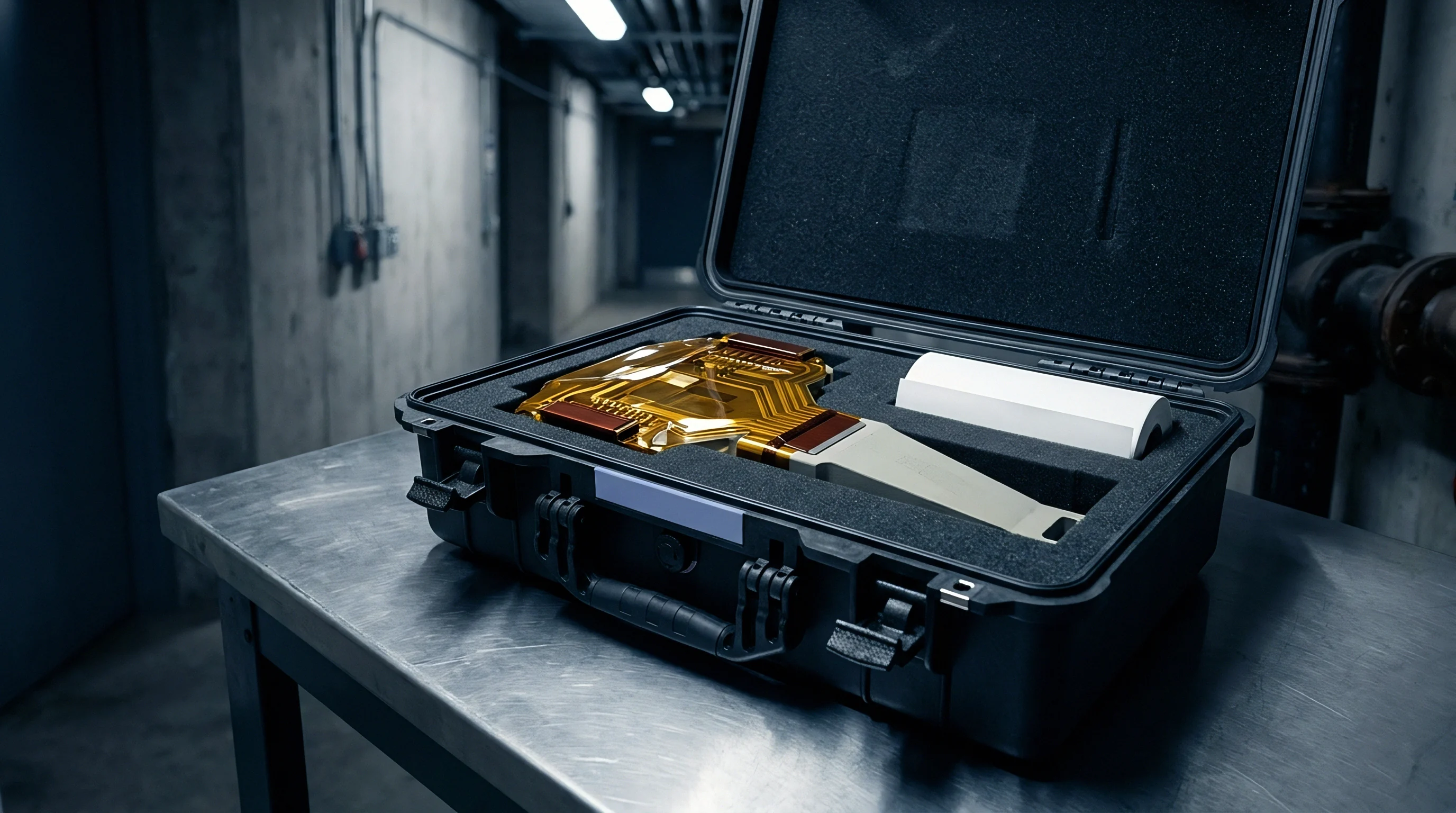

Grid
A 280-ampere-hour prismatic cell expands along its thickness dimension during charge, generating non-uniform displacement profiles that peak across the central third of the casing. Lithium intercalation drives volumetric expansion in graphite and nickel-manganese-cobalt electrodes. Silicon-doped anodes expand up to three times more than pure graphite equivalents.
When cells sit constrained inside a pack module, this localized breathing induces mechanical stress distributions across the exterior metal enclosure.
Planar sensors track these surface shifts. Placing discrete sensor elements on an exterior cell surface converts mechanical swelling into electrical signals that feed pack management algorithms. Because casing deformation concentrates near the center of the electrode stack, placing sensors uniformly across the cell face creates blind spots near the perimeter and oversamples the center.
Instrumenting a module requires balancing transducer density against flexible circuit routing limits.

Spatial Placement across Prismatic Casing Faces
Transducer clusters positioned on large exterior planes capture localized displacement caused by jelly-roll expansion. Prismatic cells enclosed in welded aluminum cans exhibit complex boundary constraints: the rigid perimeter seams resist deflection, while the flat central face deflects outward under internal electrode swelling. Surface arrays arranged in a non-uniform four-by-four matrix capture both the central maximum and the steep strain falloff near the welded edges.
- Lithium stage transition swelling generates periodic displacement peaks corresponding to graphite staging plateaus between ten and eighty percent state of charge.
- Electrode overhang misalignment creates localized stress concentrations along perimeter edges where unreacted negative electrode material absorbs stray lithium ions.
- Internal gas evolution separates electrode layers and deflects the central diaphragm of the casing outward under elevated operating temperatures.
- Structural enclosure compliance redistributes mechanical loads toward the radiused corners of aluminum cans during high-current charging pulses.
Thick electrodes exacerbate localized swelling gradients. When charging at rates exceeding one C, current density concentrates near the tab connections at the top of the cell. This non-uniform current generates a transient longitudinal strain gradient that peaks minutes before bulk cell temperature rises.
A sensor array with nodes positioned within fifteen millimeters of the current collection tabs detects this localized over-potential before voltage sensors indicate an anomaly.

Sensor Transduction Mechanics under Cyclic Pressure
Direct quantification of casing displacement depends on resilient physical interfaces that survive millions of microstrain repetitions. Thin-film piezoresistive arrays, capacitive tactile sheets, and Fiber Bragg Grating optical networks represent the primary sensing options for cell-level strain monitoring. Piezoresistive arrays offer minimal profile thickness, fitting into the standard zero-point-five millimeter gaps allocated between adjacent cells in an electric vehicle module.
| Transducer Architecture | Strain Resolution (microstrain) | Sensor Thickness (mm) | Thermal Drift (microstrain per deg C) | Unit Cost Per Node (USD) |
|---|---|---|---|---|
| Printed Piezoresistive Matrix | 15.0 | 0.22 | 8.5 | 0.45 |
| Thin-Film Constantan Foil | 1.0 | 0.08 | 1.2 | 3.80 |
| Fiber Bragg Grating Array | 0.5 | 0.15 | 0.8 | 12.50 |
| Capacitive Micro-Array | 5.0 | 0.40 | 3.1 | 1.60 |
Constantan foil strain gauges deliver superior signal linearity and minimal drift over operational lifespans, yet their discrete wiring demands excessive assembly labor during module build. Printed piezoresistive matrices integrate dozens of sensing nodes onto a single polyimide sheet, lowering bill-of-materials cost while introducing hysteresis that algorithm developers must calibrate out. Capacitive arrays provide high mechanical durability under sustained static compression but suffer from electromagnetic interference when placed near module busbars carrying high pulse currents.
Array layout designs succeed when transducer density directly follows internal jelly-roll winding geometry.
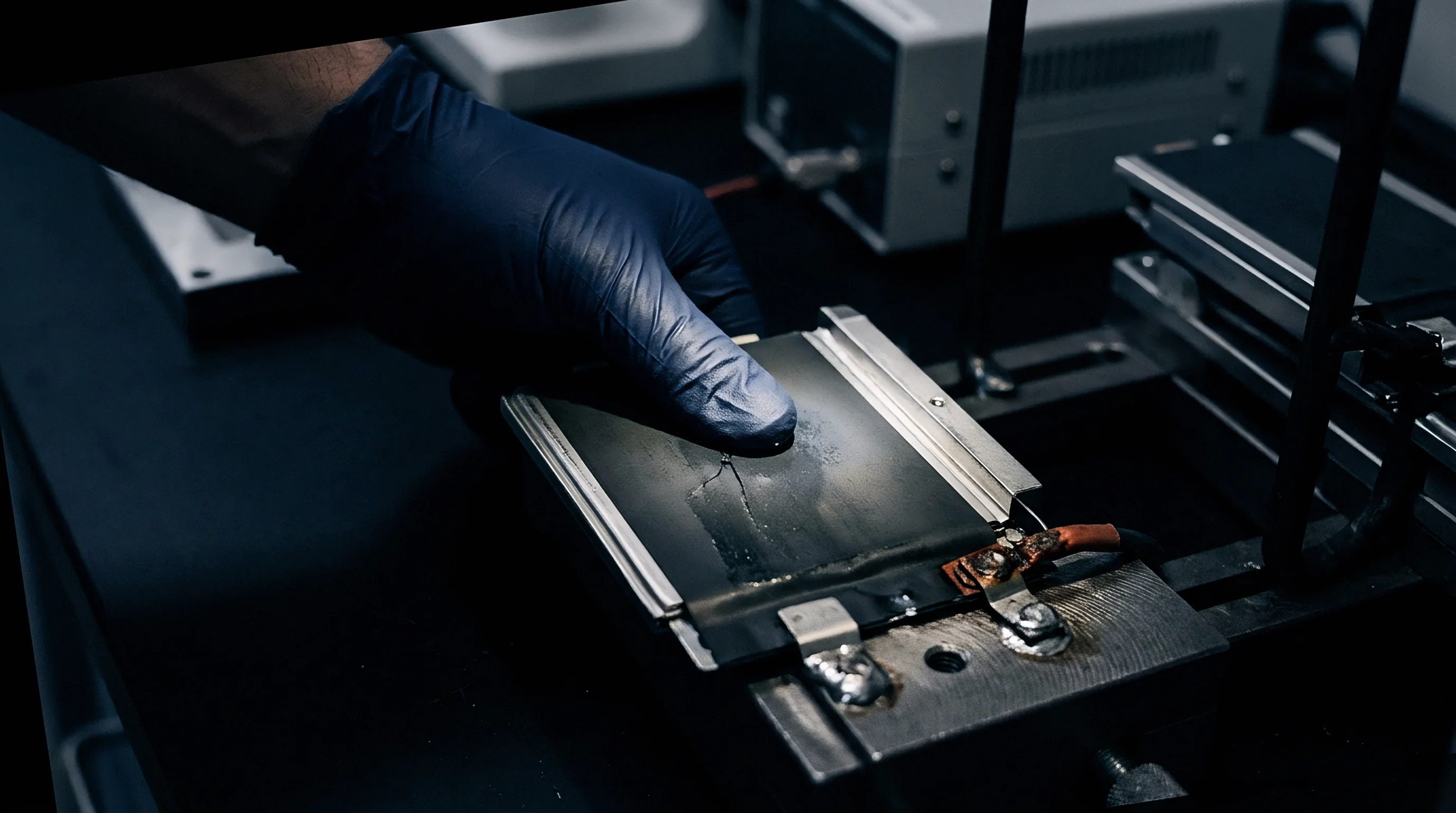

Pad
Inter-cell elastomeric buffers govern how casing expansion translates into mechanical stress against module side plates. Unconstrained lithium cells expand freely, exhibiting pure dimensional displacement. Cells compressed inside rigid structural modules experience mechanical opposition, converting unconstrained volumetric expansion into internal hydrostatic pressure and surface contact stress.
The elastomeric cushion placed between cells serves as both a mechanical spring and a thermal insulator.
Microcellular polyurethane and silicone foams exhibit non-linear stress-strain relationships. At low compression levels below fifteen percent strain, these materials deform easily, allowing the cell to breathe during normal charge cycles without loading the module endplates. Beyond thirty percent compression, the foam cells collapse completely, causing the elastic modulus to spike by an order of magnitude.
Sensor arrays embedded within this compliance stack measure the convolution of cell casing displacement and foam compression kinetics.
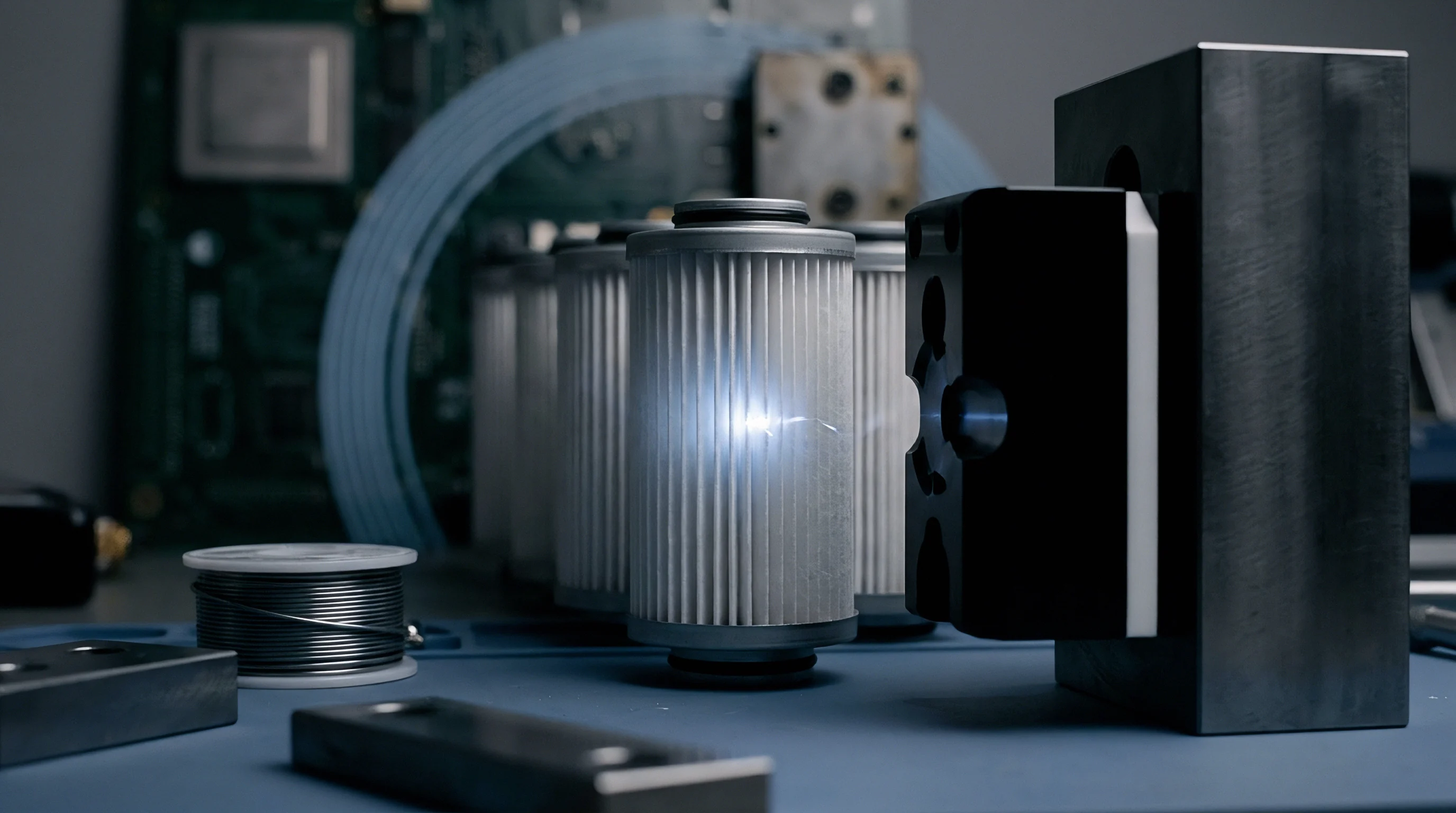
What Governs Mechanical Resolution across Prismatic Faces?
Elastic spring rates within compression foam dampen localized displacement gradients before mechanical forces reach the instrumented surface. When an internal lithium plating dendrite generates a two-millimeter localized swelling zone on an electrode, the stiff aluminum casing spreads this displacement over a twenty-millimeter zone on the can surface. The inter-cell cushion further disperses this force across the sensor array, acting as a spatial low-pass filter that attenuates high-frequency mechanical details.
A microcellular polyurethane buffer compressed to thirty percent strain delivers a predictable two-tenths megapascal restoring force across ten thousand mechanical cycles at twenty-five degrees Celsius.
Placing the sensor array between the bare aluminum casing and the elastomeric cushion preserves spatial resolution. Placing the sensor array between the elastomeric cushion and the rigid module side plate measures only the bulk average force, destroying localized strain gradients. Silicon anodes compound this displacement.
When silicon content in the negative electrode exceeds eight percent by weight, the resulting twenty percent volume swings overwhelm standard polyurethane foam buffers, demanding micro-machined metal wave springs or aerogel composite sheets to maintain linear load transfer across five thousand operating cycles.

Compliance Transfer across Polyurethane Shims
Stress relaxation in non-metallic spacers alters the baseline electrical resistance of thin-film transducers over seasonal temperature swings. Polyurethane foams subjected to sustained sixty-degree-Celsius pack operating environments exhibit significant mechanical compression set, losing up to fifteen percent of their original restoring force within six months. This loss of clamping pre-load manifests in the sensor array telemetry as an apparent negative strain drift, confusing pack algorithms that track irreversible cell degradation.
Bonding adhesives decouple at elevated temperatures. Pressure-sensitive acrylic adhesives used to laminate sensor arrays onto cell casings experience viscoelastic creep under sustained cyclic shear stresses. When the adhesive creeps, the strain transmission coefficient from the aluminum casing to the piezoresistive trace drops from ninety-eight percent down to seventy-five percent.
Rigid endplates concentrate stress at corners.
Cell manufacturers assert that external pressure readings remain unrepresentative because internal jelly-roll slip relieves local stress before the outer casing deflects.

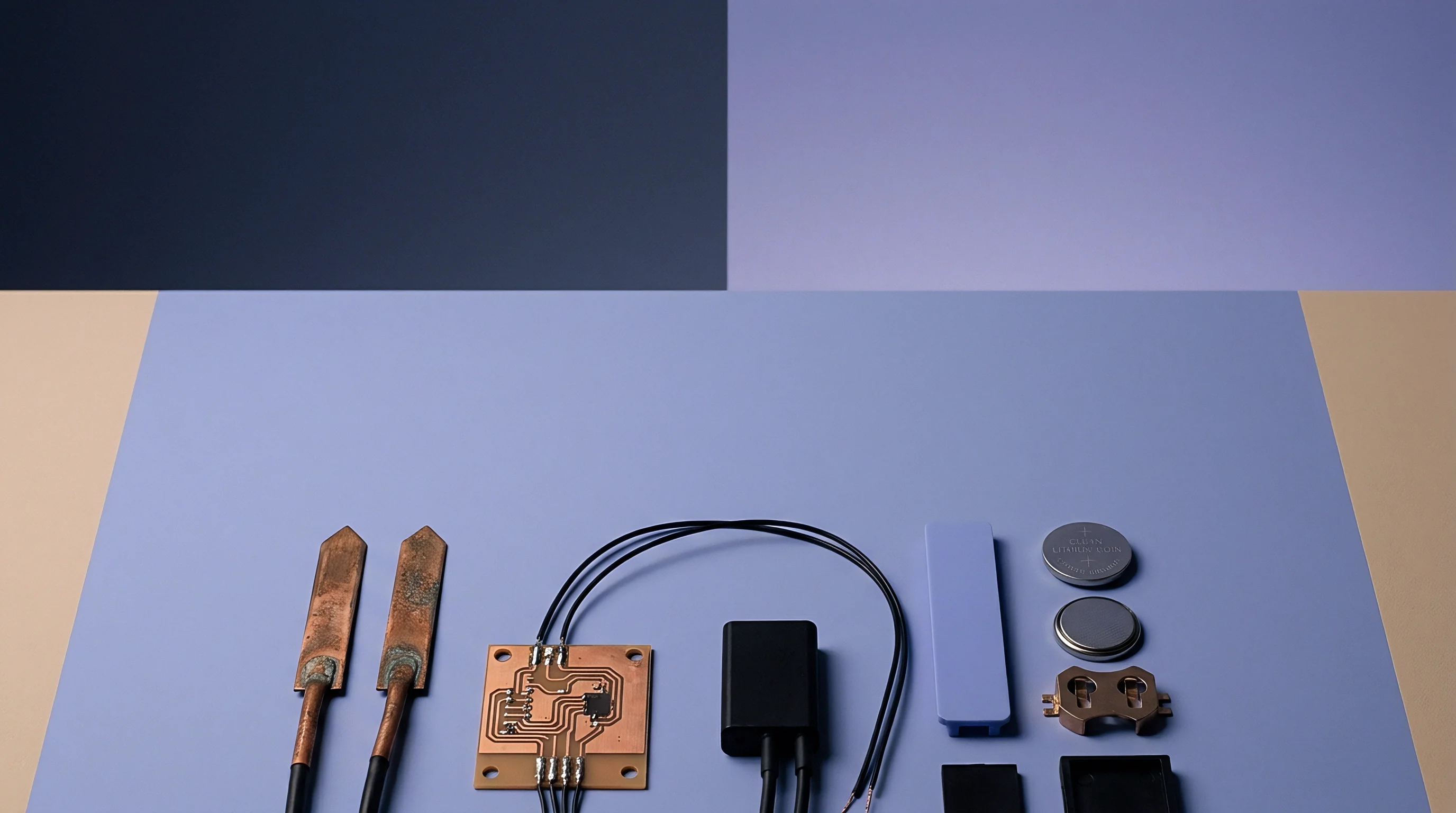
Reconstruction
Mathematical inversion transforms external displacement readings into internal state estimates and localized current density maps. The forward mechanical problem uses structural finite element matrices or elastic Green functions to calculate casing surface strain from known internal electrode expansion fields. The inverse problem runs in reverse: given twenty discrete surface strain readings from a planar array, the inversion engine reconstructs the internal volumetric expansion field and infers local state of charge, temperature, and degradation state.
The inverse mechanical problem is mathematically ill-posed. Multiple distinct internal swelling patterns can produce identical exterior casing displacement fields because the structural rigidity of the aluminum can smooths sharp internal gradients. Calculating a unique, stable internal state reconstruction requires constraining the inversion with physical boundary conditions, mechanical constitutive equations, and regularized optimization solvers running on module-level processors.

Does Inversion Accuracy Survive Thermal Transients?
Operating batteries experience simultaneous heat-induced expansion and electrochemical phase transitions during standard drive cycles. Aluminum possesses a thermal expansion coefficient of twenty-three parts per million per degree Celsius, whereas graphite intercalation strain contributes roughly three hundred parts per million per unit state of charge. During rapid charging at low ambient temperatures, thermal expansion gradients across the cell can exceed the mechanical strain generated by lithium movement, corrupting the reconstruction if temperature decoupling algorithms fail.
Thermal expansion masks electrochemical phase changes. Cold charging accelerates local lithium deposition. Separating thermal expansion from electrochemical strain requires collocated resistance temperature detector arrays integrated directly into the flexible circuit substrate alongside the strain gauges.
Subtracting the calculated thermal expansion tensor from raw strain readings isolates the pure electrochemical displacement field prior to matrix inversion.
- Baseline thermal correction subtracts the thermo-elastic expansion component using synchronized temperature data from collocated resistance temperature sensors.
- Ill-conditioned matrix inversion applies singular value decomposition with Tikhonov regularization to prevent transducer noise from corrupting reconstructed volumetric profiles.
- Phase boundary extraction separates reversible graphite staging plateaus from anomalous non-linear volume expansions indicative of metallic lithium plating.
- Degradation state classification updates cell health records within pack memory, initiating current tapering when localized strain rates exceed safe operational thresholds.
Tikhonov filtering stabilizes the inversion matrix. The inversion solver expresses the relationship between internal volume changes and external surface strain through a discretized sensitivity matrix. Because the condition number of this sensitivity matrix typically exceeds ten thousand, raw matrix inversion amplifies sensor measurement noise into unphysical spatial oscillations in the reconstructed internal volume map.
Adding a quadratic smoothing penalty suppresses these high-frequency numerical artifacts, stabilizing the output.
Regularization Parameters and Ill Posed Boundary Conditions
Selecting the penalty weight lambda dictates whether the mathematical solver captures sharp lithium plating boundaries or produces an overly smoothed pressure map. High lambda values bias the reconstruction toward uniform internal swelling, missing localized lithium plating zones that precede internal short circuits. Low lambda values preserve spatial resolution but render the inversion vulnerable to sensor drift and mechanical noise induced by pack shock and vibration.
| Array Configuration | Inversion Method | Condition Number | Reconstruction Error (Percent) | Computation Time (ms) |
|---|---|---|---|---|
| 3 x 3 Piezoresistive Grid | Direct Tikhonov SVD | 1.2 x 10^3 | 8.4 | 4.2 |
| 4 x 4 Piezoresistive Grid | L-Curve Regularization | 4.8 x 10^3 | 4.1 | 12.8 |
| 6 x 6 Piezoresistive Grid | Truncated Newton CG | 2.1 x 10^4 | 2.2 | 45.0 |
| 8-Channel FBG Array | Bayesian Elastic Solver | 8.5 x 10^2 | 3.5 | 18.5 |
Bayesian reconstruction frameworks incorporate prior electrochemical knowledge into the inversion algorithm. Instead of treating internal volume change as an unconstrained mathematical field, the solver bounds the permissible expansion within known electrochemical limits dictated by the active material chemistry. For a nickel-manganese-cobalt graphite cell, local electrode expansion cannot exceed the theoretical lattice expansion of fully lithiated graphite, which sits at thirteen point two percent along the crystallographic c-axis.
Enforcing this physical boundary condition eliminates unphysical solutions during aggressive dynamic loading.
Mathematical inversion solvers trade spatial sharpness for numerical stability whenever transducer noise floors rise above the baseline elastic deformation signal.
Calibration shifts ruin the inverted state. Uncalibrated channels introduce permanent state offsets. Interfacial friction distorts raw transducer readings.
When mechanical friction between the cell casing and the compression cushion generates shear stresses, the normal strain measured by surface sensors deviates from the true hydrostatic pressure field. Advanced inversion formulations incorporate two-dimensional contact friction models to decouple normal casing displacement from tangential friction drag.
Whether real-time inversion algorithms can reliably separate the mechanical signature of micro-scale lithium dendrite growth from localized binder creep under variable road vibration remains unresolved across the industry.


Flex
Polyimide circuits route dozens of transducer traces through the narrow gaps between adjacent cells in a module. Integrating dense sensor arrays into automotive battery packs introduces severe wiring complexity. A sixteen-cell module instrumented with four-by-four sensor grids yields two hundred and fifty-six individual analog sensing lines.
Direct parallel wiring saturates harness channels, increases pack mass, and elevates fire risks associated with insulation chafing against module structural members.
Copper traces crack under repetitive shear. Flexible printed circuits using rolled-annealed copper foils endure cyclic bending better than electrodeposited alternatives. When cell casings expand and contract during charge-discharge cycling, the inter-cell wiring flexes continuously in shear.
Specifying rolled-annealed copper with an adhesive-less polyimide base layer prevents trace micro-cracking across ten-year vehicle operational design targets.

Interconnect Routing and Signal Integrity Limits
Direct integration of multi-node sensing elements demands dielectric substrate thicknesses below one hundred micrometers to prevent mechanical binding. Thick circuit assemblies create point loads against the cell casing, causing localized electrode indentation and premature separator degradation. Standard module production limits total flexible circuit thickness, including coverlays and stiffeners, to one hundred and fifty micrometers within the inter-cell gap.
Compliance with UN three-eight-point-three shock and vibration regimes invalidates non-strain-relieved surface solder joints, forcing the integration of adhesively bonded zero-insertion-force terminations.
Multiplexing architectures located directly on the flexible circuit substrate resolve trace routing bottlenecks. Integrating miniature analog multiplexer integrated circuits onto the flex harness drops the wire count from dozens of individual lines down to a shared four-wire digital bus. These localized switching circuits must operate reliably across automotive temperature windows spanning negative forty degrees Celsius to positive eighty-five degrees Celsius while withstanding intense electromagnetic transients generated by adjacent inverter switching.

Factory Fixturing and First Article Yields
Automated assembly stations employ vacuum pick-and-place grippers to align printed sensor circuits onto primed cell casings within a two-hundred-micrometer positioning tolerance. Misaligning a sensor array by more than two millimeters shifts the physical coordinates of the sensing nodes relative to the internal jelly-roll edges, corrupting the spatial sensitivity matrix used by the inversion software. High sampling frequencies saturate pack microcontrollers.
- Substrate thickness verification confirms that the flex assembly does not breach the nominal two-millimeter cell-to-cell gap budget under maximum end-of-life swell conditions.
- Solder joint shear screening validates that copper-to-pad interfaces survive twenty g root-mean-square random vibration across a fifty to two thousand hertz bandwidth.
- Multiplexer crosstalk rejection establishes that signal leakage between adjacent analog measurement channels remains below negative sixty decibels under continuous cell cycling.
- Adhesive peel resistance guarantees that structural acrylic transfer tapes maintain ten Newtons per centimeter of bond strength through automotive thermal shock profiles.
First-article inspections focus on trace resistance uniformity across production lots. Etching variations during flexible circuit fabrication can alter trace resistance by up to fifteen percent, creating channel-to-channel gain mismatches that appear to inversion algorithms as localized mechanical strain anomalies. Factory end-of-line testing protocols must execute automated resistance balancing routines, writing channel calibration coefficients into non-volatile memory on the module interface board before packs receive final sealing.
Overlooking circuit fatigue life produces intermittent open circuits that blind the battery management system to sudden cell swelling events, precipitating undetected mechanical breaches and pack thermal events.
Recourse
Disputes over early cell degradation split the financial exposure between the raw cell manufacturer and the pack integrator. Cell vendors reject module strain claims. When an automotive fleet experiences premature capacity fade, telemetry indicating abnormal mechanical swelling becomes the primary evidence used by warranty adjusters.
If the pack lacks instrumentation, the vehicle manufacturer carries the entire burden of proof, unable to demonstrate whether degradation stemmed from cell manufacturing defects or abusive thermal operation.
Installing surface sensor arrays shifts the evidentiary boundary in commercial warranty claims. When an array detects non-uniform swelling indicative of localized lithium plating during charging within certified current limits, the data isolates cell manufacturing variances as the primary cause. Conversely, if telemetry reveals excessive compressive loads caused by improper module mechanical fixturing, the cell manufacturer successfully rejects the warranty claim, assigning replacement costs to the pack packager.
Warranty Seams across Cell and Module Boundaries
Cell procurement agreements define acceptance criteria through electrical metrics such as capacity retention and direct-current internal resistance. Mechanical swelling rarely appears in cell purchase specifications beyond a crude end-of-life thickness limit measured under uniform platen pressure. When cells expand non-uniformly inside a production module, standard cell datasheets offer zero commercial protection to the pack integrator.
Tier-one cell suppliers refuse liability for cell swelling whenever module restraint fixtures apply non-uniform clamping pressures that exceed engineering drawing specifications.
Bridging this contractual gap requires incorporating spatial strain limits directly into cell master purchase agreements. Integrators negotiate specific deformation envelopes, defining maximum permissible casing deflection gradients across the cell face over specified cycle intervals. Establishing these quantitative mechanical thresholds transforms ambiguous degradation disputes into clear-cut contractual obligations governed by verifiable array telemetry.

Contract Language for Module Swell Tolerances
Commercial procurement agreements specify mechanical envelope limits alongside standard electrochemical delivery warranties. Procurement contracts establish precise protocols for validating strain inversion telemetry against certified laboratory teardowns. When array data indicates irreversible casing expansion exceeding agreed thresholds, the contract triggers an automated root-cause investigation involving accelerated CT scanning and destructive physical analysis performed by an independent test laboratory.
Legal agreements define who pays for destructive validation testing based on telemetry accuracy. If physical teardown confirms localized lithium plating corresponding to the inverted strain map, the cell vendor reimburses testing expenses and replaces the affected manufacturing lot. If physical teardown reveals that the anomalous strain reading stemmed from sensor debonding or algorithmic inversion error, the pack integrator absorbs all analytical costs.
Standard warranty clause section eight point four defines an allowable casing expansion threshold of eight percent over three thousand cycles, transferring replacement costs to the cell manufacturer when measured dimensional growth outpaces contractually agreed mechanical aging curves.