Cyclic Strain Accumulation Mechanics in Impact Loading Battery Housing Plates
Repetitive sub-critical roadway stone strikes induce cyclic strain ratcheting that progressively exhausts alloy ductility and closes cell safety clearances.
Strike
Bottom enclosure plates absorb continuous gravel loft and road debris at high speeds. A strike on the battery housing floor is rarely a single, isolated overload; impacts range from 5 joules for loose asphalt up to 120 joules or more for dense roadway scrap and curb scuffs. Where crash regulations test against single massive pulses that crush sills, long-term field durability comes down to resisting hundreds of sequential, sub-critical strikes along wheel paths.
Every impact leaves a localized dent framed by a bending moment gradient. Once projectile kinetic energy passes the local cross-section’s elastic strain capacity, the alloy yields into the plastic regime.
At impact speeds between 15 and 60 meters per second, inertial confinement restricts immediate flexural dissipation to the immediate contact zone. The plate undergoes a brief biaxial stress state ~ high peak compressive strain on the strike face and high tensile strain on the interior floor. As the projectile rebounds, the elastic core tries to spring back to its original shape, leaving the yielded volume with permanent plastic deformation and localized residual stresses concentrated around the impact point.
A 2.5 mm 6003-T6 bottom plate exhibits 0.42 mm permanent center deflection after twelve sequential 35-joule conical projectile strikes at 20 degrees Celsius.
Gravel trajectory patterns compound this local wear. Computational fluid dynamics and chassis multi-body simulations show that front tires launch gravel plumes at predictable exit angles, concentrating over 70 percent of debris impacts onto two narrow longitudinal bands along the bottom plate. Positioned directly beneath the forward battery modules, these corridors absorb thousands of low-energy hits over a vehicle’s lifespan on unpaved roads.
Standard single-event drop-tower tests miss this cumulative mechanical damage along the strike paths.
Ballistic Gravel Regimes and Energy Partition
Road aggregate generally strikes with conical or polyhedral contact points. Because the contact patch is often under 12 square millimeters, local pressures can exceed 1.2 gigapascals, forcing immediate subsurface yielding in structural aluminum well before the overall tray flexes. This impact energy splits into three routes: residual kinetic energy in the rebounding stone, elastic vibration traveling into the enclosure frame, and plastic work converted into localized heat and lattice strain within the plate wall.
Thin plates under 2.0 mm dissipate energy primarily through membrane stretching and shear localization, whereas plates over 3.5 mm shift toward flexural bending and indentation cratering. That transition changes the strain profile on the inner face near the battery cells. Thin plates form a pronounced tensile dome directly behind the impact crater; in thicker multi-wall extrusions, internal webs carry the shear pulse across to the upper deck, shielding the inner surface while keeping plastic deformation concentrated in the outer impact wall.

Repetitive Impact Spectra
Impact energy varies widely in the field. Data from gravel test tracks shows velocity distributions following skewed Weibull profiles, where frequent low-energy impacts are punctuated by occasional heavy hits from loose stones or frozen slush. The sequence of these impacts dictates cumulative damage.
An initial 80-joule hit creates a plastic dimple and leaves residual tensile stress on the interior face; subsequent 15-joule strikes that would bounce elastically off a fresh plate cause added plastic deformation when landing in that pre-strained zone.
Successive gravel hits within an eight-millimeter radius of an existing dent progressively thin the plate floor. As the aluminum work-hardens under repeated strikes, its uniform elongation drops, bringing the alloy closer to its forming limit under biaxial tension and initiating micro-void coalescence around the crater rim. Ignoring gravel trajectory pathways over unshielded pockets risks cumulative plate rupture, opening a path for road brine to reach module terminals.


Shakedown
Repeated impact loads lead to one of three responses: elastic shakedown, plastic shakedown, or cyclic ratcheting. Under elastic shakedown, early impacts induce minor plastic deformation and leave protective compressive residual stresses, so later strikes of equal or lower severity yield a purely elastic response. Plastic shakedown creates closed plastic strain loops ~ forward and reverse strain increments balance out, causing low-cycle fatigue over time without progressive geometric distortion.
Cyclic ratcheting takes hold when non-zero mean stresses or asymmetric constraints prevent loop closure, building up irreversible plastic strain with each impact.
Ratcheting represents the main failure mode for bottom plates subjected to repetitive stone strikes. Even if an individual strike adds an effective plastic strain increment of just 0.0008, three hundred impacts along a narrow corridor accumulate over 24 percent plastic strain. That level of strain exhausts the material’s ductility, tearing the inner surface of the plate without a single strike ever crossing the nominal single-impact puncture threshold.
Plastic Ratcheting under Transient Multiaxial Cycles
Bottom skid plates experience complex multiaxial stress during an impact. The outer face sees localized contact indentation and shear, while the inner surface undergoes biaxial tension from bending. Because structural battery packs carry pre-stress from chassis torsional rigidity, global bending moments overlay steady membrane stresses onto the transient impact stress field.
This baseline tensile or compressive stress acts as a continuous mean stress driver, accelerating ratcheting.
Armstrong-Frederick non-linear kinematic hardening models track yield surface evolution under this asymmetric multiaxial loading. The backstress tensor shifts through stress space during the pulse, but because impacts last only 0.2 to 1.5 milliseconds, reverse plasticity during rebound is limited. As the struck zone unloads, surrounding elastic material constrains the region and causes secondary reverse yielding.
If steady chassis loads maintain a non-zero mean stress, the backstress tensor fails to return to the origin, producing a persistent directional drift in accumulated strain.
| Alloy And Temper | Yield Strength (MPa) | Tensile Strength (MPa) | Kinematic Modulus C (MPa) | Backstress Parameter Gamma | Elastic Shakedown Limit (J) |
|---|---|---|---|---|---|
| AA6060-T6 | 160 | 215 | 8,400 | 55 | 18.5 |
| AA6008-T6 | 250 | 295 | 12,600 | 42 | 31.0 |
| AA6082-T6 | 295 | 340 | 15,200 | 38 | 38.5 |
| AA7003-T6 | 350 | 410 | 19,500 | 31 | 52.0 |
| DP600 Steel | 340 | 620 | 28,000 | 26 | 74.0 |
| PHS 1500 (22MnB5) | 1,150 | 1,550 | 64,000 | 14 | 145.0 |

Constitutive Hardening Models under Transient Strain Rates
Calculating strain accumulation from gravel strikes requires dynamic material properties rather than static values. At strain rates between 100 and 2,500 s⁻¹, precipitation-hardened aluminum alloys and dual-phase steels show noticeable rate-dependent yield elevation. The Cowper-Symonds constitutive relation models this increase via empirical scaling parameters, raising dynamic yield stress above static coupon figures.
6000-series aluminum displays moderate rate sensitivity, with dynamic stress ratios between 1.10 and 1.25 across stone impact velocities, while dual-phase steels exhibit higher sensitivity, pushing dynamic stress ratios to 1.35 ~ 1.60.
Reverse yielding depends heavily on kinematic hardening behavior. Multi-component Chaboche models refine simpler single-backstress formulations by splitting backstress into three parts: initial rapid hardening at small strains, a non-linear middle stage, and linear hardening at higher plastic strain levels. High-velocity impacts trigger higher-order flexural modes in the plate, driving fast stress sign reversals.
Calibrating a multi-component Chaboche model against split-Hopkinson pressure bar data reveals whether repeated 25-joule hits will stabilize through plastic shakedown or creep indefinitely along a ratcheting curve to point of rupture.

Where Does Progressive Deflection Threaten Cell Integrity?
Strain accumulation across the housing base is uneven. Local indentation concentrates around the contact point, while broader deflection develops across the spans between internal cross-members. Battery pack architects set strict intrusion limits to keep high-voltage modules clear of external structural deformation.
Once repeated strikes push plastic deflection beyond this engineered gap, the housing plate contacts the thermal chill plate or module compression hardware directly.
Initial impacts leave shallow, barely visible exterior dents under 0.5 mm deep. Over fifty impact cycles, ratcheting deepens the center deflection, driving the inner face closer to the cooling plate. Once contact is made, further stone impacts transmit shock loads straight into the lower module casing or prismatic cell can headers ~ turning a structural fatigue issue into an electrical short risk.
Whether thermal aging over five years of fast-charging cycles shifts the cyclic hardening exponent enough to trigger tertiary ratcheting remains an open question for production extrusions.
Shell
Bottom enclosure architectures trade off mass, tooling cost, and deformation limits through profile design. Two main approaches dominate: wide multi-void extruded aluminum hollow floors and stamped dual-sheet monolithic structures. Multi-void extrusions place vertical or diagonal internal webs between an outer impact skin and an inner floor deck, whereas stamped assemblies rely on deep-drawn steel or aluminum sheets bolted or bonded to perimeter frame castings.
This internal layout determines how local impact forces transfer into the surrounding structure.
Double-wall extrusions absorb impact energy through progressive wall deformation. A gravel hit dents the outer sacrificial wall first, while internal shear webs transfer bending forces across to the upper deck to engage the full section in bending resistance. So long as these internal webs resist shear buckling, plastic strain stays mostly in the bottom layer, allowing the top deck to remain flat and protect the seal against the module chill plate.
Extrusion web geometry determines whether cumulative plastic deformation concentrates within local cell bays or disperses across adjacent internal stiffeners.

Extruded Floor Profiles against Stamped Monosheets
Single-sheet stamped plates offer lower tooling costs and fast press cycle times. However, a 2.5 mm steel or 3.2 mm aluminum stamped sheet deforms through global membrane action when struck by debris; without a sacrificial outer wall, every millimeter of external denting translates directly to lost internal cell clearance. Under repeated hits, stamped plates ratchet symmetrically, bowing upward toward the cells over time.
Adding hat-section stiffeners helps control deflection, but weld heat-affected zones form metallurgical notches that concentrate cyclic strain.
Multi-cavity extruded profiles in 6000-series alloys isolate damage by varying wall thickness across the section. Designing the lower impact wall between 2.8 mm and 4.0 mm while thinning the inner deck to 1.8 mm keeps mass down and ensures ratcheting consumes ductility in the outer layer first. Producing wide hollow shapes requires multi-port porthole dies that can hold web tolerances to ±0.15 mm across widths over 400 mm.
Any variation in wall thickness shifts the local elastic shakedown threshold across the profile.
- Extrusion Web Shear Buckling occurs when a high-energy strike collapses the vertical web between the lower plate and upper deck, dropping section modulus by over 60 percent instantly.
- Heat Affected Zone Softening lowers yield strength along longitudinal friction stir welds by up to 35 percent, creating localized bands that concentrate cyclic strain.
- Anisotropic Extrusion Texture causes yield strength variations of 12 to 18 percent between longitudinal and transverse directions, resulting in asymmetric elliptical dent patterns from spherical impacts.
- Secondary Spallation Delamination occurs on the back of stamped ultra-high-strength steel plates when high-velocity impacts reflect tensile shock waves, triggering micro-cleavage along grain boundaries.

Strain Rate Hardening across Structural Alloys
Selecting enclosure materials requires balancing formability against high-rate impact resistance. While 7000-series aluminum provides higher initial yield strength, lower fracture toughness and stress corrosion sensitivity along lower tray seams limit its use. 6000-series alloys, especially AA6008-T6 and AA6082-T6, offer a better compromise between extrusion productivity, weldability, and cyclic strain endurance.
Even during cold stone impacts at minus 40 degrees Celsius, these alloys show little ductile-to-brittle transition and maintain uniform elongation above 8 percent.
Dual-phase and press-hardened steels deliver higher shakedown limits at the cost of added weight. A 1.2 mm press-hardened boron steel plate (PHS 1500) achieves an elastic shakedown limit over 140 joules, effectively preventing ratcheting under ordinary road gravel conditions. However, steel’s higher density requires hybrid joining methods ~ like structural adhesive combined with flow-drill screws ~ to join aluminum perimeter castings, and galvanic coatings must survive repeated hits without cracking to avoid localized corrosion on wet undersides.
| Material Architecture | Total Plate Mass (kg/m²) | Cumulative Plastic Strain (%) | Max Internal Intrusion (mm) | Outer Wall Cracking Observed |
|---|---|---|---|---|
| Single Sheet AA6063-T6 (3.0 mm) | 8.1 | 18.4 | 7.2 | Yes (at cycle 64) |
| Single Sheet AA6082-T6 (3.0 mm) | 8.1 | 11.2 | 4.6 | No |
| Double Wall Extrusion AA6008-T6 (2.5/1.8 mm) | 12.4 | 6.8 (lower wall) | 1.1 (upper deck) | No |
| Stamped DP600 Steel (1.8 mm) | 14.1 | 8.9 | 3.8 | No |
| Sandwich Panel (1.0 mm Steel + 8 mm Al Foam) | 11.2 | 4.2 (facesheet) | 0.8 (backing) | No |
Minor center bowing across wide hollow profiles falls within standard commercial mill straightness allowances regardless of how impacts accumulate in service.

Intrusion
Clearance between the outer bottom plate and the active cells serves as the primary passive barrier against intrusion. This gap absorbs assembly stack-up tolerances, chassis flexing, thermal expansion, and permanent deformation from road hits. A standard pack layout leaves 8.0 mm of nominal dry space between the inner face of the structural floor and the module electrical insulation layer ~ space that progressive impact ratcheting gradually erodes over time in heavy gravel conditions.
As the interior surface of the bottom plate bows upward, it compresses the thermal interface paste sitting beneath the cooling plate. While thermal paste flows laterally under slow compression, rapid shock pulses generate hydrostatic pressure spikes within the material. If intrusion happens faster than the paste can flow, the interface behaves like an incompressible fluid, transferring impact forces straight into the liquid cooling channels.
ISO 6469-1 pack mechanical integrity testing invalidates base certifications whenever bottom plate permanent deflection breaches the nominal 8.0 mm cell isolation boundary.
Bottom Clearance Budgets and Chill Plate Coupling
Cooling manifolds positioned directly above the bottom plate are vulnerable to progressive deformation. In bottom-cooled battery designs, extruded or roll-bonded cooling plates lie right on the housing floor. Upward denting of the outer plate pushes into the underside of the cooling plate, pinching internal micro-channels.
A 2.0 mm drop in channel height can raise hydraulic flow resistance by up to 45 percent in that loop, creating local cell hotspots during fast charging.
Evaluating tolerance stack-ups requires combining six production variables: extrusion profile crown (±0.8 mm), frame weld distortion (±1.2 mm), cooling plate thickness (±0.25 mm), thermal paste bond-line (±0.35 mm), module bottom datum variation (±0.5 mm), and dynamic chassis frame racking (±1.5 mm). Subtracting these stacked variations from a nominal 8.0 mm gap leaves a net initial safety clearance of just 3.4 mm for absorbing impact ratcheting in service.
Cumulative Indentation Mechanics
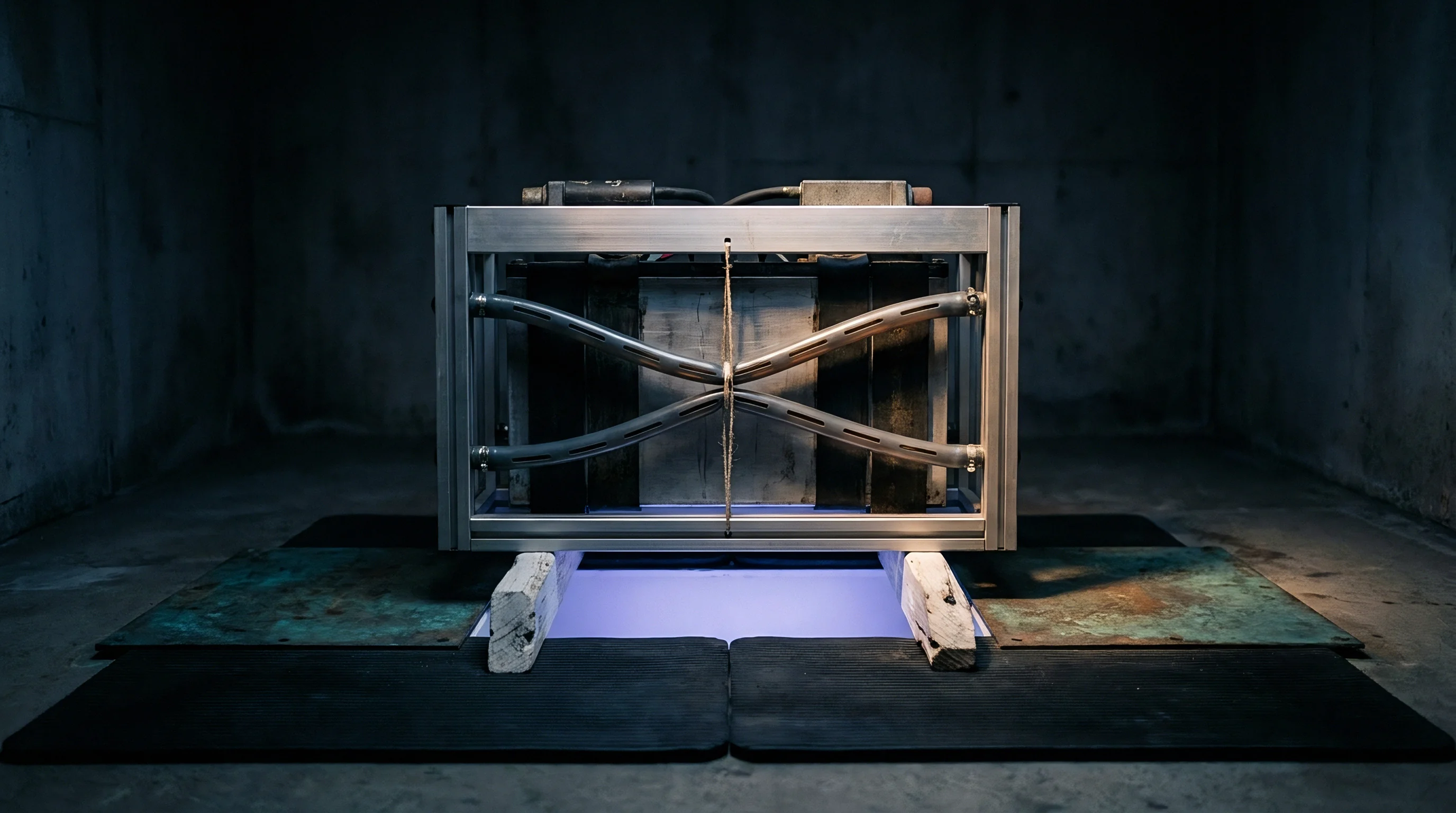
Take a baseline example for accumulated deformation in a battery floor tray: an AA6008-T6 extruded hollow plate spanning 380 mm between cross-members, with a 3.0 mm lower wall and a 2.0 mm upper deck. Subjecting this tray to repeated 45-joule conical gravel hits with a 4.0 mm tip radius produces an initial plastic indentation of 0.85 mm and an elastic springback of 0.35 mm in finite element models, leaving an initial permanent dent of 0.50 mm.
When a second strike lands within 6.0 mm of the first, isotropic strain hardening raises local yield stress from 250 MPa to 285 MPa, reducing incremental plastic denting to 0.28 mm. By the tenth impact, isotropic hardening saturates and deformation shifts into kinematic hardening governed by the backstress tensor, accumulating plastic deflection at a steady 0.045 mm per hit. After sixty sequential impacts in the same debris path, the bottom wall reaches 3.82 mm of permanent intrusion ~ completely collapsing the inner cavity, pressing the bottom wall against the shear webs, and forcing the top deck upward.
- Initial Elastic Flexure absorbs impacts below 15 joules without forming permanent dislocation networks or leaving outer surface marks.
- Localized Yield Inception begins around the impact edge above 22 joules, creating compressive residual stress on the exterior face and tensile offsets on the interior side.
- Void Coalescence starts along slip bands when cumulative plastic strain surpasses the material failure limit under multiaxial stress.
- Cavity Closure takes place in hollow profiles when the outer wall crushes completely flat against internal webs, exhausting the protective crush distance.
- Secondary Boundary Intrusion occurs as the collapsed section flexes as a single solid plate, forcing upward movement directly against the cooling manifold.
Prismatic and cylindrical cell cans rely on thin aluminum walls between 0.3 mm and 0.8 mm thick. Direct contact from an intruding bottom plate concentrates stress on cell bases, crushing internal separators and risking latent micro-shorts. Maintaining a designed air gap between structural armor and the cooling manifold keeps localized denting from pinching coolant passages against cell walls.

Settlement
Liability for progressive impact damage spans three parties: the material mill supplying extrusions or sheet, the tier-one fabricator building the tray, and the OEM integrating the pack into the vehicle platform. Standard supply warranties guarantee initial receipt dimensions and static tensile properties, but typically disclaim coverage for in-service fatigue and cumulative debris damage from road hazards.
When fleet vehicles show field failures from pinched coolant channels or reduced electrical clearance under modules, one argument attributes the damage to debris spectra exceeding program design limits, while another points to poor control over extrusion grain structure or heat-affected zone softening. Resolving these disputes requires clear mechanical criteria built directly into contracts and engineering prints.
Whose Balance Sheet Absorbs Progressive Yielding Claims?
Warranty responsibility depends on distinguishing product defects from road hazards. A puncture from a single 250-joule obstacle falls under road hazard collision insurance. Conversely, a plate that remains intact but absorbs 5.5 mm of permanent upward deformation over hundreds of small gravel hits ~ eventually causing thermal isolation faults ~ points to a design defect.
If the vehicle manufacturer approved a thin 2.5 mm single-sheet layout to hit weight targets, recall liabilities sit with the pack integration team.
Supply agreements and engineering scope documents need specific validation protocols for cyclic impact resistance. Standard UN 38.3 transport tests and crash drop tests evaluate single hits on fresh packs, missing cyclic strain accumulation entirely. Program requirements increasingly mandate sequential impact protocols, subjecting prototype trays to 50 drop-tower strikes in designated wheel-track zones prior to environmental thermal cycling and water immersion testing.

Drawing Callouts and Incoming Lot Acceptance
Controlling cyclic strain accumulation requires adding material constitutive specs directly to engineering drawings. Specifying a basic alloy designation like AA6082-T6 is not enough, because mill variations in quench rates and aging cycles ~ used to maximize press speed ~ cause wide spreads in cyclic hardening exponents and backstress parameters while still passing standard ASTM B221 tensile tests.
To guard against microcracking from low-temperature impacts, enclosure drawings must define minimum fracture energy absorption across operating temperatures. Adding a cyclic ball-drop test to incoming lot criteria forces suppliers to verify ductility under repeated impact shocks. First-article inspection reports need to document grain size distributions across weld zones and residual surface stress profiles from X-ray diffraction alongside standard yield strength and elongation figures.
Under Section 7.4 of the standard tray supply contract, replacement liability shifts to the fabricator if dimensional drift under cyclic impact exceeds the agreed first-article deflection envelope.