Atomic Layer Deposition Coating Integrity during Extended High Temperature Storage
Atomic layer deposition integrity during high temperature storage depends on coating conformity, mitigating interdiffusion, HF attack, and capacity degradation.
Bake
Sustained temperature exposure of 55 °C or higher forces mechanical and chemical restructuring at active material boundaries. Ultra-thin metal oxide shells created through vapor phase synthesis experience severe physical stress when stored at elevated temperatures over hundreds of hours. Lithium-ion cell storage in warm environments accelerates structural decay inside the cathode host lattice, testing the mechanical continuity of the protective shell.
Thermal aging alters interfacial resistance. Microstructural integrity determines whether the deposited layer remains a continuous ion-conductive shield or degrades into isolated islands that expose active material directly to aggressive liquid electrolyte components.
Thermal Stress Kinetics in Amorphous Metal Oxides
Deposition of aluminum oxide or zirconium oxide via atomic vapor reaction leaves an amorphous surface layer measuring between 0.5 and 2.0 nanometers in thickness. This nanoscale shell exhibits structural disorder that initial thermal cycles tend to relax. Prolonged thermal aging past 500 hours at 60 °C causes localized crystallization within initially amorphous films.
Grain boundaries forming between newly crystalline domains create mechanical stress concentrations. These structural boundary defects turn continuous films into porous barriers. Gas evolution accelerates under high heat.
Conformity determines thin film longevity. Thin layers deposited onto nickel-rich cathode active materials like NMC811 must accommodate anisotropic crystal lattice movement during ambient thermal fluctuation. Elevated storage temperature amplifies lattice volume change differentials between the substrate and the oxide coating shell.
Micro-cracking initiates at structural defect points when thermal expansion stresses exceed the fracture toughness of the thin film.
| Coating Material | Deposition Precursor | Nominal Thickness (nm) | CTE Mismatch (10⁻⁶/K) | Pinhole Growth Rate (60 °C Storage) |
|---|---|---|---|---|
| Aluminum Oxide (Al₂O₃) | Trimethylaluminum / H₂O | 1.0 | 8.4 | 1.2 x 10⁻⁴ pinholes/μm²·hr |
| Titanium Dioxide (TiO₂) | Titanium Isopropoxide / H₂O | 1.5 | 4.1 | 8.5 x 10⁻⁵ pinholes/μm²·hr |
| Zirconium Oxide (ZrO₂) | Tetrakis(dimethylamido)zirconium / H₂O | 2.0 | 3.2 | 3.1 x 10⁻⁵ pinholes/μm²·hr |
| Lithium Zirconium Oxide (LZO) | Lithium t-butoxide / Zirconium Precursor | 2.5 | 2.1 | 1.1 x 10⁻⁵ pinholes/μm²·hr |
Substrate Expansion Mismatch during Elevated Storage
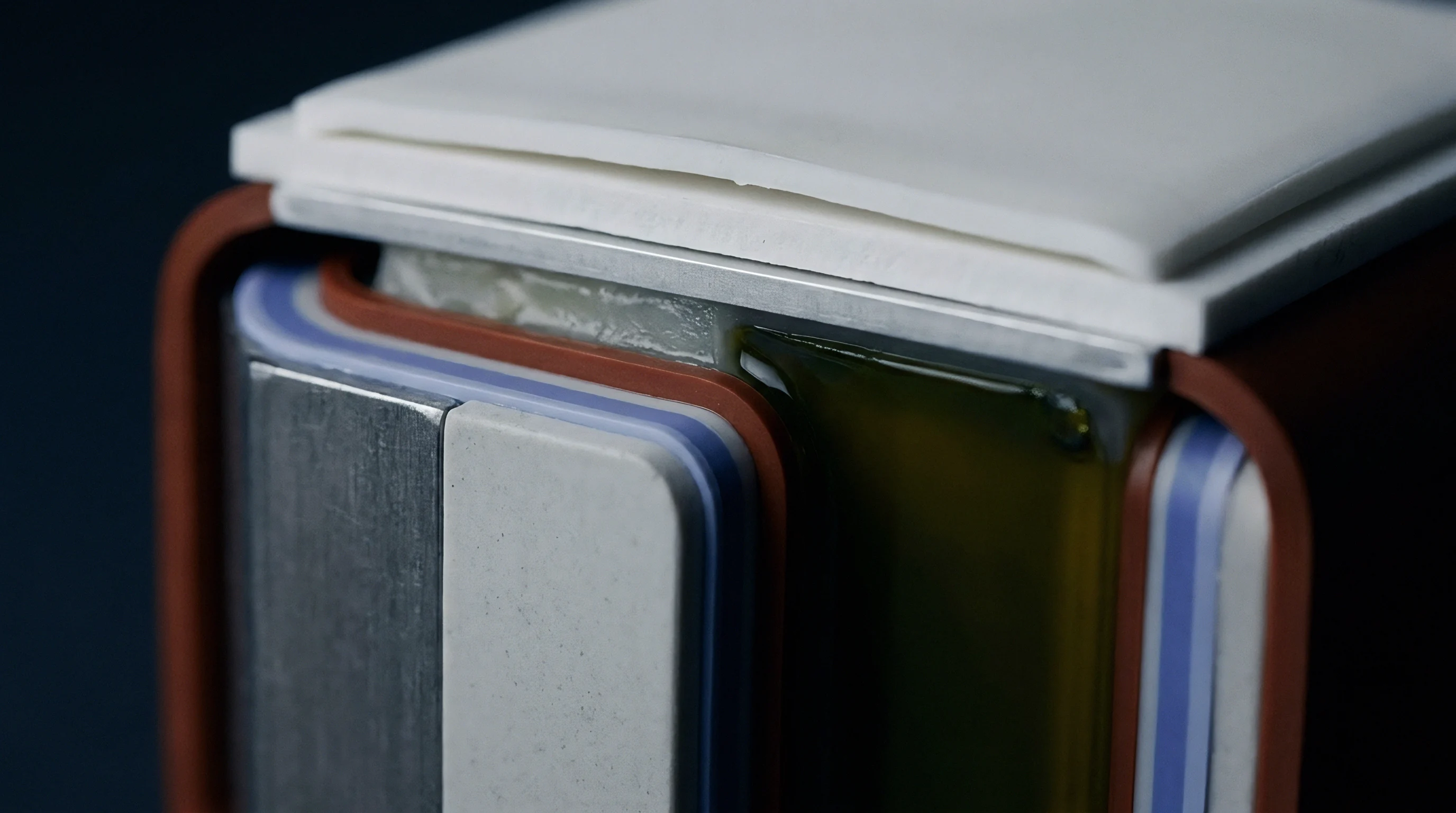
Continuous exposure to heat causes nickel-rich layered oxides to undergo isotropic lattice volume shifts. The volumetric expansion coefficient of NMC811 cathode active material differs significantly from that of synthetic aluminum oxide or titanium dioxide shells. Repeated temperature excursions induce shear stresses across the interface.
Cracks permit liquid electrolyte access. Over extended storage intervals, these mechanical shear forces break interfacial adhesive bonds, triggering localized delamination of the nanometer-thin shell.
Cell swelling indicates structural breakdown. When surface passivations fracture under high thermal loads, direct contact between active nickel ions and liquid carbonate solvents resumes. Thermal aging accelerates parasitic side reactions, generating volatile gases such as carbon dioxide and carbon monoxide.
Pinhole density dictates leakage rates. Uncoated particles suffer rapid dissolution. Cell manufacturers frequently attribute elevated-temperature capacity fade to baseline electrolyte decomposition rather than structural breakdown of the surface nanolayer.
Barrier
Chemical protection provided by nanometer-thin oxide layers depends on maintaining stoichiometric stability against aggressive liquid electrolytes. High storage temperatures drive complex chemical transformations across liquid-solid phase boundaries. Hydrofluoric acid formed by trace water contamination attacks unprotected cathode surfaces, leaching critical transition metals.
Continuous atomic layer coatings mitigate acid attack by sacrificing a uniform outer monolayer while keeping the bulk cathode crystal lattice intact.
- Pinhole Thermal Expansion opens localized pathways through the protective oxide shell, exposing raw cathode crystal faces to fluorine radicals in the liquid electrolyte.
- Cation Migration Induced Phase Conversion transforms active surface layers from rhombohedral to rocksalt structures, consuming mobile lithium ions during storage.
- Transition Metal Dissolution Pathways allow dissolved nickel and manganese ions to cross the separator and poison the graphite solid electrolyte interphase.
- Gas Generation Acceleration releases oxygen gas into the cell container from interfacial degradation, inflating internal cell pressure during storage.
Transition Metal Dissolution and Acid Attack Suppression
Traces of ambient moisture inside sealed lithium-ion cells react with hexafluorophosphate anion salts to form hydrofluoric acid. Storage temperature governs diffusion kinetics. At 55 °C or 60 °C, hydrofluoric acid generation speeds up dramatically, attacking trivalent nickel and manganese cations in the active material cathode matrix.
Dissolved transition metal ions migrate through the liquid electrolyte toward the anode. Once at the graphite anode, transition metal species reduce into metallic state deposits, degrading the protective solid electrolyte interphase and causing rapid capacity loss.
Moisture fuels hydrofluoric acid generation. Atomic layer oxide shells consume ambient hydrofluoric acid through chemical conversion reactions, forming stable metal fluoride surface layers such as aluminum trifluoride. This sacrificial mechanism protects underlying transition metal ions from dissolution.
However, extended thermal exposure exhausts the sacrificial oxide reservoir if the initial deposition thickness is below 1.0 nanometer. High heat accelerates cation exchange. Thin layers under 0.5 nanometers break down completely within 300 hours of continuous exposure to 60 °C storage environments.
Amorphous coating layers offer superior resistance to thermal micro-cracking compared to crystalline oxide shells of identical thickness.

Cation Interdiffusion across Interfacial Boundaries
Prolonged thermal aging drives high-valence cations like tetravalent zirconium or trivalent aluminum into nickel oxide crystalline sites. This solid-state diffusion process occurs rapidly at temperatures above 55 °C. Transition metal ions simultaneously move outward into the oxide shell, altering its local stoichiometry. Cation interdiffusion changes a pure metal oxide surface film into a complex mixed-metal spinel layer.
Impedance spikes mark barrier failure.
Delamination degrades long term storage. Phase conversion from active rhombohedral structure to electrochemically inactive spinel or rocksalt structures consumes available active lithium ions. The depth of this transformed surface layer correlates directly with storage duration and temperature.
Surface passivations using multi-component coatings like lithium zirconium oxide slow cation interdiffusion by maintaining a higher thermodynamic barrier against lattice substitution. A surface layer that admits hydrofluoric acid will permit transition metal dissolution regardless of nominal coating thickness.


Spectroscopy
Evaluating the physical continuity of nanometer films post-aging requires analytical tools capable of sub-nanometer depth resolution. Standard electron microscopy lacks the contrast needed to resolve thin oxide shells on rough powder surfaces. Analytical methods combining surface-sensitive photoemission spectroscopy and electrochemical impedance spectroscopy reveal structural breakdown patterns without destroying specimen geometry.
Technical teams use these measurements to determine whether high-temperature storage has breached coating integrity.
When Does Atomic Layer Deposition Fail under Continuous Thermal Stress?
Structural breakdowns manifest when thermal aging shifts the surface impedance semicircle toward higher real resistance values during electrochemical measurement. High-temperature storage expands the charge transfer arc, indicating increased charge transfer resistance at the cathode interface. Uncoated NMC active materials experience a fivefold increase in interfacial resistance after 500 hours at 60 °C. Optimized zirconium oxide surface coatings limit resistance growth to less than 35 percent under identical storage parameters.
Storage at 60 °C for 1,000 hours at 100 percent state of charge increases interfacial charge transfer resistance by 312 percent in uncoated NMC811 cells.
Voltage drift signals parasitic reactions. Electrochemical impedance spectroscopy separates overall cell impedance into solid electrolyte interphase resistance, charge transfer resistance, and solid-state diffusion resistance. Monitoring charge transfer growth over aging time pinpoints the exact hour when surface passivations fracture.
A sudden slope change in the resistance curve indicates localized pinhole formation or film delamination.
Quantitative Film Continuity and Depth Profile Benchmarks
X-ray photoemission analysis measures elemental photopeaks across sequential ion milling steps to map oxygen, fluorine, and transition metal concentration profiles. Intact surface coatings produce strong metal oxide signals while completely shielding the underlying transition metal signals from detection. Thermal aging that degrades coating continuity allows substrate nickel photopeaks to emerge before ion sputtering begins.
Depth profiling quantifies the precise thickness of fluorinated interfacial decay layers.
- X-Ray Photoelectron Depth Criteria confirms peak intensity ratios of metal oxides remain constant across a minimum ion sputtering depth of 1.5 nanometers after heat treatment.
- Electrochemical Impedance Thresholds restrict charge transfer arc growth to under 40 percent following 500 hours of thermal exposure.
- Transmission Electron Micrograph Continuity verifies zero visible grain boundary cracking or pinhole formation across a 50-nanometer sample cross-section.
- Secondary Ion Mass Concentration Limits bound fluorinated degradation species at the oxide-cathode interface to less than two atomic percent.
Time-of-flight secondary ion mass spectrometry identifies microscopic chemical species across cathode surfaces with extreme analytical sensitivity. High temperature storage of degraded coatings leads to elevated intensity counts for transition metal fluorides. Clean spectra with low fluorinated fragment signals confirm that the protective oxide shell successfully blocked hydrofluoric acid penetration.
The remaining analytical challenge is determining whether high-temperature cation interdiffusion creates a self-limiting passivating phase or an expanding region of structural disorder.

Storage
Regulatory compliance regimes evaluate cell safety after controlled temperature conditioning to ensure transport stability. International transport laws mandate thermal stability testing for lithium cells before shipping authorization occurs. Extended storage under elevated temperatures alters internal cell chemistry, modifying safety risks during air and ocean transport.
Regulatory audit dossiers require detailed environmental exposure documentation proving that high heat storage has not compromised cell containment or thermal stability limits.

Thermal Test Standards and Compliance Criteria
International transport rules mandate environmental exposure cycles to verify structural containment before air or maritime freight dispatch. Test T.2 within the UN Manual of Tests and Criteria subjects lithium cells to 72 hours at 72 °C, followed immediately by sub-zero conditioning. Standard IEC 62133-2 enforces thermal abuse evaluation by storing fully charged cells at 55 °C for 7 days.
Passing these regulatory trials demands zero internal short circuits, zero gas leakage, and zero mass loss.
| Standard Body | Test Procedure | Temperature & Duration | State of Charge (%) | Pass-Fail Criteria |
|---|---|---|---|---|
| UN Manual of Tests | UN 38.3 Test T.2 (Thermal) | 72 °C for 6 hours / -40 °C for 6 hours (10 cycles) | 100 | No mass loss, no leakage, OCV drop < 10% |
| IEC Standards | IEC 62133-2 Clause 7.3.2 | 55 °C for 7 days (168 hours) | 100 | No fire, no explosion, no structural leakage |
| EU Battery Regulation | Annex VII Durability Test | 40 °C for 28 days ambient storage | 30 to 50 | Capacity fade < 3.0%, resistance growth < 10% |
| UL Certification | UL 1642 Thermal Abuse | 70 °C for 4 hours continuous | 100 | No venting, no thermal runaway initiation |
Defective atomic layer passivations lead to catastrophic failure during mandatory transport testing. When high-temperature warehousing degrades surface coatings, subsequent UN 38.3 thermal stress cycles trigger severe internal parasitic reactions. Cells stored at 100 percent state of charge under high temperatures show heightened sensitivity to mechanical impact and thermal shock testing.
Transport clearance requires verifiable proof that cell batches maintain structural integrity throughout their mandated shelf storage lifespan.
Failure to satisfy UN 38.3 test T.2 thermal criteria voids the safety dossier and halts dangerous goods transport documentation approval at origin.
Shift in Calorimetric Thermal Runaway Onset
Accelerating rate calorimetry reveals that degraded surface passivations lower the self-heating onset point under adiabatic conditions. Uncoated or damaged NMC811 cells exhibit self-heating onset at temperatures as low as 105 °C due to rapid exotherm generation from electrolyte breakdown on exposed active material. Continuous atomic layer oxide coatings delay the self-heating onset point beyond 145 °C. Prolonged thermal storage that degrades coating continuity shifts this safety threshold back down to dangerous levels.
- Sample representative cell lots from incoming shipments in accordance with ISO 2859-1 sampling plans.
- Subject test units to environment chamber conditioning at 72 °C for 6 hours, followed immediately by negative 40 °C for 6 hours, completing 10 continuous cycles.
- Measure open-circuit voltage and internal resistance after a 24-hour ambient thermal equilibration period.
- Conduct accelerating rate calorimetry on disassembled cell components to record self-heating thermal onset temperatures.
- Attach compiled test results to the UN 38.3 Section 38.3.4.2 test summary document for border clearance compliance.
Elevated storage degrades active material surfaces. Tracking self-heating rate trajectories allows battery system buyers to detect subtle coating degradation before full physical cell breakdown occurs. Cells exhibiting early self-heating onsets during qualification screening carry elevated risks of thermal runaway during commercial shipping operations.
Subclause 6.2 of UN 38.3 section 38.3.4.2 mandates zero mass loss and zero open-circuit voltage drift following 72 hours at elevated temperature, shifting transport rejection liability directly to the manufacturer of record.

Penalty
Unintended capacity fade during extended thermal exposure converts directly into contractual financial adjustments and product recalls. Commercial supply agreements specify rigid storage life performance metrics, linking cell capacity retention under specified storage temperatures directly to supplier liability clauses. When cathode passivations fail during extended warehousing, cell buyers face substantial financial losses from unusable inventory, battery pack re-qualification costs, and dangerous goods logistics delays.

Commercial Warranty Allocation for High Heat Storage
Purchase agreements for energy storage cells state explicit capacity retention thresholds under specified temperature limits. A standard warranty line guarantees less than 2.0 percent irreversible capacity loss after 30 days of storage at 45 °C and 50 percent state of charge. When manufacturing defects or poor atomic layer coating continuity lead to capacity loss exceeding 5.0 percent, contractual defect mechanisms trigger lot rejection rights.
Buyers enforce liquidated damages clauses to cover landed freight expenses and delayed deployment penalties.
Extended high temperature storage degrades unpassivated active material surfaces and accelerates selfdischarge kinetics during warehousing.
Supplier agreements shift testing costs to the cell vendor when incoming inspection uncovers non-conforming degradation rates. Buyers write strict quality assurance provisions that demand independent laboratory validation of atomic layer deposition thickness and continuity before batch release. Failing thermal shelf-life tests forfeits supplier progress payments and requires complete lot replacement at the vendor’s expense.

Worked Financial Assessment of Aging Failure Lots
Consider a supply agreement comprising 100,000 prismatic NMC811 cells held at 55 °C for 1,000 hours prior to battery module installation. The base cell price equals $45.00 per unit, representing a total batch purchase value of $4,500,000. Contract specifications stipulate a maximum allowable capacity degradation of 3.0 percent during this storage window, backed by a performance guarantee clause.
Pre-installation testing reveals an average capacity loss of 7.2 percent across the lot due to microscopic pinhole formation in a 0.8-nanometer aluminum oxide coating shell.
Financial recovery calculations apply a contractual performance penalty proportional to the excess capacity fade plus secondary testing fees:
Excess Capacity Loss Penalty ~ (7.2% actual loss – 3.0% contract threshold) x $4,500,000 base value = $189,000 direct capacity loss chargeback.
Landed Freight and Warehousing Recovery ~ 100,000 cells x $3.50 logistics cost per cell = $350,000 unrecoverable freight expenditure.
Re-qualification and Analytical Testing Expense ~ 25 cells destroyed in destructive XPS and impedance testing at $1,200 per laboratory sample = $30,000 testing fee.
Total Financial Reclamation ~ $189,000 + $350,000 + $30,000 = $569,000 total claim against the cell manufacturer.
Contractual penalty clauses convert technical coating deficiencies into immediate cash recoveries for the buyer. Without explicit atomic layer deposition quality metrics embedded in purchasing contracts, procurement teams absorb the financial burden of high-temperature storage degradation. Improperly allocated thermal aging liabilities result in unrecoverable warranty expenses and immediate rejection of cell shipments at destination ports.