Classification Rules for Lithium Cell Maritime and Air Transit
Lithium cell transit mandates Class 9 classification, certified UN 38.3 summaries, verified low charge states, and rigid UN-spec packaging across air and sea.

Boundary
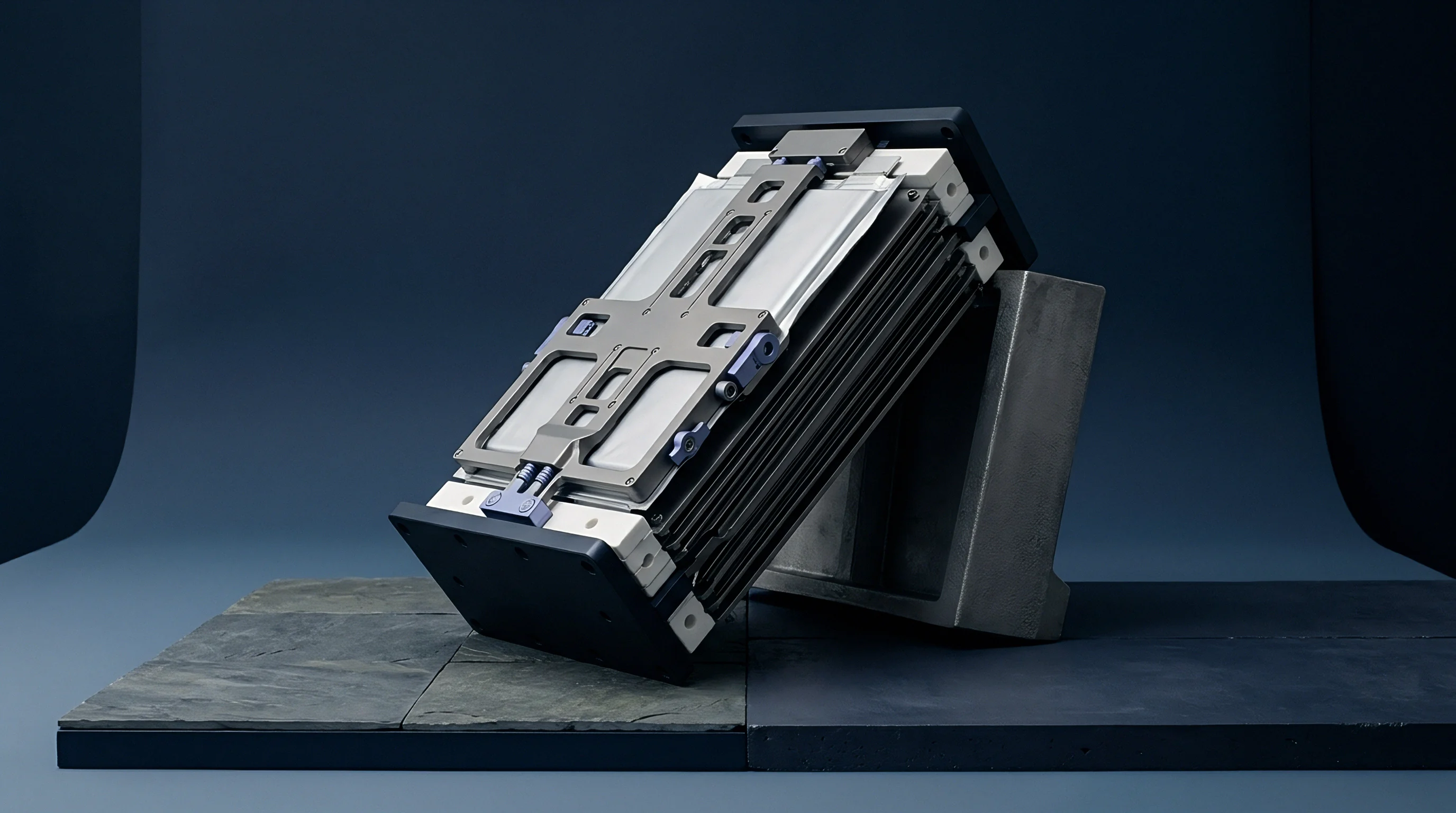
Classifying a lithium cell for maritime or air transit turns on the strict physical distinction between a cell, a battery, and an assembly. Under the United Nations Model Regulations on the Transport of Dangerous Goods, a cell is a single encased electrochemical unit with one positive and one negative electrode, exhibiting a voltage differential across its terminals. A battery links two or more cells electrically, fitted with permanent protective circuitry, a housing, or terminal leads.
Even if a single-cell unit includes internal monitoring electronics or sits inside secondary casing, international transport law still classifies it as a cell. Sourcing teams frequently misdeclare high-capacity single-cell formats as batteries, creating compliance failures before the cargo ever reaches the terminal gate.
Every commercial movement of lithium electrochemical storage falls under Class 9 Miscellaneous Dangerous Goods. Four primary proper shipping names establish the regulatory pathways for transit, split across distinct United Nations numbers based on active chemistry and operational integration. UN 3480 covers individual lithium ion cells and batteries, including lithium polymer variants operating via intercalation mechanisms.
UN 3481 applies when lithium ion cells travel packaged with equipment or contained inside the actual equipment they power. Standalone lithium metal cells, relying on non-rechargeable metallic or alloyed lithium anodes, move under UN 3090, while UN 3091 covers lithium metal chemistries packed with or contained inside devices.
The presence of an integrated protection circuit board on a single encased electrochemical unit leaves its classification as a cell unchanged under dangerous goods rules.
Misclassification across these designations alters the applicable packing instructions, mode-specific quantity limitations, and carrier documentation requirements. Declaring an uncased batch of high-capacity prismatic cells under equipment-contained provisions invalidates carrier acceptance checks at port gates. Cargo handlers turn away misdeclared consignments immediately, holding pallets until the shipper generates corrected declarations, issues revised dangerous goods notes, and secures port authority approval for relabeling.


Envelope
Transit compliance enforces physical thresholds that separate standard commercial handling from heavily restricted, fully regulated hazardous material regimes. For lithium ion cells, that line is drawn by nominal energy capacity in watt-hours ~ calculated by multiplying nominal design voltage by rated ampere-hour capacity, both verified against manufacturer production sheets. Lithium metal cells follow a parallel limit based on total lithium metal content in grams, calculated as 0.3 times the rated capacity in ampere-hours per cell unless direct elemental assay data is recorded.

Threshold Parameters Governing Exemption Pathways
Both the International Maritime Dangerous Goods Code and the International Civil Aviation Organization Technical Instructions incorporate special provisions that relieve smaller energy storage units from specific packaging and documentation duties. Special Provision 188 under the IMDG Code and Section II of the relevant ICAO packing instructions establish clear numerical thresholds. Exceeding any individual value removes the consignment from simplified carriage and triggers full Class 9 operational handling.
| Unit Configuration | Chemical System | Small Unit Threshold | Fully Regulated Boundary |
|---|---|---|---|
| Individual Cell | Lithium Ion | Equal to or below 20 Wh | Exceeding 20 Wh |
| Battery Pack | Lithium Ion | Equal to or below 100 Wh | Exceeding 100 Wh |
| Individual Cell | Lithium Metal | Equal to or below 1.0 g lithium | Exceeding 1.0 g lithium |
| Battery Pack | Lithium Metal | Equal to or below 2.0 g lithium | Exceeding 2.0 g lithium |

Cargo Manifest Energy Accumulation
Individual container loads require calculations that account for spatial packing efficiency alongside localized thermal mass. For industrial buyers importing 280 Ah lithium iron phosphate prismatic cells, classification falls immediately under fully regulated Class 9 procedures. A standard 3.2 V cell at 280 Ah stores 896 Wh of potential electrical energy ~ exceeding the 20 Wh small-cell threshold by a factor of forty-four.
Crossing that boundary dictates outer packaging drop testing, specific dangerous goods labeling, and strict separation from flammable gases or organic peroxides inside maritime intermodal containers.
Packaging standards diverge sharply when scaling from sample shipments to utility-scale lots. A pallet containing 160 such cells carries 143.36 kWh of total energy. Shippers must secure UN-specification outer packaging rated at Packing Group II performance levels, verified by third-party testing facilities.
Failure to control terminal isolation during container stuffing creates localized heating hazards capable of invalidating insurance coverage before the vessel clears port limits.


Air
Aviation transport represents the most restrictive corridor for commercial energy storage cells. The International Air Transport Association Dangerous Goods Regulations enforce the ICAO Technical Instructions through rigid packing instructions, requiring standalone lithium ion cells shipped under UN 3480 to move exclusively under Packing Instruction 965. Commercial passenger airframes carry an absolute ban on UN 3480 cargo.
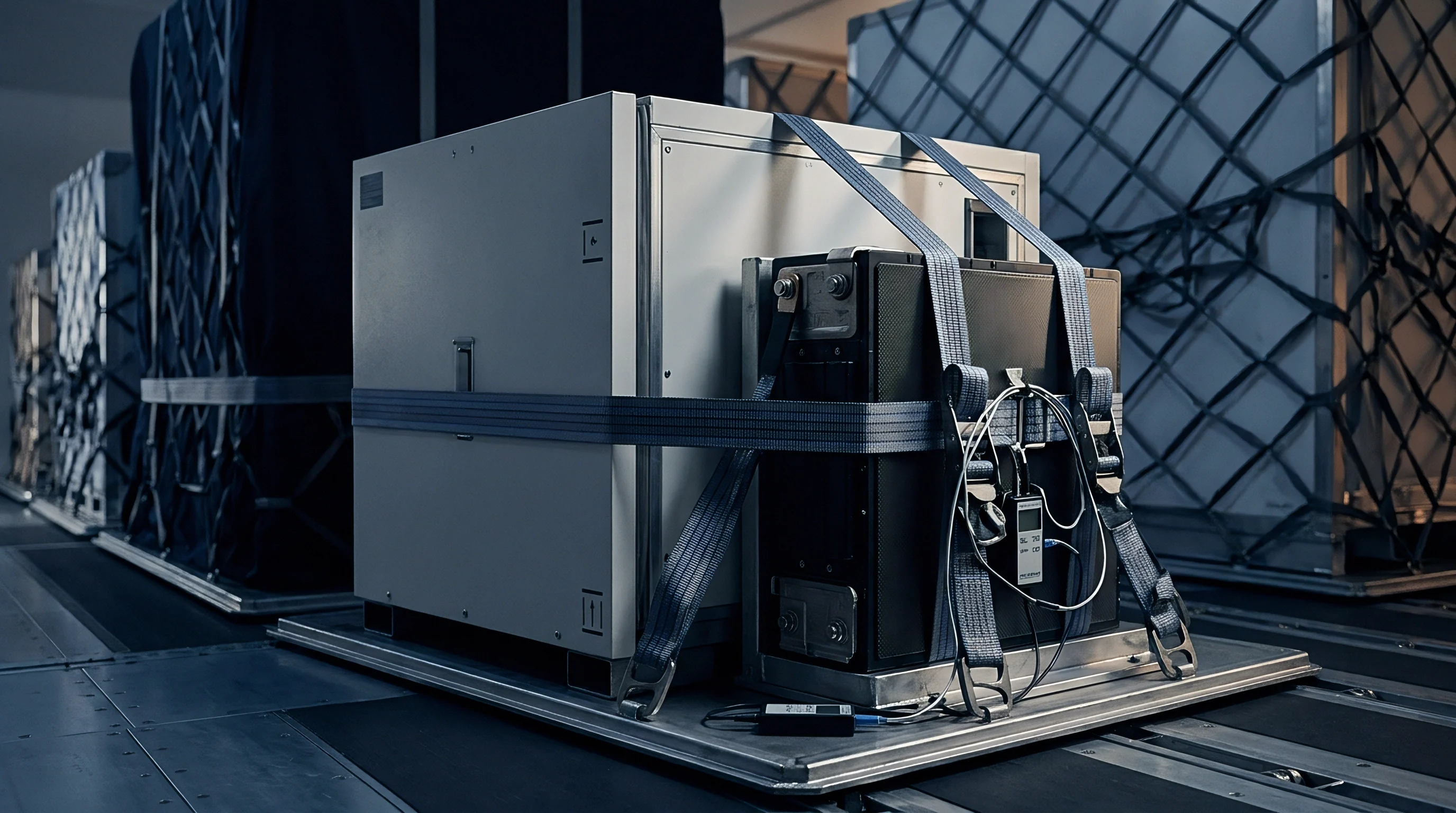
Every standalone consignment travels on dedicated cargo aircraft, marked with the Cargo Aircraft Only handling label.

Section Allocation Criteria
Packing Instruction 965 splits into three tiers based on energy thresholds and consignee shipping volumes. Section IA governs cells exceeding 20 Wh, demanding full Class 9 specification packaging ~ such as rigid steel or fiberboard drums ~ alongside formal Dangerous Goods Declarations and UN performance package markings. Section IB applies to cells at or below 20 Wh packaged in quantities exceeding the strict package allowances of Section II; it requires a dangerous goods transport document, Class 9 hazard labels, and lithium battery marks.
Section II provides relief for small quantities of cells below 20 Wh, though air carriers maintain operational variations that refuse Section II cargo entirely.

State of Charge Limitations
Aviation safety rules restrict the internal charge state of standalone lithium ion cells offered for air transit. ICAO mandates that all cells moving under UN 3480 enter air carriage at a state of charge not exceeding 30 percent of their rated design capacity. Factory acceptance protocols must calibrate final formation cycling to stay under this operational ceiling before cartoning.
Carriers operating under regional civil aviation authorities inspect state of charge documentation and immediately impound consignments lacking verified open-circuit voltage records.
Confirming compliance demands calibrated open-circuit voltage measurements correlated to the cell chemistry discharge curve. For a typical nickel manganese cobalt cell with a nominal 3.65 V plateau, 30 percent state of charge corresponds to an open-circuit voltage near 3.60 V at 20 degrees Celsius. In contrast, lithium iron phosphate chemistries present flat open-circuit voltage profiles between 20 percent and 70 percent capacity.
Verifying state of charge for iron phosphate cells requires precise coulometric tracking during the final factory discharge step, as resting voltage measurements show minimal variation across this operating window.
- Coulometric capacity titration establishes the baseline capacity of sample cells selected from the production batch under controlled 0.2C discharge rates.
- Automated formation discharge draws the entire shipping lot down to 28 percent nominal capacity to prevent cell relaxation voltages from crossing the 30 percent ceiling during warehouse staging.
- Batch voltage logging records individual terminal potentials across every carton, compiling the statistical distribution required for airfreight acceptance dossiers.
A supplier who ships cells above the 30 percent limit shifts strict statutory liability onto the air forwarder and importing entity.

Maritime
Ocean freight governed by the International Maritime Dangerous Goods Code accommodates larger cargo masses while introducing severe stowage and segregation constraints. Standalone cells moving under UN 3480 follow Packing Instruction P903. Unlike aviation rules, the IMDG Code does not impose an absolute 30 percent state of charge ceiling on maritime movements.
Sourcing contracts nevertheless specify lower charge states to minimize thermal runaway propagation energy while vessels spend weeks at sea.

Vessel Stowage Categories and Segregation
Lithium cell containers fall under Stowage Category A under the IMDG Code, allowing placement on deck or under deck on container vessels. Container ship operators routinely enforce stricter company booking rules, segregating Class 9 lithium shipments to weather deck locations to facilitate emergency fire response. Placing containers on deck increases ambient temperature swings and solar loading, accelerating internal self-discharge and electrolyte aging during tropical transit passages.
Segregation tables in IMDG Code Chapter 7.2 dictate physical clearance between lithium containers and conflicting hazard classes. Consignments must maintain strict spatial buffers from Class 1 explosives, Class 2.1 flammable gases, and Class 3 flammable liquids. Intermodal freight forwarders must construct container packing plans that account for adjacent container assignments, preventing vessel planners from bumping hazardous containers during harbor turnarounds.

How Does Moisture Alter Ocean Container Classification?
Relative humidity inside maritime shipping containers routinely hits saturation points, causing container rain during diurnal cooling cycles. Standard cardboard packaging weakens under moisture condensation, risking mechanical compression of inner cell terminals. If moisture penetrates unsealed battery enclosures, corrosion across external terminals introduces localized leakage currents.
Corrosion-induced short circuits produce heat, venting, and electrolyte degradation. Should inspection authorities discover chemical venting or packaging collapse during transshipment, the consignment loses its standard UN 3480 P903 classification. Port authorities immediately reclassify damaged units under UN 3480 Packing Instruction P908 or P911, governing damaged or defective cells.
Reclassification requires specialist explosion-proof recovery packaging, triggering harbor demurrage charges that exceed the original commercial value of the cargo.


Crate
Packaging integrity provides the physical foundation of dangerous goods compliance across intermodal legs. International testing standards require UN-certified packaging designs to demonstrate survival against drops, stacking forces, vibration, and internal pressure differentials. A design type earns its packaging specification code only after passing destructive physical qualification at an ISO 17025 accredited laboratory.

Package Testing Specifications
Packing Group II specifications mandate that packaging designs survive a 1.2-meter drop test onto a rigid, non-resilient target surface without incurring internal cell movement or terminal contact. The test strikes the package across five distinct orientations: flat on the bottom, flat on the top, flat on the long side, flat on the short side, and onto the structural corner. Stacking tests apply a compressive force equivalent to the weight of identical packages stacked to a height of three meters for a continuous duration of twenty-four hours.
Inner packagings must incorporate complete physical insulation to eliminate contact between active terminals.
- Individual cell containment prevents physical bridging across external terminals through bespoke thermoformed trays or isolated partition dividers.
- Impact absorbing outer cartons employ double-wall corrugated fiberboard or reinforced plywood crating meeting 4G or 4D specification criteria.
- Absorbent non-conductive cushioning lines interior voids to capture loose electrolyte in the event of minor casing failure during heavy sea conditions.
- Vapor barrier liners maintain interior relative humidity below critical condensation thresholds during extended ocean voyages.
Palletizing Class 9 goods introduces additional geometric constraints. Overpacks must bear the word OVERPACK alongside required hazard labels and UN specification marks unless existing package markings remain completely visible from the exterior. Strapping methods avoid concentrated line pressures that distort interior carton walls and compromise terminal clearances.
When inner terminal separators shift during transport, contact short circuits develop undetected until thermal signatures register on vessel monitoring arrays. The importer of record absorbs all port handling, repackaging, and regulatory fine expenses whenever an arriving shipment demonstrates package structural failure.

Dossier
Every commercial consignment of lithium cells moves on the legal validity of its administrative paperwork. Forwarders, terminal operators, and customs agents inspect document packages prior to releasing cargo into international lanes. The critical element of this dossier is the UN 38.3 Test Summary report, governed by Section 38.3 of the United Nations Manual of Tests and Criteria.
The transport regulations require manufacturers and subsequent distributors to make this document available down the entire supply chain.

Required Elements in a Compliant UN 38.3 Test Summary
The sixth revised edition of the UN Manual of Tests and Criteria standardizes the required data fields within the UN 38.3 Test Summary. Shippers must present complete documentation matching specific design parameters without omitting technical fields.
| Data Field Item | Operational Requirement | Verification Method |
|---|---|---|
| Entity Identification | Full legal name, address, telephone, email of manufacturer | Corporate registration records |
| Testing Laboratory | Accredited testing facility contact details and location | ISO 17025 accreditation scope |
| Report Reference Number | Unique test report identifier with completion date | Laboratory internal database cross-check |
| Product Description | Cell or battery identification, model name, mass, electrical rating | Physical engineering drawing match |
| Physical Parameters | Nominal Wh for ion or lithium mass for metal systems | Calculated formula verification |
| Test Schedule Completed | Specific record of tests T.1 through T.8 execution | Pass/fail status per test criteria |

Evaluation of Required Physical Bench Tests
The UN 38.3 test battery subjects test specimens to physical and environmental extremes designed to induce failure in unstable cell architectures. Test T.1 through T.5 run sequentially on the same sample lot. T.1 evaluates altitude simulation by holding cells at 11.6 kPa for six hours.
T.2 applies thermal shock between 72 degrees Celsius and minus 40 degrees Celsius across thirty cycles. T.3 introduces mechanical vibration sweeping from 7 Hz to 200 Hz. T.4 applies shock pulses reaching 150g peak acceleration. T.5 introduces an external short circuit below 0.1 ohms at 57 degrees Celsius.
T.6 conducts mechanical impact or crush forces on cell casings. T.7 applies electrical overcharge conditions, and T.8 induces forced electrical discharge under reverse polarity.
A supplier who provides an outdated test summary based on superseded cell revisions leaves the shipment vulnerable to administrative seizure at customs ports of entry.

Exposure
Legal liabilities arising from lithium cell carriage attach to distinct entities as cargo crosses international boundaries. Under international trade incoterms, commercial contracts dictate when risk, transport cost, and compliance obligations shift between vendor and purchaser. In standard FOB or FCA maritime shipments, the buyer assumes operational responsibility the moment cargo clears the departure terminal gate, inheriting regulatory consequences for documentation errors made upstream by the cell manufacturer.

The Chain of Custody and Regulatory Accountability
Dangerous goods transport regulations treat the entity named as shipper on the dangerous goods note as strictly liable for declarations, packaging certifications, and payload limits. If an overseas factory books shipping lanes through an offshore trading intermediary, the intermediary frequently signs declarations without inspecting warehouse stock. When enforcement officers discover improperly secured cargo, regulatory authorities penalize the registered importer of record within their jurisdiction, applying statutory fines and impounding parallel freight consignments.
Contractual indemnification clauses remain unenforceable against state transport ministries issuing civil penalties or environmental cleanup demands.
Importers manage liability by executing preshipment verification audits before releasing manufacturing balances. Independent technical inspectors verify packaging design approvals, photograph pallet label placement, and log state of charge meter readings across randomized statistical samples taken from crated lots. Commercial contracts must reserve clear rights of rejection and payment retention linked directly to dangerous goods compliance verification at the factory floor.
A typical commercial purchase agreement clause establishes this operational protection: “The seller warrants that all units supplied under this agreement strictly conform to UN 38.3 design certifications and IMDG or ICAO packaging directives, maintaining an open-circuit voltage verified below thirty percent state of charge at the time of air cargo acceptance; failure to provide authentic test summaries or compliant packaging constitutes a material breach entitling the buyer to immediate cargo rejection at the seller expense.”